Lessons from Jeb Blount
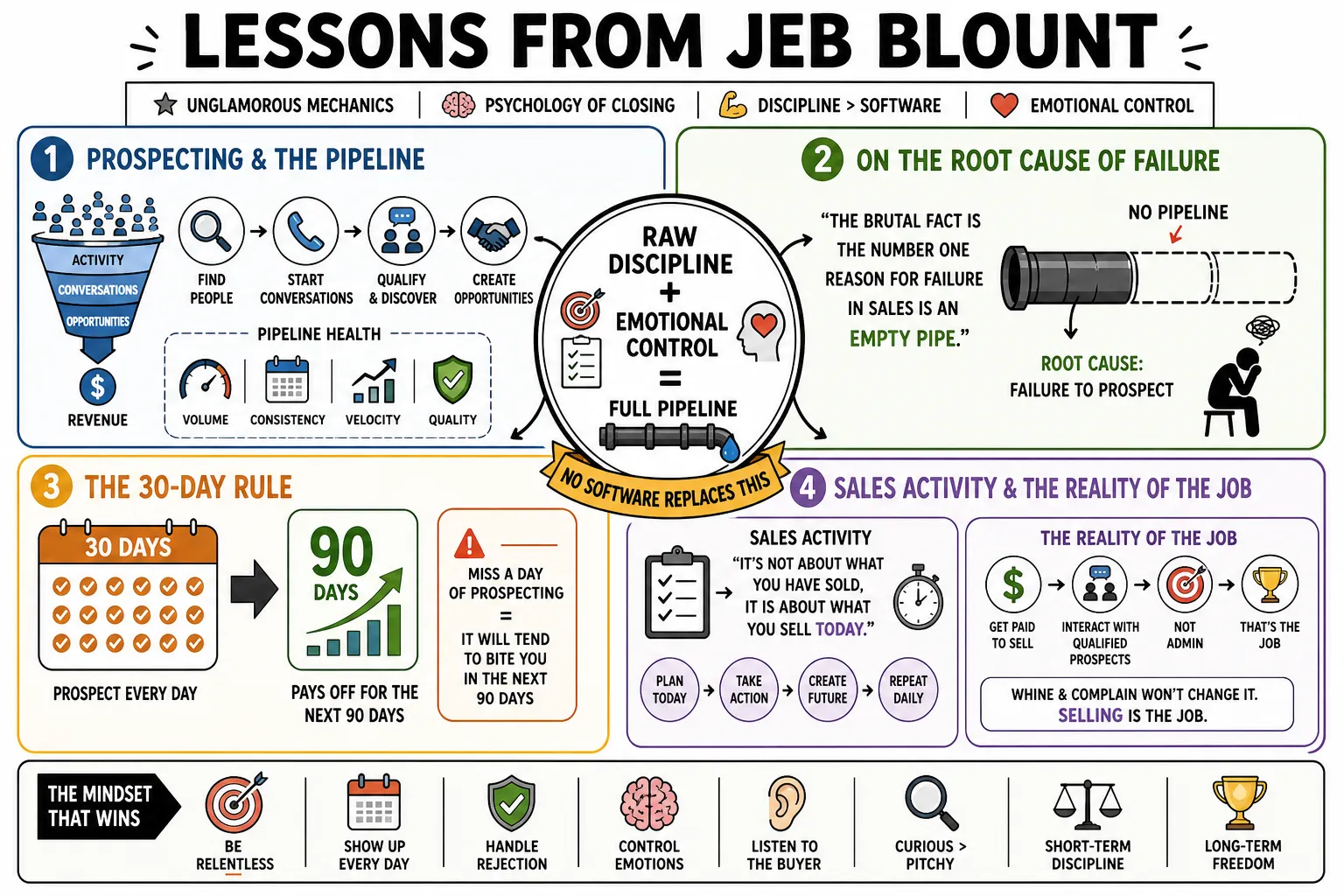
Jeb Blount focuses on the unglamorous mechanics of pipeline generation and the psychology of closing deals. In books like Fanatical Prospecting and Sales EQ, he argues that no amount of new software can replace raw discipline and emotional control. This collection outlines his straightforward approach to managing time, facing rejection, and reading buyers.
Part 1: Prospecting and the Pipeline
- On the Root Cause of Failure: "The brutal fact is the number one reason for failure in sales is an empty pipe, and the root cause of an empty pipeline is the failure to prospect." — Source: [Fanatical Prospecting]
- On the 30-Day Rule: "The 30-Day Rule states that the prospecting you do in this 30-day period will pay off for the next 90 days. Miss a day of prospecting and it will tend to bite you sometime in the next 90 days." — Source: [Fanatical Prospecting]
- On Sales Activity: "In the sales profession, it's not about what you have sold, it is about what you sell today." — Source: [Fanatical Prospecting]
- On the Reality of the Job: "Salespeople get paid to sell. Period. End of story. Whine and complain about all the stuff you’ve got to do if you like, but it will not change the fact that your job is to be interacting with qualified prospects during the Golden Hours." — Source: [Fanatical Prospecting]
- On Sales Effort: "There is no easy button in sales. Prospecting is hard, emotionally draining work, and it is the price you have to pay to earn a high income." — Source: [Fanatical Prospecting]
- On Perseverance: "The enduring mantra of the fanatical prospector is: One more call." — Source: [Fanatical Prospecting]
- On Generating Appointments: "The fact is, if you are having a hard time getting appointments... 9 out of 10 times it is because you are not asking." — Source: [Fanatical Prospecting]
- On Amateurs vs. Professionals: "Amateurs wait until they feel like prospecting. Professionals prospect whether they feel like it or not." — Source: [Sales Gravy]
- On Measuring Output: "Elite salespeople, like elite athletes, track everything. You will never reach peak performance until you know your numbers." — Source: [Fanatical Prospecting]
- On Activity Levels: "If you have enough activity, you will at least sell something, even if you do everything else wrong. If you have no activity, but do everything else right, you will sell nothing." — Source: [People Buy You]
Part 2: Emotional Intelligence in Sales
- On Emotional Control: "In every sales conversation, the person who exerts the greatest amount of emotional control has the highest probability of getting the outcome they desire." — Source: [Sales EQ]
- On Influencing Emotions: "You must first gain control of your emotions before you can influence the emotions of other people." — Source: [Sales EQ]
- On Disrupting Patterns: "Salespeople who disrupt emotions pull stakeholders toward them… Different is sexy. Different sells." — Source: [Sales EQ]
- On Managing Disruption: "Sales EQ is the ability to manage your own disruptive emotions while at the same time accurately interpreting and responding to the emotions of stakeholders." — Source: [Sales EQ]
- On the Role of Self-Control: "Awareness is the mother of self-control." — Source: [Sales EQ]
- On Feeling vs. Reacting: "There is a difference between experiencing emotions and being caught up in them." — Source: [Sales EQ]
- On the Nature of the Deal: "The end game is not the relationship, it's the deal. Salespeople who forget this basic fact are doomed to mediocrity because they're good at making friends and bad at moving deals forward." — Source: [Sales EQ]
- On Driving Behavior: "Many brilliant people fail in sales because they can't influence others' behaviors." — Source: [Sales EQ]
- On Empathy: "Listen with all your might, which means a lot more than just being silent when someone else is speaking." — Source: [People Buy You]
- On Emotional Friction: "You cannot argue another person into believing that they are wrong. The more you push another person, the more they dig their heels in and resist you." — Source: [People Buy You]
Part 3: Handling Objections and Rejection
- On Internalizing Rejection: "The feeling of rejection is real. When a prospect tells you no, your brain doesn’t know the difference between the prospect rejecting your proposition or rejecting you. To your brain, it is one and the same." — Source: [Fanatical Prospecting]
- On Reframing "No": "Starting today, I will no longer allow rejection to control me or my actions... I will find lessons in rejection. I will embrace it and allow it to fuel my ambition." — Source: [Objections]
- On Objections vs. Rejection: "The thing about objections is that they aren't necessarily rejection... but our brains treat an objection like it's a rejection because we perceive it to be that way." — Source: [Objections]
- On Asking Under Pressure: "Nothing requires a higher level of emotional control than asking for something and subsequently dealing with objections." — Source: [Objections]
- On Resilience: "Getting past no in all its various forms, begins and ends with emotional control." — Source: [Objections]
- On Engagement: "Objections signal engagement, not rejection – they reveal cognitive biases and hidden buying signals." — Source: [Objections]
- On the Process of Asking: "There are three steps to asking: Ask with confidence and assume you will get what you want. Shut up. Be prepared to deal with reflex responses, brush-offs, and objections." — Source: [Fanatical Prospecting]
- On Failing by Default: "When you fail to ask, you fail completely." — Source: [Objections]
- On Follow-Up Respect: "Usually, I try to get past an objection a couple of times. If I don't, I hang up and I move on... More often than not, you're going to create respect because you're willing to call back." — Source: [Sales Gravy]
- On Dealing with Fear: "Go for no." — Source: [Objections]
Part 4: The Psychology of Buying
- On Why Buyers Act: "People buy for their reasons, not yours." — Source: [Sales EQ]
- On Emotion vs. Logic: "People act on emotion and justify with logic." — Source: [Sales EQ]
- On the Illusion of Rationality: "Average salespeople delude themselves into believing that buyers make rational, logical decisions... But that’s not how the human mind works. Emotions come first, then logic." — Source: [Sales EQ]
- On Buyer Trajectories: "Most salespeople begin the sales process from a position of logic and shift toward emotion. In contrast, buyers begin at the emotional level and shift toward logic." — Source: [Sales EQ]
- On Hidden Drivers: "We feel, then we think." — Source: [Objections]
- On Approaching the Buyer: "To be effective, you must approach people the way they buy rather than the way you sell." — Source: [Sales EQ]
- On the Buyer's Mindset: "Buyers don't attend 'objection school'." — Source: [Objections]
- On Speaking the Buyer's Language: "Language is the ultimate sales technology… speaking your stakeholder's language makes your message sound familiar, safe, comfortable, and memorable." — Source: [Sales EQ]
- On Craving Connection: "Buyers are starving for authentic human interaction." — Source: [Sales EQ]
Part 5: Negotiation and Closing
- On Driving to the Finish Line: "Always drive the sale until it's inked, until the system is installed, until the commission check cashes in your investment account. Period. Then you can sleep." — Source: [Inked]
- On the Reality of Win-Win: "Sales negotiation is not about creating 'win-win' outcomes, but about securing the best possible deal for your company while preserving long-term relationships." — Source: [Inked]
- On Maintaining Leverage: "Never give leverage away for free." — Source: [Inked]
- On Power Imbalances: "Buyers are almost always in a stronger power position than sellers. Buyers typically have more alternatives and less urgency, giving them an inherent advantage." — Source: [Inked]
- On When Negotiation Starts: "Effective negotiation starts long before the final meeting; it begins with building an unassailable business case during the discovery phase." — Source: [Inked]
- On Securing the Next Step: "Never leave a meeting without a next step." — Source: [Sales EQ]
- On Managing Desperation: "Effective negotiating begins and ends with emotional discipline." — Source: [Inked]
- On the Objective of the Sale: "Sales is about influencing change." — Source: [Sales EQ]
- On Poetry and Probability: "There are no guarantees, no magic pills, no holy grail. There is only poetry and probability." — Source: [Sales EQ]
Part 6: Virtual Communication and Technology
- On the Inevitability of Virtual: "Virtual selling is the new normal. There is no turning back." — Source: [Virtual Selling]
- On Adaptation: "If you fail to rapidly adopt and assimilate omnichannel virtual selling... you will either become extinct or be replaced by a robot." — Source: [Virtual Selling]
- On Integration: "Virtual selling should be an enhancement to your existing sales processes, not a complete replacement of everything you've been doing up until now." — Source: [Virtual Selling]
- On the Ultimate Tool: "The telephone has always been and will continue to be the most powerful virtual selling tool." — Source: [Virtual Selling]
- On Choosing the Right Medium: "When in doubt, pick up the phone." — Source: [Virtual Selling]
- On Video Connectivity: "Video is the closest alternative to face-to-face meetings, crucial for building trust and rapport." — Source: [Virtual Selling]
- On the Unsexy Truth: "The real secret to effective virtual selling is not a sexy, cool Jedi mind trick. It's something much more boring. It's faithfully executing the sales process." — Source: [Virtual Selling]
- On Channel Diversity: "Virtual selling is omnichannel communication." — Source: [Virtual Selling]
- On Familiarity at a Distance: "Familiarity is virtual selling lubrication. It takes the friction out of virtual communication and makes everything easier." — Source: [Virtual Selling]
Part 7: Human Connection and Likability
- On the Ultimate Differentiator: "When all things are equal—and in the competitive world we live in today they almost always are—people buy you." — Source: [People Buy You]
- On Making People Feel Valued: "The key to connecting and winning others over is, therefore, extremely simple: make them feel important." — Source: [People Buy You]
- On the Necessity of Likability: "Likability is the gateway to connections and ultimately to relationships. If others don't find you likable, then it is virtually impossible to form profitable business relationships." — Source: [People Buy You]
- On Future-Proofing: "Relationship is the future of selling." — Source: [Virtual Selling]
- On Discovering Needs: "Watch out for the icebergs—hidden needs that don't come out without good questioning techniques or a proper needs assessment." — Source: [People Buy You]
- On the Significance of Details: "Small gestures carry more meaning than large ones." — Source: [People Buy You]
- On Friendliness vs. Business: "Be friendly, but making a friend doesn't mean making a deal." — Source: [People Buy You]
- On Five Key Questions: "Stakeholders are subconsciously asking: Do I like you? Do you listen to me? Do you make me feel important? Do you get me and my problems? Do I trust and believe you?" — Source: [Sales EQ]
- On Pre-Engagement Dynamics: "The more familiar a prospect is with you, the more likely the person will be to engage." — Source: [Virtual Selling]
Part 8: Time Management and Discipline
- On the Value of Action: "Procrastination is the grave in which opportunity is buried." — Source: [Fanatical Prospecting]
- On Chunking Time: "You become incredibly efficient when you block your day into short chunks of time for specific activities. You get more accomplished in a shorter time with far better results." — Source: [Fanatical Prospecting]
- On Saying No: "One of the most effective ways to unload non-sales activity is to just say no. Whenever someone brings a task to you that has the potential to derail your Golden Hours and it is not mission critical—say no." — Source: [Sales Gravy]
- On Daily Execution: "Every major failure in my life has been a direct result of a collapse in my self-discipline to do the little things every day." — Source: [Fanatical Prospecting]
- On Living by Intent: "If you don’t have a plan, you will become a part of someone else’s plan. You can either take control of your life or someone else will use you to enhance theirs. It's your choice." — Source: [Fanatical Prospecting]
- On the Danger of Complacency: "Mediocrity is like a broke uncle. Once he moves into your house, it is nearly impossible to get him to leave." — Source: [Fanatical Prospecting]
- On Choosing Priorities: "Not everything is a priority, and in some cases, this means that there are tasks that may not get done. That's okay." — Source: [Sales Gravy]
- On Professional Decision Making: "The distinction between amateur and professional behavior isn't skill. It's the decision to perform regardless of mood." — Source: [Sales Gravy]
- On Creating Luck: "The more I practice, the luckier I get." — Source: [Fanatical Prospecting]