Jessica Fain is a product leader at Webflow and a former product leader and Chief of Staff to the CPO at Slack. Her work on influence focuses on helping product teams understand executive context, align ideas with company goals, and turn good proposals into decisions and shipped products. Lenny’s Podcast ↗
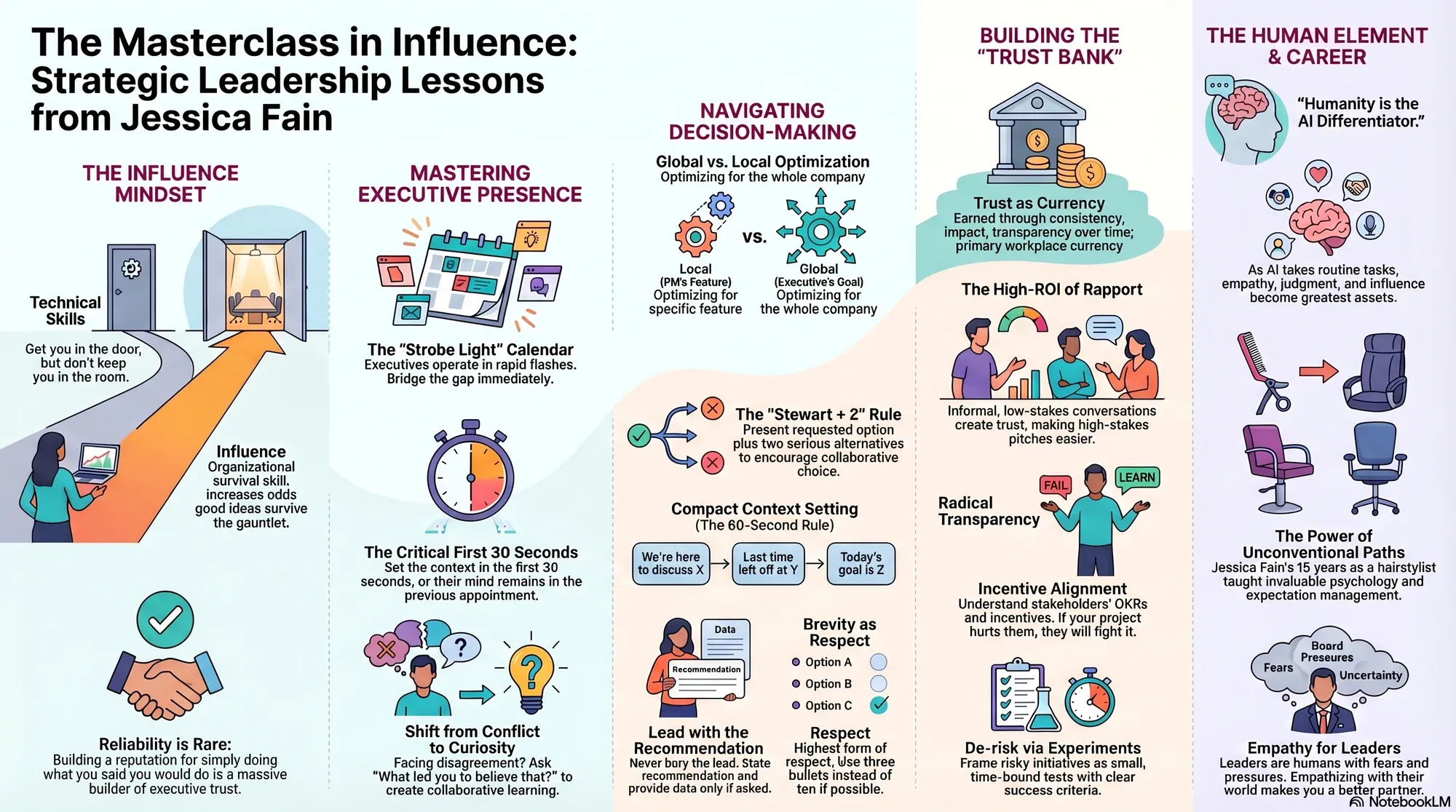
Part 1: The Art of Influence
- On Influence as a Product Skill: Influence builds momentum and stakeholder backing behind good ideas; without it, product teams struggle to turn those ideas into shipped work. — Full video interview ↗
- On Influence versus Politics: Fain distinguishes politics—manipulating outcomes for personal gain—from influence, which increases the odds that a good idea survives through genuine learning and empathy. — Full video interview ↗
- On Owning the Persuasion Work: When leaders do not buy into an idea, product leaders should examine their own framing, preparation, and understanding of the stakeholder instead of dismissing the decision as someone else’s failure. — Full video interview ↗
- On Responding with Curiosity: When a leader offers a view that conflicts with the evidence, ask what led them to that belief; the answer can surface experience, context, or pressure that was previously invisible. — Full video interview ↗
- On Engaging Leaders Early: Use office hours and low-stakes conversations to understand an executive’s beliefs before a proposal is fully formed, when their context can still improve the work. — Full video interview ↗
- On Learning Rather than Convincing: Enter executive conversations to learn and strengthen the plan, not merely to obtain a rubber stamp. — Full video interview ↗
- On Authentic Influence: Influence does not require copying someone else’s personality; people can build trust and communicate effectively in ways that remain true to their own strengths. — Full video interview ↗
- On Preparing for the Stakeholder: Before a review, learn what matters to the executive, what pressures they face, and how they prefer to process information. — Full video interview ↗
Part 2: Executive Presence and Communication
- On Executive Context Switching: Executives move rapidly among budgets, hiring, legal issues, people problems, and product reviews; assume they have not been centered on your project since the last conversation. — Full video interview ↗
- On Opening with Context: Use the first 30 seconds to explain why the meeting is happening, where the prior discussion ended, and why the decision matters now. — Full video interview ↗
- On Leading with the Recommendation: Start with the recommendation and keep the detailed research available in an appendix rather than narrating the entire process before reaching the point. — Full video interview ↗
- On Showing Enough Evidence: Executives generally assume the team did its homework; show the reasoning needed to evaluate the recommendation and keep deeper proof ready for questions. — Full video interview ↗
- On Protecting Discussion Time: Use scarce group time for the largest or most controversial questions that require live discussion; resolve simple clarification questions offline. — Full video interview ↗
- On Becoming a Communication Chameleon: Adapt the format to the person: some executives respond to customer stories, designs, dashboards, experiments, written documents, or quiet pre-reading. — Full video interview ↗
- On Watching for Lost Attention: Fain describes losing a key reviewer by overexplaining her research; the lesson is to notice when the presentation is obscuring the decision and move the detail to an appendix. — Full video interview ↗
Part 3: Navigating Executive Decision-Making
- On Global versus Local Optimization: Executives optimize across the company while teams naturally optimize their own area; better proposals connect local work to the wider company outcome. — Full video interview ↗
- On “Stewart Plus Two”: After a design review, Fain’s Slack team would build the version Stewart Butterfield requested plus two alternatives they believed in, creating a concrete forum for comparison. — Full video interview ↗
- On Understanding Executive Incentives: Ask what success means for the leader, how they are measured, and what pressure the board is applying, then connect the proposal to those outcomes. — Full video interview ↗
- On Defining Experiment Success: When shrinking a risky idea into an experiment, state how the team will know whether it worked and when it will return with a decision. — Full video interview ↗
- On Clarifying Urgency: When an executive raises an idea, ask how strongly they feel and whether it should displace current priorities; not every passing thought is a mandate. — Full video interview ↗
- On Shrinking the Change: Turn a frightening six-month commitment into a small proof of concept or time-bounded experiment that can generate evidence and momentum. — Full video interview ↗
- On Building Trust through Results: Trust grows when teams act on feedback, ship strong products, and report the outcome back to the leader who helped shape the work. — Full video interview ↗
- On Fast Follow-Up: Respond while the conversation still has momentum; waiting a week on agreed follow-ups can squander executive attention and enthusiasm. — Full video interview ↗
Part 4: Lessons from the Chief of Staff Role
- On Learning Executive Decision-Making: Serving as Chief of Staff to two Slack CPOs gave Fain direct exposure to executive calendars, incentives, and the context behind product decisions. — Full video interview ↗
- On Following Executive Breadcrumbs: Strong operators notice subtle prompts, clarify their urgency, and respond quickly instead of waiting for a perfectly explicit assignment. — Full video interview ↗
Part 5: Product Leadership and Scaling
- On Empowering Website Teams: At Webflow, Fain leads Collaboration and Scale product work intended to help website teams build, launch, and optimize securely at scale. — Webflow Conf ↗
- On Guardrails for AI Teammates: When agents accelerate work, teams still need clear identity, security, and compliance guardrails, including decisions about where human review is required. — Full video interview ↗
- On Deprioritization as a Trust Signal: Killing or deprioritizing your own initiative when the evidence turns against it demonstrates alignment with company and user outcomes rather than personal scope. — Full video interview ↗
- On Customer Love Sprints: At Slack, a two-week Customer Love Sprint let engineers choose small customer-facing improvements they could ship quickly, supported by product, design, and customer support. — Slack Design ↗
- On Strategy Clarity in the AI Era: As building accelerates, clear shared beliefs about users, business dynamics, priorities, and success become more important because mistakes can compound faster. — Full video interview ↗
Part 6: Building Trust and High-ROI Relationships
- On Treating Stakeholder Conversations as Discovery: Apply product discovery skills to stakeholders: listen for their context, incentives, and expertise before trying to move them toward a decision. — Full video interview ↗
Part 7: Career Growth and Unconventional Paths
- On Being a Villager: If you want a supportive professional village, participate in one: reach out, take the first step, and be present for other people. — Full video interview ↗
- On Bringing Domain Expertise: Influence works best when it is paired with real expertise; product leaders are expected to understand their domain deeply and bring that knowledge into the room. — Full video interview ↗
Part 8: Philosophy and Personal Habits
- On Reading as a Window: Fain recommends multigenerational historical fiction such as *Pachinko*, *Homegoing*, and *A History of Burning* because it offers a window into histories and experiences unfamiliar to the reader.Pachinko, Homegoing, and A History of Burning. They provide a deep understanding of human history and struggle that informs my empathy." — — Full video interview ↗
- On Human Judgment in an AI-Rich World: As software creation accelerates, product leaders remain responsible for choosing worthwhile problems, applying judgment and taste, earning trust, and building support for the result. — Full video interview ↗
Learn more: