Jim Burns (1931–2016), author of At Home with the Inner Self, was a spiritual teacher whose ideas emerged from a life of intense personal struggle, including schizophrenia. His work survives largely through transcripts of informal talks and book excerpts. Burns taught a practical form of self-examination: turn toward recurring feelings, habits, dreams, and bodily responses until the mind reveals what it has been avoiding. He was a longtime friend of and speaker at the TAT Foundation, founded by his teacher Richard Rose.
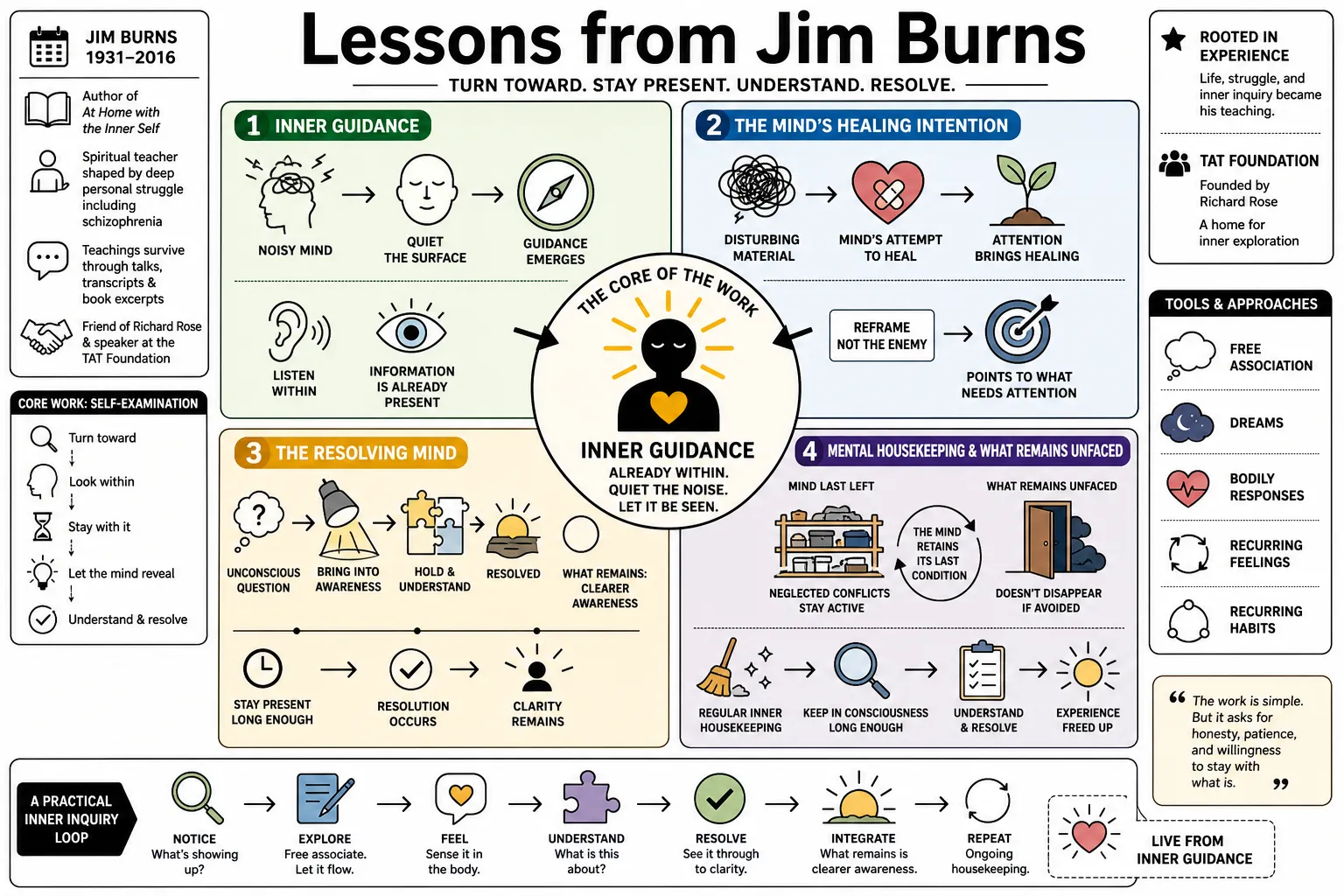
Core Philosophy and the Inner Self
- On Inner Guidance: Guidance is not something a person must manufacture; the work is to quiet the surface mind enough for information already within to become perceptible. — Reference: TAT Forum — Jim Burns memorial and teaching recollections
- On The Mind's Healing Intention: Disturbing material can be treated as the mind's attempt to reveal what needs attention and healing rather than as an enemy to suppress. — Reference: TAT Forum — Jim Burns memorial and teaching recollections
- On The Resolving Mind: Bring unconscious questions into awareness and hold them there; what remains after the issue resolves is clearer awareness itself. — Reference: TAT Forum — Jim Burns memorial and teaching recollections
- On Mental Housekeeping: The mind retains the condition in which it was last left, so neglected conflicts continue shaping experience until they are consciously examined. — Reference: TAT Forum — Jim Burns memorial and teaching recollections
- On What Remains Unfaced: An issue does not disappear because attention turns away from it; keep it in consciousness long enough to understand and resolve it. — Reference: TAT Forum — Jim Burns memorial and teaching recollections
- On Free Association: Free association was one of Burns's primary methods for letting feelings and unconscious material translate into words without forcing the answer. — Reference: TAT Forum — Jim Burns memorial and teaching recollections
- On Dreams as Feedback: Dreams can expose what remains unfulfilled or unconscious, but their value comes from carrying that recognition into waking awareness. — Reference: TAT Forum — Jim Burns memorial and teaching recollections
Techniques for Inner Work
- On Understanding Feelings: Do not obey a feeling blindly; investigate the causes and unresolved material behind it. — Reference: TAT Forum — Jim Burns, The Chief Hang-up
- On Where to Begin: Start self-examination with the repetitive habit you already know is off-key, because the strongest repetition often marks where the most energy is trapped. — Reference: TAT Forum — Jim Burns, The Chief Hang-up
- On The Chief Hang-up: Much of thought and behavior circles a primary psychological blockage; identifying that recurring center gives the work a practical starting point. — Reference: TAT Forum — Jim Burns, The Chief Hang-up
- On Breaking Through Obstacles: Facing a deep blockage can release energy that was previously consumed by avoidance and open a much wider field of action. — Reference: TAT Forum — Jim Burns, The Chief Hang-up
- On Learning from the Body: Observe how the body responds when meeting another person; bodily reactions can register information before the conscious story catches up. — Reference: TAT Forum — Jim Burns, The Chief Hang-up
- On Cellular Intelligence: Treat the body as an instrument of intuition: its living systems carry information that conscious reasoning alone may miss. — Reference: TAT Forum — Jim Burns memorial and teaching recollections
- On Practicing with Appetite: A simple exercise in bodily attention is to wait before eating until the body gives a specific, recognizable signal about what it wants. — Reference: TAT Forum — Jim Burns memorial and teaching recollections
Honesty, Ego, and Self-Confrontation
- On The Cost of Authenticity: Showing one's real feelings can threaten relationships built around a social pose, which is why honest self-expression can initially feel isolating. — Reference: TAT Forum — Jim Burns on self-confrontation and internal harmony
- On The Fear Beneath Self-Betrayal: People may abandon what feels true to avoid loneliness and the fear of being rejected or left behind. — Reference: TAT Forum — Jim Burns on self-confrontation and internal harmony
- On Ego as an Object: The ego's central mistake is assuming it stands before and authors everything, rather than recognizing that it too can be observed as an object. — Reference: TAT Forum — Jim Burns on self-confrontation and internal harmony
- On Dropping the Poses: Sustained self-analysis removes social poses that once created conflict and makes it easier for both the person and those around them to live honestly. — Reference: TAT Forum — Jim Burns on self-confrontation and internal harmony
- On Examining the Demand for Love: When people speak about love, they often mean a demand to be loved; examining that demand is more useful than idealizing the word. — Reference: TAT Forum — Jim Burns on self-confrontation and internal harmony
- On Facing Hatred Directly: Hatred consumes energy, and escape from it requires confronting the feeling face to face rather than pretending it is absent. — Reference: TAT Forum — Jim Burns on self-confrontation and internal harmony
- On The Relief Beyond Avoidance: The first honest passage through a long-avoided conflict can reveal that others have crossed the same terrain and release years of accumulated strain. — Reference: TAT Forum — Jim Burns on self-confrontation and internal harmony
- On The Ego's Illusion of Control: The ego claims authorship over events even though action is heavily conditioned by circumstance; seeing that weakens the story of total personal control. — Reference: SearchWithin — 1983 meeting transcript with Jim Burns
The Spiritual Path in Daily Life
- On The Universal Search: The search for truth is not limited to spiritual seekers; it appears in every serious effort to understand people, work, nature, or oneself more accurately. — Reference: TAT Forum — Jim Burns on self-confrontation and internal harmony
- On Self-Knowledge by Elimination: Self-knowledge begins by discovering what one is not; removing self-delusion allows a clearer definition to emerge. — Reference: TAT Forum — Jim Burns on self-confrontation and internal harmony
- On Practical Value Before Realization: Even before any spiritual breakthrough, self-confrontation can make a person easier to live with and reduce the damage caused by unexamined poses. — Reference: TAT Forum — Jim Burns on self-confrontation and internal harmony
- On Two Kinds of Benefit: Burns framed inner work as offering both a psychological benefit—becoming a better person—and the possibility of spiritual realization. — Reference: TAT Forum — Jim Burns on self-confrontation and internal harmony
- On Relief Through Attention: The desire to release one's own tension is connected to relieving tension around oneself; Burns found that paying attention to others produced the relief he had sought from them. — Reference: TAT Forum — Jim Burns on self-confrontation and internal harmony