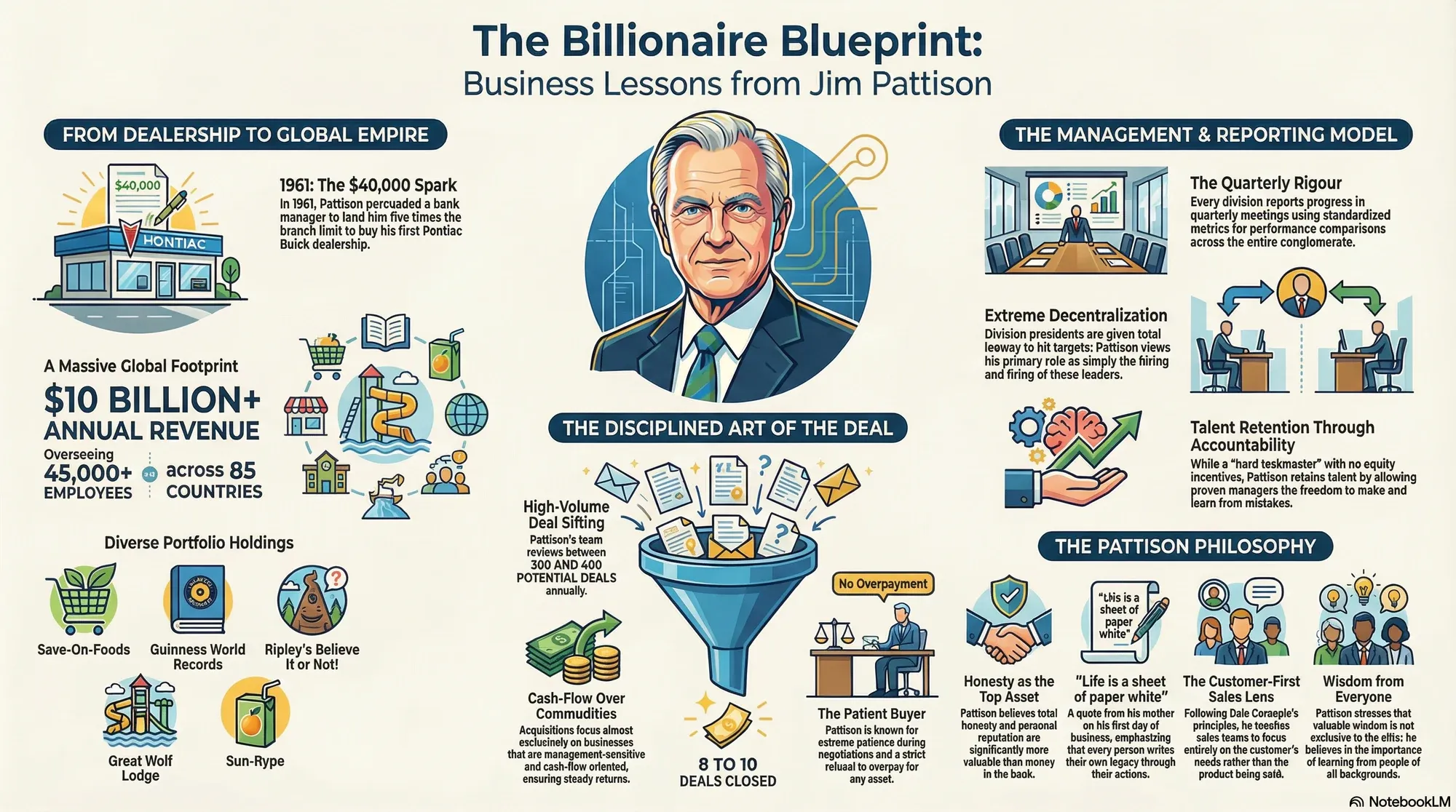
Jim Pattison is chairman and CEO of the Jim Pattison Group, a diversified holding company he built from a single car dealership opened in 1961. The group operates across automotive, food and beverage, media, entertainment, packaging, and other sectors.
Pattison was born during the Great Depression and moved to Vancouver at age six. He bought his first dealership with a bank loan after persuading the local manager to exceed the branch’s lending limit, then expanded through acquisitions into one of Canada’s largest private companies.
Ownership, Capital & Dealcraft
- On Private Ownership: “Being a private company has advantages. You don’t have to tell anybody your business, including your competition. Your access to capital is not nearly as good, but that hasn’t been an issue for years.”
- On Long-Term Ownership: Keeping a company private makes it possible to optimize decisions over decades instead of managing around quarterly public-market expectations. — Farnam Street The Knowledge Project
- On Keeping Control: "His new philosophy: “No partners, no shareholders, no relatives.”" — Farnam Street The Knowledge Project
- On Deal Selectivity: "Pattison’s conservative estimate of the number of deals he looks at every year runs between 300 and 400. Some are not very big. They’re opportunities where we can make our minds up pretty quick, we have a team of about three people who look at these things. We’ll buy eight or 10 a year, and maybe they’re just extensions.”
- On Information Asymmetry: When pursuing a takeover, use secrecy as a tactical advantage so the target remains unaware until it is too late. — Farnam Street The Knowledge Project
- On Choosing Partners: Choosing the wrong partner can do more than slow a company down; it can permanently damage its future. — The Knowledge Project Ep. #235
- On Acting Decisively: Taking action is the only way to bridge the gap between where you currently are and where you ultimately want to be. — The Knowledge Project Ep. #235
Management, Talent & Customers
- On Operating Accountability: "the very size and complexity of the Jim Pattison Group has forced it to develop a management and reporting structure adept at encouraging divisional initiative while still providing adequate oversight. A system of quarterly meetings sees every division report on what it’s doing, with metrics that allow comparisons across the company. If you owe the bank enough money, you decide what you have to do to pay your bills. It was trial and error. We’re car dealers, and then as we struck out into new things, they didn’t manage themselves. So we evolved a process that worked for us”
- On Reading People and Cash Flow: "He's very good at reading and understanding people. Second, he’s a great buyer. When examining an acquisition, he’s very patient; he never overpays. Third, except for a couple of recent forays into the commodity business, Pattison has concentrated almost exclusively on businesses that are cash-flow oriented and management sensitive. And the management style we had was well suited to most of them. Pattison gives his divisions a lot of leeway to do what they like as long as they meet targets, believing that his role extends, explicitly at least, only to the hiring and firing of the president. Finally, Pattison has been effective at retaining talent. That’s impressive, since no equity carrots are dangled and he is a hard taskmaster. Very hard. He pushed hard, and if you broke, you didn’t belong. But once proven, you were allowed to make mistakes.”
- On Rigour: “There is a rigour,” he says of the dozens of Pattison managers and executives he has dealt with. “They’re disciplined and accountable. And they are very results focused.”
- On Autonomy: Give people enough freedom to make decisions and learn through responsibility rather than controlling every move. — Farnam Street The Knowledge Project
- On Honest Performance Standards: "They were never going to be successful at selling cars, so why shouldn’t they cut their losses and become mechanics or teachers?" — Farnam Street The Knowledge Project
- On Customer-First Selling: "Pattison believes that sales take total honesty, hard work, and a clear and un-obscured focus on the customer. Pattison paraphrases a well known parable from Dale Carnegie, telling his sales people to focus on customers' needs, not on what they are trying to sell."
Learning, Change & Resilience
- On Embracing Change: “If you don’t, you’re going to be eventually out of business – because there’s always change and at least in my opinion, it’s important to embrace the change and try to figure out how you can take advantage of the changes because there always seems be change. And today, the speed of the change is what’s different than what I’ve ever experienced before.”
- On Learning from Everyone: "to be truly successful you need to learn from everybody. Pattison, who came from humble roots, stresses that wisdom is not the exclusive purview of the elite, the educated, and the rich."
- On Revising Your Beliefs: Never assume you have everything figured out; remain open to discovering that your entire business philosophy might be wrong. — Farnam Street The Knowledge Project
- On Bouncing Back: When faced with an obstacle, view it as an opportunity to pivot and recover rather than a definitive defeat. — Farnam Street The Knowledge Project
AI, Media & Local Markets
- On AI as Leverage: Treat AI as a tool that helps employees improve their work, not as a substitute for them. — Billboard Canada FYI interview
- On AI Where Talent Is Scarce: Use AI to extend service in smaller markets where recruiting enough talent is difficult. — Billboard Canada FYI interview
- On Local Relevance: Media businesses should create the best local content and distribute it across as many platforms as possible so audiences and advertisers can connect wherever they are. — Billboard Canada FYI interview
Character, Work & Legacy
- On Loving the Work: “If you like your work, it’s not a chore. I like what I do. There’s always something to do – put it that way.”
- On Reputation: Pattison's mantra is total honesty. He prides himself on this and believes that reputation is more important that money in the bank.
- On Trust: True reputation isn't about being liked, but about being trusted. While trust takes decades to build, it can be destroyed in seconds. — The Knowledge Project Ep. #235
- On Giving Back: “I was always taught – even when we didn’t have much money – to give back and support people that weren’t as fortunate as we are.”
- On a Mother's Lesson: Julia Pattison visited her son’s Pontiac/Buick dealership on the opening day in 1961 in Vancouver. “My mother came to my office. She said, ‘Jimmy, we don’t have a lot of money as you know and I can’t give you a nice present.’ But she gave me this. This is important.” In part, it reads: “Life is a sheet of paper white, whereon each one of us may write.”
Sources for the original lessons
- The Good Faith Work of Jimmy Pattison
- On the road with 90-year-old Jim Pattison, 'Canada's Warren Buffett'
- On the road with Jimmy Pattison, “Canada’s Warren Buffett”
- 'I am no Warren Buffett': One-on-one with Canadian billionaire Jim Pattison
- As he turns 90, Jim Pattison is still fine-tuning his business empire
- Exceptional Advising and Assisting--Interview with Maureen Chant, Jim Pattison's Executive Assistant
- He's 91 and worth billions. Now Jimmy Pattison is hunting deals
- 90-Year-Old Billionaire Jimmy Pattison Says These Are the 7 Secrets to His Success