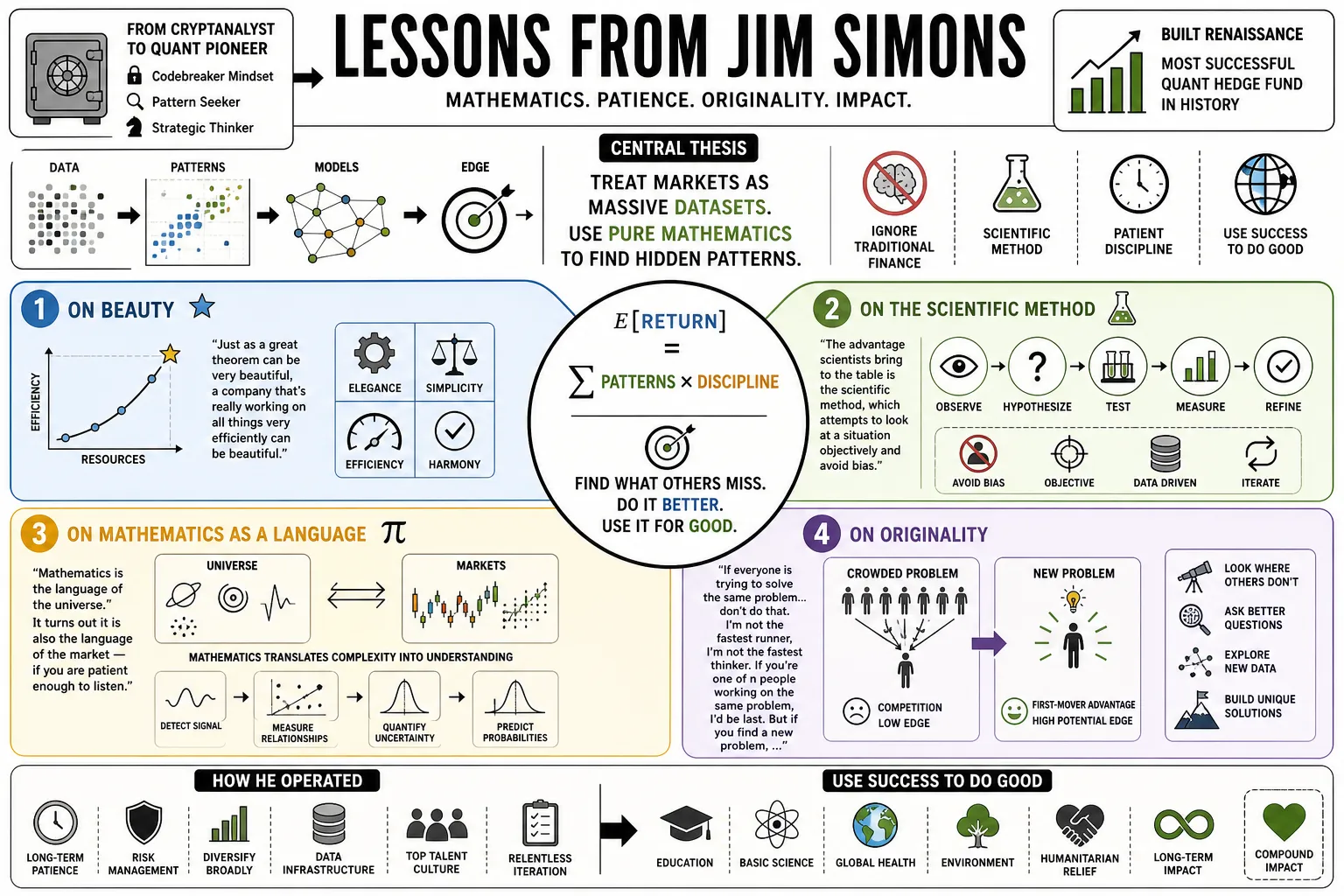
Lessons from Jim Simons
Jim Simons built Renaissance Technologies into the most successful quantitative hedge fund in history by ignoring traditional finance entirely. The former cryptanalyst treated markets as massive datasets, relying on pure mathematics to hunt for hidden patterns. This collection explores how that strict reliance on data dictated his approach to everything from managing risk to giving his money away.
Part 1: On Mathematics and Science
- On Beauty: "Just as a great theorem can be very beautiful, a company that’s really working on all things very efficiently can be beautiful." — Source: [MIT Lecture]
- On the Scientific Method: "The advantage scientists bring to the table is the scientific method, which attempts to look at a situation objectively and avoid bias." — Source: [The Man Who Solved the Market]
- On Mathematics as a Language: "Mathematics is the language of the universe. It turns out it is also the language of the market — if you are patient enough to listen." — Source: [The Man Who Solved the Market]
- On Originality: "If everyone is trying to solve the same problem... don’t do that. I’m not the fastest runner, I’m not the fastest thinker. If you're one of n people working on the same problem, I'd be last. But if you find a new problem, you have a chance." — Source: [MIT Lecture]
- On Searching for Truth: "I don't hire economists. I hire physicists and mathematicians. Economists know too many theories. Scientists know how to find what is actually true." — Source: [The Man Who Solved the Market]
- On Data Purity: "We don't start with models. We start with data. We don't have any preconceived notions. We look for things that can be replicated thousands of times." — Source: [TED Talk]
- On Extracting Signal from Noise: "Meaningful patterns can be uncovered with the right tools and insights... the market is not static, it’s dynamic; things change." — Source: [Simons Foundation]
- On Math vs. Business: "Math is more the real world than business." — Source: [Numberphile Interview]
- On Early Curiosity: "I discovered Zeno's Paradox at age 4, wondering why a car never runs out of gas if it always uses half of what's left. I just liked math." — Source: [Numberphile Interview]
Part 2: On Building Teams and Talent
- On Hiring Physicists: "We hire physicists, astronomers, and mathematicians. We don't hire from Wall Street. You can teach a physicist finance, but you can't teach a finance person physics." — Source: [TED Talk]
- On Delegation: "Surround yourself with the smartest people you can. Let them do their thing; don’t sit on top of them." — Source: [MIT Lecture]
- On Managerial Humility: "The best thing I ever did was hire people smarter than me and get out of their way." — Source: [The Man Who Solved the Market]
- On Industry Outsiders: "We never hired anyone from the financial world at Renaissance. We never did. Because they didn't have anything to add, I didn't think." — Source: [TED Talk]
- On the Secret Sauce: "The secret sauce is hiring great people, providing a great infrastructure, collaborating across the board, and sharing profits with everyone." — Source: [MIT Lecture]
- On Intellectual Raw Material: "We hired statisticians, physicists, astronomers, mathematicians — the important thing was that they were very smart." — Source: [TED Talk]
- On Collaboration Over Silos: "Work collaboratively, and let everyone know what everyone else is researching, so people aren't wasting their time." — Source: [The Man Who Solved the Market]
- On Building the Machine: "I didn’t build the trading models alone; I built the team that built them." — Source: [The Man Who Solved the Market]
- On Retaining Talent: "To keep a brilliant team from leaving, you share the wealth. High performance-based bonuses align the team’s goals with the firm’s success." — Source: [The Man Who Solved the Market]
Part 3: On Markets and Quantitative Investing
- On Human Bias: "Human emotion and bias are the biggest threats to successful investing. The most reliable approach is to be disciplined rather than make predictions." — Source: [The Man Who Solved the Market]
- On Correlation Over Causation: "We're not looking for reasons why something should work. You don't need to know why a pattern works. You need to know that it works." — Source: [The Man Who Solved the Market]
- On Statistical Significance: "We search through historical data to find anomalies... any one anomaly might be a random thing; however, if you have enough data you can tell that it’s not." — Source: [TED Talk]
- On the Slight Edge: "We're right 50.75 percent of the time... but we're 100 percent right 50.75 percent of the time. You can make billions that way." — Source: [The Man Who Solved the Market]
- On Data Volume: "There's no data like more data." — Source: [The Man Who Solved the Market]
- On Predictable Panic: "We aren't just modeling prices, but human behavior. Humans are most predictable in times of high stress and panic." — Source: [The Man Who Solved the Market]
- On Finding Ghosts: "We didn't look for home runs. We looked for thousands of tiny, statistically significant anomalies—ghosts—that occurred frequently enough to exploit." — Source: [The Man Who Solved the Market]
- On Market Inefficiency: "Patterns of price movement are not random. However, they're close enough to random so that getting some excess, some edge out of it, is not easy and not so obvious." — Source: [TED Talk]
- On Selection Criteria: "We have three criteria: If it’s publicly available, computable, and predictive, we use it." — Source: [Simons Foundation]
- On Trusting the Math: "We don't override the models. When you start doing that, you have a problem. The model is built on evidence. Your gut is built on stories." — Source: [The Man Who Solved the Market]
Part 4: On Leadership and Management
- On System Discipline: "The models were always right. The question was whether we'd follow them." — Source: [The Man Who Solved the Market]
- On Open Architecture: "My success was a managerial achievement as much as a mathematical one—creating a culture where scientists collaborate and share all their code rather than working in silos." — Source: [MIT Lecture]
- On Encouraging Ideas: "Bad ideas are good, good ideas are terrific, no ideas are terrible." — Source: [The Man Who Solved the Market]
- On Pure Automation: "The goal was a pure system without human interference. Even when the market crashed, we had to let it ride." — Source: [The Man Who Solved the Market]
- On Managing Intelligence: "It’s unbelievably difficult to manage intelligent people, and it’s worse when there’s a lot of money involved." — Source: [MIT Lecture]
- On Managing Egos: "If they’re smarter than you, all the better. You provide the infrastructure, and they provide the brilliance." — Source: [MIT Lecture]
- On Publicity: "God gave me a tail to keep off the flies. But I’d rather have had no tail and no flies." — Source: [The Man Who Solved the Market]
- On Organizational Aesthetics: "Fashioning an organization that runs extremely well and accomplishes its mission with excellence is a beautiful thing." — Source: [MIT Lecture]
- On Shared Ownership: "By making everyone a part-owner of the same black box, we eliminated internal silos and encouraged the sharing of ideas." — Source: [The Man Who Solved the Market]
- On Pursuing Passion: "Find something that you really like... and then put your heart and soul into it. The secret to happiness is finding something you love and doing it for the rest of your life." — Source: [Numberphile Interview]
Part 5: On Risk and Strategy
- On Accepting Losses: "If you get to bet heads, you are going to win seven times out of ten. Three times out of ten you are going to lose, and that’s bad luck. You need a measure of good luck to avoid a long run of tails... eventually, the math will hold up." — Source: [The Man Who Solved the Market]
- On Built-in Safeguards: "If a strategy stops working or volatility surges, the system must be designed to automatically reduce positions and risk." — Source: [The Man Who Solved the Market]
- On Capacity Constraints: "We recognized that our strategies only worked at a certain scale. To maintain returns, we capped the size of the fund and regularly returned capital." — Source: [The Man Who Solved the Market]
- On Ignoring Gut Feelings: "Over the years, data-driven decisions have proven to be better than gut feelings." — Source: [The Man Who Solved the Market]
- On Market Dynamics: "The market is not static, it’s dynamic; things change. Meaningful patterns can be uncovered with the right tools." — Source: [TED Talk]
- On Preventing Panic: "The system must be automated to protect the fund from the smartest person in the room's emotions during a panic." — Source: [The Man Who Solved the Market]
- On the Limits of Quants: "Good quants don’t always make good traders. Trading is an art as well as a science." — Source: [The Man Who Solved the Market]
- On Statistical Proof: "We have no economic model of why our trades work. We have statistical evidence that they do. That is enough." — Source: [The Man Who Solved the Market]
- On Recovering from Failure: "The Medallion Fund didn't work immediately. We failed repeatedly in the early years, treating each failure as a data point, refining the models, and testing again." — Source: [The Man Who Solved the Market]
Part 6: On Problem Solving and Thinking
- On Quantitative Mentality: "We applied the scientific method to the markets. You don't try to outguess it; you try to measure it." — Source: [The Man Who Solved the Market]
- On Illogical Connections: "You don't need to know why. If the data shows that X usually follows Y, you trade it, even if the connection seems illogical." — Source: [The Man Who Solved the Market]
- On Parsing Noise: "Mathematics is the language of the market, but only if you have the tools to parse the noise." — Source: [The Man Who Solved the Market]
- On Data Supremacy: "Our advantage wasn't just better math; it was better data. We spent years cleaning and organizing historical data before placing a trade." — Source: [The Man Who Solved the Market]
- On Rebuilding Models: "For six months, they studied what went wrong and rebuilt the model. You keep testing until the math holds." — Source: [The Man Who Solved the Market]
- On Slow Thinking: "I was never the fastest guy in the world, but I would plow through it with determination." — Source: [Numberphile Interview]
- On Independence: "Try to do something that’s original... if everyone is doing the same thing, it’s hard to get an edge." — Source: [MIT Lecture]
- On Elegance in Systems: "I see beauty in the elegance of a theorem or a mathematical proof, and that same aesthetic applies to solving complex systems." — Source: [MIT Lecture]
- On Objectivity: "The scientific method attempts to look at a situation objectively and avoid bias." — Source: [TED Talk]
Part 7: On Luck, Failure, and Persistence
- On the Role of Luck: "Luck is largely responsible for my reputation for genius. I don’t walk into the office and say, ‘Am I smart today?’ I walk in and wonder, ‘Am I lucky today?’" — Source: [MIT Lecture]
- On Hope: "Hope for good luck. That’s the most important one of the five guiding principles." — Source: [MIT Lecture]
- On Sticking With It: "Don’t give up easily. Stick to something. Not to the point where it’s clearly insane, but really give it a chance." — Source: [MIT Lecture]
- On Being Fired: "Getting fired once can be a good experience. You just don't want to make a habit of it." — Source: [The Man Who Solved the Market]
- On Early Rejection: "When I told my bosses at the garden supply store I wanted to study math at MIT, they laughed, thinking the boy who couldn't find the sheep manure would never make it." — Source: [MIT Lecture]
- On Starting Late: "I didn't start my serious trading career until I was 41 years old. It’s never too late to pivot into a new field." — Source: [Numberphile Interview]
- On Treating Losses as Data: "The Medallion Fund was born in 1988. It was a rough start at first... but we treated each loss as information." — Source: [The Man Who Solved the Market]
- On Randomness: "Luck plays a meaningful role in everyone’s life... it’s the twin of probability." — Source: [MIT Lecture]
- On Grinding Through Hard Problems: "I wasn't the fastest, but I plowed through. I just liked math." — Source: [Numberphile Interview]
- On Allowing Time to Succeed: "Stick with it. Not forever, but really give it a chance to get where you’re going." — Source: [MIT Lecture]
Part 8: On Wealth and Philanthropy
- On Funding Basic Science: "We focus on basic science that might not otherwise receive funding, advancing the frontiers of research in mathematics and the physical and life sciences." — Source: [Simons Foundation]
- On Computation in Science: "We treat software engineering and data analysis as first-class scientific citizens to solve complex problems in physics and biology." — Source: [Simons Foundation]
- On Supporting Teachers: "We created Math for America to celebrate and support high-quality math and science teachers in public schools." — Source: [Simons Foundation]
- On Investigating Autism: "The goal is to understand the underlying causes of the disorder, applying the same rigor we applied to the markets." — Source: [Simons Foundation]
- On the Flatiron Institute: "We built a community of scientists dedicated to advancing scientific research through computational methods." — Source: [Simons Foundation]
- On the True Value of Money: "The most important thing money can do is allow you to do the things you truly care about." — Source: [Numberphile Interview]
- On Empowering Researchers: "We fund individual researchers and large-scale collaborations on problems like the origins of life and the nature of the universe." — Source: [Simons Foundation]
- On Distributing Wealth: "Once you have fashioned an organization that runs extremely well, the next beautiful thing is giving it away effectively." — Source: [MIT Lecture]
- On Scientific Philanthropy: "Our philanthropy is guided by the same principles as the business: hire the smartest people and let them find the truth." — Source: [Simons Foundation]