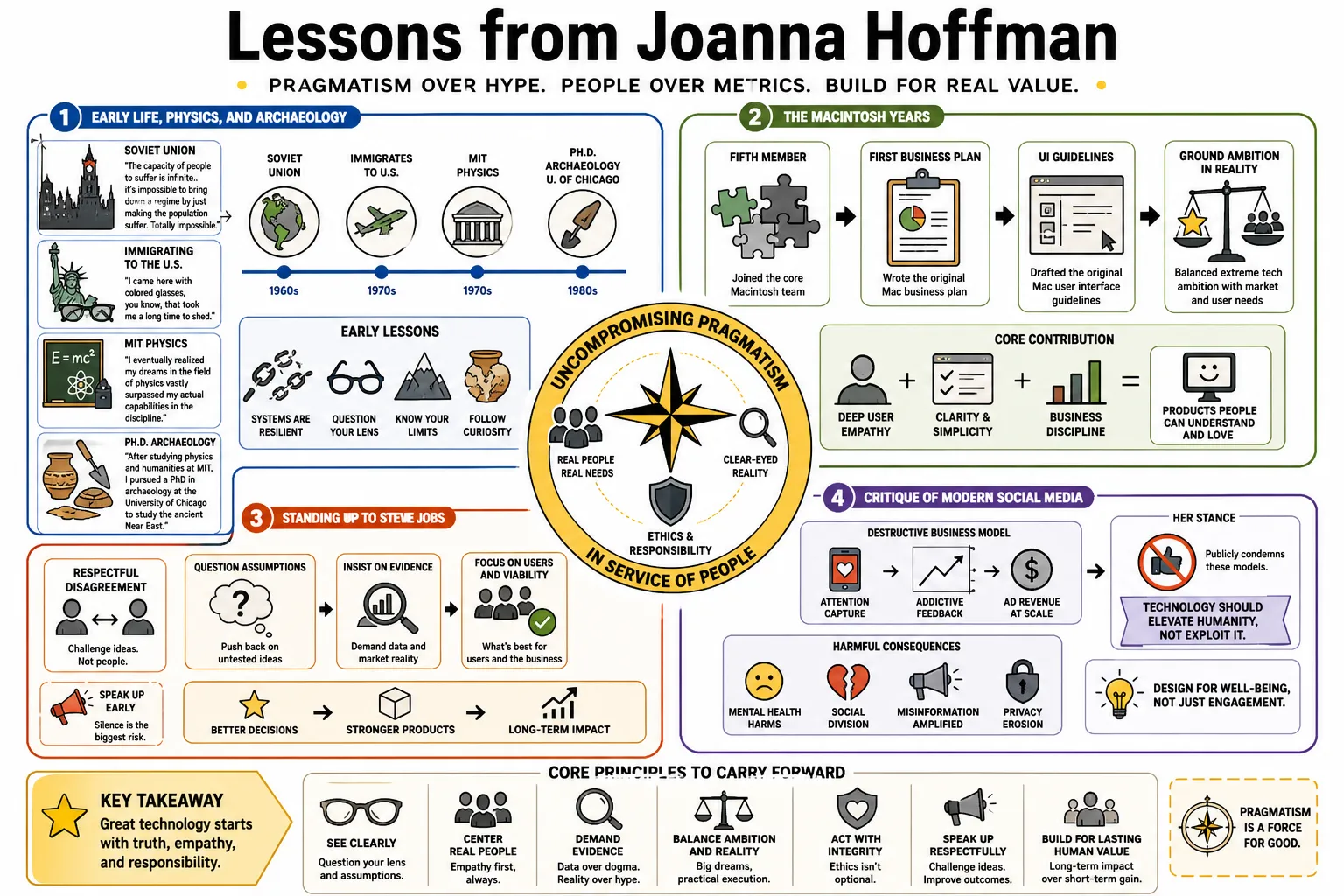
Lessons from Joanna Hoffman
Joanna Hoffman was the fifth member of the Apple Macintosh team and the author of its first business plan. Though widely known for standing up to Steve Jobs, she also drafted the original Mac user interface guidelines and grounded extreme technological ambition in market reality. She later turned that uncompromising pragmatism on modern social media companies, publicly condemning their destructive business models.
Part 1: Early Life, Physics, and Archaeology
- On living in the Soviet Union: "The capacity of people to suffer is infinite... it's impossible to bring down a regime by just making the population suffer. Totally impossible." — Source: [Computer History Museum]
- On immigrating to the United States: "I came here with colored glasses, you know, that took me a long time to shed." — Source: [Computer History Museum]
- On her MIT physics education: "I eventually realized my dreams in the field of physics vastly surpassed my actual capabilities in the discipline." — Source: [Vintage Apple]
- On shifting academic focus: "After studying physics and humanities at MIT, I pursued a PhD in archaeology at the University of Chicago to study the ancient Near East." — Source: [Evan McCann]
- On the Iranian Revolution's impact: "Geopolitical disruptions in the late 1970s made it impossible to conduct my planned archaeological digs, prompting a leave of absence that changed my life." — Source: [Vintage Apple]
- On abandoning archaeology for technology: "I decided I'd been living in the past so long that I felt I now wanted to be in the future." — Source: [Vintage Apple]
- On her unlikely tech background: "I am fundamentally a physicist and an archaeologist, not a marketer." — Source: [Computer History Museum]
- On early intellectual debates: "My entry into the tech industry began with a heated philosophical debate over what computers should look like at a Xerox PARC lecture." — Source: [Computer History Museum]
- On being discovered by Apple: "Jef Raskin was so impressed by my pointed, critical questions during our initial debate that he immediately invited me to interview for his secretive new project." — Source: [Computer History Museum]
Part 2: Joining Apple and the Macintosh Vision
- On the nascent Macintosh project: "At the time I began at Apple Computer, the Mac was still a research project searching for an identity." — Source: [Evan McCann]
- On her unconventional job interview: "Part of my initial evaluation by Jef Raskin involved a musical test where I had to identify the different stylistic improvisations he played on his home piano." — Source: [Medium]
- On defining the target audience: "I authored the original Macintosh business plan, defining the knowledge worker as the ideal user long before the machine was even built." — Source: [Computer History Museum]
- On early Macintosh projections: "The business plan targeted higher education and international markets as the crucial footholds for the Macintosh's long-term survival." — Source: [Evan McCann]
- On breathing life into hardware: "An inanimate object with a personality could garner a cult following. And that's what we did with the Macintosh as well, give that little twinkle... there was just a personality to the machine." — Source: [Computer History Museum]
- On the hubris of the early Mac team: "There was an immense cockiness among the young Macintosh team, and our sheer confidence masked the massive risks we were taking." — Source: [Medium]
- On building a computer for everyone: "We viewed the project as an ideological crusade to democratize computing, bringing tools of creation out of enterprise server rooms and into the hands of artists and students." — Source: [Computer History Museum]
- On her role as the conscience of the team: "I quickly became known as the moral compass of the Mac division, ensuring the team's lofty marketing claims aligned with the reality of the hardware." — Source: [History vs Hollywood]
- On navigating male-dominated Silicon Valley: "As the only marketing person on the Mac team for its first year and a half, I held my ground against a highly aggressive, engineering-led culture." — Source: [Evan McCann]
- On pretending to be a cynic: "The truth is, I pretend to be a cynic, but I am really a dreamer who is terrified of wanting something she may never get." — Source: [AppleInsider]
Part 3: Marketing and the "Computer for the Rest of Us"
- On standing as a solo department: "For the critical first eighteen months of the Macintosh's development, I effectively operated as the entire marketing department single-handedly." — Source: [Medium]
- On protecting the brand's truth: "Third-party software needed to look and feel native because absolute consistency was a core part of the Macintosh brand's truth." — Source: [Medium]
- On taking the Mac international: "As the leader of the International Marketing Team, I localized the Macintosh for Europe and Asia, refusing to let the product be an English-only experience." — Source: [Evan McCann]
- On industry rivalries: "During the Mac's European tour, Steve Jobs quipped in my presence that AT&T was like a thirty-year-old virgin who would jump into bed with anyone." — Source: [Medium]
- On enforcing reality in marketing: "In late 1984, when Macintosh sales floundered, the team was too terrified to tell Steve Jobs the truth until I unilaterally slashed the official forecasts to reflect reality." — Source: [Medium]
- On the danger of false projections: "Real deep shit, because if we are unrealistic about this date, we make design decisions that we then have to go over, re-iterate, throw out, start all over again." — Source: [Evan McCann]
- On aggressive product defense: "Upon discovering Steve Jobs had secretly altered my marketing projections to look more favorable, I famously marched toward his office threatening to take a knife and stab it into his heart." — Source: [Medium]
- On managing corporate panic: "It reportedly took Apple’s corporate counsel physically intervening to stop me from confronting Jobs in a blinding rage over the altered marketing data." — Source: [Medium]
- On the trauma of early setbacks: "The emotional toll of missing early sales targets was devastating to the team, a period that served as a traumatic wake-up call to the realities of the market." — Source: [Medium]
- On long-term product impact: "The Macintosh functioned primarily as an educational tool that would fundamentally change how students interacted with information." — Source: [Computer History Museum]
Part 4: User Interface, Design, and Localization
- On defining the standard: "I wrote the very first draft of the Macintosh User Interface Guidelines, establishing the baseline rules for how human beings would interact with personal computers." — Source: [Evan McCann]
- On the danger of rigid rules: "Once it becomes dogma it becomes counterproductive and the doctrine of our user interface became a dogma. For much longer than it should have been." — Source: [Computer History Museum]
- On software architecture for the world: "I insisted that no text strings be hardcoded into the software, forcing engineers to use a separate resource fork so the system could be translated easily." — Source: [Computer History Museum]
- On hardware localization: "To make the machine feel natural to non-English speakers, I successfully lobbied for the use of universal symbols on the keyboard rather than English words." — Source: [Medium]
- On engineering pushback: "My localization efforts often frustrated the engineering team, who wanted to hardcode text for simplicity, but I held the line for international usability." — Source: [Computer History Museum]
- On the evolution of UI: "I foresaw that the guidelines I helped create would eventually need to be broken in order to allow for more complex, fluid user interactions." — Source: [Computer History Museum]
- On intuitive design: "The overarching goal of the interface guidelines was to eliminate the need for an instruction manual, making software discoverable through play rather than study." — Source: [Evan McCann]
- On the intersection of design and marketing: "I viewed the user interface as the primary marketing vehicle that communicated the computer's underlying philosophy rather than a purely technical feature." — Source: [Computer History Museum]
- On the permanence of early decisions: "Many of the universal icons and translation architectures I championed in the early 1980s remain foundational to operating systems today." — Source: [Evan McCann]
Part 5: Confronting the Reality Distortion Field
- On challenging authority: "I won a satirical internal award at Apple in both 1981 and 1982 for being the person who did the best job of standing up to Steve Jobs." — Source: [Evan McCann]
- On earning Jobs' respect: "My refusal to back down from Steve Jobs earned me his enduring respect, proving that he valued extreme competence and pushback over sycophancy." — Source: [Medium]
- On the utility of the distortion field: "The distortion field was a known phenomenon that pushed engineers to achieve the impossible, but it became actively dangerous when applied to immovable manufacturing deadlines." — Source: [Evan McCann]
- On the limits of persuasion: "I don't care what you say. Reality distortion is reality distortion... when it comes to that date affecting the design of the product, that's when we get into a rut." — Source: [Evan McCann]
- On the inevitable collision with truth: "The reality distortion field can serve as a spur, but then reality itself hits." — Source: [AZ Quotes]
- On managing the distortion: "I operated as the grounding wire for the team, meticulously checking impossible timelines against the actual physical constraints of manufacturing and software development." — Source: [History vs Hollywood]
- On the culture of fear: "The internal culture of fear preventing the team from giving Jobs accurate data posed a greater threat to the Macintosh than IBM." — Source: [Medium]
- On speaking truth to power: "By unilaterally cutting the sales forecasts to match reality, I demonstrated that preserving the company's financial health was more important than preserving the founder's ego." — Source: [Medium]
- On the necessity of conflict: "Intense, friction-filled debate was the only way to forge truly great products; I refused to let politeness get in the way of the truth." — Source: [Computer History Museum]
- On her reputation as a fixer: "Whenever a project was spinning out of control due to unrealistic promises, executives relied upon me to bring the timeline back to reality." — Source: [History vs Hollywood]
Part 6: Steve Jobs and Leadership
- On Jobs' unique talent: "People who are able to bring visions into reality, and make them successful, and make them stick are one in a billion. He was definitely one in a billion." — Source: [Computer History Museum]
- On his true motivations: "Steve was never doing it for himself, was not doing it for the money, was not doing it for the fame... he had the strong sense that this is the right thing to do, and that it's going to change the world." — Source: [Computer History Museum]
- On his relentless forward focus: "Steve never looked back... He never talked about his past accomplishments. He only talked about what he intended to do for the future." — Source: [Computer History Museum]
- On the necessity of strong leadership: "Individuals make a huge difference. Without a strong leader then nothing productive results in the end." — Source: [AppleInsider]
- On being his anchor: "I was one of the few people who could manage his temper while still driving the product forward, acting as his operational conscience." — Source: [History vs Hollywood]
- On his flaws as a manager: "I was acutely aware of his interpersonal shortcomings, frequently stepping in to repair the emotional damage he inflicted on the engineering teams." — Source: [Computer History Museum]
- On his evolution at NeXT: "Following Jobs to NeXT, I continued to serve as a vital counterbalance, challenging his perfectionism when it threatened to stall the launch of the NeXT Computer." — Source: [Evan McCann]
- On his demanding nature: "His aggressive demands stemmed from a desperate, uncompromising desire to make the product absolutely perfect rather than malice." — Source: [Computer History Museum]
- On matching his intensity: "To survive in his orbit, I learned to match his volume and intensity, ensuring that my strategic objections could not be ignored or shouted down." — Source: [Medium]
Part 7: General Magic and Inventing the Future
- On the sheer ambition of General Magic: "No matter how big we dreamed, the fact that you could touch the lives of billions, billions... it was vaguely imaginable, but the scale of it was inconceivable." — Source: [SubsLikeScript]
- On the burden of being right: "The reason this story so haunts the people that were involved, that they still live with it, is because they knew that they were right." — Source: [SubsLikeScript]
- On inventing the smartphone too early: "As VP of Marketing at General Magic, I helped pioneer the concepts of mobile apps, touchscreens, and emojis long before the market or the internet infrastructure was ready." — Source: [Evan McCann]
- On the tragedy of the visionary: "The failure of General Magic remains a testament to the bitter truth that having the right idea at the wrong time is indistinguishable from being wrong." — Source: [SubsLikeScript]
- On managing runaway optimism: "Just as I did at Apple, I served as the voice of reason at General Magic, trying to ground the engineering team's sky-high dreams in commercial reality." — Source: [StockQ]
- On the emotional toll of failure: "The collapse of General Magic was a profoundly bittersweet experience, as we watched the technologies we invented reshape the world decades after our company died." — Source: [SubsLikeScript]
- On the importance of timing: "General Magic taught us that technological brilliance cannot overcome the physical limitations of cellular networks and processor speeds of the era." — Source: [SubsLikeScript]
- On corporate spin-offs: "Transitioning from Apple to General Magic presented the unique challenge of building an entirely new culture while escaping the shadow of our former employer." — Source: [Computer History Museum]
- On the legacy of failure: "I remain intensely proud of the General Magic team, as the talent assembled there went on to build the modern Apple Watch, Android, and eBay." — Source: [SubsLikeScript]
Part 8: Modern Technology and Social Media
- On Facebook's destructive impact: "Facebook is destroying the very fabric of democracy, destroying the very fabric of human relationships, and peddling in an addictive drug called anger." — Source: [MacObserver]
- On the ethics of tech leadership: "As I look at Facebook, for example, I keep thinking are they really that ignorant or is this motivated by something… darker than what appears?" — Source: [MacObserver]
- On the addiction business model: "You know it's just like tobacco, it's no different than the opioids. We know anger is addictive, we know we can attract people to our platform and get engagement if we get them pissed off enough." — Source: [AppleInsider]
- On capitalizing on outrage: "Modern social media companies intentionally capitalize on negative human emotions simply because it drives engagement metrics." — Source: [AppleInsider]
- On the ignorance of young founders: "They are genius in what they've accomplished and what they have done at a very young age, but remarkably ignorant on what they are sowing in the world." — Source: [MacObserver]
- On the contrast with early computing: "The early Macintosh aimed to educate the user, whereas modern social networks are designed to distract them." — Source: [9to5Mac]
- On separating technical achievement from impact: "I have enormous respect for the technical and business milestones Facebook has achieved, but those achievements do not excuse the societal harm." — Source: [AppleInsider]
- On the lack of a moral compass in modern tech: "There are simply too few people willing to stand up to modern tech CEOs the way I stood up to Steve Jobs." — Source: [iMore]
- On the ultimate purpose of technology: "Technology must serve to elevate human potential, not degrade it into a monetizable feedback loop of anger." — Source: [FastCompany]