Jocko Willink is a retired Navy SEAL, co-founder and CEO of Echelon Front, and host of the Jocko Podcast. He is chairman of Jocko Fuel. — Echelon Front biography.
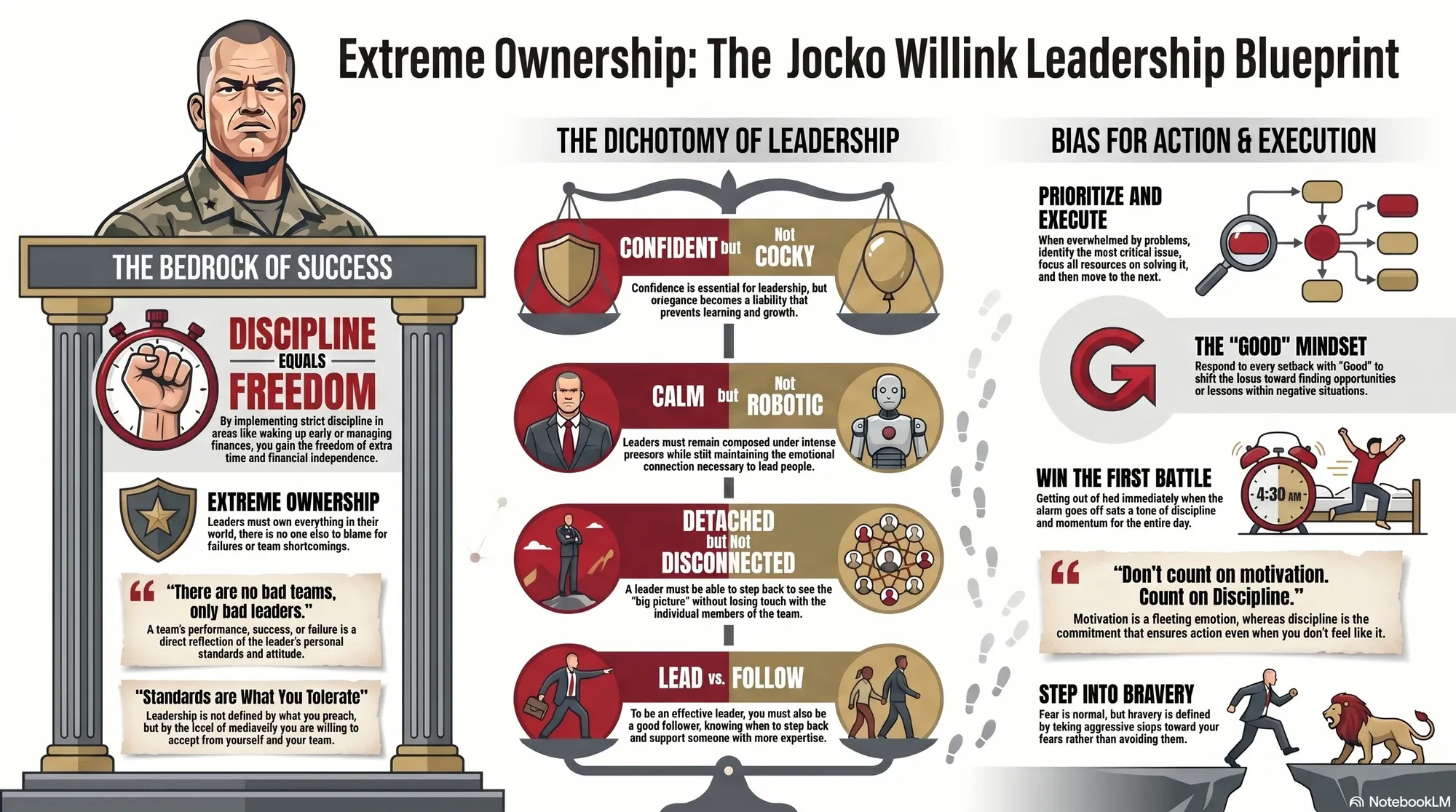
Core Philosophy: Discipline and Ownership
Willink’s leadership work centers on ownership and discipline, two explicit principles in the Echelon Front framework. — Echelon Front — Extreme Ownership.
1. Discipline Equals Freedom: Willink describes disciplined management of time and money as creating more choices. — Jordan Harbinger interview.
- Learning: Managing time and spending deliberately can leave more room to choose what matters. Willink presents early rising as his practice, not a universal wake-up rule. — Jordan Harbinger interview.
2. Extreme Ownership: leaders take responsibility for problems and solutions within their remit. — Echelon Front — Extreme Ownership.
- Learning: The Willink–Babin framework asks leaders to examine their own decisions and support the team instead of defaulting to blame. — Echelon Front — Extreme Ownership.
3. Team performance is a leadership responsibility, not just a roster problem. — Jordan Harbinger interview.
- Learning: Willink recounts Leif Babin’s boat-crew example to show how a change in leadership can change a team’s performance; the lesson comes from their joint work. — Jordan Harbinger interview.
4. Team standards depend on what a leader tolerates. — Echelon Front — Accountability.
- Learning: The jointly authored Extreme Ownership framework argues that leaders must model the standards they expect and address deviations, not merely announce values. — Echelon Front — Accountability.
5. Discipline can carry action when motivation fades. — Tim Ferriss interview.
- Learning: Willink says motivation comes and goes; following through on needed work does not have to wait for that feeling to return. — Tim Ferriss interview.
- On Decentralized Command: Decentralized command means explaining the purpose and priorities, then allowing team members to make decisions within that intent instead of micromanaging every step. — Echelon Front — Extreme Ownership.
On Leadership and Humility
Willink and Babin's leadership framework treats humility and balance as practical qualities for leaders. — Echelon Front — The Dichotomy of Leadership.
6. Ownership requires humility: a leader must be willing to examine mistakes and check ego. — Echelon Front — Extreme Ownership.
- Learning: Humility makes it easier to hear feedback and see what needs to change; ego can block self-assessment and cooperation. — Echelon Front — Extreme Ownership.
7. Leadership requires decisive action without recklessness. — Echelon Front — The Dichotomy of Leadership.
- Learning: Willink and Babin frame leadership as a balance between opposing tendencies; acting decisively should not mean ignoring risk or other perspectives. — Echelon Front — The Dichotomy of Leadership.
8. Leaders must also know when to follow. — Echelon Front — The Dichotomy of Leadership.
- Learning: The joint Dichotomy of Leadership framework asks leaders to balance taking charge with allowing others to lead when their judgment or position is better suited to the moment. — Echelon Front — The Dichotomy of Leadership.
9. Ownership means working the problem rather than defaulting to excuses. — Tim Ferriss interview.
- Learning: In discussing recurring team failures, Willink argues that leaders and members must identify, own, and resolve problems; otherwise they remain unsolved. — Tim Ferriss interview.
10. Influence is earned through competence, relationships, and humility. — Tim Ferriss interview.
- Learning: Willink advises building a reputation, developing useful solutions, and presenting them respectfully when trying to influence leaders above you. — Tim Ferriss interview.
11. Ownership must be balanced with delegation. — Tim Ferriss interview.
- Learning: Willink says excessive micromanagement leaves team members without initiative, while too little direction leaves them unsure where to go. — Tim Ferriss interview.
12. Stay composed without becoming emotionally remote. — Echelon Front — Emotional Discipline.
- Learning: Echelon Front advises leaders to pause and make thoughtful decisions under stress while retaining empathy for the people involved. — Echelon Front — Emotional Discipline.
13. Detachment is a way to gain perspective, not an excuse to disconnect. — Tim Ferriss interview.
- Learning: Stepping back from an immediate emotional reaction can help a leader assess choices more clearly without ignoring feelings or the team. — Tim Ferriss interview.
14. Identify weaknesses through self-assessment and trusted feedback. — Tim Ferriss interview.
- Learning: Willink describes regularly asking what he can improve, seeking feedback, acting on a weakness, and reassessing as he goes. — Tim Ferriss interview.
15. Earn respect by giving respect and listening. — Echelon Front — Respect.
- Learning: Leif Babin recounts that Willink listened to his suggestions despite their experience gap. The relationship strengthened because the exchange was reciprocal; the old three-part quote is not verified. — Echelon Front — Respect.
- On Managing Superiors: When a superior is not giving the support a team needs, Willink advises building trust, doing the preparatory work, and presenting a useful solution rather than simply assigning blame upward. — Tim Ferriss interview with Jocko Willink.
On Action and Overcoming Obstacles
Willink emphasizes beginning concrete work and responding to obstacles with deliberate action. — Tim Ferriss — Jocko book reading.
16. Treat a setback as a chance to learn, when that response is available. — Tim Ferriss interview.
- Learning: Willink describes preparing for failure, then learning and improving if it happens. That is a bounded version of his constructive-response mindset, not a promise that every setback is good. — Tim Ferriss interview.
17. Execution matters: plans and intentions need a concrete act to become work. — Tim Ferriss — Jocko book reading.
- Learning: In his reading from Discipline Equals Freedom, Willink urges people to begin the task rather than keep debating or researching indefinitely; this is not a ban on useful planning. — Tim Ferriss — Jocko book reading.
18. Getting up when the alarm rings can be an early act of self-discipline. — Jordan Harbinger interview.
- Learning: Willink describes resisting the snooze button as a way he starts acting on his plan for the day. He does not make one wake-up time a rule for everyone. — Jordan Harbinger interview.
19. Fear of failure can prompt preparation. — Tim Ferriss interview.
- Learning: Willink says internal doubt can be useful when it leads to rehearsal and better preparation; bravery is not presented here as the absence of fear. — Tim Ferriss interview.
20. Deliberate training should stretch the comfort zone. — Echelon Front — How Often Do You Train?.
- Learning: Echelon Front recommends practicing difficult conversations and decisions, while balancing challenge with learning so training does not demoralize the team. — Echelon Front — How Often Do You Train?.
21. Notice stress and focus on what you can control. — Tim Ferriss interview.
- Learning: Willink describes preparing, recognizing nervousness without being overwhelmed, and directing attention to controllable actions rather than claiming stress itself always improves performance. — Tim Ferriss interview.
22. Start with a concrete first step. — Tim Ferriss — Jocko book reading.
- Learning: Willink says that an idea will not execute itself; beginning here and now matters more than waiting for a perfect moment. — Tim Ferriss — Jocko book reading.
23. Prioritize and Execute. — Echelon Front — Extreme Ownership.
- Learning: When demands compete for limited time and resources, choose the most consequential problem, act on it, and then reassess the next priority. — Echelon Front — Extreme Ownership.
24. Take ownership of your response, not of every event outside your control. — Echelon Front — Choosing a Response.
- Learning: In a firsthand Echelon Front account, Willink distinguishes a tragedy someone did not cause from the actions and care they can choose afterward. The old victim-blame wording should not remain. — Echelon Front — Choosing a Response.
25. On a difficult day, scale the work rather than assuming every session must be maximal. — Tim Ferriss — Jocko book reading.
- Learning: Willink describes doing a shorter workout or beginner-level variation when circumstances require it, as a way to maintain his own routine; the old numerical comparison is not substantiated. — Tim Ferriss — Jocko book reading.
Additional Impactful Quotes
- Practice Creates Creative Freedom: Willink connects disciplined practice with creative freedom: repeated work builds the fluency to make choices while creating. — Tim Ferriss interview with Jocko Willink.
- Redirect Attention: Willink describes noticing nervousness and unhelpful thoughts without letting them overwhelm him, then focusing on preparation and actions he can control. — Tim Ferriss interview.
- Be Humble Without Becoming Passive: The Willink–Babin curriculum treats humility and passivity as a balance to manage: leaders can stay open to feedback while still making decisions and acting. — Echelon Front — Leadership Curriculum.
- Make Ownership a Team Practice: The Extreme Ownership framework asks the whole team to own problems and solutions and support one another, rather than leaving responsibility with the leader alone. — Echelon Front — Extreme Ownership.
- Keep Improving: Willink describes leadership as an ongoing process of learning, assessing performance, and improving rather than declaring the work finished. — Jordan Harbinger interview with Jocko Willink.
- Keep Plans Simple: The Echelon Front framework warns that overcomplicated plans and communication create confusion and bottlenecks. A usable plan should be simple enough for the team to understand and execute. — Echelon Front — Extreme Ownership.
- Lead Before You Fire: The Echelon Front account of the jointly authored leadership framework says many underperformers need mentoring and leadership before dismissal, though dismissal can eventually be warranted. — Echelon Front — When to Mentor, When to Fire.
- Build Belief in the Mission: A leader must explain the mission and its purpose to the whole team, then work with key supporters so the rationale is understood and reinforced throughout the organization. — Echelon Front — The Balance of Spreading Belief.
- Relax, Look Around, Make a Call: The Echelon Front training framework advises leaders facing competing demands to pause, survey the situation, choose a priority, and act. — Echelon Front — How to Cope With Uncertainty.
- Say What You Know—and What You Don't: When circumstances are uncertain, Willink advises leaders to separate their forecast from what they actually know, tell the team the truth, and prepare for more than one outcome instead of promising an easy resolution. — The Debrief with Jocko — Telling Your Employees the Truth
- Explain the Why When a Plan Changes: If a leader's forecast proves wrong, Willink advises acknowledging the mistake, explaining the new decision and its rationale, and speaking with care for the people affected rather than hiding behind a generic business explanation. — The Debrief with Jocko — Telling Your Employees the Truth
Sources and Links
For further exploration of Jocko Willink's teachings, you can refer to the following sources:
- Books:
- Official Leadership Books: Echelon Front’s catalog lists Extreme Ownership, The Dichotomy of Leadership, and Leadership Strategy and Tactics among its leadership books. — Echelon Front — Leadership Books.
- Podcast:
- Jocko Podcast Episodes: The first-party episode index covers conversations about discipline, leadership, war, relationships, and everyday life. — Jocko Podcast — Episodes.
Learn more:
- Jocko Willink — Echelon Front Biography
- What Is Extreme Ownership? — Echelon Front
- Accountability — Echelon Front
- The Dichotomy of Leadership — Echelon Front
- Discipline Equals Freedom: Field Manual — Echelon Front
- Motivation Doesn't Work: Do This Instead — Echelon Front
- How to Better Control Your Emotions — Echelon Front
- How Often Are You Training? — Echelon Front
- Train Hard, But Train Smart — Echelon Front
- When to Mentor, When to Fire — Echelon Front
- The Balance of Spreading Belief — Echelon Front
- Respect — Echelon Front
- How to Get Out of Victim Mentality? — Echelon Front
- Tim Ferriss Show #187: Jocko Willink on Discipline and Leadership
- Tim Ferriss Show #275: Discipline Equals Freedom, Read by Jocko Willink
- Jordan Harbinger Show #608: Jocko Willink on Extreme Ownership