Lessons from John Barrows
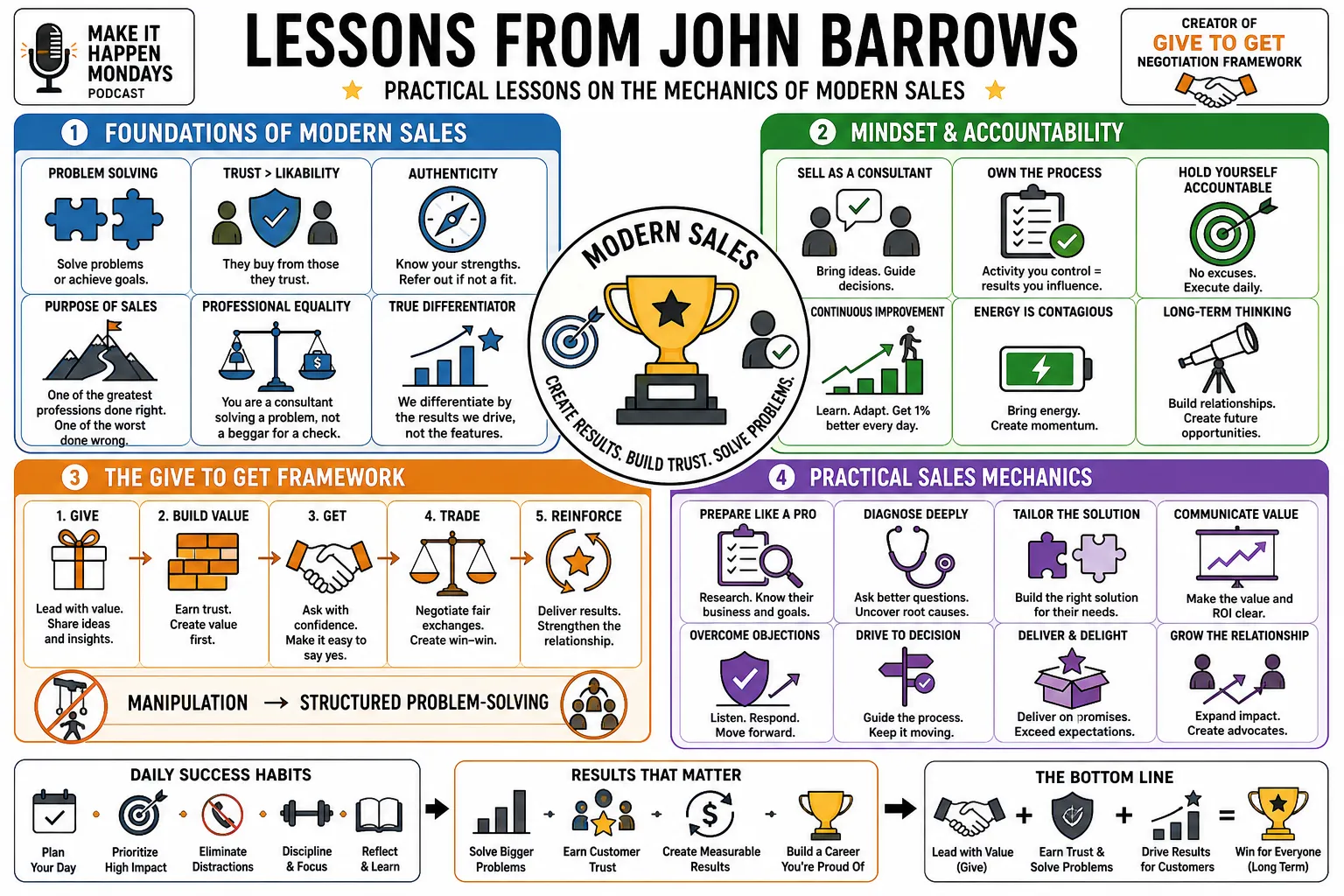
Veteran B2B sales trainer John Barrows hosts the Make It Happen Mondays podcast and created the "Give to Get" negotiation framework. He built his career teaching reps to trade manipulative tactics for structured problem-solving and strict accountability. This profile covers his practical advice on the mechanics of modern sales.
Part 1: The Foundations of Modern Sales
- On Problem Solving: "Sales is about helping people solve problems or achieve goals. If you are not a problem solver, get out of the profession." — Source: [JB Sales]
- On Trust vs. Likability: "People often say they buy from those they like. No, they don’t. They buy from those they trust." — Source: [Make It Happen Mondays]
- On Authenticity: "It’s better to know what you’re great at and focus on that... If you’re not a fit, make the recommendation to a competitor." — Source: [JB Sales]
- On The Purpose of Sales: "Sales is one of the greatest professions in the world when done right, but it’s one of the worst when done wrong." — Source: [JB Sales]
- On Professional Equality: "You are a consultant solving a problem, not a beggar asking for a check." — Source: [SellBetter by JBarrows]
- On The True Differentiator: "Our main differentiator is the result we drive for our customers, not the features of our product." — Source: [John Barrows on YouTube]
- On Meaning Over Money: "A 'job' is something you do for a paycheck; a 'career' is something you build. The money will follow the expertise." — Source: [Make It Happen Mondays]
- On Self-Investment: "Top performers invest in their own development because they view themselves as a 'business of one'." — Source: [JB Sales]
- On Confidence: "Confidence overcomes shortcomings. Believe in your value, but keep your ego in check." — Source: [John Barrows LinkedIn]
- On Feedback: "Always ask for feedback. Constantly seek critiques to identify your blind spots." — Source: [JB Sales]
Part 2: Control What You Can
- On The E.A.T. Framework: "Effort, Attitude, and how you Treat people... These are the only three things you can truly control in sales." — Source: [JB Sales]
- On Effort: "You control how hard you work. This includes making the 'one more call,' staying an extra hour, or doing the extra research." — Source: [Make It Happen Mondays]
- On Attitude: "Adopt a 'split-test mentality'—viewing a bad day not as a failure, but as a data point that shows what doesn't work." — Source: [John Barrows on YouTube]
- On Treating People: "Treating people with respect and adding value to every interaction builds long-term professional capital." — Source: [JB Sales]
- On Continuous Improvement: "The reps who are going to thrive are the ones who commit to getting one percent better every single day." — Source: [Make It Happen Mondays]
- On Avoiding Burnout: "Instead of trying to improve by fifty percent overnight, focus on tiny, daily improvements." — Source: [JB Sales]
- On Daily Reflection: "At the end of every day, ask yourself: 'Am I better today than I was yesterday?'" — Source: [John Barrows LinkedIn]
- On Earning Success: "Earn everything. Don't expect success to be handed to you." — Source: [SellBetter by JBarrows]
- On Compounding Growth: "Over a year, tiny daily improvements compound into massive professional growth and a significant competitive advantage." — Source: [Make It Happen Mondays]
Part 3: Mastering the Cold Call
- On Process Over Scripts: "Cold calling should be treated as a structure, not a script." — Source: [JB Sales]
- On Selling Time: "You aren't selling your product on a cold call; you are selling time and the next step." — Source: [John Barrows on YouTube]
- On The Five-Second Goal: "The goal of the first five seconds is purely to earn the next thirty seconds." — Source: [Make It Happen Mondays]
- On The Disarming Opener: "Use pattern interruption. Ask: 'Can I get thirty seconds to tell you why I’m calling before you hang up on me?'" — Source: [JB Sales]
- On Avoiding Weak Intros: "Never ask 'How are you today?' or 'Is this a good time?'—it gives them an easy out." — Source: [SellBetter by JBarrows]
- On The Magic Transition: "Always use the phrase 'The reason for my call is...' If you can't finish that sentence with value, don't dial." — Source: [Make It Happen Mondays]
- On Action Over Demos: "Don't ask for a demo; ask for a brief conversation to see if this might be worth a deeper look." — Source: [John Barrows on YouTube]
- On The Power Hour: "Don't sprinkle calls throughout the day. Block off one hour for pure dialing to gain momentum." — Source: [JB Sales]
- On Voicemail Strategy: "Don't start a voicemail with your name. Lead with the reason for your call to force them to listen to the value." — Source: [SellBetter by JBarrows]
- On Self-Correction: "Record your calls. Listening to yourself is the fastest way to identify filler words or weak tonality." — Source: [Make It Happen Mondays]
Part 4: Email Prospecting and The Summary Email
- On The Power of Summaries: "Send a brief email summarizing the priorities and timeline discussed to confirm understanding and create accountability." — Source: [JB Sales]
- On Earning The Email: "Never leave a call without a firm next action. Tell the prospect you are sending a summary and ask them to confirm it." — Source: [Make It Happen Mondays]
- On Email Structure: "The summary email should be short and focused on the prospect's pain points and timeline, not your solution." — Source: [John Barrows on YouTube]
- On Accountability: "If a prospect misses a follow-up, reference the confirmed summary to hold them accountable to their own timeline." — Source: [JB Sales]
- On Re-engaging Prospects: "If they go dark, resend the summary email with a short note: 'Did I lose you? Has your priority shifted?'" — Source: [Make It Happen Mondays]
- On Executive Escalation: "If you need to go above their head, forward the confirmed summary to the decision-maker—it shares the agreed-upon business case." — Source: [SellBetter by JBarrows]
- On Cold Outbound Openers: "For initial cold outreach, start with a personalized subject line to grab attention immediately." — Source: [John Barrows LinkedIn]
- On The First Ten Words: "The first ten words of your cold email should be about them, such as a relevant question about their role." — Source: [Make It Happen Mondays]
- On The Low-Friction CTA: "Ask for an interest-based call to action rather than a meeting, such as asking if they are open to learning how you solved a specific problem." — Source: [JB Sales]
Part 5: Negotiation and "Give to Get"
- On The Principle of Reciprocity: "Never give something away without receiving something of equal value in return." — Source: [Make It Happen Mondays]
- On Maintaining Control: "Every concession or 'give' must be immediately followed by a 'get' to ensure the negotiation remains a fair exchange." — Source: [JB Sales]
- On Defining The Get: "A 'get' can be a meeting with the CFO, a signed contract by a specific date, a referral, or a defined next step." — Source: [SellBetter by JBarrows]
- On Proactive Discounting: "If you offer a discount unprompted, you lose all negotiating power and signal that your initial price was inflated." — Source: [John Barrows on YouTube]
- On Using Discounts as Currency: "If they ask for a discount, say: 'I can probably get that, but I’ll need the contract signed by the twenty-fifth in exchange.'" — Source: [Make It Happen Mondays]
- On The Signing Day Tactic: "Once verbal agreement is reached, schedule a ten-minute 'Signing Day' meeting to prevent deals from stalling at the finish line." — Source: [JB Sales]
- On The Assumptive Close: "Say: 'When do you want to schedule a call so I can get a yes or a no from you either way? This way we don't play chase.'" — Source: [John Barrows LinkedIn]
- On Embracing No: "Making 'no' an acceptable answer removes the pressure of a hard sell and shows you value your own time." — Source: [Make It Happen Mondays]
- On Transparency: "Be clear about what you need in exchange for what you provide; establishing boundaries builds respect." — Source: [JB Sales]
Part 6: Active Listening and Discovery
- On The 125-400 Rule: "Most people speak at 125 words per minute but listen at 400. Prospects use that extra gap to wander." — Source: [JB Sales]
- On Using The Listening Gap: "Great sellers use the 300-word listening gap to actively observe the unsaid and formulate thoughtful follow-ups." — Source: [Make It Happen Mondays]
- On Segmenting Leads: "Random calling is guessing. Segment your leads by persona so your message stays consistent." — Source: [John Barrows on YouTube]
- On Handling Objections: "Acknowledge early objections as automatic brush-offs, then ask one follow-up question to keep the dialogue open." — Source: [JB Sales]
- On Asking The Right Questions: "Get them talking by asking about their current state, such as how they are motivating their team during a shift." — Source: [SellBetter by JBarrows]
- On Contextual Discovery: "Marketing provides content, but sales provides context. Use discovery to bridge that gap." — Source: [Make It Happen Mondays]
- On Digging for Pain: "Identify what is stopping them from achieving their priorities; that is where your solution must fit." — Source: [JB Sales]
- On The Impact of Inaction: "Always uncover what happens if the prospect does nothing—this is the true driver of urgency." — Source: [John Barrows LinkedIn]
- On Testing Approaches: "A/B test your intros and discovery questions. Try one for twenty calls and see which earns you more engagement." — Source: [Make It Happen Mondays]
Part 7: Managing the Process and Next Steps
- On The Defined Next Step: "The most important thing to 'get' at every stage of the sales process is a scheduled next step on the calendar." — Source: [JB Sales]
- On Scheduling During The Call: "Average reps wait until the end of the call to ask for next steps. Great reps schedule the next meeting during the conversation." — Source: [John Barrows on YouTube]
- On Avoiding The Chase: "Say, 'Why don't we put ten minutes on the calendar for next Tuesday to review it so we don't have to play chase?'" — Source: [Make It Happen Mondays]
- On Measuring Seriousness: "If they won't commit to a time for a next step, they aren't serious. Scheduling it prevents ghosting." — Source: [JB Sales]
- On Avoiding Bloated Tech: "Leaders should rebuild around fundamentals first, then layer in tools—not the other way around." — Source: [John Barrows LinkedIn]
- On Self-Sourced Pipeline: "The most important skillset you need to be successful is how to prospect for yourself. Don't wait for marketing." — Source: [SellBetter by JBarrows]
- On Dealing with Politics: "You cannot control a customer's internal politics, but you can control your own actions and follow-up rigor." — Source: [JB Sales]
- On Momentum: "Use small 'Gives' and 'Gets' to maintain deal momentum and prevent the sales cycle from stalling." — Source: [Make It Happen Mondays]
- On Working Smart: "It isn't enough to just grind; you must be efficient and use tools to handle repetitive tasks." — Source: [JB Sales]
- On Execution Over Ideas: "Sales is a fundamentals-first approach. The best tactics are useless without disciplined execution." — Source: [John Barrows on YouTube]
Part 8: The Future of Sales and AI
- On AI as an Enabler: "AI is not replacing salespeople. It’s replacing lazy salespeople." — Source: [JB Sales]
- On The True AI Threat: "Salespeople who use AI are replacing salespeople who don’t." — Source: [Make It Happen Mondays]
- On The Curiosity Engine: "Use AI to understand the 'why' behind a business's problems before you ever write a pitch." — Source: [John Barrows LinkedIn]
- On Pre-Call Profiling: "Feed a buyer's LinkedIn posts and podcast transcripts into AI to identify their communication style and priorities." — Source: [Make It Happen Mondays]
- On Bridging Content and Context: "Ask AI to rewrite generic case studies to be specifically relevant to a prospect's key performance indicators." — Source: [JB Sales]
- On AI Objection Labs: "Use AI to act as a skeptical CFO and beat you up in roleplay scenarios to test your context against generic content." — Source: [SellBetter by JBarrows]
- On The Human 'Last Mile': "AI does the heavy lifting, but the human must always be the 'last mile' to add soul and empathy." — Source: [John Barrows on YouTube]
- On Forcing Nuance: "If your AI output sounds like a template, it will be ignored. Use prompts that force the AI to be specific." — Source: [Make It Happen Mondays]
- On Scaling Personalization: "Use AI to A/B test approaches, like focusing on a trigger event versus a business challenge, to see what gets responses." — Source: [JB Sales]