Julie Zhuo is a former Facebook product-design leader, a Sundial founder, and the author of The Making of a Manager. Her writing spans management, product design, data and work with AI agents. — The Looking Glass — About Julie Zhuo.
On the Core Role of a Manager
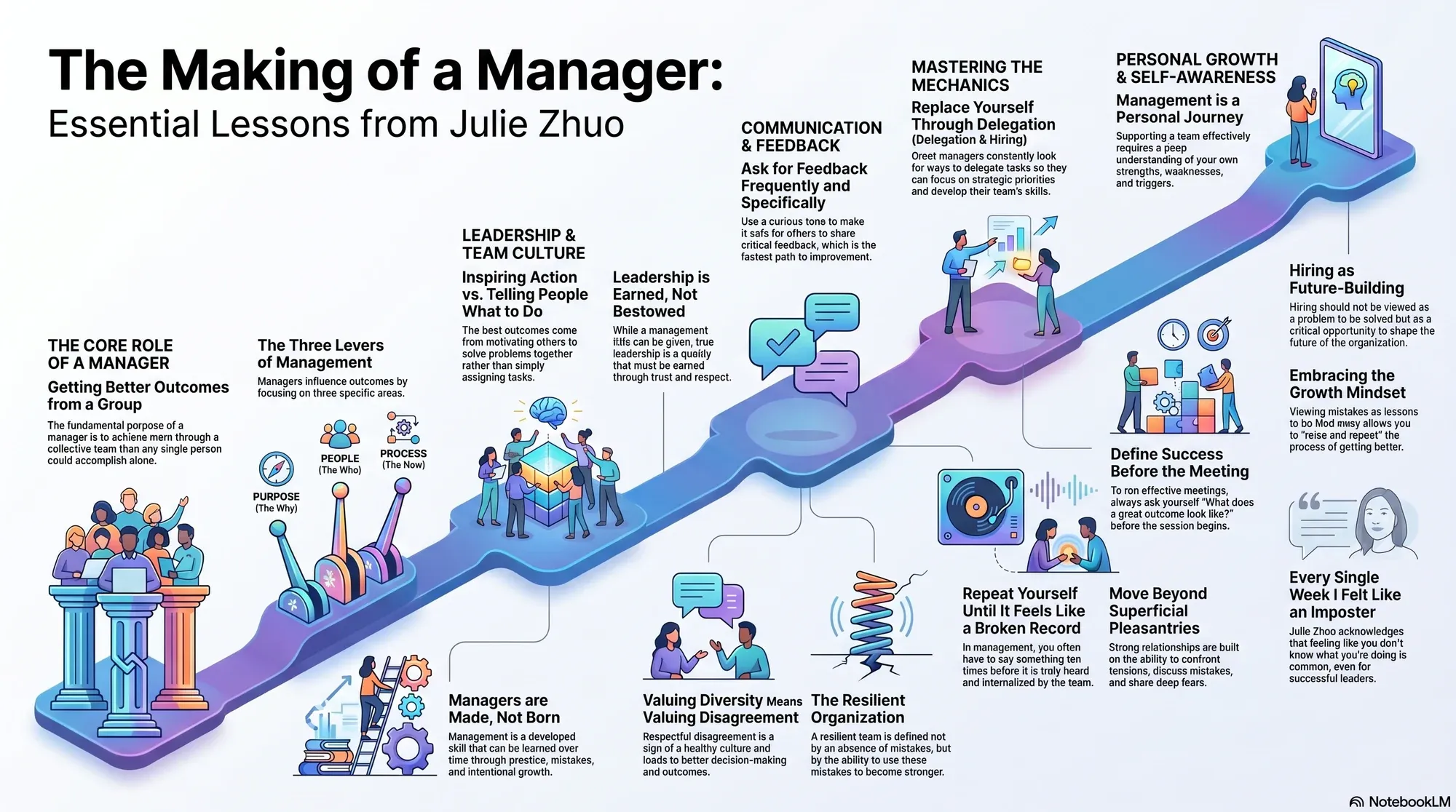
- Manager outcomes: A manager’s central task is helping a group of people achieve better outcomes together. — The Making of a Manager — Publisher Excerpt.
- The team advantage: Management rests on the possibility that people working together can accomplish more than one person alone. — The Making of a Manager — Publisher Excerpt.
- Enable the work: A manager usually creates the conditions for others to do strong work, though Zhuo also allows that sometimes doing the task yourself is what the team needs. — So You Think You Want to Manage.
- Purpose, people and process: Zhuo describes three levers for team outcomes: align purpose, put the right people in roles, and clarify how the work gets done. — A User Guide to Working With Julie Zhuo.
- Managers can be made: Zhuo argues that management is learned through practice rather than an innate gift. — The Making of a Manager — Publisher Excerpt.
- Managing AI agents: Zhuo predicts that delegating to AI agents will call for management skills such as defining outcomes, selecting the right agent and reviewing its work. — You’re Definitely Going to Be a Manager Now.
On Leadership and Influence
- Inspire independent answers: In one-on-ones, Zhuo advises managers to ask questions that help reports work toward their own conclusions instead of simply supplying answers. — The Essential Questions That Have Powered This Manager’s Career.
- Lead without every answer: A manager need not have every answer; they can help the team identify problems and produce better work together. — Unintuitive Things I’ve Learned About Management.
- Leadership must be earned: Zhuo distinguishes a formal manager title from leadership, which shows up when others choose to follow someone. — Indeed — How to Be a Good Manager.
- Care in hard conversations: Difficult feedback is more useful when the manager genuinely cares about the other person and approaches the conversation with openness. — HBR — How to Become a Better Manager.
- Listen without automatic agreement: Zhuo says that attentive listening does not mean she agrees with every proposal; respectful disagreement can still move the work forward. — A User Guide to Working With Julie Zhuo.
On Team and Culture
- Culture has underlying beliefs: Zhuo treats team culture as the beliefs behind repeated behaviors, not merely the visible rituals or perks. — Culture Changers.
- Make room for disagreement: Zhuo argues that teams should make it safe to express contrarian views, because diversity of opinion can improve product decisions. — Building Products.
- Learn from failures: Zhuo says ambitious teams will sometimes fail; the useful response is to extract lessons and improve the process for future attempts. — A User Guide to Working With Julie Zhuo.
- Earn respect through conduct: Zhuo links a manager’s influence to self-awareness, feedback, care and a clear vision rather than assuming authority from the title. — Unintuitive Things I’ve Learned About Management, Part 2.
- Change the belief behind behavior: To change a team’s culture, Zhuo recommends investigating why a behavior persists before trying to change the visible habit. — Culture Changers.
On Feedback and Communication
- Ask for specific feedback: Zhuo recommends asking specific, curious questions so a colleague can speak candidly about what is and is not working. — The Essential Questions That Have Powered This Manager’s Career.
- Make feedback specific: Managers should give both positive and constructive feedback, with enough detail for a report to know what to repeat or change. — The Essential Questions That Have Powered This Manager’s Career.
- Surface problems early: A manager can ask questions and create enough safety for reports to raise obstacles and concerns before they become harder to address. — The Essential Questions That Have Powered This Manager’s Career.
- Trust supports candid feedback: Zhuo describes trust and care as the foundation for conversations about mistakes, criticism and personal difficulties. — HBR — How to Become a Better Manager.
- Repeat the message: Zhuo advises leaders to repeat important messages more often than feels necessary, because people may not absorb them the first several times. — Unintuitive Things I’ve Learned About Management, Part 2.
On Personal Growth and Self-Awareness
- Know yourself to support others: Zhuo says self-awareness helps her recognize how her habits and limitations affect the way she supports a team. — A User Guide to Working With Julie Zhuo.
- Seek the truth through feedback: Zhuo values admitting growth areas and seeking feedback as inputs to continuous learning. — A User Guide to Working With Julie Zhuo.
- Learn management by doing: Zhuo says confidence as a manager grows through varied situations, reflection and practice, not reading alone. — Unintuitive Things I’ve Learned About Management.
- Impostor feelings can coexist with growth: Zhuo describes her own early-career impostor feelings as a designer while learning to improve her craft. — 8 Unintuitive Lessons on Being a Designer.
On Delegation and Empowerment
- Delegate instead of doing everything: Zhuo says the manager’s usual contribution is nurturing and coaching people so they can do strong work, not taking every task back. — Indeed — How to Be a Good Manager.
- Make room for higher priorities: Zhuo’s calendar review led her to delegate operational calls so she could spend more time on recruiting and product work. — What Do I Do at Work All Day.
- Delegate operational decisions: Delegating some operational decisions can free a manager’s limited attention for responsibilities only they can perform. — What Do I Do at Work All Day.
On Meetings and Processes
- Define the desired outcome: Zhuo suggests asking a report what an ideal outcome would look like before discussing obstacles and next steps. — The Essential Questions That Have Powered This Manager’s Career.
- Strategy fits team strengths: A strategy should account for the problems a team is uniquely suited to solve, including its strengths and weaknesses. — How to Be Strategic.
- Use process to draw on the team: Zhuo argues that a rigorous design process combines critique and exploration so the team’s collective strengths improve the work. — Build a Trustworthy Design Process.
- Make meetings earn their time: After reviewing her calendar, Zhuo looked for ways to make meetings more efficient and leave room for higher-priority work. — What Do I Do at Work All Day.
- Codify repeatable workflows: In AI-assisted work, Zhuo recommends turning successful repeatable workflows into shared systems while leaving rare, judgment-heavy work for later. — You Cannot Mandate an AI Transformation.
On Hiring and Building a Team
- Hiring shapes future outcomes: Zhuo treats hiring as one of the manager’s major ways to improve what a team can accomplish over time. — Unintuitive Things I’ve Learned About Management.
- Hire complementary strengths: Zhuo recommends bringing in people who are strong where the manager or current team is weak. — Unintuitive Things I’ve Learned About Management.
- Test value alignment: When hiring, Zhuo looks for genuine resonance between a candidate’s values and the company’s values. — Unintuitive Things I’ve Learned About Management, Part 2.
- Match people to roles: Zhuo names matching the right person with the right role as a core management lever tied to team outcomes. — A User Guide to Working With Julie Zhuo.
On Design and Product
- Design for the user’s problem: Zhuo judges design by whether it helps the intended users solve the problem it was meant to address. — 8 Unintuitive Lessons on Being a Designer.
- Choose defaults deliberately: Visible defaults shape what people actually use; adding a buried option does not remove the need to make a product decision. — What You See Is What You Use.
- Train design judgment: Zhuo urges designers to develop discernment through critique and close examination of what works and what does not. — 8 Unintuitive Lessons on Being a Designer.
- Design leadership goes beyond craft: Zhuo says senior designers influence which people-centered problems a team chooses to solve, not only the polish of a proposed solution. — 8 Unintuitive Lessons on Being a Designer.
- Use data to diagnose, design to explore: Zhuo adopts Chandra Narayanan’s formulation of using data to diagnose a problem and design to explore treatments; the phrase is his, as she credits him. — Stay Healthy, Stay Data-Informed.
- AI and taste as a thought experiment: Zhuo explores whether AI systems could approximate aspects of taste through pattern recognition; she presents this as a question about future capabilities. — When AI Has Better Taste Than You.
On Motivation and Purpose
- Align on success: Zhuo says managers need to make the team’s desired outcome clear and help people care about pursuing it. — A User Guide to Working With Julie Zhuo.
- Diagnose barriers to good work: When work falls short, Zhuo advises examining expectations and skills; motivation is another useful question rather than an exhaustive two-cause law. — The Essential Questions That Have Powered This Manager’s Career.
- Connect tasks to the why: Zhuo urges leaders to explain how projects and tasks connect to the larger purpose until teammates can articulate that purpose themselves. — Unintuitive Things I’ve Learned About Management, Part 2.
- Make the vision clear: Zhuo argues that a clear shared vision lets teams improvise the details of how to move toward it. — Unintuitive Things I’ve Learned About Management, Part 2.
- Progress through aligned decisions: Zhuo says big results emerge from many individual decisions pointing in the same direction. — Unintuitive Things I’ve Learned About Management, Part 2.
- Human agency still matters: Zhuo argues that choosing goals and acting on values remains a human responsibility even as AI improves at capabilities and taste. — When AI Has Better Taste Than You.
Learn more:
- The Making of a Manager — Publisher Excerpt
- A User Guide to Working With Julie Zhuo
- Unintuitive Things I’ve Learned About Management
- Unintuitive Things I’ve Learned About Management, Part 2
- So You Think You Want to Manage
- The Essential Questions That Have Powered This Manager’s Career
- HBR — How to Become a Better Manager
- Culture Changers
- Holding Up the Mirror
- 8 Unintuitive Lessons on Being a Designer
- What You See Is What You Use
- Stay Healthy, Stay Data-Informed
- When AI Has Better Taste Than You
- Indeed — How to Be a Good Manager
- What Do I Do at Work All Day
- How to Be Strategic