Justin Gage is the VP of Marketing at Amplify Partners and the founder of the Technically newsletter. His core philosophy revolves around authentic and helpful engagement with developers, whom he sees as a practical and solution-oriented audience.
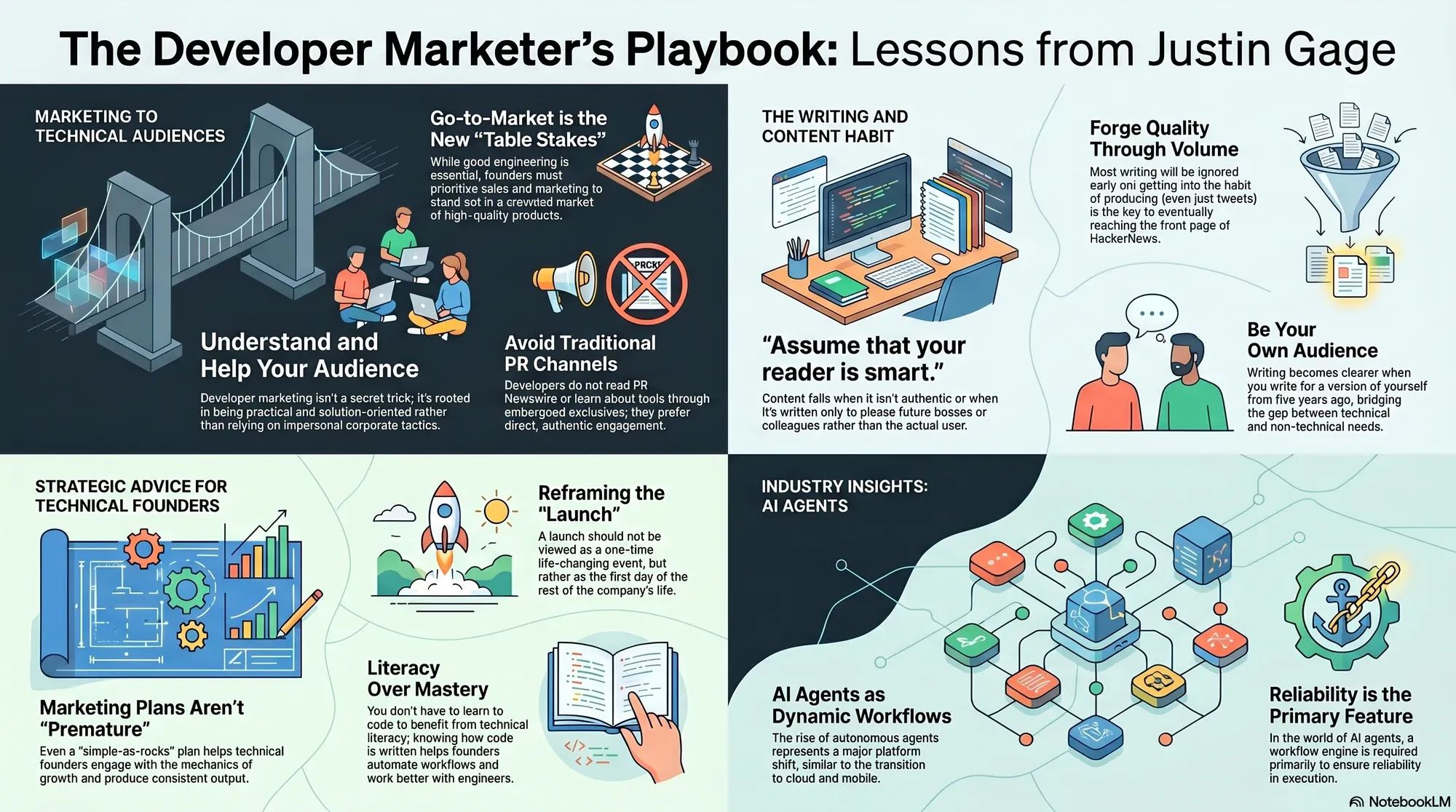
On Marketing to Technical Audiences
Justin Gage's core philosophy revolves around authentic and helpful engagement with developers, whom he sees as a practical and solution-oriented audience.
- "The secret (hint: not a secret) to marketing to developers is the same as marketing to anyone: understand your audience, help your audience." [1]
- "Developers are practical, solution-oriented, and like specifics." [1]
- "Any success I've had doing developer marketing is rooted in being a developer, albeit a bad one." [1]
- "My job at Amplify is to help founders get their product in front of developers and data teams, ideally to critical acclaim." [1]
- "Startups need to meet their users where they are and speak to them directly and authentically." [2]
- "Trade shows, SEO, billboards, and impersonal corporate marketing just aren't enough anymore." [2]
- "Good product and engineering, to some degree, are table stakes. Everything else – specifically go-to-market – has never been more important." [3]
- "Founders who can put their creative energy towards sales and marketing, instead of treating them like a necessary evil, are going to have the best chance of standing out from the pack." [3]
- "Developers do not read PR Newswire, nor do they learn about new tools through embargoed exclusives." [4]
- "Brilliant, product-minded developers start new companies every day that offer something of real value. Awareness in their target markets does not grow though, because about 5-6 other brilliant, product-minded developers also started new companies around that time... that offered something of real value too." [3]
On Writing and Content Creation
- "Most of the things I've written have been completely ignored by everyone, which I think might be what forges good writers." [1]
- "For everything I've gotten to the front page of HackerNews, there's a tweet with 4 likes sitting in the trash can. They say rejection gets easier, which I am still looking forward to!" [1]
- "I have a really good sense of what non-technical people need because I'm basically writing this newsletter for myself five years ago. Being your own audience makes things clearer!" [5]
- "Sadly, a lot of people are out there writing newsletters about things that they think their colleagues, future bosses, or potential customers want to hear—but if it's not authentic, it won't last." [5]
- "The biggest marketing problem for most early stage technical founders isn't bad marketing, it's not enough marketing." [6]
- "Most technical founders simply do not produce consistently enough to have a meaningful impact (often the case for positioning, messaging, and marketing overall)." [6]
- "Just start with what is one thing that you could write about. It could even be a series of tweets... just getting into the habit of writing is pretty much one of the secrets." [7]
- "Assume that your reader is smart." [7]
- "Writing really changed my life... early in my career... I had trouble communicating the stuff that I was thinking." [7]
- "You need to stay fresh, no matter what; for me that has meant building marketing site pages, making small commits to the frontend, and picking up side projects outside of work, basically whatever I can do without breaking things." [1]
- On Rejecting AI Slop: "We are absolutely drowning in slop. Across every discipline businesses are cutting (human) writing talent in favor of cookie cutter, brain numbing, information-hollow generated words that insult the intelligence of their barely engaged readers." — Amplify Partners Blog
- On Refusing Shallow Content: You must reject the modern media trend of producing shallow, information-hollow content designed merely to capture attention. — Amplify Partners Blog
- On Technical thought leadership: "Developers, engineers, researchers, and scientists are some of the best remaining bastions of deep thought. The nature of their work is this deliberateness: the focus on details, the irrepressible obsession with the problem, the meticulous attention to standards and the willingness to equivocate." — Amplify Partners Blog
- On Content quality and deep thinking: Technical professionals—developers, researchers, and engineers—are uniquely positioned to push back against the tide of low-quality, AI-generated content through deep, deliberate writing. — Amplify Partners Blog: Announcing the Amplify writing fellowship
- On The state of writing: "Writing – and perhaps even deep thinking itself – is at a crossroads." — Amplify Partners Blog: Announcing the Amplify writing fellowship
Advice for Technical Founders
- "If you're a technical founder... the idea of a marketing plan might seem comically premature. But I'm here to argue (as someone generally allergic to plans) that a simple-as-rocks, basic marketing plan will help you produce more consistent, better output and grow your business faster." [6]
- "Growth has mechanics, and marketing plans explicitly engage with those mechanics." [6]
- "The first step to poorly launching your developer tool is to make sure you don't spend the requisite time thinking about what the point of the launch is in the first place." [4]
- "Founders who make the most of launches tend to reframe their launch as less of a one-time, critical, life-changing event, and more of something akin to…the first day of the rest of your company's life." [4]
- "It's very, very hard to pull yourself out of that mindset and ask yourself the big questions that your eventual buyers will be thinking about." [4]
- "Becoming more technically literate will help you work better with engineers, identify chances to automate or improve your workflows, and become a whiz in the tools you use to get your job done." [5]
- "You don't have to learn how to code to benefit from knowing what code is and how it gets written." [5]
- On The build-deploy cycle: The overhead of traditional software development pipelines only makes sense when writing the software itself is time-consuming and expensive. — Amplify Partners Blog
- On Agent security: As AI agents gain more control over systems, securing credentials and minimizing potential damage from compromised tokens is critical. — Amplify Partners Blog
- On Production reality: "There is, as many readers know first hand, a long long space between ideas working in papers and ideas working in production." — Amplify Partners Blog
On Venture Capital and the Tech Industry
- "People (myself included) rip VCs for hypocrisy, ignorance and shallow understanding, and parody is a common form of this as well. I don't think a single other profession deals with this depth of critique from such a wide group. Why? What do we have against them?" [Source: A 2019 Twitter thread referenced in a Substack post by Yoni Rechtman, though the original tweets may be deleted.] [8]
- "It seems like everyone (including your author) is coalescing around AI agents as the next major platform shift." [Amplify Partners Blog]
- "Like every platform shift before it – think cloud and mobile in particular – the rise of autonomous agents will require a complete transformation in how we think about infrastructure and the developer toolchain." [Amplify Partners Blog]
- "I'm going to argue that agents in essence are just dynamic workflows." [Amplify Partners Blog]
- "Reliability is not just a feature, it is the entire reason agents need a workflow engine." [Amplify Partners Blog]
- On Computing primitives: "A computer used to be defined by four things: CPU, memory, storage, network. LLM tokens are now a fifth primitive." — Amplify Partners Blog
- On AI inference speed: Rapid inference speeds can fundamentally alter the scaling laws for reinforcement learning by increasing the cycles spent on generation, effectively equating speed with quality. — Amplify Partners Blog
- On Video model architectures: General world models like GWM-1 represent a major architectural shift toward autoregressive, causal models that can generate video in near real-time, unlike older bidirectional diffusion models. — Amplify Partners Blog: The infrastructure behind Runway Characters
- On Model training constraints: "But you can’t train autoregressive models like this. They need to be causal, meaning that during training the model only has access to prior context." — Amplify Partners Blog: The infrastructure behind Runway Characters
Learn more:
- How Justin Gage Grew Technically to 50k Subscribers Without a Large Audience
- Welcome Justin Gage - Amplify Partners
- by Ed Sim - What's in Enterprise IT/VC #171
- What is the range of capital you can expect from an Angel vs VC? - Quora
- How to Excel in Tech Without Learning to Code | Future
- Marketing planning 101 for technical founders | Amplify Partners
- Marketing: An unruly discipline?
- Dunking on VCs (99 Damages)