Justin Gold started making nut butters in his home food processor simply because the grocery store selection was too limited. He built that experiment into Justin's, a major brand known for introducing single-serve squeeze packs that completely altered the nut butter category. These lessons detail how he handled early manufacturing roadblocks, navigated retail merchandising, and grew a thriving natural foods business from the ground up.
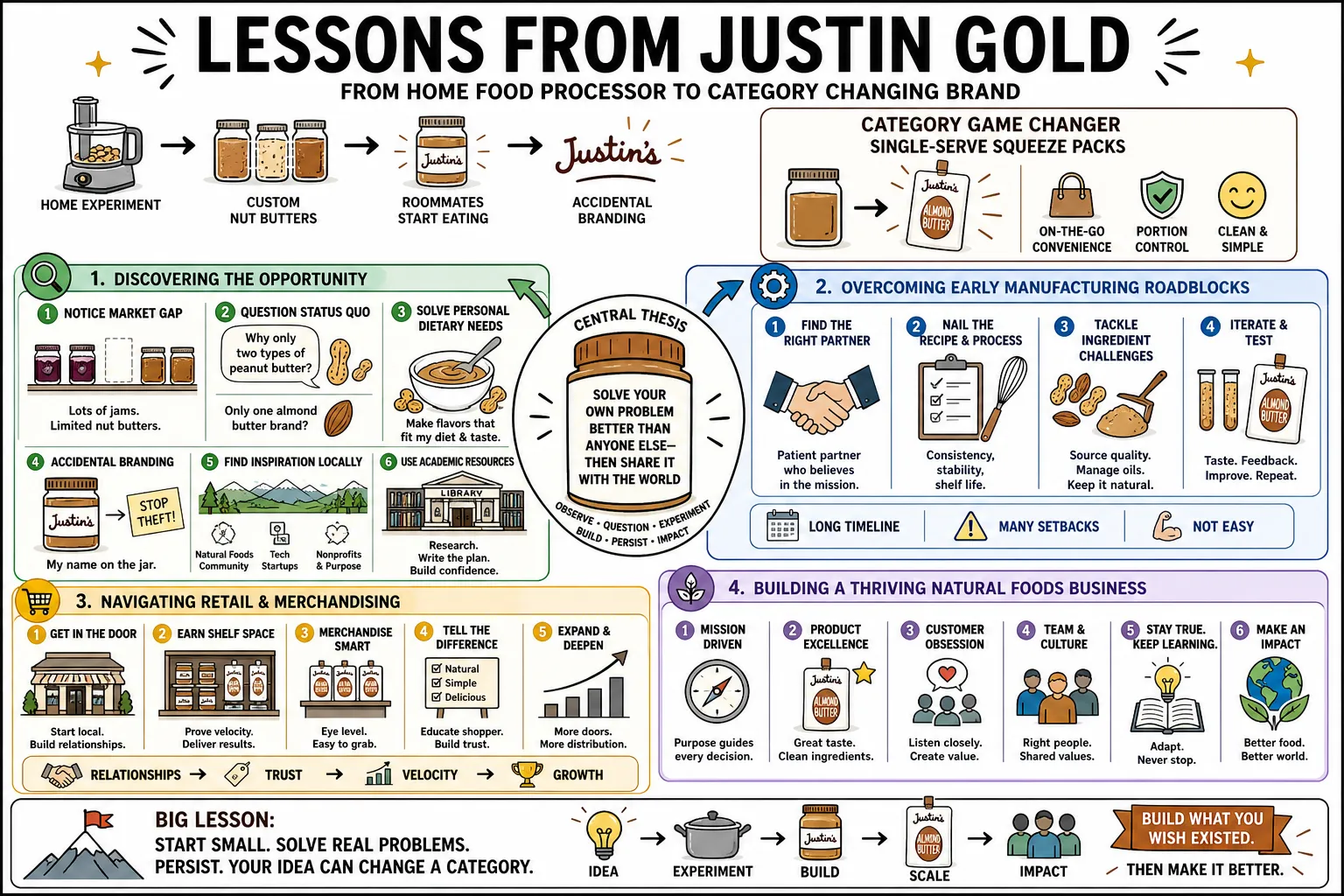
Part 1: Discovering the Opportunity
- On noticing market gaps: As a vegetarian relying on nuts for protein, he noticed a lack of variety in nut butters—which only came in smooth or crunchy—compared to the expansive selection of fruit jams and preserves. — Reference: podcasttranscript.ai
- On questioning the status quo: He wondered why there were only two types of peanut butter on the market and only one brand of almond butter, which he felt didn't even taste good. — Reference: thekitchn.com
- On accidental branding: After making custom nut butters in his food processor, his roommates began eating them. He wrote his name on the jars to stop the theft, which inadvertently sparked the brand name. — Reference: foodnavigator.com
- On finding inspiration locally: He credits his move to Boulder, Colorado, for exposing him to a community of natural food companies, tech startups, and nonprofits that collectively gave him the confidence to start something of his own. — Reference: thekitchn.com
- On utilizing academic resources: Despite not having a formal business background, his college degree gave him the confidence to walk into a university library to research and write his first business plan. — Reference: thepitchqueen.com
- On solving personal dietary needs: His initial motivation for creating flavored nut butters was simply to make something that suited his own diet, not a grand plan to build a massive commercial enterprise. — Reference: entrepreneur.com
Part 2: Scrappy Beginnings and Bootstrapping
- On juggling responsibilities: For the first few years of the business, he continued waiting tables to support himself while simultaneously running a commercial kitchen and selling at the local farmers market. — Reference: thekitchn.com
- On asking naive questions: He tapped into Boulder’s network of natural food mentors and asked basic questions about distribution and regulations to overcome his lack of industry experience. — Reference: podcasttranscript.ai
- On trusting initial feedback: The direct consumer feedback he received while selling jars at local farmers markets helped him refine and alter his early product line based on what people actually enjoyed. — Reference: podcasts.apple.com
- On having patience: It took a total of 15 years to scale the business to significant retail success, including six years of selling products at local farmers markets. — Reference: foodbizsuccess.com
- On formulating for stability: During his early kitchen experiments, he had to use low-moisture ingredients to overcome texture issues when adding flavors like honey and banana to the nut butter. — Reference: podcasttranscript.ai
- On taking a hands-on approach: In the early days, he worked overnight in a shared industrial kitchen to hand-fill his nut butter jars one by one to keep costs low. — Reference: podcasts.apple.com
Part 3: Product Innovation and Production
- On seizing new formats: The idea for portable squeeze packs came during a mountain bike ride when he realized athletes needed a protein-rich alternative to sugary energy gels. — Reference: foodnavigator.com
- On overcoming manufacturing roadblocks: When contract manufacturers refused to pack his nut butters into pouches due to allergen concerns, he decided to produce them himself instead of abandoning the idea. — Reference: foodnavigator.com
- On creative equipment sourcing: To produce his single-serve pouches, he purchased a 30-year-old machine originally designed to fill hair conditioner sachets. — Reference: thekitchn.com
- On reaching unexpected places: His dedication to portable, shelf-stable protein resulted in Justin's squeeze packets making their way onto a NASA shuttle for astronauts. — Reference: entrepreneur.com
- On anticipating future consumer needs: He believes future product development should focus strictly on identifying other problems consumers have around plant-based protein and creating specific products to solve them. — Reference: foodnavigator.com
Part 4: Merchandising and Retail Strategy
- On early placement mistakes: He initially merchandised his protein squeeze packs in the energy bar aisle for athletes, which resulted in poor sales and a request from the grocer to remove them. — Reference: hormelfoods.org
- On pivoting in-store locations: Instead of giving up on the squeeze packs, he moved them into small caddies directly next to the jars of nut butter so customers understood exactly what the product was. — Reference: hormelfoods.org
- On the hidden value of trial sizes: He discovered that a low-cost squeeze pack acted as the perfect trial size, allowing customers to taste the product before committing to a full jar, which ultimately drove up jar sales. — Reference: hormelfoods.org
- On unintended market segments: While he designed the squeeze packs for athletic energy, the top uses ended up being product trials and everyday portion control. — Reference: hormelfoods.org
- On unit economics: Selling single-serve squeeze packs allowed him to charge a higher price by weight while still presenting an affordable value to the customer. — Reference: foodnavigator.com
- On doing the unscalable: Before he could secure a proper distributor, he personally restocked the shelves at the Boulder Whole Foods to ensure his products were always available. — Reference: podcasts.apple.com
- On redesigning for scale: He transitioned his packaging from a down-to-earth aesthetic to a simple nut-focused design so the brand could sell just as effectively in mass-market retailers as it did in specialty stores. — Reference: thekitchn.com
- On identifying the root of failure: He notes that failing retail products are often victims of poor execution—such as incorrect store placement or bad pricing—rather than fundamentally bad ideas. — Reference: foodnavigator.com
Part 5: Expanding and Focusing the Portfolio
- On capitalizing on shifting trends: He attributes part of his growth to being in the right place at the right time when consumers stopped fearing healthy fats and began experiencing peanut butter fatigue. — Reference: thekitchn.com
- On organic category expansion: He branched out into making organic peanut butter cups simply because he couldn't find a healthier alternative to traditional candy at his local natural grocery store. — Reference: thekitchn.com
- On pulling successful products: He discontinued a great-tasting cinnamon peanut butter because consumers only bought it occasionally, realizing retailers prioritize shelf space for items people eat every day. — Reference: foodnavigator.com
- On avoiding shiny objects: He explored the idea of creating a peanut butter for dogs but ultimately abandoned it, recognizing that a growing company needs to remain focused rather than throwing everything at the wall. — Reference: foodnavigator.com
- On shifting operational priorities: "When you start out, you say yes to every opportunity; as you get bigger, you have to start saying no." — Source: foodnavigator.com
- On market timing: He acknowledges that while creating products consumers don't know they need yet can be a great idea, you sometimes have to wait for the universe to be ready for it. — Reference: hormelfoods.org
Part 6: Raising Capital and Building Relationships
- On shocking the family: His family initially expected him to ask for money to apply to grad school, but he shocked them by presenting a shoebox and asking for $35,000 to launch a peanut butter business. — Reference: podcasttranscript.ai
- On securing initial capital: Because traditional channels were unavailable to him early on, he had to borrow $75,000 from his roommate's parents to purchase his packaging machinery. — Reference: thekitchn.com
- On finding the right investors: When raising capital, he learned to prioritize investors who aligned with the company's vision and could offer strategic guidance rather than just seeking out the wealthiest individuals. — Reference: greatpodcastnetwork.com
- On establishing industry credibility: He discovered that building an advisory board of experienced leaders was an effective way to quickly establish instant credibility for his young brand. — Reference: greatpodcastnetwork.com
- On handling retail rejection: He utilized a mental framework where a buyer's rejection simply means "not now," allowing him to turn a dismissal into a future yes. — Reference: greatpodcastnetwork.com
- On avoiding rapid geographical expansion: He noted that trying to scale too fast by launching in every energy bar section in the country early on would have caused him to run out of money and fail. — Reference: hormelfoods.org
Part 7: Maintaining Values and Company Culture
- On committing to sustainability: He insisted on environmentally friendly practices early on, powering the brand's offices with solar energy and using wind power to manufacture the cartons and boxes. — Reference: dickinson.edu
- On challenging industry standards: He believed that insisting on an organic and sustainable approach was the only way to challenge a stagnant industry and force long-term change. — Reference: dickinson.edu
- On building team culture: To foster a tight-knit culture at the company, he took his team on a vacation every year to spend a week volunteering together at a Native American reservation in South Dakota. — Reference: entrepreneur.com
- On maintaining founder passion: "But if you love what you do and you’re having fun, it doesn’t feel like a job." — Source: foodnavigator.com
- On combining wealth and mission: He believes that generating a lucrative exit and maintaining a deep mission to change the world are not mutually exclusive pursuits. — Reference: hormelfoods.com
Part 8: Acquisitions, Scale, and Legacy
- On partnering for structural resources: He initially sold the company to a larger corporation because the growing brand needed additional support for everything from raw material sourcing to human resources. — Reference: foodnavigator.com
- On the power of founder connection: He stayed closely tied to the company after its acquisition because the brand's values, personality, and charisma hinge directly on his presence to drive connection with consumers. — Reference: hormelfoods.com
- On the reality of corporate portfolios: He observed that inside a massive public company with billion-dollar brands, a smaller asset can easily lose the dedicated attention it needs to thrive. — Reference: foodnavigator.com
- On returning to basics: After rejoining the brand as a strategic advisor following a carve-out, he emphasized the need to first win back the core grocery channel before looking toward expansion. — Reference: foodnavigator.com
- On seeking white space opportunities: Once the brand's grocery footprint is stabilized, he plans to patiently but deliberately pursue untraditional white space opportunities like corporate cafeterias and universities. — Reference: foodnavigator.com
- On knowing your lane: Recognizing where his strengths lay as a founder, he stepped down as CEO of his own company while remaining highly active in culture, innovation, and marketing. — Reference: greatpodcastnetwork.com