Kaz Nejatian leads Opendoor after serving as Shopify’s Chief Operating Officer and Vice President of Product. His lessons address product craft, how teams work, and serving independent businesses. — Opendoor: Kaz Nejatian.
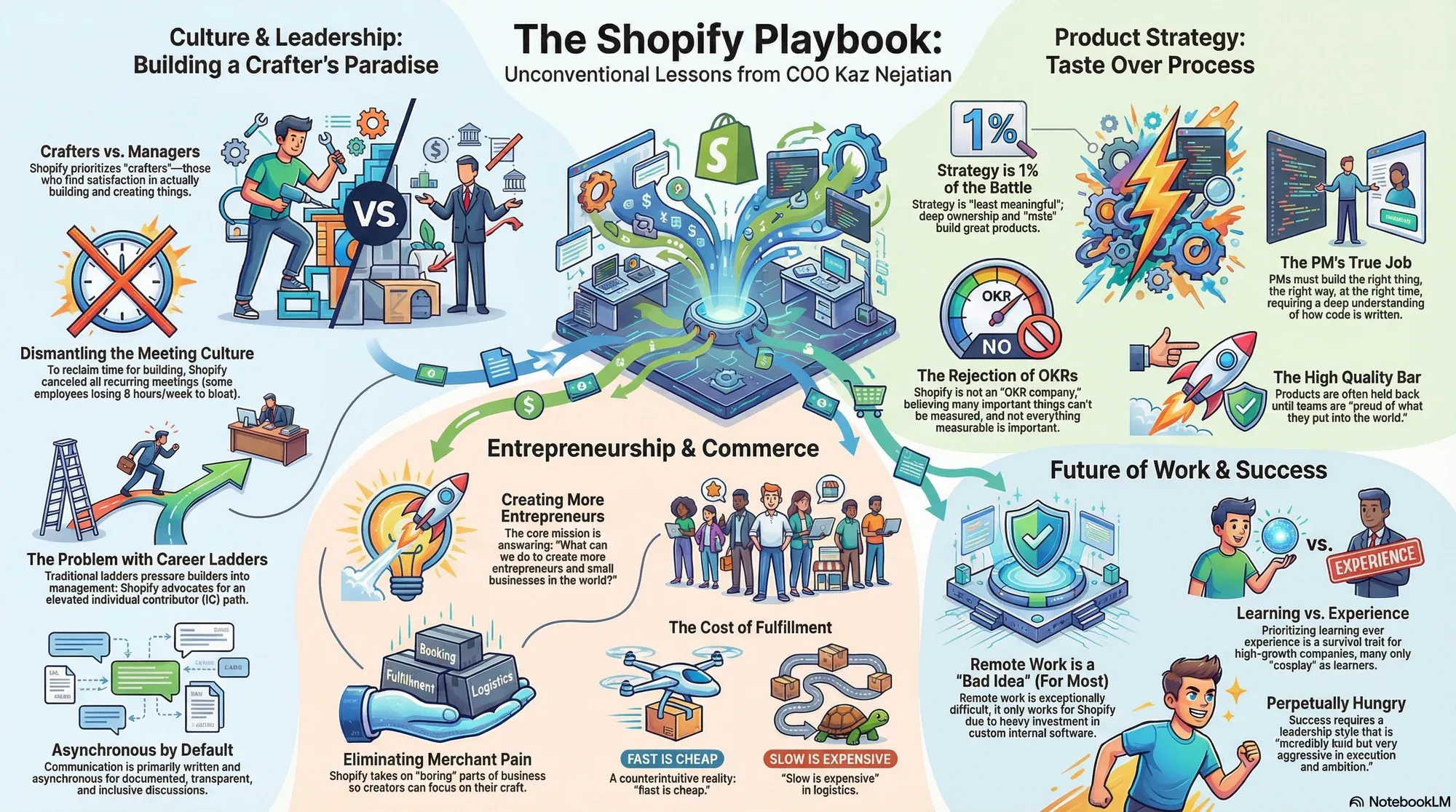
Leadership, Culture and Talent
- On Crafters and Managers: Distinguish building from managing by how people spend their working time, not merely their titles. — Peter Yang: Crafters and Career Paths.
- On Creating a Crafter’s Paradise: Remove obstacles and reward craft so builders can do excellent work without being pushed into management. — Peter Yang: Crafters and Career Paths.
- On Career Ladders: Let individual contributors advance in responsibility and pay without requiring more direct reports. — Peter Yang: Crafters and Career Paths.
- On Resisting Big-Company Behavior: Resist bureaucracy by reviewing working products rather than rewarding polished internal presentations. — Peter Yang: Crafters and Career Paths.
- On Valuing Being Wrong: Being corrected is useful when the aim is discovering the truth, rather than protecting appearances. — OpenStore Live Interview.
- On Founder-Led Leadership: Nejatian described Shopify’s leadership as founder-like, with entrepreneurial instincts rather than a conventional professional-management identity. — OpenStore Live Interview.
- On Meetings: Reset meeting defaults to protect building time. Nejatian reported deleting large numbers of calendar events involving three or more people—not banning every conversation. — Nejatian: Reducing Meetings.
- On Meeting Bloat: In Rossi’s interview, Nejatian estimated that overlapping team all-hands consumed roughly six hours per employee each week. — Refactoring: A Company Around Crafters.
- On Asynchronous Communication: Prefer written words and code for routine communication; meetings consume listeners’ time too. — 20VC: Building for the Long Term.
- On the Role of Managers: Managers should protect builders from unnecessary managerial work, not fill their calendars with it. — Behind the Craft Interview.
- On Preserving Craft Time: Even as COO, he reserved Wednesday time for building and product work, while still attending some meetings. — Behind the Craft Interview.
- On Founder-Mode Accountability: He defines founder-mode leadership as responsibility for outcomes, not merely compliance with process. — Sequoia: Founder-Mode Leadership.
- On Complementary Leadership Teams: He hires complementary operators to address weaknesses rather than trying to become uniformly well-rounded. — Sequoia: Founder-Mode Leadership.
- On Organizational Drift: He warns that accumulated comforting lies can let an organization drift away from reality. — The Knowledge Project: Truth Over Feelings.
- On Refounding a Company: He argues that a company in a death spiral needs fundamental change, not merely incremental management. — Sequoia: Founder-Mode Leadership.
- On Underwriting Talent: Start teammates with meaningful trust and room to take risks, then revise that trust quickly. — Sequoia: Founder-Mode Leadership.
Product Development, Strategy and AI
- On the Limits of Strategy: A strategy presentation cannot establish product quality. Inspect what people can actually use. — Peter Yang: Crafters and Career Paths.
- On How Great Products Are Built: Develop products through prototypes, repeated adjustments and customer contact rather than treating a strategy document as the product. — Behind the Craft Interview.
- On OKRs: He described Shopify as not an OKR company. Measurement matters, but debating metrics should not replace building good products or judging work that resists measurement. — Behind the Craft Interview.
- On the Product Manager’s Job: A PM owns the right product, implementation and timing—not only the feature choice. — 20VC: Building for the Long Term.
- On Product-Management Talent: He seeks PMs with empathy, ownership and taste, which he believes are difficult to teach from scratch. — Behind the Craft Interview.
- On the Lean Startup Method: His Lean Startup criticism targets shipping knowingly incomplete, unusable software merely to provoke feedback. — 20VC: Building for the Long Term.
- On Shipping Products with Pride: Ship a complete, usable first version you can stand behind; its scope can still be limited. — 20VC: Building for the Long Term.
- On How Versus What: Implementation choices, including where functionality belongs in the stack, deserve serious product attention. — 20VC: Building for the Long Term.
- On Technical Understanding: PMs need to understand how code is written, even when they do not write it themselves. — 20VC: Building for the Long Term.
- On Shopify’s Three Priorities: Prioritize good products, then revenue, then reinvestment; do not let money-making reverse that order. — 20VC: Building for the Long Term.
- On Building Internal Tools: Build internal tools when the company’s operating needs justify them; Nejatian explicitly cautioned smaller businesses against copying Shopify’s investment. — OpenStore Live Interview.
- On the Cost of Internal Tools: Remote infrastructure carries an opportunity cost: engineers building internal tools could otherwise serve merchants. — OpenStore Live Interview.
- On Data-Driven Decisions: Models can conceal uncertainty. Make assumptions and confidence visible rather than mistaking spreadsheet precision for reality. — OpenStore Live Interview.
- On Product Quality: He links Shopify’s willingness to delay releases for quality to its long investment horizon. — 20VC: Building for the Long Term.
- On Overriding Defaults: Choose a few consequential defaults to override, then commit fully rather than changing everything casually. — Sequoia: Founder-Mode Leadership.
- On Enduring Business Models: His business thesis looks for valuable adjacent economic engines, not only the obvious core activity. — Sequoia: Founder-Mode Leadership.
- On Becoming AI-Native: At Opendoor, he made defaulting to AI a stated performance expectation, supported by training and practice. — Sequoia: Founder-Mode Leadership.
Entrepreneurship, Commerce and Customer Value
- On Shopify’s Mission: Reduce barriers so more independent businesses can start and grow; that mission helped draw him to Shopify. — Joining Shopify.
- On a Personal Connection to Entrepreneurship: Shopify’s biography describes his mother’s small business and early experimentation with payment terminals as part of his entrepreneurial background. — Shopify: Leadership Changes.
- On Removing Financial Pain: Make earnings and funding easier for entrepreneurs to access rather than adding financial friction. — Nejatian: Merchant Financial Friction.
- On Supporting Creators: Focus creator tools on commerce; helping someone sell does not require solving every content-production problem. — Behind the Craft Interview.
- On Fulfillment Speed: In discussing fulfillment, he argued that slow operations can hurt both costs and conversion. Treat speed as an operating-design issue, not simply an expensive extra. — OpenStore Live Interview.
- On the Craft Economy: His family’s entrepreneurial history informed his commitment to helping small businesses participate in the digital economy. — Joining Shopify.
- On Keeping Merchants Central: Keep merchant needs central when setting product priorities and helping businesses pursue their goals. — Shopify: Leadership Changes.
- On Stock-Price Discipline: Concentrate on durable customer and shareholder value rather than treating daily stock moves as a scorecard. — Sequoia: Founder-Mode Leadership.
- On Meaningful Missions: He finds purpose in difficult work that reduces the friction and cost of homeownership for families. — Sequoia: Founder-Mode Leadership.
Long-Term Thinking, Career and Work
- On Remote Work: He cautions against adopting remote work without substantial supporting systems; Shopify invested heavily to make it work. — 20VC: Building for the Long Term.
- On Making Remote Work Succeed: Remote work required deliberate tools and cultural changes, not simply sending an office-based organization home. — 20VC: Building for the Long Term.
- On Learning Versus Experience: For growth software, he values learning from scratch over relying entirely on experience. — 20VC: Building for the Long Term.
- On Marriage and Family: He credits family support with making leadership’s difficulties easier to bear; this is personal experience, not proof that marriage increases everyone’s productivity. — Sequoia: Founder-Mode Leadership.
- On Staying Hungry: He admires Rabois and Levchin’s persistent ambition alongside personal kindness. — 20VC: Building for the Long Term.
- On Keeping the Main Thing Central: Keep attention on the chosen customer problem instead of expanding into every adjacent request. — Behind the Craft Interview.
- On Stewardship over Status: Choose useful service and stewardship over pursuing a title for its status. — Sequoia: Founder-Mode Leadership.
- On Operating Horizons: He favors weekly execution and a decade-long horizon over letting quarterly measurement dominate decisions. — Sequoia: Founder-Mode Leadership.
Learn more:
- Why Shopify Elevated the IC Career Path and Ditched Meetings | Kaz Nejatian — Peter Yang
- Elevate Crafters and Rage Against Meetings | Kaz Nejatian (COO Shopify) — Peter Yang
- Shopify COO and VP Product, Kaz Nejatian, with OpenStore’s Keith Rabois at OpenStore Live
- Your Company Is Holding Too Many Meetings — Kaz Nejatian
- How to Build a Company around Crafters — Luca Rossi’s Interview with Kaz Nejatian
- Kaz Nejatian — Chief Executive Officer & President, Opendoor
- Joining Shopify — Kaz Nejatian
- Kaz Nejatian, COO @ Shopify: How Shopify Built a $90BN Business to Last 100 Years — 20VC
- Entrepreneurs Need Easy Access to Earnings and Funding — Kaz Nejatian
- Shopify Announces Leadership Changes — September 8, 2022
- Opendoor’s Kaz Nejatian: The Most Founder Mode CEO Working Today Isn’t the Founder — Sequoia Capital
- Truth Over Feelings: Inside Opendoor’s Turnaround — The Knowledge Project