Keith Ferrazzi writes about building relationships and collaborative leadership. These lessons examine generosity, supportive peer relationships and working together without relying solely on formal authority. — Chicago Booth CareerCast: Leading Without Authority.
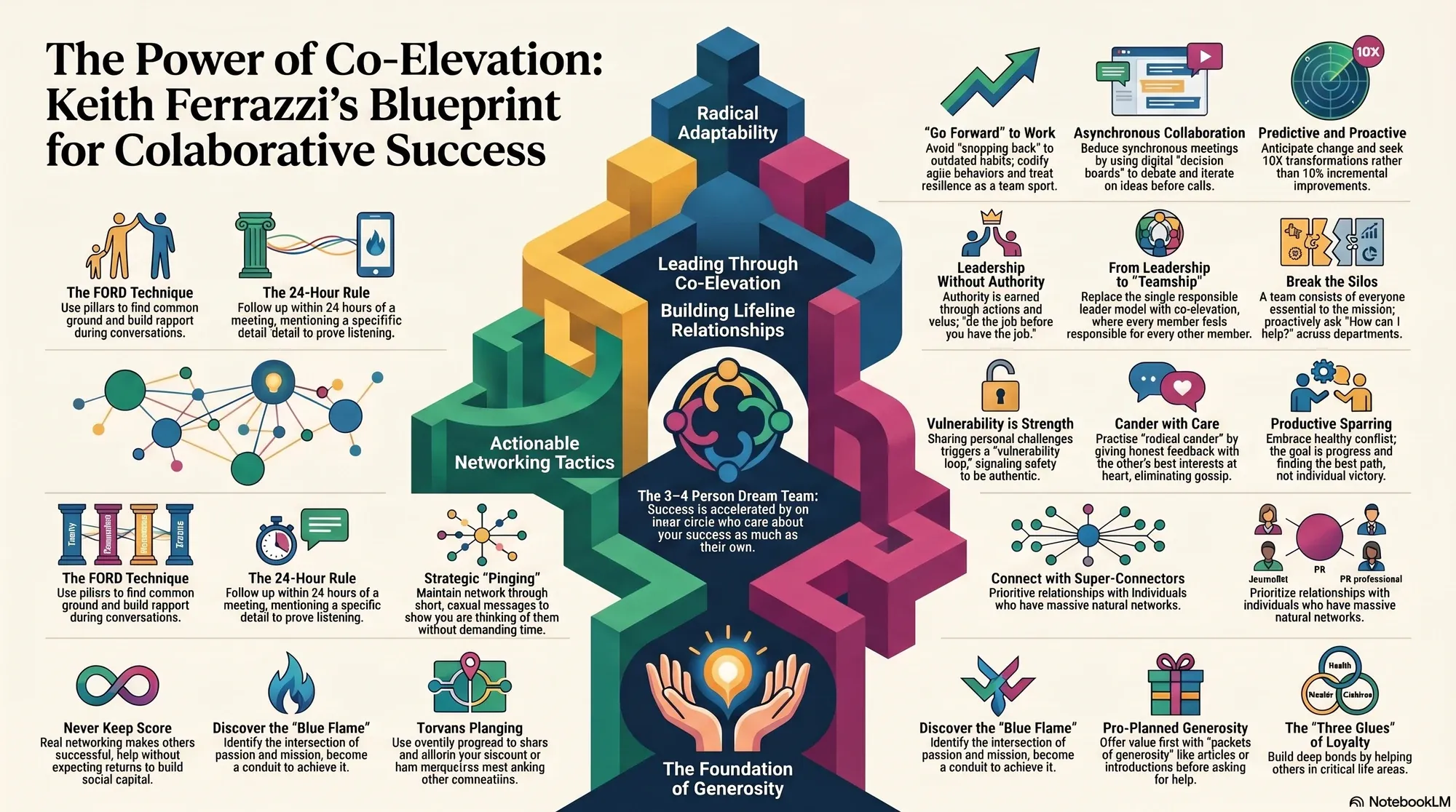
Part 1: The Foundation of Generosity
- On The True Goal: Help other people succeed without keeping a ledger of favors. — Never Eat Alone — Official Publisher.
- On Giving First: Build relationships before an urgent need arises; look for ways to help before asking for favors. — Inc.: The 10 Secrets of a Master Networker.
- On the Relationship Muscle: Relationship-building is a skill you can improve through practice, even if it comes more naturally to someone else. — TD Magazine: Keith Ferrazzi Interview.
- On Pre-Planned Generosity: Prepare useful help before approaching someone: a relevant insight, introduction or resource can make the conversation valuable to them. — Speaking of Wealth: Relationships and Networking.
- On The Blue Flame: Learn what matters most to the other person and how they define success; then look for ways to help. — Science of Success: Never Eat Alone.
- On Value: Develop something useful to contribute—knowledge, ideas or help—rather than relying on collecting contacts. — Inc.: The 10 Secrets of a Master Networker.
- On The Three Glues: Ferrazzi highlights health, wealth and children as areas where help can matter deeply. Treat this as relationship advice, not a guarantee of loyalty. — Brand Builders Podcast: Lead with Generosity.
- On Fear vs. Service: Be willing to take the initiative when you can genuinely help someone, rather than letting hesitation prevent an offer. — Win the Day #214: Keith Ferrazzi.
Part 2: Rethinking Networking and Success
- On Poverty: Reflecting on his upbringing, Ferrazzi describes relationships as a route to opportunities his family’s finances alone could not provide. — Brand Builders Podcast: Lead with Generosity.
- On Collaborative Success: Treat success as a shared effort: enlist people around a common mission and invest in their growth as well as your own. — Science of Success: Never Eat Alone.
- On Connection: Invest real attention in relationships, including acquaintances; Ferrazzi describes making limited time together more generous and meaningful. — Win the Day #214: Keith Ferrazzi.
- On Business Fundamentals: Business relationships need genuine human engagement, not merely a larger contact list. — Speaking of Wealth: Relationships and Networking.
- On Personal Branding: Build your personal brand through genuine relationships and continuing dialogue, not superficial networking. — Dan Schawbel: Interview with Keith Ferrazzi.
- On Being a Connector: Make introductions when you can see value for both people, not merely to increase the number of connections you broker. — Brand Builders Podcast: Lead with Generosity.
- On Goals: Clarify what you want before imposing a deadline. Ferrazzi argues that goals should fit your talents and desires, rather than begin with a timetable. — Keith Ferrazzi: Setting Goals.
Part 3: The "Never Eat Alone" Philosophy
- On Shared Meals: Use meals to spend time with people and deepen relationships, rather than treating eating as time outside relationship-building. — Inc.: The 10 Secrets of a Master Networker.
- On Strategic Preparation: Research someone’s interests and challenges before meeting so you can offer relevant help instead of making a generic approach. — Speaking of Wealth: Relationships and Networking.
- On Pinging: Keep relationships alive with regular, brief contact—not only when you need something. — Never Eat Alone — Official Publisher.
- On The 24-Hour Rule: Follow up promptly and record details worth remembering. Ferrazzi’s conference guide recommends messages during the event or on the flight home, rather than prescribing a fixed 24-hour deadline. — Keith Ferrazzi: Be a Conference Commando.
- On Super-Connectors: Get to know people whose work connects many others, such as journalists, recruiters and public-relations professionals. — Inc.: Never Eat Alone Excerpt.
- On The FORD Technique: Use family, occupation, recreation and dreams as possible conversation topics. Earn the right to ask more personal questions rather than making the exchange an interrogation. — Keith Ferrazzi: The FORD Framework.
- On Networking Action Plans: Translate your goals into a relationship action plan: identify people important to those goals, prioritize the relationships and find ways to serve them. — Speaking of Wealth: Relationships and Networking.
- On Fear of Rejection: A possible refusal need not stop you from making a thoughtful request. Ferrazzi recalls his father’s willingness to ask for help as an important example. — Inc.: The 10 Secrets of a Master Networker.
Part 4: Building "Lifeline Relationships"
- On Inner Circles: Cultivate a small, close circle that offers honest feedback, accountability and support when things go wrong. — Win the Day #214: Keith Ferrazzi.
- On Deep Mindsets: Ferrazzi identifies generosity, vulnerability, candor and accountability as four mindsets for building close, supportive relationships. — Dan Schawbel: Interview with Keith Ferrazzi.
- On Collaboration Over Compromise: Co-create the path forward with others instead of deciding alone and then trying to secure their buy-in. — Bregman Leadership Podcast: Leading Without Authority.
- On The Long Slow Dinner: Give dinners room for candid conversation about what people are facing, rather than turning them into sales pitches. — Brand Builders Podcast: Lead with Generosity.
- On Career-Crippling Habits: Invite trusted peers to identify behaviors you may not see in yourself, then consider which changes would help you. — How to Use Your Staff Meeting for Peer-to-Peer Coaching.
- On Sparring: Use constructive challenge to improve the work, not to win an argument. Small-group discussion can expose risks and invite practical help. — A New Social Contract for Teams.
Part 5: Co-Elevation and Teamship
- On Teamship: Teamship means peers share responsibility for feedback, accountability and one another’s energy, rather than leaving that work entirely to a leader. — Win the Day #214: Keith Ferrazzi.
- On Co-Elevation: Co-elevation combines commitment to a shared mission with commitment to one another’s growth. — Science of Success: Never Eat Alone.
- On Shared Responsibility: Take responsibility for helping colleagues succeed and develop, rather than treating their difficulties as solely the manager’s problem. — Bregman Leadership Podcast: Leading Without Authority.
- On Unleashing Teams: Replace the leader’s role as sole problem-solver with peers coaching and helping one another. — Bregman Leadership Podcast: Leading Without Authority.
- On The Definition of Team: Define your team around the mission, including people outside your reporting line whose contributions are needed. — Chicago Booth CareerCast: Leading Without Authority.
- On Breaking Silos: Work across functional boundaries toward a shared goal, and offer help when another part of the team is struggling. — A New Social Contract for Teams.
- On Emotional Support: Show interest in the person beyond the immediate task. Supportive relationships leave room for personal concerns as well as professional goals. — Speaking of Wealth: Relationships and Networking.
- On Co-Elevating The Tribe: Make shared responsibility an explicit team agreement, supported by recurring practices rather than a slogan about collaboration. — A New Social Contract for Teams.
Part 6: Leading Without Authority
- On Earning The Right: Earn permission to influence by serving, sharing and showing care; a title alone does not create that relationship. — Bregman Leadership Podcast: Leading Without Authority.
- On Doing The Job: Begin contributing as a leader before receiving a formal title. Ferrazzi describes taking on broader marketing responsibilities before becoming chief marketing officer. — Chicago Booth CareerCast: Leading Without Authority.
- On Taking Ownership: Ask what part you can own in a difficult working relationship and how you can improve it, rather than waiting for the other person to change. — Bregman Leadership Podcast: Leading Without Authority.
- On Leading Change: Even formal authority does not remove the need to enlist others in change. Invite people to help shape the mission. — Chicago Booth CareerCast: Leading Without Authority.
- On Laziness in Leadership: Do the work of building relationships and helping colleagues; do not use busyness or convenience as a reason to avoid it. — Science of Success: Never Eat Alone.
- On Overcoming Ignorance: The interview’s published notes identify ignorance as an excuse to move past: not knowing how to help need not end the effort to learn. — Coaching for Leaders #488: Leadership First.
- On Stopping the Victim Mentality: Look for actions within your control instead of remaining stuck in blame or resentment about colleagues. — Bregman Leadership Podcast: Leading Without Authority.
Part 7: Vulnerability and Authenticity
- On Vulnerability as Strength: Being open about a real challenge can support connection; vulnerability need not mean presenting yourself as flawless. — Instant Intimacy.
- On The Vulnerability Loop: A modest personal disclosure can invite openness in return. Listen without judgment, and do not confuse vulnerability with unloading every problem. — Instant Intimacy.
- On Breaking the Perfect Facade: A leader’s flawless facade can discourage honest learning. Acknowledge limits rather than pretending to have every answer. — TD Magazine: Keith Ferrazzi Interview.
- On Authenticity: Approach relationships genuinely, rather than using a polished networking performance to pursue an immediate transaction. — Brand Builders Podcast: Lead with Generosity.
- On Connecting at Davos: At Davos, Ferrazzi describes opening a lunch with questions about excitement and concern, then sharing his own answer to set a more personal tone. — Keith Ferrazzi: Building Rapport at Davos.
- On Bringing Your Whole Self: Allow appropriate personal interests and experiences into professional conversations, while respecting the other person’s boundaries. — Instant Intimacy.
- On Passion Sharing: Share interests you genuinely care about and listen for the other person’s interests; common enthusiasm can help a conversation move beyond small talk. — Instant Intimacy.
Part 8: Radical Candor and Accountability
- On Candor With Care: Make candid feedback an expression of care for the other person, not an opportunity to display superiority. — Bregman Leadership Podcast: Leading Without Authority.
- On Feedback as a Gift: Earn permission for candid feedback through a caring relationship. Offer information the recipient can evaluate, not a command they must obey. — Keith Ferrazzi: Making Feedback a Force for Positive Change.
- On Eliminating Gossip: Bring tensions into an open, caring conversation rather than complaining about colleagues behind their backs. — Bregman Leadership Podcast: Leading Without Authority.
- On Safe Spaces for Transformation: Build psychological safety through regular team practices that let people raise difficulties and ask for help, rather than treating it as a lecture topic. — Win the Day #214: Keith Ferrazzi.
- On Accountability: Choose a behavior to work on and ask a peer to check in between meetings. Accountability requires follow-through, not just discussing feedback once. — How to Use Your Staff Meeting for Peer-to-Peer Coaching.
- On Deference as a Sin: The interview’s published notes identify deference as a leadership excuse: do not assume that only people above you can initiate improvement. — Coaching for Leaders #488: Leadership First.
- On Avoiding Cowardice: Notice when fear is keeping you from a needed conversation or relationship, and take a constructive step rather than avoiding it. — Science of Success: Never Eat Alone.
- On Indulgence and Resentment: Letting resentment toward a colleague persist can obstruct useful collaboration. Examine your own contribution and look for a constructive way forward. — Bregman Leadership Podcast: Leading Without Authority.
- On Asking for Truth: Make feedback reciprocal: invite colleagues’ suggestions about your behavior as well as offering suggestions about theirs. — How to Use Your Staff Meeting for Peer-to-Peer Coaching.
- On Candor Breaks: Pause for a candor break and ask what is not being said. Give smaller groups a chance to surface concerns that may stay hidden in a full meeting. — A New Social Contract for Teams.
Part 9: Radical Adaptability and The New World of Work
- On Going Forward to Work: Keep useful practices learned during disruption instead of automatically returning to earlier ways of working. — Next Big Idea Club: Competing in the New World of Work.
- On Radical Adaptability: Ferrazzi’s adaptability framework combines foresight, agility, collaboration and inclusion, and resilience. It is broader than reacting once a crisis arrives. — Guy Kawasaki: Keith Ferrazzi Interview.
- On The Rubber Band Effect: Make improved working practices deliberate team agreements, or the pressure to return to familiar routines can undo them. — Guy Kawasaki: Keith Ferrazzi Interview.
- On Asynchronous Collaboration: Use shared decision boards to gather input asynchronously, reserving meeting time for issues that benefit from live discussion. — Next Big Idea Club: Competing in the New World of Work.
- On Treating Workers as Fully Human: Recognize that colleagues bring personal strain to work, and make room to discuss support needs rather than treating them only as task performers. — Next Big Idea Club: Competing in the New World of Work.
- On Agility as an Operating System: Make agility routine with short work cycles, clear outcomes and frequent review—not merely a response to emergencies. — Next Big Idea Club: Competing in the New World of Work.
- On Crowdsourcing Foresight: Invite people across the organization to contribute emerging risks and opportunities; foresight should not be reserved for senior leaders. — Next Big Idea Club: Competing in the New World of Work.
- On Resilience as a Team Sport: Treat resilience as something teammates help sustain together, not just a test of individual toughness. — Next Big Idea Club: Competing in the New World of Work.
- On 10X Transformation: Use a much more ambitious goal to challenge incremental thinking. Ferrazzi credits Peter Diamandis when contrasting tenfold thinking with a ten-percent improvement. — Chicago Booth CareerCast: Leading Without Authority.
- On Inclusion in Innovation: Design collaboration so quieter and remote participants can contribute, using written input and smaller discussions rather than relying only on the loudest voices. — Guy Kawasaki: Keith Ferrazzi Interview.
Part 10: Practical Action and Future Growth
- On Personal Check-ins: Begin with a brief check-in on people’s energy and difficulties, then use what you learn to offer practical support. — Next Big Idea Club: Competing in the New World of Work.
- On Crowdsourcing Strategy: Invite a broader group into strategy work through digital collaboration instead of limiting input to a small planning meeting. — Guy Kawasaki: Keith Ferrazzi Interview.
- On Praising and Celebrating: Recognize colleagues’ contributions and celebrate progress; Ferrazzi treats appreciation as part of sustaining the team’s energy. — Chicago Booth CareerCast: Leading Without Authority.