Ken Griffin began investing while at Harvard and founded Citadel in 1990, a year after graduating. He and his partners established the separate market-making business Citadel Securities in 2002. His work combines investment research, quantitative tools and team-building. — Citadel — Kenneth C. Griffin.
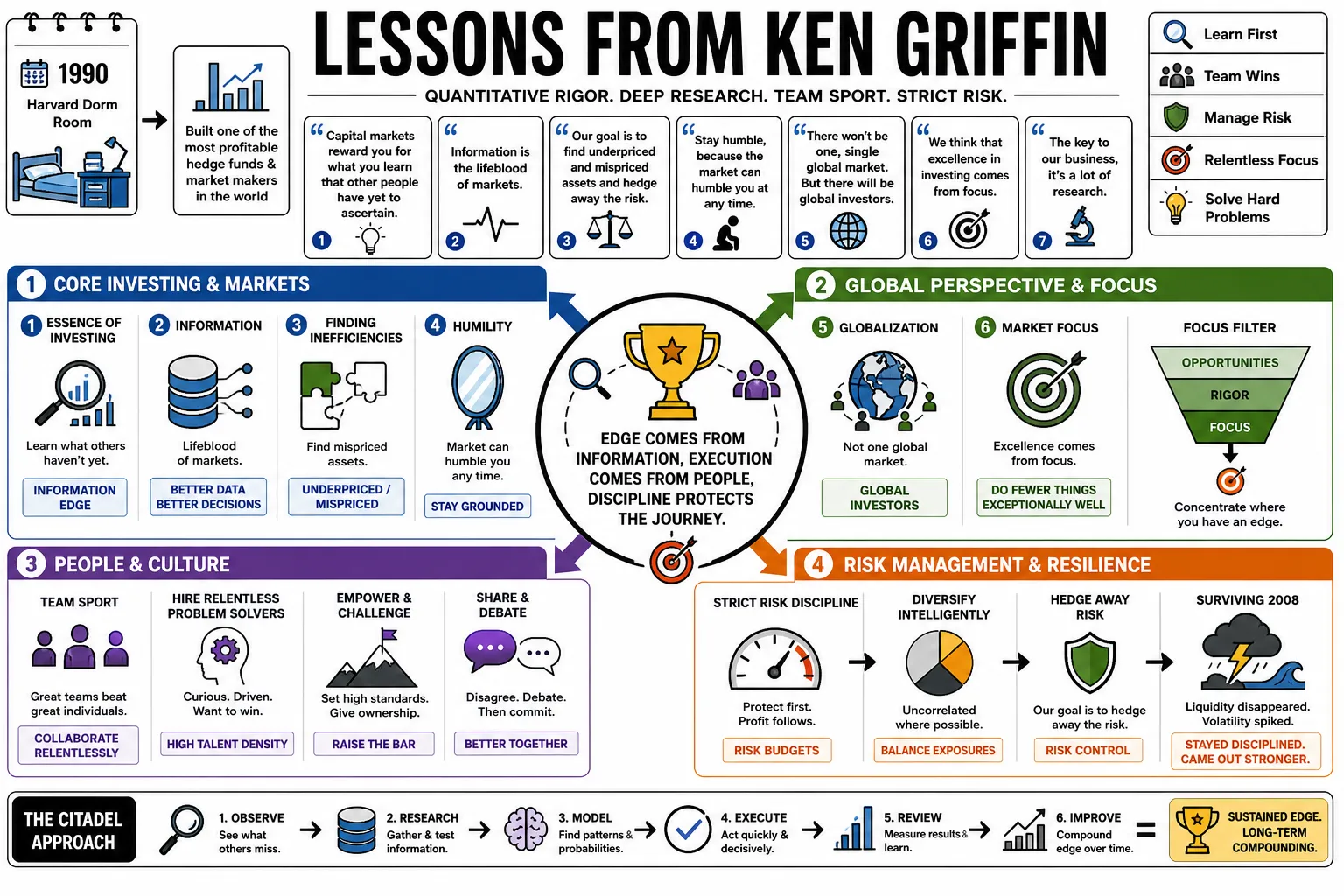
Part 1: Core Investing & Markets
- On The Essence of Investing: Griffin describes investing as uncovering opportunities the market underappreciates and committing capital against that research. — LEADERS — Extraordinary People Working Together.
- On Information: Timely, accurate information matters most when conditions are unsettled; errors undermine the foundation of investment decisions. — S&P Global Leaders — Ken Griffin (2025).
- On Finding Inefficiencies: Griffin’s early arbitrage work compared common stocks with related securities, using real-time prices and quantitative skills to investigate pricing differences. — Stanford GSB — View From The Top (2025).
- On Humility: When a position moves against you, Griffin advises stepping back to ask what you do not understand rather than assuming the market must be wrong. — The David Rubenstein Show — Ken Griffin.
- On Globalization: Griffin describes a fragmented global environment in which cross-border business and investment remain shaped by national interests and geopolitical tensions. — Future of Global Markets — Ken Griffin (2025).
- On Market Focus: Griffin links investment excellence to sustained focus and discipline in strengthening specific competitive advantages. — Ken Griffin’s 2023 Year-End Letter.
- On Research: Citadel’s research combines specialists’ deep fundamental work with quantitative tools, rather than relying on one technique alone. — LEADERS — Extraordinary People Working Together.
- On Managing Trades: Research a differentiated view and understand your advantage before committing capital with conviction. Griffin also stresses acknowledging a mistaken position and moving on. — Stanford GSB — View From The Top (2025).
- On Artificial Intelligence Returns: In 2025, Griffin described generative AI as a productivity aid at Citadel, not yet a transformation of its investment process. — Stanford GSB — View From The Top (2025).
Part 2: Competitive Advantage & Excellence
- On The Edge: Identify the specific advantage behind an investment process, whether in pricing, risk management or execution, and keep improving it. — Ken Griffin’s 2023 Year-End Letter.
- On Investor Expectations: Griffin says investors expect rigorous work and willingness to commit capital to well-supported ideas, not caution used as a substitute for judgment. — Stanford GSB — View From The Top (2025).
- On Tenacity: Griffin compares financial competition with elite sport: ability must be accompanied by sustained effort and perseverance. — Ken Griffin — Learning from Extraordinary Colleagues.
- On Growth: Griffin links organizational growth with retaining ambitious colleagues: if a firm stops developing, talented people may look elsewhere for opportunities. — Institutional Investor — Boy Wonder.
- On Focus: Discipline your curiosity by asking whether a problem deserves your time and whether the work will make an impact. — Griffin’s Advice to Interns — Insider (2022).
- On Hustle: Griffin connects hustle with taking extra research steps to reach sound conclusions ahead of competitors. — S&P Global Leaders — Ken Griffin (2025).
- On Mastery: Keep learning after graduation; seek mentors and challenges that expand your capabilities. — LEADERS — Extraordinary People Working Together.
Part 3: Risk & Conviction
- On Mistakes: Learn from a setback without allowing regret to dominate what you do next. — Griffin’s Advice to Students — Insider (2025).
- On Defining Risk: Griffin defines effective risk management as preparation before a shock, because options can disappear quickly once a crisis begins. — Risk.net — Ken Griffin’s Lessons in Risk Management.
- On The Necessity of Risk: Griffin describes thoughtful risk-taking as part of investing: research and debate must sometimes lead to committing capital, rather than avoiding risk altogether. — Stanford GSB — View From The Top (2025).
- On Risk as Research: Griffin compares financial risk-taking with research and development in other industries, while distinguishing it from imprudent risk. — House Testimony — Hedge Funds (2008).
- On Mismanaging Risk: Griffin warns that poor risk controls, opaque markets and inadequate collateral arrangements can amplify financial losses and systemic stress. — Senate Testimony — Derivatives Oversight (2009).
- On Providing Liquidity: Griffin describes providing market liquidity alongside managing investment risks, rather than treating trading as detached from market structure. — Senate Testimony — Derivatives Oversight (2009).
- On Youth and Risk: Griffin urges young people to establish career foundations early, before family and other responsibilities make their time harder to allocate. — Griffin’s Advice to Interns — Insider (2022).
- On Seeking Challenges: Choose an early employer that challenges you intellectually and helps you develop skills for greater responsibility. — Griffin’s Advice to Interns — Insider (2022).
Part 4: Talent, Hiring & The Team
- On Teamwork: Griffin credits collaboration among investment, portfolio-construction and risk teams with strengthening decisions, particularly during market stress. — Ken Griffin’s 2023 Year-End Letter.
- On Surrounding Yourself with Talent: Griffin urges leaders to recruit exceptional colleagues rather than expect an outstanding team to emerge without strong individual talent. — LEADERS — Extraordinary People Working Together.
- On Intellectual Diversity: Work with thoughtful colleagues whose strengths and perspectives differ from yours, so disagreement can improve decisions. — Stanford GSB — View From The Top (2025).
- On Hiring Criteria: Griffin looks for intellect, aptitude and communication skills, alongside resilience and the ability to learn from setbacks. — Griffin’s Advice to Students — Insider (2025).
- On The Athlete-Scholar: Griffin values academically successful athletes as candidates who have practiced competition, handled losses and balanced demanding commitments. — Milken Global Conference — Ken Griffin (2026).
- On Time Management: He treats strong academic performance alongside athletic commitments as one indication of time-management ability. — Milken Global Conference — Ken Griffin (2026).
- On Grit: Griffin seeks ambition, perseverance and a willingness to keep learning as job requirements evolve. — Milken Global Conference — Ken Griffin (2026).
- On Decision Making: Griffin looks beyond interview likability for demonstrated accomplishment and a record of sound decisions. — The David Rubenstein Show — Ken Griffin.
- On Math as a Crutch: A model’s prediction is not enough: Griffin wants investors to understand why it arises and whether it reflects a durable relationship rather than data-mining. — Risk.net — Ken Griffin’s Lessons in Risk Management.
- On Communication Skills: Griffin credits writing instruction with helping his development and urges students to practice clear, face-to-face communication. — Griffin’s Advice to Students — Insider (2025).
Part 5: Leadership & Management
- On Empowerment: Develop colleagues by giving them responsibility to decide and solve problems. — LEADERS — Extraordinary People Working Together.
- On Succession: Build a team with capable successors so that taking a larger role does not leave your existing responsibilities unsupported. — Griffin’s Advice to Interns — Insider (2022).
- On Advocating for Yourself: Ask for greater responsibility and harder problems rather than assuming your ambitions will be recognized without discussion. — Griffin’s Advice to Interns — Insider (2022).
- On Leadership Impact: Griffin expects leaders to create an environment where ideas are debated in pursuit of understanding. — LEADERS — Extraordinary People Working Together.
- On The Human Mind vs. AI: In May 2025, Griffin argued that investment judgment about unfamiliar future developments could not simply be delegated to models trained on past information. — S&P Global Leaders — Ken Griffin (2025).
- On Intrinsic Motivation: Griffin values genuine interest in the problems a career involves, rather than trying to keep someone in finance whose real ambition lies elsewhere. — The David Rubenstein Show — Ken Griffin.
Part 6: The 2008 Crisis & Resilience
- On Survival: Griffin recalls that Citadel’s survival in 2008 was uncertain and depended partly on counterparties beyond its control. — The David Rubenstein Show — Ken Griffin.
- On the Lehman Collapse: Lehman’s collapse was followed by a global liquidity freeze that hit Citadel’s credit-related strategies. The damage extended beyond the failed bank itself. — Institutional Investor — Griffin’s Post-Crisis Banking Alternative.
- On Systemic Failure: In his 2008 testimony, Griffin emphasizes the danger of interconnected counterparties, not merely the size of individual institutions. — House Testimony — Hedge Funds (2008).
- On Humility in Crisis: Griffin accepts responsibility for failing to understand the banking system’s vulnerability before 2008, describing the crisis as a professional low point. — Risk.net — Ken Griffin’s Lessons in Risk Management.
- On the Ultimate Lesson: Match investment strategies with reliable funding. Griffin preferred a smaller base of stable, longer-term capital to money that could leave during market stress. — Risk.net — Ken Griffin’s Lessons in Risk Management.
- On Rebounding: Acknowledge the possibility of failure, then concentrate on the best available decisions to survive rather than surrendering to it. — The David Rubenstein Show — Ken Griffin.
- On Real-Time Learning: Study how other firms withstand losses. Griffin says lessons from LTCM’s funding and contract terms helped Citadel prepare for the 2008 crisis. — Risk.net — Ken Griffin’s Lessons in Risk Management.
- On Transparency: During the 2008 crisis, Griffin held a conference call to address concerns about Citadel’s financial health. The example highlights responding publicly rather than leaving those concerns unanswered. — The New York Times — Citadel’s 25 Years.
- On Market Panic: Griffin warns that exuberant markets can reverse abruptly; apparent calm is not a reason to neglect risk management. — Future of Global Markets — Ken Griffin (2025).
Part 7: Economics, Debt & Regulation
- On Fiscal Health: In his April 2024 investor letter, Griffin warns that persistent government borrowing shifts burdens toward future generations. This is his fiscal-policy argument, not a forecast guarantee. — Ken Griffin’s 2023 Year-End Letter.
- On Economic Illusions: In October 2025, Griffin argued that fiscal and monetary stimulus was supporting an economy already well into its expansion, rather than responding to a recession. — Future of Global Markets — Ken Griffin (2025).
- On Sovereign Debt Limits: In May 2025, Griffin warned that persistent large deficits could strain the United States’ financial flexibility and access to global capital. — Milken Global Conference — Ken Griffin (2025).
- On Inflationary Policy: In October 2025, Griffin viewed immigration restrictions alongside fiscal and monetary policy as inflation risks, emphasizing immigrant workers’ roles in several industries. — Future of Global Markets — Ken Griffin (2025).
- On Trade and Tariffs: Griffin argues that uncertainty over changing trade arrangements can disrupt investors’ ability to price assets. — S&P Global Leaders — Ken Griffin (2025).
- On Proper Regulation: In his 2009 testimony, Griffin advocates transparent pricing, appropriate capital and margin requirements, and central clearing to reduce systemic risk. — Senate Testimony — Derivatives Oversight (2009).
- On Regulatory Overreach: Griffin argues that limiting new regulatory burdens can encourage entrepreneurship, while acknowledging protections for healthy food, clean air and safe schools. — Milken Global Conference — Ken Griffin (2025).
- On Cryptocurrencies: In October 2021, Griffin said regulatory uncertainty kept his market-making business out of crypto, while indicating willingness to provide prices if a clearer regulatory framework emerged. — Economic Club of Chicago — Ken Griffin (2021).
Part 8: Education, Philanthropy & The American Dream
- On Social Mobility: Griffin treats access to high-quality education as a foundation for opportunity and a well-informed democracy. — LEADERS — Extraordinary People Working Together.
- On Educational Freedom: Griffin advocates giving families educational choices, including charter schools, as part of expanding students’ opportunities. — Milken Global Conference — Ken Griffin (2025).
- On Teachers: Griffin supports recruiting and preparing high-quality teachers, emphasizing the lasting influence educators can have on children’s lives. — Griffin Catalyst — Developing a New Generation of Teachers.
- On Problem Solvers: Griffin seeks philanthropic partners with capable leaders and teams working on consequential problems. — LEADERS — Extraordinary People Working Together.
- On Liberal Arts vs. STEM: Griffin supports rigorous liberal-arts and civic education that develops critical thinking, clear reasoning and open inquiry. — University of Florida — Griffin’s Support for Classical and Civic Education.
- On Systemic Reform: Griffin supports developing strong school principals as a route to improving public education and protecting children’s access to it. — Chicago Public Education Fund — Investing in Principals.
- On the Constitution: Griffin’s acquisition and loans of a Constitution printing emphasize public access to historic documents, rather than private possession alone. — Griffin Catalyst — Public Access to Founding Documents.
- On Human Destiny: Griffin connects his desire to contribute to society with the belief that people can help shape their collective future. — Griffin Catalyst — Civic Engagement and Opportunity.