Ken Ravizza was a pioneering sport psychologist and peak performance consultant whose teachings have had a profound impact on countless athletes, coaches, and teams, including the Chicago Cubs and Los Angeles Angels. His practical, process-oriented approach helped performers manage pressure, stay present, and achieve consistency. His work, especially in baseball, has become legendary.
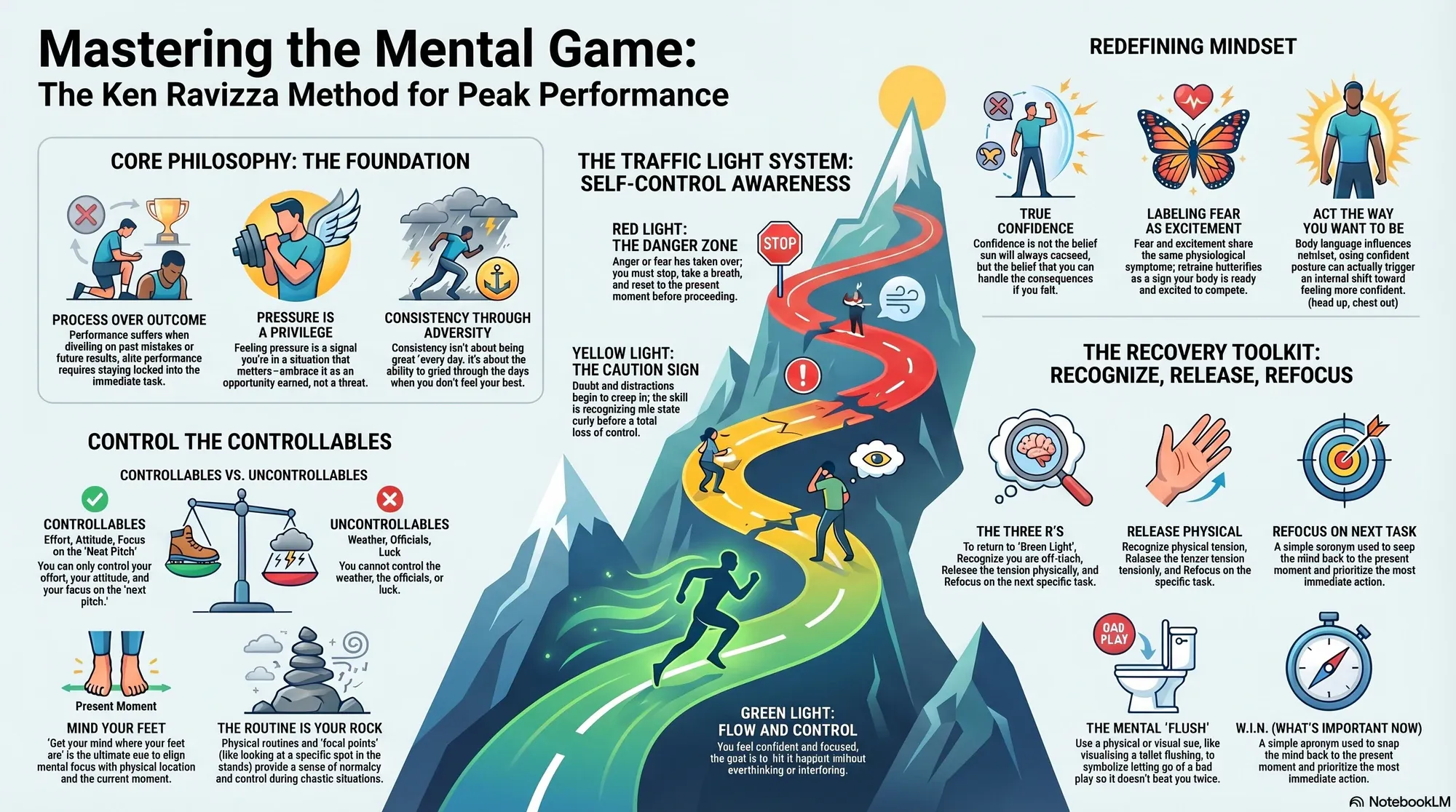
Core Philosophy: The Mental Game
- The fundamentals list opens with this exact idea: play one pitch at a time, confident and focused on each pitch as it is played, with disregard for past and future pitches. [2]
- "You can't play the game of baseball if you're thinking about the outcome. You have to stay in the process."
- Source: Widely attributed to his coaching philosophy.
- Link: YouTube - A Tribute to Ken Ravizza
- A sport psychologist who used the book as his training manual puts it this way: Ravizza's strategy is simple and effective, but it is easier said than done. [6]
- This is documented as one of Ravizza's own signature sayings on his foundation's official list of Ravizza'isms, where the full line pairs pressure with pleasure: do not let pressure exceed pleasure, because pressure is a privilege. [7]
- "My job is to give you the tools. It’s your job to use them."
- Source: His general approach to consulting.
- Link: The Athletic - Remembering Ken Ravizza
- The same fundamentals list puts it this way: develop your mental skills so you consistently perform near the best of your ability and have something to go to when faced with adversity. [3]
- "Don’t get good at displaying your frustration. Get good at releasing it."
- Source: Coaching advice often repeated by players he mentored.
- Link: Baseball America - Ken Ravizza's Impact
The Traffic Light Analogy: A Key Learning
Ravizza's most famous tool for self-control is the Traffic Light system, designed to help performers recognize and manage their mental state.
- Learning: The Green Light. "This is when you feel great. You're confident, focused, and in control. The key here is to just let it happen. Don't overthink it, just play."
- Source: Heads-Up Baseball: Playing the Game One Pitch at a Time
- Learning: The Yellow Light. "This is a caution sign. You're starting to get distracted, maybe by the umpire, the crowd, or a previous play. Doubt begins to creep in. This is the signal to take a step back and regroup."
- Source: Heads-Up Baseball: Playing the Game One Pitch at a Time
- Learning: The Red Light. "You've lost control. Anger, frustration, or fear has taken over. You are no longer in control of your performance. You absolutely have to stop, take a breath, and get back to the present moment before proceeding."
- Source: Heads-Up Baseball: Playing the Game One Pitch at a Time
- A sport psychologist who teaches this system explains that the whole key is learning to catch yellow lights before they become red lights, since players who notice a yellow light too late can rush straight through it into trouble. [4]
The Three R's: Recognize, Release, Refocus
- Learning: The Three R's. To get back to a "green light" state, use the Three R's: Recognize you're not in control, Release the tension or negative thought, and Refocus on the present task.
- Source: Heads-Up Baseball 2.0
- Link: Positive Performance Coaching
- "You've got to have a routine to get you back to the present. A deep breath, a focal point—something to anchor you."
- Source: A core component of his "release" strategy.
- Learning: The mental reset isn't abstract; it needs to be a physical, practiced routine.
Control What You Can Control
- "Control the controllables. You can’t control the umpire, the weather, or a bad hop. You can control your attitude, your effort, and your focus."
- Source: A fundamental tenet of sport psychology, heavily emphasized by Ravizza.
- Link: BelievePerform - The Controllables
- His own signature-sayings list frames control more broadly than just the next pitch: you have very little control over what goes on around you, but total control over how you choose to respond to it. [9]
- A sport psychologist he mentored recalls him giving the same core advice to professionals as to little leaguers, distilled into one line he was known to say: be where you need to be, when you need to be there. [5]
Routines and Focal Points
- His own official list of signature sayings defines a routine more precisely than a metaphor about rocks: a routine is not a superstition or a ritual, and it is not magic -- it is a process that is fundamental to creating consistency in performance. [8]
- Learning: Use a Focal Point. "Find something to look at—a spot in the stands, the foul pole, your glove—to quiet your mind and bring your focus back to the present moment before the play."
- Source: Heads-Up Baseball 2.0
- Learning: The Release. "After a play, good or bad, you need a physical and mental 'release.' Touch a specific spot, take a deep breath, and let it go. This signals that the last play is over and you are moving on."
- Source: A key part of his process for staying in the moment.
- The material puts it plainly: you can't control what happens around you, but you can control your response to it, and you have to be in control of yourself before you can control your performance. [1]
On Confidence and Fear
- His own official list of signature sayings frames confidence in process terms rather than outcome terms: the process is your armor against results and the fear of failure, meaning real confidence comes from trusting your preparation and approach rather than needing any single at-bat to go your way. [10]
- "Fear and excitement are the same emotion. It’s your label that makes the difference."
- Source: His teachings on managing performance anxiety.
- Learning: You can reframe the physical symptoms of anxiety (racing heart, butterflies) as signs that you are ready and excited, rather than scared.
- "Embrace the suck. Some days are going to be a grind. Accept it and compete."
- Source: A phrase popularized by athletes he worked with.
- Learning: Acknowledging that a situation is difficult, rather than fighting it, can free you up to perform.
- "Fake it 'til you make it. Your body language can change your mindset."
- Source: His advice on projecting confidence.
- Learning: Acting confident—head up, chest out—can actually make you feel more confident.
The Mental "Flush"
- Learning: The Flush. Ravizza taught players to visualize a toilet flushing to symbolize letting go of a bad play or a negative thought. It was a simple, sometimes humorous, but highly effective mental cue.
- Source: Famously used with the Chicago Cubs during their 2016 World Series run.
- Link: MLB.com - Cubs embrace Ravizza's teachings
- "You can be pissed off, but you can’t be pissed on. Don’t let one bad play beat you twice."
- Source: A gritty reminder not to carry mistakes forward.
Additional Quotes and Learnings
- "Are you a fountain or a drain?" - A question he would pose to players about their impact on team energy.
- "Sometimes you have to slow the game down."
- "The mind controls the body, the body tells the mind how you're feeling."
- "What's important now? (WIN)." - A simple acronym for staying present.
- "Quality practice is better than quantity practice."
- "Don’t let the past steal from the present."
- "The greatest performers are the ones who are the most adaptable."
- Learning: Self-talk is a skill. "Your inner voice is your most important coach. Train it to be a positive and constructive one."
- "See the ball, be the ball... No, it's 'See the ball, hit the ball.' Keep it simple." - A jab at overthinking.
- "Get out of your own way."
- "The game doesn't know who is supposed to win."
- "Act the way you want to be."
- Learning: Use cue words. "Have a simple word or phrase like 'Focus!' or 'Next pitch' to bring you back to the present."
- "You have to be a great teammate to yourself first."
- "The dugout is a great place to get your head straight or to mess it up." - On the importance of the team environment.
- "It's about having a plan, but also the ability to adjust that plan."
- "Let your preparation give you your confidence."
- "The moment you start thinking about mechanics in the game, you’re dead."
- "Breathe. It’s the simplest tool you have to control your physiology and your mind."
- Learning: Focus on the process, not the results. "If you focus on executing one good pitch at a time, the results will take care of themselves."
- "Your opponent is the game, not the other team."
- "Be where your feet are." - A simple reminder for presence.
- "A mistake is just information. Use it to make the next play better."
- "Have fun. It's still a game." - The ultimate reminder that joy and passion are essential for peak performance.
Learn more:
- Heads-Up Baseball (Ravizza/Hanson) handout excerpt
- Heads-Up Baseball (Ravizza/Hanson) handout excerpt
- Heads-Up Baseball (Ravizza/Hanson) handout excerpt
- Mental Toughness Tips #3: Internal Traffic Signals (CBT SoCal)
- Mental Toughness Tips #1: Lessons in Sport Psychology from Ken Ravizza (CBT SoCal)
- Mental Toughness Tips #2: Playing One Pitch at a Time (CBT SoCal)
- Ken Ravizza, "Ravizza'isms" (official site, via Wayback Machine)
- Ken Ravizza, "Ravizza'isms" (official site, via Wayback Machine)
- Ken Ravizza, "Ravizza'isms" (official site, via Wayback Machine)
- Ken Ravizza, "Ravizza'isms" (official site, via Wayback Machine)