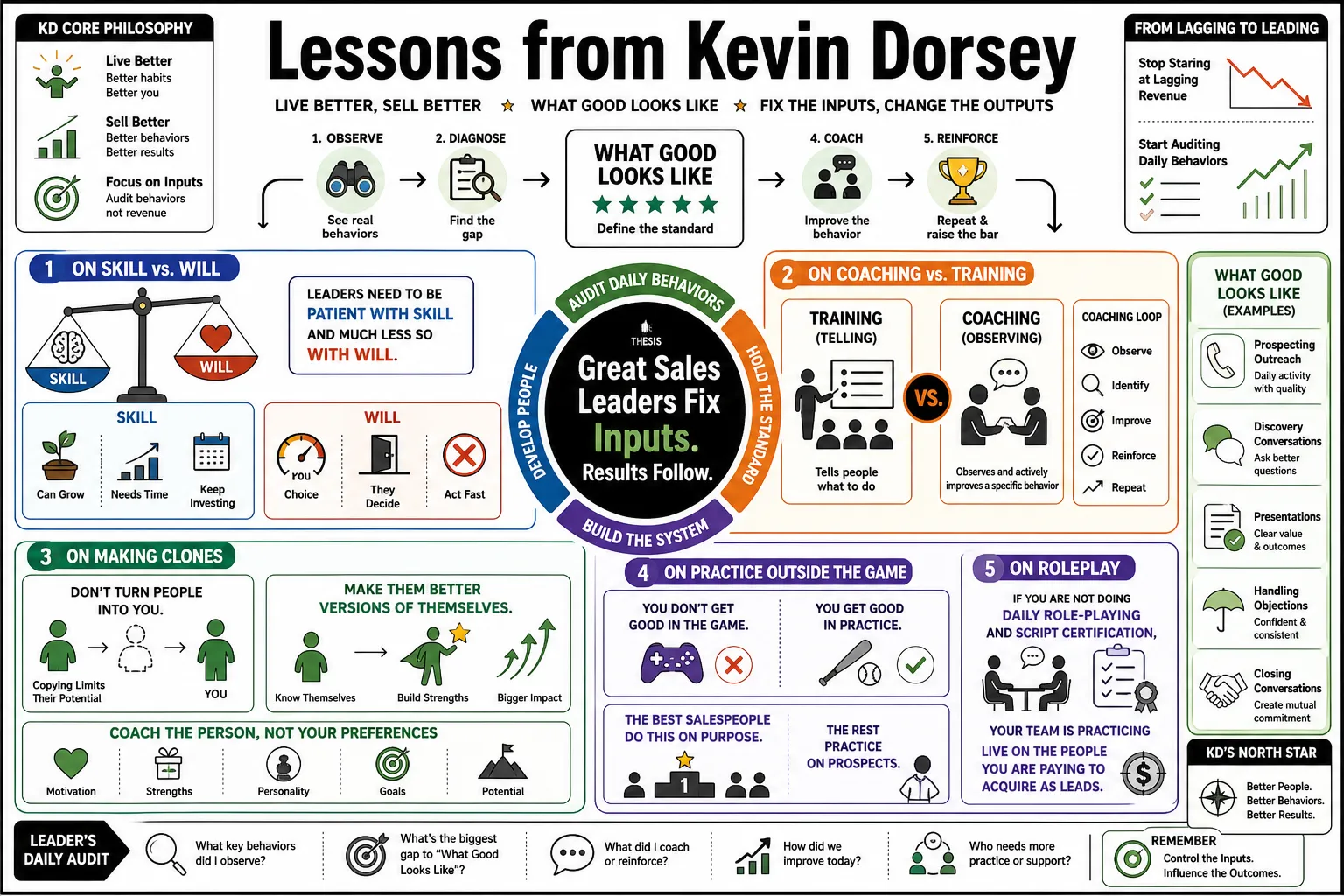
Lessons from Kevin Dorsey
B2B sales coach Kevin "KD" Dorsey shifted the standard management model by pushing leaders to stop staring at lagging revenue and start auditing their reps' daily behaviors. Known for his "Live Better, Sell Better" philosophy and "What Good Looks Like" framework, he focuses entirely on fixing the actual inputs of selling. This profile breaks down his systems for diagnosing performance gaps and structuring a modern sales floor.
Part 1: Coaching and Developing Reps
- On Skill vs. Will: "Leaders need to be patient with skill and much less so with will." — Source: [Live Better Sell Better]
- On Coaching vs. Training: "Most companies train by telling people what to do. They fail to coach, which requires observing and actively improving a specific behavior." — Source: [Outbound Squad]
- On Making Clones: "Don't turn people into you. Make them better versions of themselves." — Source: [Pavilion]
- On Practice Outside the Game: "You don't get good in the game; you get good in practice. The best salespeople do this on purpose. The rest practice on prospects." — Source: [Inside Sales Excellence]
- On Roleplay: "If you are not doing daily role-playing and script certification, your team is practicing live on the people you are paying to acquire as leads." — Source: [Sales Leadership Accelerator]
- On Live Deal Reviews: "When interviewing reps, avoid hypotheticals. Have them walk through a real deal they closed to directly assess their discovery and closing abilities." — Source: [30 Minutes to Presidents Club]
- On Studying Greatness: "You need to study greatness just as much as you try to fix the things that are broken. Find the top performer for a specific metric and document exactly what they do." — Source: [Revenue Leadership Podcast]
- On Individual Diagnosis: "When a rep struggles, you have to diagnose the individual rather than guessing. What is specifically blocking this person from hitting their numbers?" — Source: [Substack]
- On Hiring for Grit: "Grit is perseverance and resilience. It is the ability to get knocked down and get back up. That is what you screen for in an interview." — Source: [Live Better Sell Better]
Part 2: Leadership and Management Mechanics
- On Managing People: "Leaders guide people, but they manage processes. People are inherently unmanageable." — Source: [GetReditus]
- On the Root of Leadership: "Sales and leadership are the exact same thing. You're trying to change minds to change behavior to change results." — Source: [Live Better Sell Better]
- On Green Time vs. Red Time: "Leaders must ruthlessly divide their schedule. Green Time is for money-making activities like coaching and one-on-ones, while Red Time is for support activities like reviewing metrics." — Source: [JMR Publication]
- On BIPSY: "When performance drops, use BIPSY: evaluate Behaviors, Individual gaps, Process adherence, Skill levels, and You. Examine how you as a leader are contributing to the issue." — Source: [Inside Sales Excellence]
- On Assessing Candidates: "Never ask 'What would you do?' Ask for Proof of Performance: 'How have you done this in the past?'" — Source: [30 Minutes to Presidents Club]
- On the "You" in Leadership: "Accountability starts with the leader. If a rep fails, the manager must first ask if they provided the right coaching, resources, and environment." — Source: [Saasiest]
- On Clarity: "Clarity gives confidence. Confidence creates momentum. That's how you bounce back from a slump." — Source: [Live Better Sell Better]
- On Uncovering the Truth: "Give very little credence to what people say; rather, observe what they do." — Source: [Inside Sales Excellence]
- On Secret Shopping: "Leaders need to 'secret shop' their own company’s sales process to actually experience the friction points their customers face." — Source: [YouTube]
- On The Growth at All Costs Mindset: "Scaling without a documented process isn't growth, it's just burning through cash and market goodwill at a faster rate." — Source: [The Colin Cadmus Podcast]
Part 3: Cold Calling and Prospecting
- On The 8 Mile Method: "On your cold call, if there's any objection you're getting regularly, you 8 Mile it. Call it out before they do and take the ammunition away." — Source: [Inside Sales Excellence]
- On The Purpose of a Cold Call: "The two things that every single person on every call ever wants to know: Who are you and why are you calling me?" — Source: [Live Better Sell Better]
- On Problem-Based Language: "You have to master problem-based language in your prospecting, otherwise you will get ignored over and over." — Source: [Proposify]
- On The "Lost in the City" Tone: "Use a slightly confused tone to open a cold call. Asking for help disarms the prospect and triggers their natural human desire to assist." — Source: [MDPI]
- On The "Thank God!" Tone: "When a prospect raises an objection, respond with a 'Thank God!' tone. It signals you are glad they brought it up because it’s a specific problem you know how to solve." — Source: [Tim Ferriss Blog]
- On Asking for Permission: "If you respect people's time, they'll respect your pitch later. Ask for permission and then get into it." — Source: [Live Better Sell Better]
- On The Role of SDRs: "SDRs are the vanguard of any successful sales strategy. They are on the front lines, directly influencing the future growth of your business." — Source: [LeadGenius]
- On Empathy via Knowledge: "People don't care how much you know, they want to know how much you care. The only way you can share how much you care is by sharing what you know." — Source: [Millennial Momentum]
- On Pitch Framing: "Messaging is often way too product-focused and company-focused, rather than being strictly problem and persona-focused." — Source: [Live Better Sell Better]
- On Power vs. Parallel Dialing: "Parallel dialing burns leads and ruins the human element of the conversation; power dialing ensures you are actually present when the prospect answers." — Source: [Substack]
Part 4: The Psychology of the Buyer
- On Building Trust: "People feel trust when they think, 'I feel heard. I feel understood. What is being offered to me is actually helping me get what I want.'" — Source: [Pedro Lopez]
- On The Fear of Change: "The pain of change is a hidden blocker that most salespeople don't address. It is rarely a question of budget. It is a question of whether it is worth it to change a process." — Source: [Proposify]
- On Discovery: "The close is the easiest part of the sale. The discovery is what is hard. No one wants to be closed." — Source: [Inside Sales Excellence]
- On How People Buy: "We love security, but we fear commitment. We love novelty, but we fear change." — Source: [Live Better Sell Better]
- On Relating to the Buyer: "People cannot relate with the end result. They can only relate with the beginning." — Source: [YouTube]
- On The Status Quo: "Your biggest competitor isn't another software vendor. It is the status quo. You must first unsell what they currently use." — Source: [Inside Sales Excellence]
- On The Six VP Questions: "Leaders should ask customers why they bought, what they were afraid of beforehand, and how they would describe the product to someone else." — Source: [Live Better Sell Better]
- On Emotional vs. Informational Pitches: "Information on a brand or product rarely evokes emotion. Information about people does." — Source: [Gong]
- On Constructive Discontent: "To sell something new, you have to make the buyer constructively discontent with their current situation through targeted gap questions." — Source: [Sales Influence Podcast]
Part 5: Building and Scaling Process
- On What Good Looks Like (WGLL): "Most sales leaders are the bottleneck of their team because 'what good looks like' lives entirely in their head." — Source: [Inside Sales Excellence]
- On The 4 Ds of Scaling: "To roll out any behavior, you must Define it, Document it, Demonstrate it, and Deliberately Practice it." — Source: [Live Better Sell Better]
- On The 5 Ps of Playbooks: "A successful organization relies on five pillars: People, Prospect, Problem, Process, and Product." — Source: [Revenue Leadership Podcast]
- On Defining People: "Your playbook must explicitly define the standards of excellence, the core virtues required, and the exact path to promotion." — Source: [Pavilion]
- On Defining Prospect: "You have to map out a 'Buyer Matrix' so reps deeply understand the prospect's persona, success metrics, and how they are judged internally." — Source: [MDPI]
- On Defining Problem: "You must document the specific 'why' behind a prospect's pain points before you ever attempt to pitch a feature." — Source: [Inside Sales Excellence]
- On Defining Process: "Document the day-to-day operations like scripts, scorecards, and checklists. If it isn't documented, there is no way to measure deviation from it." — Source: [Substack]
- On Defining Product: "Only after understanding the previous pillars should you align the product’s features specifically to the pain and the prospect." — Source: [YouTube]
- On "The Why": "Every playbook should start with 'The Why' to explain the logic behind the process so reps actually believe in it rather than just following orders." — Source: [Live Better Sell Better]
- On Weekly Wiggles: "Hold Wiggle Wednesdays where leadership spends an hour refining a single step of the process, like the first 30 seconds of a call, to set the gold standard." — Source: [Inside Sales Excellence]
Part 6: Metrics and Pipeline Management
- On Pipeline vs. Everything: "POE: Pipeline Over Everything. Most complex sales problems are actually just pipeline problems in disguise." — Source: [Substack]
- On Results vs. Metrics: "Everything you want to know about your business is reflected in a metric. You cannot change a result without first changing a metric." — Source: [Live Better Sell Better]
- On The Core Leading Indicator: "Results live in the past. That's quite literally what makes it a result. Leaders must manage the leading indicators that create those results." — Source: [Inside Sales Excellence]
- On The Connect Rate: "You have to measure the raw output of effort—how many dials are actually resulting in a human answering the phone." — Source: [Revenue Leadership Podcast]
- On the Conversation Rate: "Measure the percentage of connections that turn into a meeting. If it's below the benchmark, you have a scripting or skill problem." — Source: [Live Better Sell Better]
- On Funnel Velocity: "You have to track stage progression carefully to understand exactly how quickly and consistently deals move through the funnel." — Source: [Sales Leadership Accelerator]
- On Manager Accountability: "It is a manager's job to know the number one metric per rep, the director's job for the team, and the CRO's job for the org." — Source: [Inside Sales Excellence]
- On Ignorance in Sales: "Ignorance is not bliss. Whether it be burnout or failing to achieve a goal, you need to know the mathematical reason why and how it happened." — Source: [Pedro Lopez]
- On Loudness vs. Volume: "When prioritizing problems, distinguish between Loudness, the noise people make about an issue, and Volume, how often it mathematically occurs." — Source: [Inside Sales Excellence]
Part 7: Habits and High Performance
- On Discipline: "Sales is getting harder, which means that we have to be better to get the same results we could get five years ago. Better or bitter, it is our choice." — Source: [Live Better Sell Better]
- On Gratitude (GERMS): "Start your morning routine by anchoring yourself in gratitude to build mental resilience for the rejections ahead." — Source: [MyCoreOS]
- On Exercise (GERMS): "Physical movement in the morning is about generating the physiological energy required to sustain a high-stress sales day." — Source: [Inside Sales Excellence]
- On Reading (GERMS): "Feed your mind with new inputs daily. You cannot solve complex buyer problems if your own intellectual inputs are stagnant." — Source: [Live Better Sell Better]
- On Meditation (GERMS): "Sales requires emotional regulation. Meditation provides the space to separate your identity from the outcome of a phone call." — Source: [MDPI]
- On Scribing (GERMS): "Writing and journaling help you process the day and clarify your strategic thinking before you get into the operational weeds." — Source: [Inside Sales Excellence]
- On Better vs. Bitter: "The market shifts are out of your control. You can either get bitter about it, or you can choose to get better at your craft." — Source: [Live Better Sell Better]
- On Mental Health in Sales: "Sales is a high-stress career; relying on structured systems and repeatable processes is how you reduce that stress and make success predictable." — Source: [Winning Adaptive Sales]
- On Holding the Bar of Excellence: "Too often in SaaS, people do a lot of stuff, but not excellent stuff. Ask yourself: Am I holding myself to a bar of excellence, or am I just checking boxes?" — Source: [Live Better Sell Better]
Part 8: Redefining the Sales Profession
- On Business to Human (B2H): "Forget the B2B or B2C labels. Every single transaction you make is Business to Human." — Source: [Inside Sales Excellence]
- On the "Person" in Salesperson: "If you make better humans who are curious and disciplined, the sales results will naturally follow." — Source: [MDPI]
- On Reversing the Stigma: "Our job is to rehabilitate the sales profession. We have to sell with such integrity and process that buyers actually look forward to the interaction." — Source: [Sales Influence Podcast]
- On Getting the Yes First: "It's easier to get the 'yes' and work backwards. Secure the commitment to the concept before fighting over the logistics." — Source: [Pedro Lopez]
- On Information vs. Connection: "We have moved past the era where buyers need us for information. They have search engines. They need us for interpretation and connection." — Source: [Live Better Sell Better]
- On Doing Stuff vs. Doing Excellence: "The difference between an average rep and a top performer is an absolute refusal to tolerate mediocrity in their daily execution." — Source: [Inside Sales Excellence]
- On Action over Words: "Pay attention to how people act and buy. If you would not buy from the way you're selling, that tells you everything you need to know." — Source: [Proposify]
- On Selling vs. Helping: "If you genuinely believe your product solves a painful problem, then failing to prospect relentlessly is doing the market a disservice." — Source: [30 Minutes to Presidents Club]
- On The End Goal of a Seller: "The ultimate goal is to guide a human being from a state of frustration to a state of success." — Source: [Live Better Sell Better]