Kyle Daigle spent over a decade building GitHub's platform and APIs after starting his career as a self-taught teenage developer. As GitHub's COO and Microsoft's CMO of Developer, he now focuses on integrating AI agents into existing workflows and managing the resulting surge in code volume. This profile covers his approach to product prioritization, token economics, and maintaining human trust as software development becomes automated.
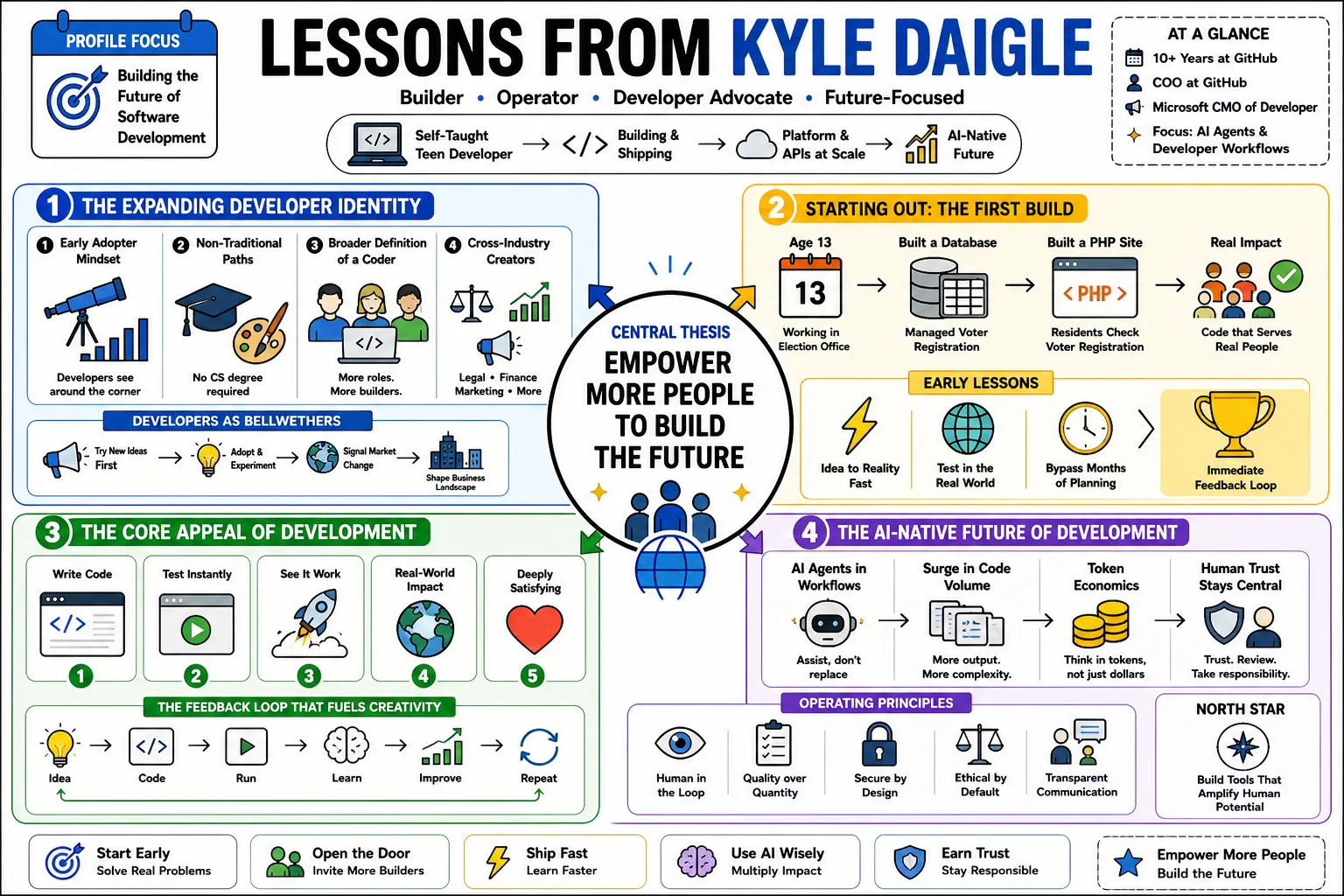
Part 1: The Expanding Developer Identity
- On starting out: Daigle began coding at 13 while working in his town’s election office, building a database and a PHP site that let residents check their voter registration. — Reference: The Future of Programming with Kyle Daigle
- On the core appeal of development: The ability to write code, test an idea instantly in the real world, and bypass months of planning is what makes software engineering uniquely satisfying. — Reference: https://www.datacamp.com/podcast/the-future-of-programming-with-kyle-daigle-coo-at-git-hub
- On non-traditional backgrounds: You do not need a computer science degree to build software; Daigle originally attended art school and wrote code on the side to pay for his education. — Reference: https://every.to/also-true-for-humans/i-interviewed-an-ai-version-of-github-s-coo-then-spoke-to-the-real-one
- On developers as early indicators: "As early adopters of new technologies and practices, developers are often bellwethers of business landscape change." — Source: https://github.blog/news-insights/research/developers-are-the-first-group-to-adopt-ai-at-work-heres-why-that-matters/
- On broadening the definition of a coder: AI tools are enabling professionals in legal, finance, and marketing to build prototypes and applications, effectively turning non-developers into software creators. — Reference: https://every.to/context-window/loops-for-non-coders
- On authentic developer marketing: The best way to communicate technical products is to tell the truth, demonstrate how they work, and then let the product speak for itself. — Reference: GitHub's plan for Agents
- On making software a household skill: People should be able to modify a small application for themselves as comfortably as they might replace a light switch, without needing to become experts in the entire underlying system. — Reference: GitHub's plan for Agents
Part 2: Product Prioritization and Constraints
- On human-readable frameworks: Prioritization should use plain language like MUST, SHOULD, and COULD, as these terms are easier for teams to understand than technical rankings like P0 or P1. — Reference: How to prioritize in the AI era
- On protecting requirements: "You can’t implement a SHOULD or COULD that undermines a MUST." — Source: How to prioritize in the AI era
- On guiding LLMs: The MUST/SHOULD/COULD framework works surprisingly well for writing AI prompts because it provides necessary guardrails without over-specifying how the model should implement the solution. — Reference: How to prioritize in the AI era
- On delegating responsibility: Focus on defining constraints and delegating entire projects rather than assigning specific tasks, which gives teams the freedom to figure out how to deliver the work. — Reference: How to prioritize in the AI era
- On resource limitations: Setting constraints on time or resources breeds creativity by forcing teams to innovate within clear boundaries of success. — Reference: How to prioritize in the AI era
- On pattern recognition as leadership leverage: Former developers in business roles can combine years of domain knowledge with their original pattern-finding and problem-solving instincts, making AI-assisted building unusually powerful for them. — Reference: GitHub's plan for Agents
- On contextualizing atomic skills: A reliable primitive such as summarization should stay small, but its output must be adapted to the audience because an analyst briefing, customer meeting, and marketing review require different emphasis. — Reference: GitHub's plan for Agents
- On editable natural-language tools: AI skills are unusually malleable because a user can inspect them, describe the correction in ordinary language, and immediately change how the tool behaves. — Reference: GitHub's plan for Agents
Part 3: Platform Operations and Internal Tooling
- On scaling the platform: Before transitioning into executive leadership, Daigle spent years as an engineering leader building GitHub's webhooks, API, and the first iteration of GitHub Actions in 2018. — Reference: GitHub's plan for Agents summary
- On the security trade-off: Improving the security posture of developer ecosystems like NPM is difficult because necessary changes, such as modifying two-factor authentication or token policies, often break existing developer workflows. — Reference: GitHub's plan for Agents summary
- On transitioning to business leadership: Moving from engineering to an executive role requires acting as a translation layer, taking developer needs and explaining them effectively to enterprise buyers and business leaders. — Reference: GitHub's plan for Agents transcript
- On remote work: Investing in a development team starts by allowing them to work remotely and operate from wherever they are located. — Reference: Kyle Daigle on investing in developers
- On frictionless internal tooling: When rolling out AI or new tools to employees, the integration will only stick if people do not have to learn a new interface or abandon their existing workflows. — Reference: GitHub's plan for Agents transcript
- On meeting users where they are: Placing an AI support bot directly inside an existing Slack IT help desk channel can significantly reduce support time by eliminating the need for employees to visit a separate documentation portal. — Reference: The Future of Programming with Kyle Daigle
- On dogfooding without a secret version: GitHub runs its own operations on the same platform customers use, so outages affect the company internally and create a direct incentive to fix reliability for everyone. — Reference: GitHub's plan for Agents
- On growth creating new failure modes: Agent-driven activity is not merely adding more users; it is multiplying commits, pull requests, builds, and permissions in ways that expose problems the platform was never designed to encounter. — Reference: GitHub's plan for Agents
- On the unit of work changing: Infrastructure built on the assumption that each push or pull request would remain roughly the same size breaks when agents make every individual event much larger as well as more frequent. — Reference: GitHub's plan for Agents
- On stopping bad scaling investments: When a technology choice fails under new workloads, teams should stop putting good money after bad and rebuild around the rules that now govern the service. — Reference: GitHub's plan for Agents
- On communicating reliability work: Restoring trust requires more than fixing the infrastructure; engineers should explain the technical changes so the community can see how the platform is adapting. — Reference: GitHub's plan for Agents
- On Actions as general-purpose compute: Although GitHub Actions is framed as CI/CD, developers use it for broad processing and automation, so agent growth turns it into a core compute layer rather than a narrow build feature. — Reference: GitHub's plan for Agents
Part 4: AI in Daily Workflows and Leadership
- On returning to code: AI tools have allowed executives to get back into coding by lowering the barrier to writing software and connecting disparate data sources. — Reference: GitHub's plan for Agents summary
- On recursive context: AI models excel at backward-looking tasks, such as parsing a week's worth of transcripts, messages, and notes to summarize patterns and inform future decision-making. — Reference: GitHub's plan for Agents summary
- On personal feedback loops: You can set up a daily AI loop to review a rolling window of your emails and messages, identifying communication patterns and providing constructive feedback on your interactions. — Reference: Loops for Non-coders
- On stealth AI output: It is entirely possible to use an AI agent alongside a database to generate comprehensive executive presentations that appear purposefully unpolished and human-made. — Reference: GitHub's plan for Agents summary
- On atomic micro-skills: The industry is moving away from massive, all-in-one AI skills in favor of incredibly small, targeted micro-skills that execute single functions flawlessly. — Reference: GitHub's plan for Agents summary
- On the changing Chief of Staff role: While AI eliminates the need for staff to manually build slides, it shifts their focus toward uncovering human connections and managing complex executive scheduling opportunities. — Reference: GitHub's plan for Agents summary
- On multiplying personal throughput: A technically fluent leader can run many agents in parallel during otherwise idle time, turning accumulated business expertise into multiple simultaneous experiments. — Reference: GitHub's plan for Agents
- On removing low-value production work: If AI can reliably assemble an internal presentation, the value lies in reviewing and discussing the information—not in spending staff time manually constructing slides. — Reference: GitHub's plan for Agents
- On context beyond the codebase: A useful coding agent needs access to product documents, emails, conversations, dependencies, and business priorities because software decisions have never been made from code alone. — Reference: GitHub's plan for Agents
Part 5: The Economics and Trust of Agent-Generated Code
- On the Copilot UX breakthrough: GitHub Copilot transformed from a powerful model into a useful product by introducing "ghost text," which inserted multi-line suggestions directly into the developer's natural typing flow without disrupting their current workflow. — Reference: The Future of Programming with Kyle Daigle
- On the AI calibration phase: "With any new technology, there is a period of calibration needed to establish best use. We’re still working out what that means for AI." — Source: GitHub COO Kyle Daigle on the secret of good AI
- On maintainer control: As AI-generated contributions flood open source, platforms must offer maintainers building blocks to establish their own acceptance rules rather than imposing a single platform-wide standard. — Reference: I Interviewed an AI Version of GitHub’s COO
- On human trust: Reviewing and merging pull requests remains a fundamentally social problem; despite better AI verification tools, teams still rely heavily on human signals and personal reputation to establish trust in the code. — Reference: GitHub's plan for Agents summary
- On token efficiency: Building practical AI models requires balancing intelligence with operational reality, ensuring that organizations can actually afford the token costs of deploying them at scale. — Reference: Kyle Daigle on models, tokens, agents, and developer calm
- On local model execution: Running smaller, specialized AI models locally on a laptop provides a massive speed advantage when working on tasks that do not require an expensive frontier model. — Reference: Kyle Daigle on models, tokens, agents, and developer calm
- On agentic code volume: The adoption of AI is pushing contribution volumes to unprecedented levels, shifting the baseline from individual human output to one person armed with multiple agents using their context and skills. — Reference: I Interviewed an AI Version of GitHub’s COO
- On costly signals of trust: Financial sponsorship can complement stars and contributor status because spending money to support a project is a harder signal of belief than a frictionless click. — Reference: GitHub's plan for Agents
- On never hiding the code: Low-code tools should reduce the friction of building and running software while keeping the underlying code visible, so new builders retain a path toward deeper understanding and control. — Reference: GitHub's plan for Agents