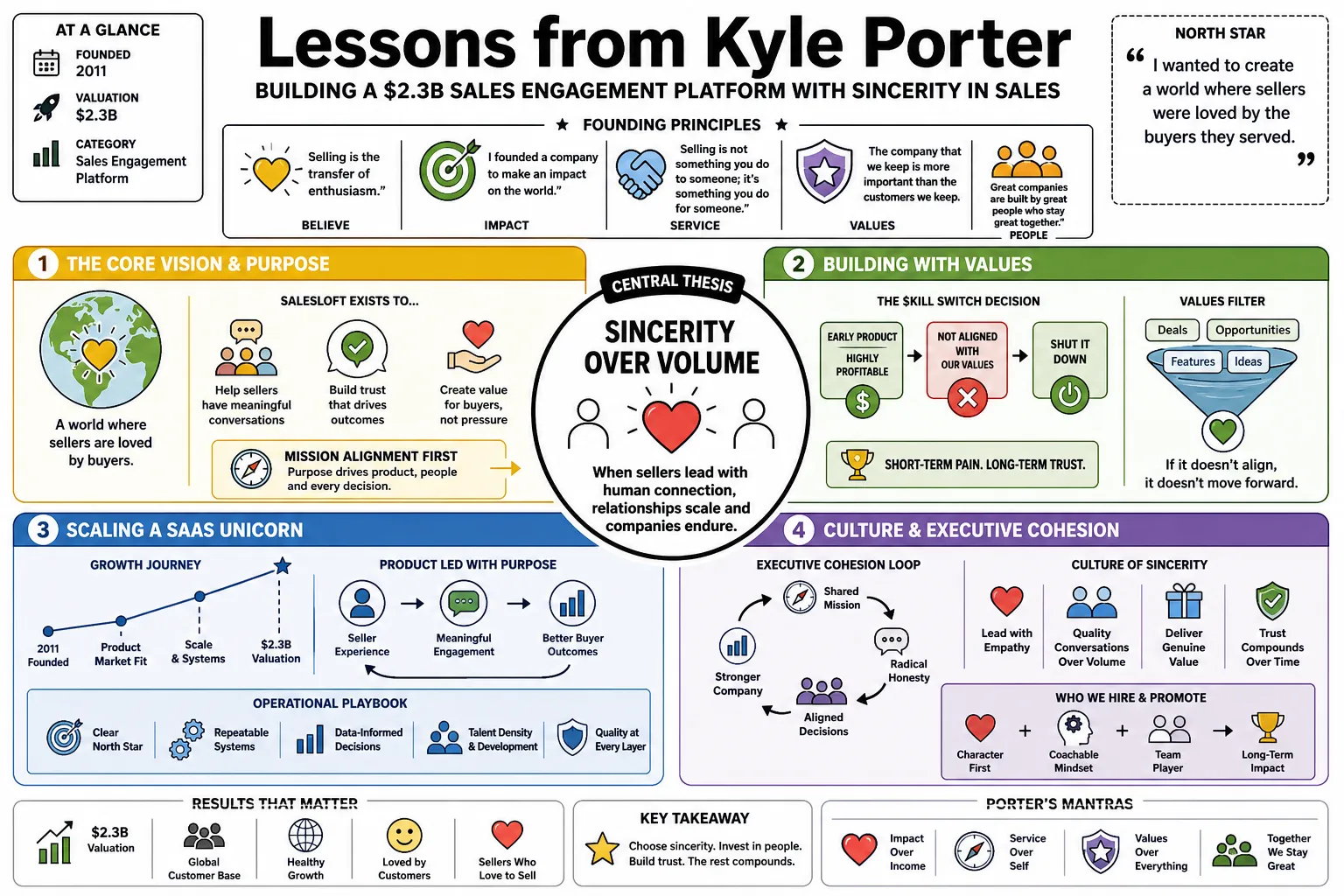
Kyle Porter founded Salesloft in 2011 and built it into a $2.3 billion sales engagement platform by rejecting aggressive outbound tactics in favor of what he termed "sincerity in sales." His operational philosophy relies heavily on organizational health, famously shutting down a highly profitable early product because it failed to align with his values-driven mission. This profile explores his frameworks for scaling a SaaS unicorn, maintaining executive cohesion, and building a culture where sellers prioritize human connection over raw volume.
Part 1: The Core Vision & Purpose
- On the founding mission: "I wanted to create a world where sellers were loved by the buyers they served." — Source: [SaaStr]
- On defining sales: "Selling is the transfer of enthusiasm, and you need to truly believe in what you do to make that happen." — Source: [I See It]
- On intent: "I didn't found a company because I wanted to make money in sales; I founded a company because I knew that a business would be the greatest vehicle that I could create to make an impact on the world." — Source: [Medium]
- On service: "Selling is not something you do to someone; it’s something you do for someone." — Source: [JBarrows]
- On corporate values: "The company that cares the most about the problem they’re solving is going to be the one that wins." — Source: [SaaStr]
- On building trust: "A customer buys you first and then your product." — Source: [SalesWings]
- On meaning in work: "Our founding purpose is to create an environment where others can come to learn more, do more, and become more." — Source: [Forbes]
- On authenticity: "We need to have a more personalized approach to everything we do; the era of 'batch and blast' is over." — Source: [OnePageCRM]
- On long-term focus: "Think long-term and don’t get complacent. Focus your attention on the products that will offer your customer base the most value." — Source: [SaaStr]
- On staying true: "Always stay true to your vision. Every decision should be based on that." — Source: [SaaStr]
Part 2: Organizational Health & Values
- On organizational advantage: A well-oiled machine where people are aligned and happy is harder to replicate than any specific product strategy. — Source: [Substack]
- On core values: A company must distinguish between core, aspirational, permission-to-play, and accidental values to maintain clarity. — Source: [Medium]
- On positive attitudes: Hiring for a constructive, positive attitude is the baseline for building a resilient sales culture. — Source: [YouTube]
- On the Lencioni playbook: Applying Patrick Lencioni’s principles of organizational health from The Advantage was the primary playbook for Salesloft's internal culture. — Source: [SaaStr]
- On internal alignment: The number one requirement for a successful executive team is absolute cohesion. — Source: [SaaStr]
- On repetition: Repetition is persuasion; to make core values stick, a leader must repeat them constantly and reward those who exhibit them. — Source: [GZ Consulting]
- On defining a 'Lofter': Employees should be positive, supportive, self-starting, exceptional, empathetic, and transparent. — Source: [YouTube]
- On permission-to-play values: Honesty and integrity are minimum behavioral standards, not unique differentiators for a company. — Source: [Medium]
- On accidental values: Traits that arise unintentionally must be guarded against if they do not serve the broader mission. — Source: [Medium]
- On shared goals: "Without getting people bought into a larger vision... you'll never get people to do more than their job." — Source: [JBarrows]
Part 3: The Rule of 1% & Continuous Learning
- On learning velocity: "Learn faster than the rate of your experience." — Source: [JBarrows]
- On the 1% Rule: Try to get 1% better every single day, applying an agile mindset to personal development. — Source: [JBarrows]
- On continuous challenge: "Never being set in your own ways... always stretching and challenging yourself to be better." — Source: [SaaStr]
- On limitations: "I believe that we really don't have any limits except for those imposed upon us by ourselves." — Source: [YouTube]
- On agility: "If anyone is comfortable with the status quo right now, I’d be worried for them. Things are changing too fast to not have an agile mindset to business." — Source: [JBarrows]
- On taking the first step: "You can do anything, but not everything. Have a bias towards action—break that big plan into small steps and take the first step right away." — Source: [Medium]
- On seeking mentors: Intentionally seek out mentors and investors who challenge your perspective and expand your belief in what is possible. — Source: [YouTube]
- On early failure: The company's near-failure in its first year was the necessary reset to build a scalable foundation. — Source: [Substack]
- On the wake-up call: Getting arrested in college served as a critical inflection point that forced a complete reevaluation of his trajectory. — Source: [Forbes]
Part 4: Sincerity in Sales & Buyer Centricity
- On buyer friction: "Selling is hard, but buying enterprise solutions is even harder." — Source: [SaaStr]
- On the primary directive: The ultimate goal is to "be the best place to be a customer of." — Source: [SaaStr]
- On sales sincerity: "Sincerity in sales" means the best sales professionals genuinely care about solving the customer's problem. — Source: [SaaStr]
- On connection: Move away from Always Be Closing to Always Be Connecting, building a reputation that serves the buyer. — Source: [SalesWings]
- On the role of AI: "The best AI vendors are the ones who walk a mile in the salesperson's shoes, and great AI results in better humanity." — Source: [Transistor]
- On human limitations: "When you're looking for shortcuts to crush your number and smash your quota out of the water, you forget about the human part of sales." — Source: [Transistor]
- On in-person events: "I don't look at Dreamforce as a place for learning and best practices. I look at it as the best opportunity to deepen customer relationships." — Source: [Medium]
- On empathy in outreach: Every sales conversation must be mapped directly to solving a customer's specific business problem. — Source: [SlideShare]
- On the digital assistant: The future of sales technology is providing every seller with a digital assistant that removes administrative burden. — Source: [GZ Consulting]
- On email personalization: Research shows that approximately 20% customization is the optimal amount of personalization for sales emails. — Source: [Medium]
Part 5: The Sales Machine & Execution Cadence
- On the 7x7 cadence: Implement a predictable prospecting model requiring seven attempts for each new prospect over seven days. — Source: [Medium]
- On human and machine: Use technology strictly to augment the human element of sales, never to replace it entirely. — Source: [SlideShare]
- On the BDR role: The Business Development Representative is the fundamental engine for building predictable pipeline. — Source: [Forbes]
- On momentum: Build sales momentum by identifying and focusing on high-probability, quick-turnaround opportunities. — Source: [YouTube]
- On scientific execution: "Test everything. Figure out scientifically which days and times are best to make calls." — Source: [JBarrows]
- On the engagement layer: A CRM is a database of record, but teams need an engagement layer to manage human interactions repeatably. — Source: [I See It]
- On focused attention: "Fight the daily war against distraction and non-urgent fire drills. Focus exclusively on what's most important to your pipeline." — Source: [Medium]
- On content sharing: "Don’t just share e-books and webinars—advise what pages to check out or what minutes to watch." — Source: [OnePageCRM]
- On data-driven outbound: Old-school prospecting must be entirely replaced by data-driven, systematic outreach cadences. — Source: [Transistor]
- On structural specialization: Segmenting the sales floor into specialized roles is required to achieve 400% of quota. — Source: [SlideShare]
Part 6: Leadership, Vulnerability & "Love"
- On leading with love: "Love Always Wins" means a commitment to platonic love and service to both employees and customers. — Source: [Forbes]
- On internal culture: "We show love to our people so they can share that sentiment with our customers." — Source: [Forbes]
- On transparency: "The more real and transparent you are with people, the more real and transparent they will be with you." — Source: [I See It]
- On vulnerability: Sharing childhood insecurities and past mistakes with new employees builds a culture of trust and transparency. — Source: [Substack]
- On servant leadership: The role of a leader is to provide the vision and then actively remove obstacles so the team can execute. — Source: [Forbes]
- On communication: Use tools like the One-Page Strategic Plan and Weekend Updates to maintain rigorous internal alignment. — Source: [ForceRank]
- On shared success: "We're going to continually love and serve our customers and our people better than anyone else. And when you care more than anyone else, you're going to win ultimately." — Source: [Medium]
- On painting the picture: "As leaders, we need to paint the vision and then help everyone understand how they fit into that vision and what their part is." — Source: [JBarrows]
- On public accountability: Using public dashboards drives performance and allows the team to celebrate wins openly. — Source: [SlideShare]
Part 7: Scaling, Strategy, & The Pivot
- On the $7M pivot: "We built a platform that would allow you to build accurate and targeted lists... but what we didn’t like is that companies were using those big lists... and just hammering out their customers." — Source: [SaaStr]
- On ethical product choices: "We weren't making the decision to try to hit a number next quarter... we were making it because it didn't match up with the vision for the company." — Source: [SaaStr]
- On shutting down features: Mothballing an early, successful email-guessing feature was necessary because it compromised sales authenticity. — Source: [JBarrows]
- On selecting investors: Prioritize alignment and expertise over valuation when fundraising; choose partners who push you to think bigger. — Source: [YouTube]
- On revenue mix: As a company scales, aim for at least a 50/50 mix of growth from new logos versus the existing base. — Source: [SaaStr]
- On the boxes model: When scaling, either aggressively develop the person in a specific organizational box or find the right external person to fill it. — Source: [SaaStr]
- On building on sand: Relying entirely on another platform's data is an unsustainable foundation for a SaaS business. — Source: [YouTube]
- On acknowledging failure: Holding a formal internal wake for retired products helps the team process a pivot and move forward collectively. — Source: [JBarrows]
- On outside capital: Bringing in venture firms was about buying operational expertise, not just extending runway. — Source: [YouTube]
Part 8: Customer Obsession & Retention
- On treating customers: "When a customer bought Salesloft, I had the mentality that they had just saved my life and I was going to treat them as such." — Source: [Medium]
- On the north star metric: "Gross revenue retention (GRR) is the north star metric" because it measures if a product is truly essential before upsells. — Source: [SaaStr]
- On identifying friction: In the early days, physically watching sales reps use the product was the fastest way to identify UX friction points. — Source: [SaaStr]
- On continuous dialogue: "Keep an open dialogue with your customers for the lifetime of the business. If you don’t understand them, you won’t offer the most value." — Source: [SaaStr]
- On problem obsession: "Really obsessing over the problem you solve is the first and foremost most critical thing that founders need to do." — Source: [SaaStr]
- On crisis support: During the pandemic, shifting the corporate message to a simple statement of support was more important than pipeline generation. — Source: [Salesloft]
- On product value: The ultimate test of a sales tool is whether it makes the seller a more valuable consultant in the eyes of the buyer. — Source: [GZ Consulting]
- On the customer experience: A superior customer experience is the natural, downstream result of genuinely caring for your team's growth. — Source: [YouTube]