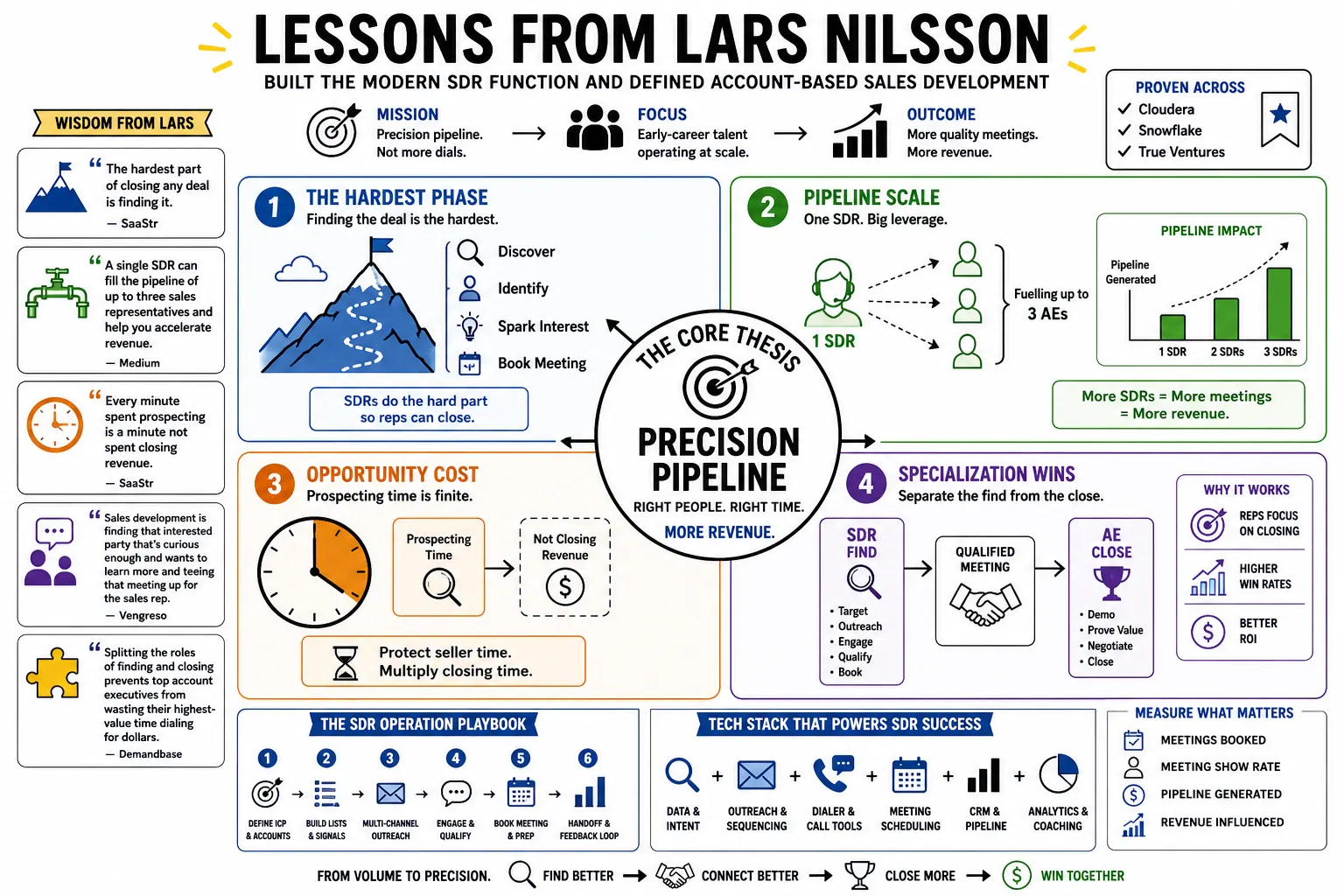
Lessons from Lars Nilsson
Lars Nilsson built the modern Sales Development Representative (SDR) function and defined Account-Based Sales Development. Across his time at Cloudera, Snowflake, and True Ventures, he turned pipeline generation from a volume-heavy cold calling grind into a precise operation. This collection unpacks his specific playbooks for managing early-career sales talent and building the technology stacks that support them.
Part 1: The Foundation of Sales Development
- On the Hardest Phase: "The hardest part of closing any deal is finding it." — Source: SaaStr
- On Pipeline Scale: "A single SDR can fill the pipeline of up to three sales representatives and help you accelerate revenue." — Source: Medium
- On Opportunity Cost: "Every minute spent prospecting is a minute not spent closing revenue." — Source: SaaStr
- On the Core Function: "Sales development is finding that interested party that’s curious enough and wants to learn more and teeing that meeting up for the sales rep." — Source: Vengreso
- On Specialization: Splitting the roles of finding and closing prevents top account executives from wasting their highest-value time dialing for dollars. — Source: Demandbase
- On SDR Importance: SDRs execute the most important role in the sales function because they are responsible for the top-of-funnel pipeline that fuels the entire organization. — Source: Medium
- On Pipeline Creation: Building pipeline requires a completely different mindset and operational cadence than negotiating and closing. — Source: FoxReach
- On Predictable Revenue: You cannot build a predictable, scalable revenue engine without first building a predictable, scalable prospecting engine. — Source: True Ventures
- On Role Evolution: The SDR role has moved from a basic telemarketing job to a highly specific, strategic position requiring intense data literacy. — Source: Modern Sales Pros
Part 2: Account-Based Sales Development (ABSD)
- On ABSD Definition: Account-Based Sales Development shifts outbound from spray-and-pray to a coordinated, personalized campaign targeting a specific set of high-value accounts. — Source: SaaStr
- On Target Addressable Market: SDR teams must operate from a tightly defined TAM rather than working loosely defined territories with generic messaging. — Source: True Ventures
- On Multi-Persona Targeting: You must map the account and reach out to multiple stakeholders across various departments simultaneously, rather than relying on a single point of contact. — Source: Modern Sales Pros
- On Hyper-Personalization: The best outreach uses immediate signals, like funding rounds or executive changes, to craft messages that speak directly to a recipient's specific pain points. — Source: 6sense
- On Bridging the Gap: ABSD acts as the bridge spanning the dead zone between marketing-led ABM campaigns and actual sales execution. — Source: Demandbase
- On Quality Over Quantity: Success in ABSD is measured by the quality of engagement within target accounts, bypassing the sheer volume of emails sent. — Source: SaaStr
- On Warm Accounts: SDRs should prioritize accounts that have already been warmed up by marketing and intent signals before attempting cold outreach. — Source: 6sense
- On Smarketing: Marketing and sales must work the exact same accounts at the exact same time using the exact same data to generate serious pipeline. — Source: Medium
- On Account Strategy: The SDR quarterbacks the initial campaign to break into the account, securing the beachhead before handing the strategy over to the Account Executive. — Source: FoxReach
Part 3: Talent Acquisition & Hiring
- On the Primary Hiring Trait: "Hire for fire in the belly. You can teach anyone how to qualify leads or present, but you can’t teach how to get up in the morning with a great attitude and get after it." — Source: SaaStr
- On Career Pathing: "If you don’t have a place for an SDR to go in your company, and the SDR to AE jump is too far, you’re going to lose them." — Source: Modern Sales Pros
- On Untapped Potential: The best SDR candidates often come from non-traditional backgrounds; you are looking for resilience and coachability rather than a perfect resume. — Source: Rise Science
- On Interviewing: When interviewing entry-level talent, focus on their response to failure and their ability to internalize feedback quickly. — Source: True Ventures
- On Building the Bench: A well-run SDR organization serves as the internal farm system for the entire company's future leadership. — Source: Medium
- On Attitude: Sales development is a high-rejection environment, making an inherently positive attitude a non-negotiable hiring requirement. — Source: Vengreso
- On Teaching Hard Skills: Product knowledge and tool proficiency can be trained in weeks; internal drive cannot be trained at all. — Source: Demandbase
- On Retention: Providing a clear, documented timeline for promotion is the only way to retain top SDR talent in a competitive market. — Source: FoxReach
- On Early Exits: If an SDR lacks the underlying grit required for the role, it is better to manage them out quickly than to drag out their tenure. — Source: True Ventures
- On Talent Pipelines: Treat your SDR recruiting funnel with the same measurement and exactness that you apply to your revenue pipeline. — Source: SaaStr
Part 4: The Sales Development Academy Model
- On Frontline Managers: "I hope this is the start of a new trend, and that is to take onboarding and enablement off of the shoulders of your frontline SDR leaders because that is a heavy lift." — Source: Modern Sales Pros
- On Academy Mission: "The Sales Development Academy is the talent pipeline for the future leadership of Snowflake and the tech industry as a whole." — Source: FoxReach
- On Ramp Time: A structured, intensive academy model can cut SDR ramp time from the industry average of three to six months down to just two to four weeks. — Source: Vengreso
- On Training Quality: "Our ambition is to provide nothing less than the life-changing experience I received at Xerox over three decades ago." — Source: Rise Science
- On Continuous Learning: The academy model shouldn't stop after onboarding; it requires a continuous, multi-month curriculum to prepare reps for the enterprise AE role. — Source: Medium
- On Dedicated Enablement: Companies need dedicated enablement professionals whose sole job is to train new reps, completely separating teaching from daily quota management. — Source: True Ventures
- On Standardization: An academy ensures every single rep learns the exact same messaging, tool stack, and qualification criteria, removing the variance of individual managers. — Source: Demandbase
- On Cohort Bonding: Hiring and training SDRs in distinct cohorts builds internal networks and peer-to-peer accountability that outlasts the onboarding period. — Source: SaaStr
- On the Payoff: Funding an initial four-week bootcamp pays massive dividends in long-term retention and early pipeline contribution. — Source: Modern Sales Pros
Part 5: The Modern Sales Tech Stack
- On Technology Quotient (TQ): Sales organizations must prioritize TQ, buying the best tools to remove manual friction from the prospecting process. — Source: 6sense
- On Stack Investment: World-class SDR operations often require spending around a thousand dollars per rep per month purely on their software stack. — Source: Medium
- On Removing Complexity: "We have taken a lot of the complexity from a salesperson and built this stack of technology and process, we can hand it to just about anyone and just say, 'Go do it.'" — Source: Medium
- On Intent Data: Tools like 6sense are non-negotiable for identifying which accounts are actively researching solutions before they ever fill out an inbound form. — Source: 6sense
- On Lead Routing: Implementing a strict lead conversion and routing engine ensures that no inbound signal is ever dropped or assigned to the wrong rep. — Source: SaaStr
- On Automation Limits: Technology should be used to automate the administrative burden, preserving the human warmth required in direct prospect communication. — Source: Rise Science
- On CRM Friction: If a process takes twenty clicks in Salesforce, operations must find a way to engineer it down to ten clicks or fewer. — Source: Demandbase
- On Data Intelligence: Accurate data providers like ZoomInfo and LinkedIn Sales Navigator are the baseline requirement for any account mapping strategy. — Source: FoxReach
- On Execution Speed: Incorporating automated dialers allows reps to navigate phone trees instantly, saving hours of dead time every week. — Source: Vengreso
- On System Integration: A tech stack only works if all the tools natively talk to each other and feed data back into the central CRM without requiring manual data entry. — Source: True Ventures
Part 6: Pipeline and Compensation Mechanics
- On Core Compensation: "Pay SDRs for what they can control." — Source: Sendoso
- On Unfair Quotas: "Tying comp and reaching quota to something that you have very little control over or no control over is a pain point." — Source: Vengreso
- On the Value of Discovery: "You can't pay for that information. That is valuable. So, pay the SDR on that." — Source: Sendoso
- On Driving Behavior: "Do spend time designing a comp plan that will drive the right behavior. By putting a plan together that focuses on a single activity, you avoid your sales reps picking and choosing what compensated activity they are best at, and ignoring the rest." — Source: True Ventures
- On Metric Focus: SDR compensation should primarily be tied to the generation of qualified meetings, rather than final closed-won revenue which depends heavily on the AE. — Source: Tom Tunguz
- On Spiffs: Use short-term financial spiffs to reward SDRs when a meeting successfully converts into an accepted pipeline opportunity. — Source: SaaStr
- On Pipeline Contribution: At high-performing companies, the SDR team generates roughly 65 to 70 percent of the total new business pipeline. — Source: Modern Sales Pros
- On Activity Traps: Do not compensate SDRs purely for volume metrics like calls made or emails sent, as it incentivizes sloppy work over deep account penetration. — Source: Medium
- On Funnel Mechanics: If an SDR uncovers account intelligence but the deal doesn't close immediately, they still delivered value to the business and should be rewarded. — Source: Demandbase
- On Clear Rules: A compensation plan must be simple enough that an SDR can calculate their exact paycheck at any point in the month without asking finance. — Source: FoxReach
Part 7: SDR and Account Executive Alignment
- On the Golden Ratio: A standard ratio of one SDR to three Account Executives works well for mid-market, but moving toward a one-to-two ratio aggressively drives enterprise pipeline. — Source: Modern Sales Pros
- On the AE's Responsibility: The Account Executive must actively guide the SDR's account strategy rather than passively waiting for meetings to appear on their calendar. — Source: Vengreso
- On the One-Two Punch: The SDR and AE must operate as a unified front, presenting a seamless transition to the prospect after the initial meeting is booked. — Source: Demandbase
- On Mutual Accountability: AEs owe their SDRs immediate, constructive feedback on the quality of every single meeting that is passed over. — Source: SaaStr
- On Pipeline Rejection: It is ultimately up to the account executives whether or not they are going to accept a meeting into their formal pipeline, demanding tight alignment on qualification criteria. — Source: Sendoso
- On Strategic Planning: AEs and SDRs should hold dedicated weekly syncs to review target accounts, map out new personas, and refine messaging. — Source: FoxReach
- On Territory Management: An SDR cannot succeed if the AE assigns them a territory that lacks a realistic target addressable market. — Source: True Ventures
- On Closing the Loop: When an AE closes a deal, they must publicly recognize the SDR who initially sourced the account to reinforce the partnership. — Source: Medium
- On Role Clarity: The SDR opens the door and qualifies the pain; the AE diagnoses the problem and prescribes the solution. — Source: 6sense
Part 8: Sales Leadership & The Human Element
- On Dedicated Ops: "In my opinion, you need a lot more dedicated ops for SDRs than you do for account execs." — Source: Vengreso
- On the Human Element: "Be Authentic, Be Human, Build Good People." — Source: Rise Science
- On Managerial Focus: Frontline managers must be on the floor coaching live calls and strategizing, rather than bogged down by administrative tasks and CRM hygiene. — Source: Modern Sales Pros
- On Caring: While technology provides a force multiplier, genuine caring and human connection remain the foundation of sales success. — Source: Rise Science
- On Sales Culture: A high-performance culture requires transparency, rigorous training, and a deep respect for the difficulty of the prospecting role. — Source: True Ventures
- On Mentorship: Senior sales leaders have a responsibility to mentor entry-level talent, ensuring the next generation learns the fundamentals of enterprise selling. — Source: Medium
- On Burnout Prevention: Leaders must actively monitor SDR activity and well-being, as the repetitive nature of outbound sales makes burnout a constant threat. — Source: Demandbase
- On Building Trust: Trust between a manager and an SDR is forged through working difficult accounts together and sharing the sting of rejection. — Source: FoxReach
- On the Ultimate Goal: The objective of an SDR organization is to hit this quarter's pipeline targets while systematically manufacturing the future top performers of the company. — Source: SaaStr