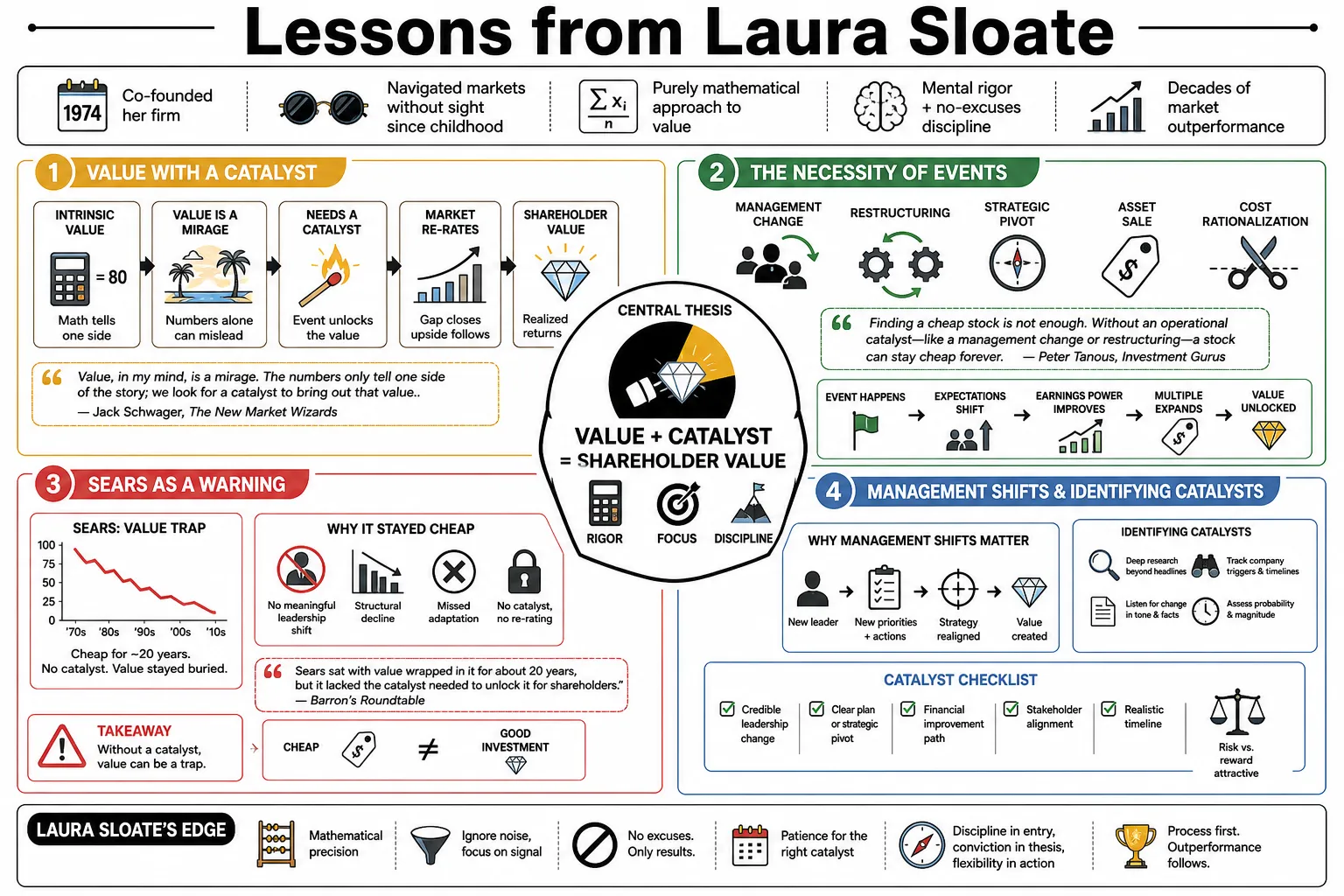
Lessons from Laura Sloate
Laura Sloate co-founded her firm in 1974, building a career as a top Wall Street analyst while navigating the markets without sight since childhood. She traded visual charts and management stories for a purely mathematical approach to value. This profile examines the mental rigor and "no-excuses" discipline that fueled her decades of market outperformance.
Part 1: Value with a Catalyst
- On value requiring a catalyst: Sloate argues that statistical cheapness is not enough; value becomes actionable only when a catalyst can bring it out. — Reference: Peter Tanous, Investment Gurus, Laura J. Sloate interview
- On the necessity of catalysts: Cheap stocks can remain cheap for years unless management change, restructuring, or a secular shift forces the market to revalue the business. — Reference: Peter Tanous, Investment Gurus, Laura J. Sloate interview
- On Sears as a warning: Sloate uses Sears as an example of value that could sit unrealized for decades when there is no catalyst to unlock it. — Reference: Peter Tanous, Investment Gurus, Laura J. Sloate interview
- On management shifts: A new leader or restructuring can turn an overlooked value situation into something the market can actually recognize and price. — Reference: Peter Tanous, Investment Gurus, Laura J. Sloate interview
- On identifying catalysts: Her process looks for specific events -- management changes, restructurings, or secular shifts -- that can make hidden value visible. — Reference: Peter Tanous, Investment Gurus, Laura J. Sloate interview
- On institutional inertia: Without a forcing event, weak industries and underperforming companies can keep drifting instead of restructuring toward profitability. — Reference: Peter Tanous, Investment Gurus, Laura J. Sloate interview
- On story versus catalyst: Sloate's value discipline is not about buying a good story; it is about tying a thesis to concrete events that can change business value. — Reference: Peter Tanous, Investment Gurus, Laura J. Sloate interview
- On corporate restructuring: Sloate evaluates whether capital is actually earning more than it costs; if not, the business is under-earning or poorly managed. — Reference: Peter Tanous, Investment Gurus, Laura J. Sloate interview
- On hidden assets: Sloate's catalyst lens applies to overlooked assets as well as earnings; hidden value matters only when management has a credible way to unlock it. — Reference: Peter Tanous, Investment Gurus, Laura J. Sloate interview
- On the catalyst checklist: Before buying, the practical question is what specific event could make other investors revalue the company within a reasonable time horizon. — Reference: Peter Tanous, Investment Gurus, Laura J. Sloate interview
Part 2: The Discipline of Risk and Selling
- On the 15 percent rule: Sloate says her firm originally used a 15 percent sell discipline to prevent portfolio meltdowns, then later evolved it into a prompt to recheck assumptions before deciding whether to sell or add. — Reference: Peter Tanous, Investment Gurus, Laura J. Sloate interview
- On cutting losses: Her sell discipline is designed to stop a single collapsing position from consuming attention, confidence, and performance. — Reference: Peter Tanous, Investment Gurus, Laura J. Sloate interview
- On Sun America as a lesson: Sloate points to Broad, later Sun America, as the painful position that helped shape her sell-discipline thinking after it fell sharply before recovering. — Reference: Peter Tanous, Investment Gurus, Laura J. Sloate interview
- On thesis checks: When a position moves against her, Sloate's process is to revisit the assumptions and ask whether the facts justify selling, holding, or increasing the position. — Reference: Peter Tanous, Investment Gurus, Laura J. Sloate interview
- On avoiding meltdowns: The point of sell discipline is not mechanical panic; it is avoiding the one or two positions that can erode focus and damage a whole portfolio. — Reference: Peter Tanous, Investment Gurus, Laura J. Sloate interview
- On emotional selling: Sloate frames selling as a disciplined review of evidence, not an emotional reaction to price movement. — Reference: Peter Tanous, Investment Gurus, Laura J. Sloate interview
- On position sizing: Sloate's process is built around preventing one position from overwhelming the portfolio or distracting the team from disciplined research. — Reference: Peter Tanous, Investment Gurus, Laura J. Sloate interview
- On avoiding hope as a strategy: Her sell discipline is meant to force a fresh look at assumptions instead of waiting passively for a damaged position to recover. — Reference: Peter Tanous, Investment Gurus, Laura J. Sloate interview
- On volatility: Sloate treats volatility as a reason to recheck facts and assumptions, not as permission to abandon discipline. — Reference: Peter Tanous, Investment Gurus, Laura J. Sloate interview
- On re-evaluating after a drawdown: When a stock falls, Sloate asks why it is down and whether the evidence now argues for selling, waiting, or increasing the position. — Reference: Peter Tanous, Investment Gurus, Laura J. Sloate interview
Part 3: Mastery through Mental Models and Focus
- On focused coverage: Sloate argues that she is not trying to beat the whole market; she is trying to know a focused set of roughly 50 to 70 stocks well enough to have superior insight. — Reference: Peter Tanous, Investment Gurus, Laura J. Sloate interview
- On staying in your circle: "Stay with what you know. Improve what you know, always keep improving, but stay with it." — Source: Peter Tanous, Investment Gurus, Laura J. Sloate interview
- On avoiding technology stocks: "We don’t know who is going to come down the pike tomorrow morning with a better widget or gizmo, and our stock will be down 30%, and we’ll have no idea what to do." — Source: Peter Tanous, Investment Gurus, Laura J. Sloate interview
- On memory and information intake: Sloate describes using memory, tactile cues, readers, and computer tools to process reports and market information with unusual concentration. — Reference: Peter Tanous, Investment Gurus, Laura J. Sloate interview
Part 4: Analytical Rigor and EVA
- On book value: Sloate warns that book value can be misleading after restructurings, write-downs, and buybacks, so asset value has to be tested against the business context. — Reference: Peter Tanous, Investment Gurus, Laura J. Sloate interview
- On EVA: Her process uses Economic Value Added to ask whether a company earns more on capital than that capital costs. — Reference: Peter Tanous, Investment Gurus, Laura J. Sloate interview
- On true profitability: Sloate likes EVA because it counts the cost of working capital, inventory, and other capital employed rather than letting accounting earnings hide weak returns. — Reference: Peter Tanous, Investment Gurus, Laura J. Sloate interview
- On Street research: She treats Wall Street research as useful background and consensus information, while staying alert to investment-banking incentives behind the opinions. — Reference: Peter Tanous, Investment Gurus, Laura J. Sloate interview
- On consensus: Sloate wants to know what the Street believes because consensus is already reflected in price; the edge comes from knowing when not to follow it. — Reference: Peter Tanous, Investment Gurus, Laura J. Sloate interview
Part 5: Career Independence and Resilience
- On early apprenticeship: Sloate describes learning the market by paying readers out of a tiny analyst salary and teaching herself accounting and financial analysis on the job. — Reference: Peter Tanous, Investment Gurus, Laura J. Sloate interview
- On independence: Her decision to start Sloate, Weisman came after seeing how large-firm management pressure and commission incentives could distort research judgment. — Reference: Peter Tanous, Investment Gurus, Laura J. Sloate interview
Part 6: Information Processing and the Edge of Blindness
- On tactile memory: Sloate describes recognizing annual reports by how their covers feel and remembering where individual reports sit in a stack. — Reference: Peter Tanous, Investment Gurus, Laura J. Sloate interview
- On research volume: Her team reads trade journals, daily newspapers, company documents, Wall Street research, and large amounts of market material to build context. — Reference: Peter Tanous, Investment Gurus, Laura J. Sloate interview
- On assistive technology: Her office used electronic news and quote systems, readers, cassettes, scanning, and text-to-speech software to turn information access into a working system. — Reference: Peter Tanous, Investment Gurus, Laura J. Sloate interview
Part 7: Portfolio Management and Concentration
- On studying mistakes: Sloate says her team studies mistakes rather than victories because mistakes reveal where the process can improve. — Reference: Peter Tanous, Investment Gurus, Laura J. Sloate interview
- On focus: She frames focus as the quality that separates durable investors from managers who wander away from what they do best. — Reference: Peter Tanous, Investment Gurus, Laura J. Sloate interview
- On avoiding false hedges: Sloate avoids options, commodities, and portfolio insurance when she does not understand the mechanics well enough to trust them under stress. — Reference: Peter Tanous, Investment Gurus, Laura J. Sloate interview
- On management quality: She evaluates management through track record, responsiveness to changing conditions, disciplined growth, and whether annual-report claims line up with returns. — Reference: Peter Tanous, Investment Gurus, Laura J. Sloate interview
- On sum-of-the-parts value: Her FMC example shows how she compares business segments to peer multiples and asks whether the downside is limited before buying. — Reference: Peter Tanous, Investment Gurus, Laura J. Sloate interview
- On local knowledge: Her Hilton example shows the value of knowing a focused business well enough to connect company-specific events to earnings before the market does. — Reference: Peter Tanous, Investment Gurus, Laura J. Sloate interview
Part 8: Case Studies and Craft
- On Comsat: Sloate's Comsat thesis was not a simple earnings story; it was an asset-redeployment thesis tied to satellite systems, privatization, and mismanaged noncore assets. — Reference: Peter Tanous, Investment Gurus, Laura J. Sloate interview
- On teaching and craft: Near the end of the interview, Sloate describes teaching at Columbia and loving the investing craft enough to work at it seven days a week. — Reference: Peter Tanous, Investment Gurus, Laura J. Sloate interview