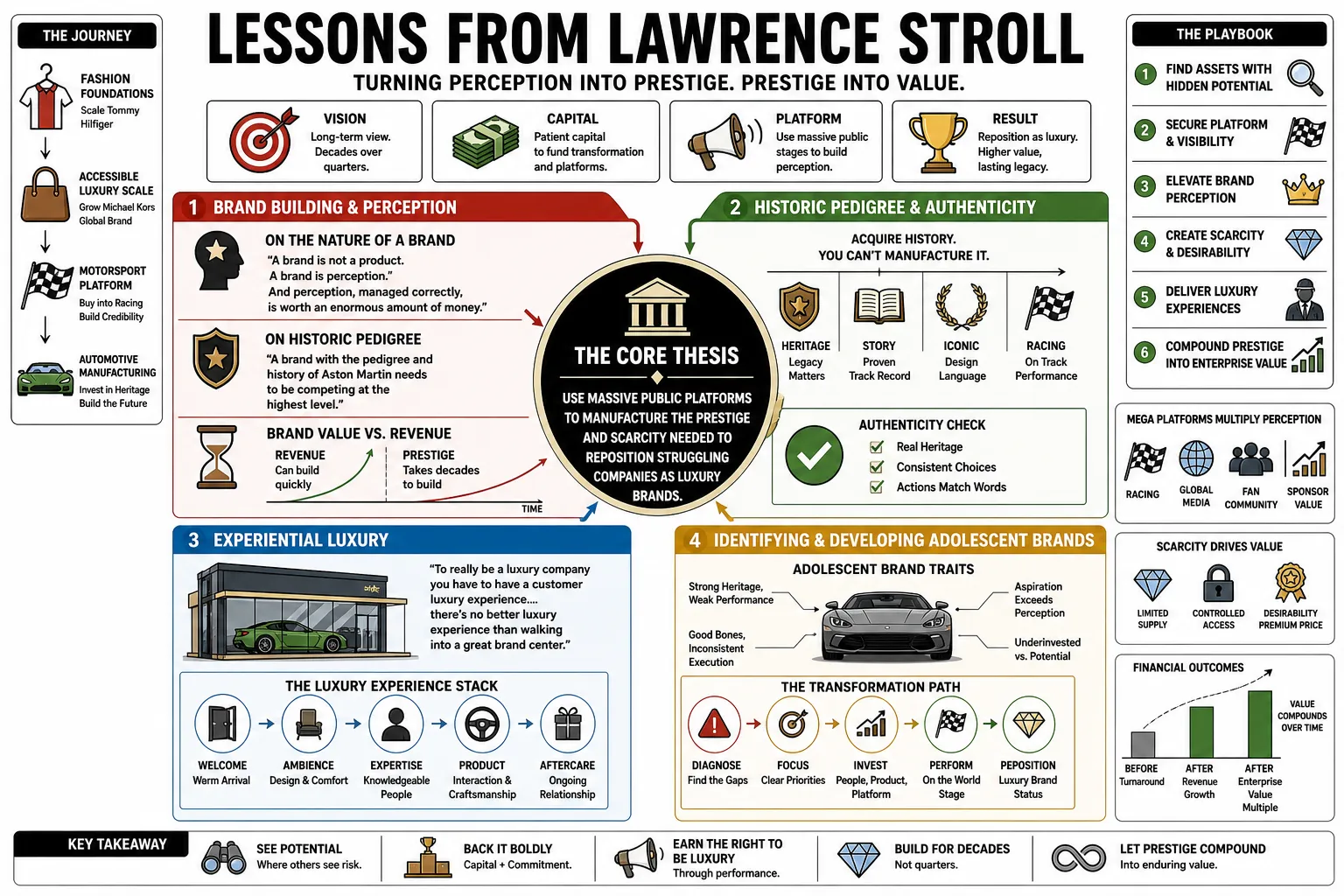
Lessons from Lawrence Stroll
Canadian billionaire Lawrence Stroll built his fortune scaling Tommy Hilfiger and Michael Kors before directing his capital toward motorsport and automotive manufacturing. His core playbook relies on using massive public platforms to manufacture the prestige and scarcity needed to reposition struggling companies as luxury brands. This profile breaks down the financial and operational mechanics behind those turnarounds.
Part 1: Brand Building and Perception
- On the Nature of a Brand: "A brand is not a product. A brand is perception. And perception, managed correctly, is worth an enormous amount of money." — Source: [Biz of Speed]
- On Historic Pedigree: "A brand with the pedigree and history of Aston Martin needs to be competing at the highest level." — Source: [Aston Martin F1]
- On Brand Value vs. Revenue: You can build revenue quickly, but building a brand's prestige takes decades; you acquire history because it cannot be manufactured overnight. — Source: [Financial Times]
- On Experiential Luxury: "To really be a luxury company you have to have a customer luxury experience... there's no better luxury experience than walking into a great brand center." — Source: [CNBC]
- On Identifying Adolescent Brands: The greatest returns come from finding brands with high cultural pedigree that have not yet scaled their operational footprint. — Source: [Forbes]
- On Lifestyle Branding: Consumers buy access to a specific, highly curated lifestyle that the brand represents, rather than just purchasing a piece of clothing or a vehicle. — Source: [Business of Fashion]
- On the Cost of Brand Equity: "I'm a brand guy. I know how much it costs and how long it takes to build a brand." — Source: [Autocar]
- On Protecting the Name: Never allow a luxury brand name to be dragged through the mud; integrity and public perception are the ultimate moats. — Source: [Netflix]
- On Celebrity Partnerships: High-profile endorsements act as a direct transfer of cultural equity to a mid-tier brand to elevate its public status. — Source: [Wall Street Journal]
- On Emotional Acquisition: "To own [Aston Martin] is the biggest dream in the world, a fantasy." — Source: [Autocar]
Part 2: The Logic of Luxury and Scarcity
- On the Core of Luxury Economics: "The first thing I did [was] aligning demand with supply and really turning this into operating as a true luxury business." — Source: [CNBC]
- On Build-to-Order Manufacturing: True luxury companies do not produce cars to sit on dealer lots; they manufacture strictly to customer orders to guarantee scarcity. — Source: [Financial Times]
- On the Ferrari Benchmark: "Ferrari has a business making 14,000 cars a year... and they're worth about £90 billion. Can you imagine what the potential value might be?" — Source: [Autocar]
- On Volume vs. Exclusivity: Chasing volume destroys luxury; disciplined volume growth coupled with improved profitability is the only sustainable path for high-end goods. — Source: [Bloomberg]
- On Personalization: The ultimate expression of luxury is unlimited personalization, allowing the customer to feel they are co-creating a one-of-a-kind artifact. — Source: [CNBC]
- On Pricing Power: When demand consistently outstrips supply, pricing power becomes absolute, shifting the business from selling a product to allocating an allocation. — Source: [The Economist]
- On Artificial Scarcity: You must always produce one less unit than the market demands to maintain the brand's mystique and desirability. — Source: [Forbes]
- On Avoiding Discounts: Never discount luxury items, as it immediately signals a compromise in value and erodes the perception that justifies the premium. — Source: [Business Insider]
- On Aspirational Reach: A luxury brand must be highly visible to the masses but accessible only to the few; the gap between desire and access creates the value. — Source: [Wall Street Journal]
- On Luxury Turnarounds: You cannot cost-cut your way to luxury; you must invest heavily to elevate the product until it commands the price point you need. — Source: [Autocar]
Part 3: Formula 1 as a Global Marketing Engine
- On F1's Audience Scale: "This sport has 2.3 billion watchers a year. What better platform could there be for marketing a road car company globally?" — Source: [Autocar]
- On the Halo Effect: "Formula One has really been transformative for us as a marketing tool... it's an extremely aspirational event and has a trickle-down effect over the whole brand." — Source: [CNBC]
- On Customer Acquisition: "50 percent of the consumers today buying our product were not Aston Martin customers before seeing us in Formula One." — Source: [CNBC]
- On Synergistic Marketing: Formula 1 acts as the most efficient global billboard for high-performance automotive engineering. — Source: [PlanetF1]
- On Racing vs. Stickers: Buying a team offers fundamentally more control and brand integration than paying to put a sticker on someone else's car. — Source: [Autocar]
- On Weekend Activations: F1 weekends operate as localized, high-density networking and sales events for the ultra-wealthy. — Source: [Financial Times]
- On Track-to-Road Technology: The credibility of a high-performance road car must be validated by the technology and success achieved on the F1 grid. — Source: [Aston Martin F1]
- On Global Prestige: Competing in Formula 1 instantly signals to the market that a brand belongs in the upper echelon of global engineering. — Source: [Beyond the Grid]
- On Dominating Sunday: Winning on the track on Sunday directly correlates to moving inventory on Monday. — Source: [Motorsport.com]
- On Continuous Visibility: A 24-race calendar provides year-round, global exposure that traditional advertising campaigns could never affordably replicate. — Source: [The Race]
Part 4: Acquisition and Turnaround Strategy
- On Spotting Potential: "By finding the right partners, making big bets on ambitious designers, and relentlessly pushing to grow." — Source: [Forbes]
- On Rescue Missions: "Sadly, the company had got into financial difficulties and needed a big injection of cash, but for a dream like this I was prepared to do it." — Source: [Autocar]
- On Scale: "Look, this has to be big or I don't want to be involved." — Source: [Netflix]
- On Supply Chain Engineering: Combining Western marketing aesthetics with highly efficient Eastern manufacturing partnerships is the key to scaling fashion brands. — Source: [Business of Fashion]
- On Strategic Diversification: Turnarounds often require moving a brand beyond its core product, expanding into high-margin categories like accessories and fragrances. — Source: [Wall Street Journal]
- On Fixing the Balance Sheet: You cannot execute a luxury strategy while suffocating under immediate debt obligations; financial restructuring is the prerequisite. — Source: [Bloomberg]
- On Active Management: Investment is an active process; you must take over day-to-day operations, marketing, and product development to ensure the turnaround succeeds. — Source: [Financial Times]
- On Global Expansion: A brand must aggressively expand its retail footprint internationally before competitors can occupy the same cultural whitespace. — Source: [Forbes]
- On Technical Partnerships: Utilize the R&D of larger partners to reduce costs on standard components while focusing investment on brand differentiators. — Source: [CNBC]
Part 5: Capital, Investment, and Risk
- On Conviction: "I've never been as confident of anything in my life. I wouldn't keep putting money into something I didn't believe in." — Source: [Autocar]
- On the Nature of Big Bets: Transforming a market requires concentrating capital into a single, massive push rather than hedging across minor initiatives. — Source: [Wall Street Journal]
- On Consortiums: Bring in partners who align with the vision and bring distinct strategic advantages, such as geographic access or supply chain expertise. — Source: [Financial Times]
- On Long-term Holds: "I plan to run these businesses for many, many years. I'm at the beginning of the journey on both." — Source: [Speedcafe]
- On Surviving the Lows: "In this business, there's a lot of lows before you get to a lot of highs." — Source: [Netflix]
- On Infrastructure Investment: You cannot expect world-class output without first spending the capital to build a state-of-the-art facility. — Source: [PlanetF1]
- On Skin in the Game: "You don't go spending hundreds of millions of pounds, building the greatest new Formula 1 campus, if you're about to leave the business." — Source: [Speedcafe]
- On Doubling Down: When a strategy proves effective, accelerate investment rather than coasting; momentum is expensive to build but lucrative to ride. — Source: [Bloomberg]
- On the Cost of Winning: If you want to compete with legacy giants, you must be prepared to outspend them in critical growth phases. — Source: [The Economist]
Part 6: Leadership, Talent, and Delegation
- On Providing Resources: "I don't know how to build or engineer a Formula One car as well as the engineers do, so I give them support, give them the tools... in order to not have any roadblocks." — Source: [Netflix]
- On Thinking Big: "I really think that my biggest contribution to the company has been to think big." — Source: [CNBC]
- On Hiring the Best: "Adrian Newey is my partner and an important shareholder... he and I have a true partnership built on a shared vision of success." — Source: [Aston Martin F1]
- On Role Clarity: "My name is Lawrence Stroll. I am the chairman. I'll leave it at that." — Source: [Netflix]
- On Empowering Experts: The job of a chairman is to build an environment where the best talent can execute without friction, rather than micro-managing technical details. — Source: [Sky Sports]
- On Defending the Team: "I am extremely angry at any suggestion we have been underhanded or have cheated. My integrity—and that of my team—are beyond question." — Source: [Netflix]
- On Poaching Talent: To be the best, you must aggressively recruit proven winners from your competitors and give them a better platform to succeed. — Source: [Autosport]
- On Uncompromising Standards: A high-performance culture requires immediately replacing underperformers with individuals who share an obsessive drive to win. — Source: [The Race]
- On Supporting Resilience: "You're a warrior. You're a champion." — Source: [Netflix]
Part 7: Patience, Timeframes, and Legacy
- On the Ten-Year Journey: "When I took over this team... I said, 'It'll be a 10-year journey to winning a Formula One World Championship.'" — Source: [Aston Martin F1]
- On Letting Things Gel: "You have to have the time and the patience for this whole thing to gel... one year is just one year out of a journey of many years." — Source: [Aston Martin F1]
- On Institutional Legacy: The ultimate goal is to take an iconic institution and guarantee its relevance and supremacy for the next century. — Source: [Financial Times]
- On Avoiding Shortcuts: There are no overnight miracles in building championship-winning infrastructure; it requires methodical, year-on-year compounding. — Source: [Motorsport.com]
- On Enduring Commitment: "I have [no] interest in ever not being the majority shareholder of this team for a very, very, very, very long time." — Source: [Speedcafe]
- On Setting Expectations: You must manage public expectations by clearly articulating that deep turnarounds require years before profitability aligns with the vision. — Source: [Wall Street Journal]
- On Generational Vision: True wealth and brand equity are built for the next generation of consumers and stewards. — Source: [Forbes]
- On the Accumulation of Successes: "The more Ferraris of this type... that I can possess, the more my dream will be complete... It is a little like in work, in the success of a new project." — Source: [Forbes]
- On Building a Permanent Campus: Real commitment is demonstrated in pouring concrete and building physical campuses that outlast temporary management trends. — Source: [PlanetF1]
Part 8: Relentlessness and the Winning Mindset
- On Refusing to Quit: "I'm relentless. I don't give up until the mission is completed. In this case, the mission is being world champions." — Source: [Netflix]
- On Measuring Success: "Winning is what we're here for. Success is measured here by how you perform. There's a stopwatch. It's very clear." — Source: [Netflix]
- On Accepting Zero Excuses: The stopwatch does not care about your budget, your history, or your excuses; it only measures absolute performance. — Source: [Sky Sports]
- On Demanding Excellence: If you are not in the business to be the absolute best in the world, you should not be in the business at all. — Source: [GQ]
- On Emotional Regulation: You must separate the emotion of the sport from the cold, hard logic required to run a billion-dollar automotive operation. — Source: [Bloomberg]
- On Facing Criticism: Let critics talk; the only response that matters is continuous execution and eventual dominance on the track and balance sheet. — Source: [The Times]
- On Intense Focus: Success requires an unreasonable level of tunnel vision directed solely at the ultimate objective. — Source: [Formula 1]
- On Out-Working the Grid: Capital alone cannot win championships; it must be paired with an operational work ethic that physically outpaces the competition. — Source: [Autosport]
- On Finality of Mission: Every investment, hire, and strategic pivot is judged by a single binary outcome: did it move the organization closer to a world championship? — Source: [F1 TV]