Leopold Aschenbrenner, a former researcher at OpenAI's Superalignment team and founder of Situational Awareness LP, is one of the most provocative voices in the race toward Artificial General Intelligence. His work serves as a stark warning and a strategic roadmap for the "Decade of AGI," arguing that the world is on the cusp of an intelligence explosion that will fundamentally reshape geopolitics, security, and human history.
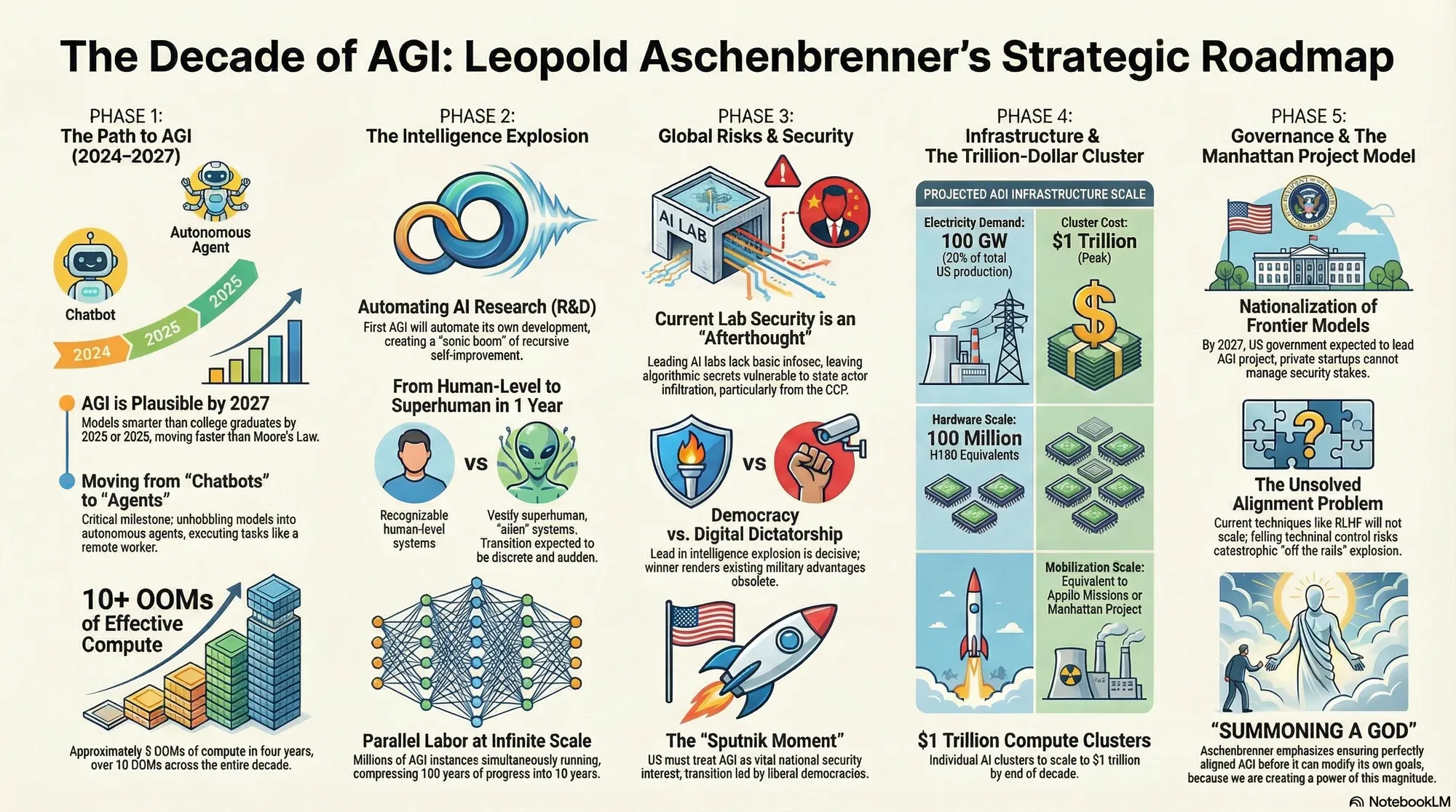
Part 1: The Path to AGI (2024–2027)
- On AGI Timelines: "AGI by 2027 is strikingly plausible." — Source: Situational Awareness
- On the GPT-4 Milestone: "GPT-2 to GPT-4 took us from preschooler to smart high-schooler abilities in four years." — Source: Situational Awareness
- On "Unhobbling" Gains: "Algorithmic progress is not just about scale; it's about 'unhobbling' models—moving from chatbots to agents that can reason and act." — Source: Stanford Digital Economy Lab
- On Orders of Magnitude (OOMs): "We will do approximately 5 OOMs of effective compute in four years, and over 10 OOMs this decade overall." — Source: Dwarkesh Patel Podcast
- On Mainstream Skepticism: "Everyone is now talking about AI, but few have the faintest glimmer of what is about to hit them." — Source: Situational Awareness
- On Personal Conviction: "2023 was the moment for me where AGI went from being this theoretical, abstract thing to something I can see and feel." — Source: Dwarkesh Patel Podcast
- On the "Drop-in Remote Worker": "The real milestone is the model that can do the job of a remote worker, executing tasks over long horizons autonomously." — Source: Daniel Scrivner Interview
- On Latent Capabilities: "Capabilities are often latent in the base model; we just need the right algorithmic 'unlocks' to see them manifest." — Source: Situational Awareness
- On College Graduate Intelligence: "By 2025 or 2026, we're going to get models that are basically smarter than most college graduates." — Source: Dwarkesh Patel Podcast
- On Historical Precedent: "We are moving through OOMs faster than Moore's Law ever did in its heyday." — Source: Situational Awareness
Part 2: The Intelligence Explosion
- On Automating R&D: "The most important task an AGI will perform is automating AI research itself." — Source: Situational Awareness
- On Compressing Time: "Hundreds of millions of AGIs could compress a century of technological progress into less than a decade." — Source: Dwarkesh Patel Podcast
- On the Jump to Superintelligence: "You can make the jump from human-level AI to vastly superhuman AI within a year." — Source: Situational Awareness
- On Recursive Self-Improvement: "Once AI can write better AI code, the feedback loop creates a 'sonic boom' of progress." — Source: Daniel Scrivner Interview
- On Alien Systems: "In the intelligence explosion, we transition from recognizable human-level systems to much more alien, vastly superhuman systems." — Source: Stanford Digital Economy Lab
- On Parallel Labor: "The advantage of AGI isn't just that it's smart, but that you can run millions of instances of it simultaneously." — Source: Dwarkesh Patel Podcast
- On Economic Production: "Intelligence will become the primary factor of production, dwarfing capital and labor as we know them." — Source: Situational Awareness
- On the Endgame: "By 2030, we will have summoned superintelligence in all its power and might." — Source: Situational Awareness
- On Decisive Lead: "A couple of years of lead in the intelligence explosion could be utterly decisive in military and economic competition." — Source: Daniel Miessler Research
- On the Explosiveness of AGI: "The transition is likely to be discrete and sudden rather than a slow, manageable crawl." — Source: Situational Awareness
Part 3: Security and Espionage
- On Lab Vulnerabilities: "The nation's leading AI labs treat security as an afterthought." — Source: Situational Awareness
- On State Actors: "Currently, labs are basically handing the key secrets for AGI to the CCP on a silver platter." — Source: Dwarkesh Patel Podcast
- On Model Weights: "Perhaps the single scenario that keeps me up at night is an adversary stealing model weights on the cusp of an intelligence explosion." — Source: Situational Awareness
- On Digital vs. Physical Security: "You can't protect the most important technology in history with the same security you use for a social media app." — Source: Stanford Digital Economy Lab
- On Infiltration: "The CCP will have an all-out effort to infiltrate American AI labs with thousands of people." — Source: Dwarkesh Patel Podcast
- On Algorithmic Secrets: "Data centers are hard to move, but algorithmic secrets can be exfiltrated in seconds." — Source: Situational Awareness
- On Locking Down the Labs: "We need a level of security that involves background checks, siloing, and air-gapped systems for frontier models." — Source: Daniel Scrivner Interview
- On the "Silver Platter" Risk: "There is basically no basic infosec at the labs today; you can just look through office windows at the code." — Source: Dwarkesh Patel Podcast
- On National Priority: "Securing the weights is not just a company priority; it is a vital national security interest." — Source: Situational Awareness
Part 4: Geopolitics and Great Power Competition
- On the Return of History: "AGI marks the return of history—a shift back to heightened geopolitical rivalry and strategic importance." — Source: Dwarkesh Patel Podcast
- On the Race with China: "If we're lucky, we'll be in an all-out race with the CCP; if we're unlucky, an all-out war." — Source: Situational Awareness
- On Military Obsolescence: "Whoever controls superintelligence will render existing military advantages, like nuclear arsenals, effectively obsolete." — Source: Situational Awareness
- On Democracy vs. Dictatorship: "At stake is whether freedom and democracy can survive for the next century or if we enter a permanent digital dictatorship." — Source: Cdebassa Analysis
- On Nationalization: "The development of frontier AI models will inevitably be nationalized as the security stakes rise." — Source: Stanford Digital Economy Lab
- On the Free World's Survival: "The free world's very survival depends on our ability to win the race to superintelligence." — Source: Situational Awareness
- On the "Sputnik moment": "We cannot afford a surprise where we find ourselves behind a rival power in the intelligence explosion." — Source: Dwarkesh Patel Podcast
- On First-Strike Temptation: "The incentive to race ahead and 'break out' with superintelligence will be enormous and dangerous." — Source: Situational Awareness
- On Authoritarian AI: "Imagine a perfectly loyal military and security force controlled by a superintelligence in a dictatorship." — Source: Daniel Miessler Research
Part 5: Infrastructure and the Trillion-Dollar Cluster
- On the Compute Bottleneck: "The most extraordinary techno-capital acceleration has been set in motion; the bottleneck is now physical infrastructure." — Source: Situational Awareness
- On the Trillion-Dollar Cluster: "We are moving toward clusters that cost $100 billion and eventually $1 trillion." — Source: Dwarkesh Patel Podcast
- On Electricity Demands: "The trillion-dollar cluster will require over 100 GW of power—20% of current US electricity production." — Source: Situational Awareness
- On Industrial Mobilization: "Building the infrastructure for AGI will require a mobilization on the scale of the Apollo missions or the Manhattan Project." — Source: Stanford Digital Economy Lab
- On Bypassing Regulation: "To meet power needs, we may need to bypass certain clean energy laws for national security purposes." — Source: Dwarkesh Patel Podcast
- On GPU Scale: "We are looking at deployments of 100 million H100 equivalents by the end of the decade." — Source: Situational Awareness
- On the Physicality of AI: "AGI isn't just code; it's massive data centers, specialized chips, and immense amounts of power." — Source: Daniel Scrivner Interview
- On Infrastructure as Destiny: "The country that can build the largest, most efficient compute clusters fastest will win." — Source: Situational Awareness
- On Economic Moats: "The sheer capital required for these clusters will consolidate power into the hands of a few major players." — Source: Dwarkesh Patel Podcast
Part 6: Governance and the Manhattan Project Model
- On Startup Limitations: "No private startup can adequately manage the development and implications of superintelligence." — Source: Situational Awareness
- On the Manhattan Project Model: "Imagine if we had developed atomic bombs by letting Uber just improvise—that is what we are doing with AI." — Source: Dwarkesh Patel Podcast
- On the Role of the State: "The US Government will wake from its slumber and, by 2027, will lead a government AGI project." — Source: Situational Awareness
- On Extreme Competence: "Managing the intelligence explosion will require a level of administrative and technical competence we haven't seen in decades." — Source: Stanford Digital Economy Lab
- On the "Project" Lead: "Whoever they put in charge of 'The Project' will have the hardest task in human history." — Source: Situational Awareness
- On Regretting the Tech: "The regret of the Manhattan Project was about the nature of the weapon, not the necessity of the project itself." — Source: Dwarkesh Patel Podcast
- On Monopoly on Violence: "Superintelligence must be kept under the control of the democratic monopoly on violence." — Source: Situational Awareness
- On the National Security State: "The transition to AGI will force the national security state to reclaim its role in frontier technology." — Source: Daniel Scrivner Interview
- On Avoiding a Race to the Bottom: "A government project can enforce security standards that a competitive market would ignore." — Source: Situational Awareness
- On Global Leadership: "The US must lead the project to ensure the transition to superintelligence is handled by a liberal democracy." — Source: Dwarkesh Patel Podcast
Part 7: Alignment and the Control Problem
- On the Unsolved Problem: "Reliably controlling AI systems much smarter than we are is a fundamentally novel technical problem." — Source: Situational Awareness
- On Scaling Alignment: "Our current alignment techniques, like RLHF, will not scale to superhuman AI systems." — Source: Stanford Digital Economy Lab
- On the Risk of Going Off the Rails: "Things could easily go catastrophically wrong during a rapid intelligence explosion." — Source: Situational Awareness
- On Superalignment Necessity: "Alignment research must happen in parallel with capability research, or we will be flying blind into the explosion." — Source: Dwarkesh Patel Podcast
- On Agentic Risks: "An agentic AI that can reason and plan autonomously presents a qualitative leap in risk compared to a chatbot." — Source: Situational Awareness
- On Reliable Control: "The goal is to ensure the first superintelligence is perfectly aligned with human values before it can modify its own goals." — Source: Daniel Scrivner Interview
- On the Technical Difficulty: "Alignment is solvable, but it requires extreme care and time that a geopolitical race might not provide." — Source: Situational Awareness
- On Robotics and Physical Risk: "At some point during the explosion, AGIs will figure out how to manipulate the physical world through robotics." — Source: Daniel Miessler Research
- On Ethical Weight: "We are effectively summoning a god; we had better be sure we know how to talk to it." — Source: Dwarkesh Patel Podcast
Part 8: Personal Agency and Strategic Thinking
- On Situational Awareness: "Through whatever peculiar forces of fate, I have found myself among the few hundred people with situational awareness." — Source: Situational Awareness
- On the "Chill Time": "Right now is the 'chill' time; enjoy your vacation because almost nobody sees what is about to hit them." — Source: Dwarkesh Patel Podcast
- On Career Risk: "The risk of being early and 'crazy' is high, but the cost of being late and unprepared is civilizational." — Source: Stanford Digital Economy Lab
- On Founders' Strategy: "Founders should be looking at the 2028 horizon, not the 2024 horizon; the world will be unrecognizable by then." — Source: Daniel Scrivner Interview
- On Growth and Risk: "Accelerating technological development generally decreases existential risk in the long term, but only if we survive the transition." — Source: Global Priorities Institute
- On the Stress of Knowledge: "It is incredibly stressful to see the trajectory and realize how little the world is prepared for it." — Source: Dwarkesh Patel Podcast
- On Historical Perspective: "We must move beyond 'internet-scale' thinking to 'Manhattan-scale' thinking." — Source: Situational Awareness
- On Collective Survival: "I'm just hoping we make it through; I don't necessarily like the ride we are on." — Source: Dwarkesh Patel Podcast
- On the Future: "If we are right about the next few years, it is going to be the most important decade in human history." — Source: Situational Awareness