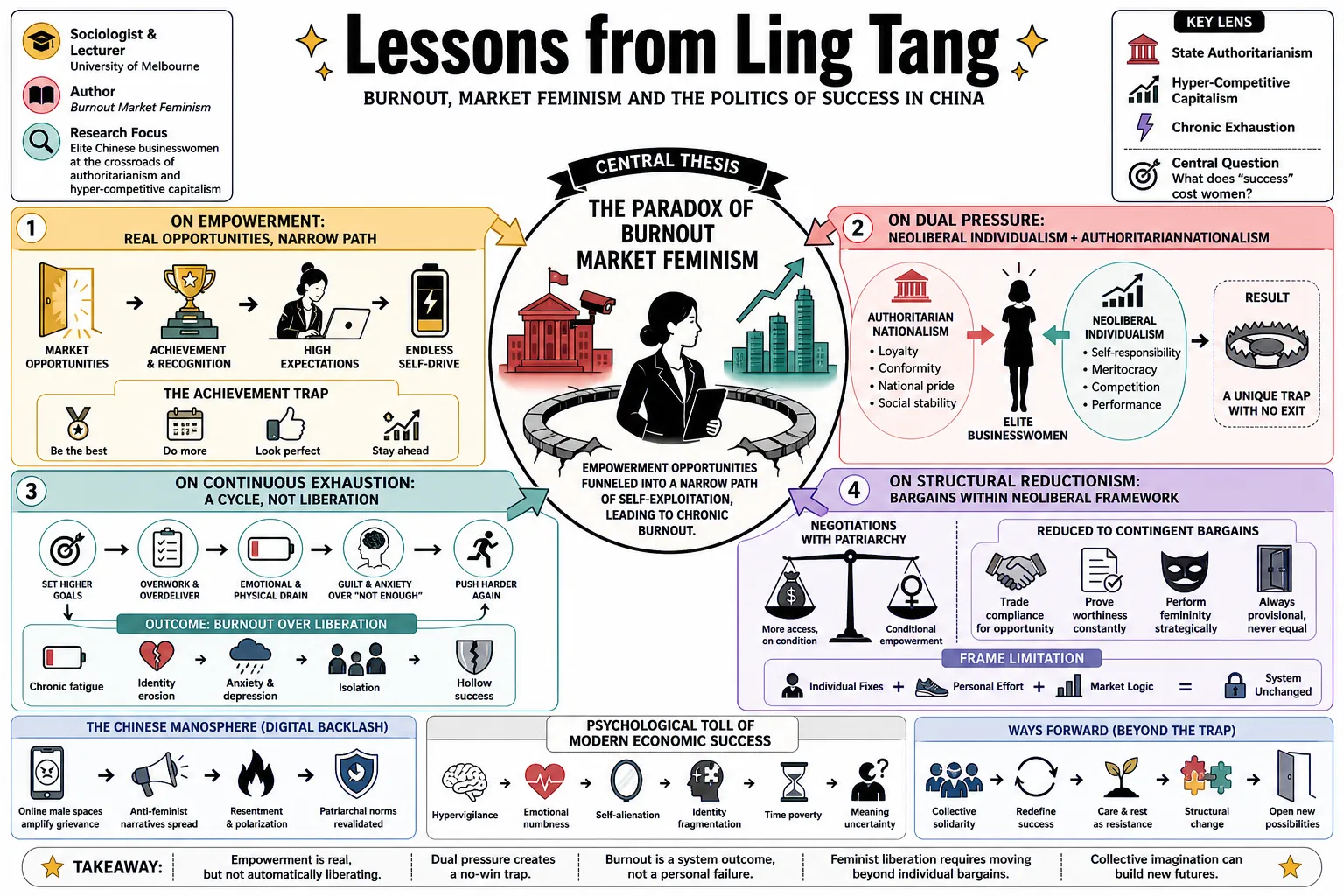
Ling Tang is a sociologist, lecturer at the University of Melbourne, and author of Burnout Market Feminism. Her research examines how elite Chinese businesswomen navigate the competing pressures of state authoritarianism and hyper-competitive capitalism, often resulting in chronic exhaustion. This collection outlines her observations on digital radical feminism, the Chinese manosphere, and the psychological toll of modern economic success.
Part 1: The Paradox of Burnout Market Feminism
- On empowerment: "The market provides genuine opportunities for female empowerment, but this energy is channeled into a narrow path of self-exploitation." — Source: Burnout Market Feminism
- On the dual pressure: "Elite Chinese women navigate a unique trap set by both neoliberal individualism and authoritarian nationalism." — Source: Burnout Market Feminism
- On continuous exhaustion: "The pursuit of market feminism ultimately leads to a cycle of burnout rather than lasting liberation." — Source: Burnout Market Feminism
- On structural reductionism: "Negotiations with patriarchy are often reduced to contingent bargains within a purely neoliberal framework." — Source: Burnout Market Feminism
- On the achievement society: "Han Byung-Chul’s theory of the 'burnout society' manifests sharply among China's female business elite." — Source: Burnout Market Feminism
- On market boundaries: "The market is viewed as a space for empowerment, yet it enforces strict boundaries on what success looks like for women." — Source: Burnout Market Feminism
- On internalized pressure: "Self-exploitation is reframed as self-improvement, masking the structural forces driving female exhaustion." — Source: Burnout Market Feminism
- On the limits of wealth: "Financial success for urban businesswomen does not inherently dismantle patriarchal constraints." — Source: Burnout Market Feminism
- On internet-age visibility: "The digital economy amplifies both the opportunities for female entrepreneurship and the visibility of their burnout." — Source: Burnout Market Feminism
- On redefining feminism: "'Burnout market feminism' captures the paradox where leaning in means burning out in the Chinese context." — Source: Burnout Market Feminism
Part 2: Neoliberalism and Authoritarian Intersections
- On structural constraints: "Elite women must constantly balance the demands of a hyper-competitive market with the political realities of authoritarianism." — Source: University of Melbourne Profile
- On contingent bargains: "Female empowerment in China often relies on fragile agreements that do not challenge state power." — Source: Burnout Market Feminism
- On systemic fatigue: "The exhaustion of the modern Chinese professional is a feature, not a bug, of rapid neoliberal expansion under state control." — Source: Burnout Market Feminism
- On individualization: "Systemic social issues are frequently rebranded as individual failings, placing the burden of resilience entirely on women." — Source: Burnout Market Feminism
- On acceptable success: "Success is conditionally granted to women as long as it aligns with broader national and economic objectives." — Source: University of Melbourne Profile
- On ideological compliance: "Entrepreneurial energy is encouraged, provided it does not cross into political dissent." — Source: Burnout Market Feminism
- On the illusion of meritocracy: "The neoliberal promise of pure meritocracy obscures the specific gendered hurdles built into the Chinese market." — Source: Burnout Market Feminism
- On navigating state capitalism: "Women must become adept at reading unwritten rules to survive at the intersection of state and market forces." — Source: University of Melbourne Profile
- On the cost of adaptation: "The constant need to adapt to shifting economic and political landscapes is a primary driver of psychological burnout." — Source: Burnout Market Feminism
- On constrained agency: "Agency is exercised, but always within a heavily regulated ideological perimeter." — Source: Burnout Market Feminism
Part 3: Burnout Queerness and Entrepreneurial Monogamy
- On conditional identity: "For queer female entrepreneurs in China, 'queerness' is often contingent on achieving a specific standard of neoliberal success." — Source: No success no queer
- On the pressure of monogamy: "Neoliberal success for queer women is frequently tied to adhering to a homonormative standard of monogamy." — Source: No success no queer
- On burnout queerness: "The relentless drive to prove market value creates a state of 'burnout queerness' among female founders." — Source: No success no queer
- On market value vs. identity: "Queer identity becomes inextricably linked to one's productivity and market viability." — Source: No success no queer
- On the burden of proof: "Queer women in business face immense pressure to out-perform their heterosexual peers to validate their existence." — Source: No success no queer
- On homonormativity: "The market rewards a version of queerness that mirrors traditional, stable, and economically productive family units." — Source: No success no queer
- On exhaustion as a lifestyle: "The intersection of entrepreneurial hustle and marginalized identity makes exhaustion a permanent state of being." — Source: No success no queer
- On navigating double margins: "Female queer entrepreneurs must negotiate both gendered market barriers and sexual marginalization simultaneously." — Source: No success no queer
- On the cost of visibility: "Visibility in the business world often requires sanitizing one's queer identity to fit acceptable market narratives." — Source: No success no queer
Part 4: Digital Radical Feminism and Affective Rage
- On soft activism: "In digital China, collective rage serves as a crucial form of 'soft activism' and 'slow resistance' against patriarchal structures." — Source: Indigenizing feminist rage
- On emotional rules: "Rage functions as a central 'emotional rule' that binds digital radical feminists together." — Source: Indigenizing feminist rage
- On navigating censorship: "Affective rage allows feminists to express dissent and build solidarity under strict authoritarian constraints." — Source: Indigenizing feminist rage
- On targeted anger: "This collective digital rage is directed not at men alone, but at the broader patriarchal structures that govern daily life." — Source: Indigenizing feminist rage
- On indigenizing feminism: "Chinese radical feminists adapt global feminist concepts to fit the specific affective and political landscape of China." — Source: Indigenizing feminist rage
- On intra-community conflict: "Feminist rage is sometimes directed inward at other women, reflecting the intense pressures of navigating a patriarchal society." — Source: Indigenizing feminist rage
- On the politics of emotion: "Emotions are not merely personal reactions, but mobilized political tools in the digital feminist sphere." — Source: Indigenizing feminist rage
- On digital solidarity: "Shared anger creates a powerful, albeit fragmented, network of support among young Chinese women online." — Source: Indigenizing feminist rage
- On resisting containment: "Affective outbursts online serve as a refusal to be silently contained by state-endorsed gender norms." — Source: Indigenizing feminist rage
Part 5: Postfeminism and Intellectual Celebrities
- On depoliticized empowerment: "'Intellectual celebrities' in digital China promote a version of feminism that is highly individualized and depoliticized." — Source: Postfeminism with Chinese characteristics
- On occasional feminism: "The market rewards an 'occasional feminism' that only challenges norms when it is profitable or safe to do so." — Source: Postfeminism with Chinese characteristics
- On state-endorsed values: "Postfeminist discourse often remains safely within the bounds of state-endorsed family and reproductive norms." — Source: Postfeminism with Chinese characteristics
- On the knowledge economy: "The rise of intellectual celebrities turns feminist theory into a consumable product for individual life guidance." — Source: Postfeminism with Chinese characteristics
- On love mentors: "Experts often package neoliberal self-improvement as feminist advice, placing the burden of relationship success on women." — Source: Postfeminism with Chinese characteristics
- On individualized solutions: "Structural gender inequalities are framed as personal challenges that can be overcome with the right mindset or expert advice." — Source: Postfeminism with Chinese characteristics
- On postfeminism with Chinese characteristics: "The integration of market-driven self-help with state-approved gender roles creates a unique form of postfeminism." — Source: Postfeminism with Chinese characteristics
- On commodifying knowledge: "Feminist discourse is easily co-opted when it becomes a tool for building personal brands in the digital economy." — Source: Postfeminism with Chinese characteristics
- On the illusion of choice: "Postfeminist rhetoric emphasizes women's choices while ignoring the limited menu of options actually available to them." — Source: Postfeminism with Chinese characteristics
Part 6: The Shenzhen Miracle and Generational Disillusionment
- On generational divides: "The meaning of the 'Shenzhen miracle' has fractured; it represents triumph to older generations but induces skepticism in the youth." — Source: South China Morning Post
- On shifting modernity: "The rapid modernization of cities like Shenzhen created a specific type of economic promise that is no longer guaranteed." — Source: South China Morning Post
- On the legacy of rapid growth: "The generation that inherited the economic boom is now grappling with its social and psychological costs." — Source: South China Morning Post
- On questioning progress: "Young urbanites are increasingly questioning whether the relentless pace of development was worth the sacrifice of well-being." — Source: South China Morning Post
- On the Taiwanese influence: "The cultural markers of the 2000s, such as Taiwanese-influenced accents, reflect a specific era of openness and aspiration that has since changed." — Source: South China Morning Post
- On inherited narratives: "The official narrative of economic miracles often glosses over the burnout experienced by those living within it." — Source: South China Morning Post
- On redefining success: "Younger generations are moving away from defining their worth purely by their proximity to economic miracles." — Source: South China Morning Post
- On urban exhaustion: "The infrastructure of rapid growth has resulted in an infrastructure of chronic exhaustion for young professionals." — Source: South China Morning Post
- On post-miracle reality: "Living in the aftermath of an economic miracle requires navigating the gap between past promises and present struggles." — Source: South China Morning Post
Part 7: The Manosphere and Digital Misogyny
- On the rise of incels: "China has seen a significant emergence of digital 'incel' culture, driven by changing gender dynamics and economic pressures." — Source: The Little Red Podcast
- On state-approved nationalism: "Digital misogyny is frequently fueled by, and entangled with, state-approved forms of hyper-nationalism." — Source: The Little Red Podcast
- On masculine anxiety: "The Chinese manosphere is largely driven by a deep-seated anxiety over shifting economic power and women's increasing independence." — Source: The Little Red Podcast
- On digital radicalization: "Online platforms serve as echo chambers that radicalize young men against feminist progress." — Source: The Little Red Podcast
- On the weaponization of tradition: "Traditional patriarchal values are weaponized online to attack women who deviate from expected roles." — Source: The Little Red Podcast
- On the intersection of misogyny and patriotism: "Attacking feminists online is often framed by internet trolls as a patriotic duty." — Source: The Little Red Podcast
- On the backlash to market feminism: "As women gain economic power, the digital backlash attempts to enforce cultural submission." — Source: The Little Red Podcast
- On unmoderated hate: "The digital landscape often provides a safe haven for misogynistic rhetoric while heavily censoring feminist organizing." — Source: The Little Red Podcast
- On the crisis of masculinity: "The rhetoric of the manosphere reveals a profound crisis in how modern Chinese masculinity is defined and valued." — Source: The Little Red Podcast
Part 8: Sociology as Life, Promise, and Practice
- On the purpose of sociology: "Sociology is not just an academic discipline; it must function as a living practice and a promise to society." — Source: University of Melbourne Profile
- On human connection: "When asked what makes life worth living, the foundational answer remains the ability to be genuinely touched by the world." — Source: University of Melbourne Profile
- On bridging academia and public life: "True scholarship must step out of the ivory tower and engage with the everyday realities of the public." — Source: University of Melbourne Profile
- On inclusive Chineseness: "There is a critical need to promote a vision of Chineseness that is inclusive, diverse, and resistant to monolithic nationalism." — Source: University of Melbourne Profile
- On art and academia: "The boundary between sociology and art is porous; both require profound empathy and a desire to reveal hidden structures." — Source: University of Melbourne Profile
- On Forest and Trees: "Public sociology requires helping people see both the individual experience and the systemic structures." — Source: University of Melbourne Profile
- On affective scholarship: "Academic research must not lose sight of the emotional and affective realities of the subjects it studies." — Source: University of Melbourne Profile
- On the role of the activist-academic: "The modern scholar must simultaneously analyze the world and actively participate in its transformation." — Source: University of Melbourne Profile
- On resisting cynicism: "Maintaining sociology as a 'promise' requires a deliberate resistance to the cynicism bred by authoritarian and neoliberal pressures." — Source: University of Melbourne Profile
- On the power of narrative: "Understanding society requires listening deeply to the individual narratives that complicate official histories." — Source: University of Melbourne Profile