Lino Saputo Jr. spent two decades as the CEO of Saputo Inc., taking the Montreal-based dairy company founded by his grandfather and expanding it into one of the top ten dairy processors in the world. He is primarily known for a disciplined, aggressive acquisition strategy that pushed the company into the U.S., Australia, and Europe while strictly protecting the culture of a close-knit family business. This profile compiles his operating frameworks for managing multi-generational leadership transitions, executing international mergers, and navigating volatile commodity markets.
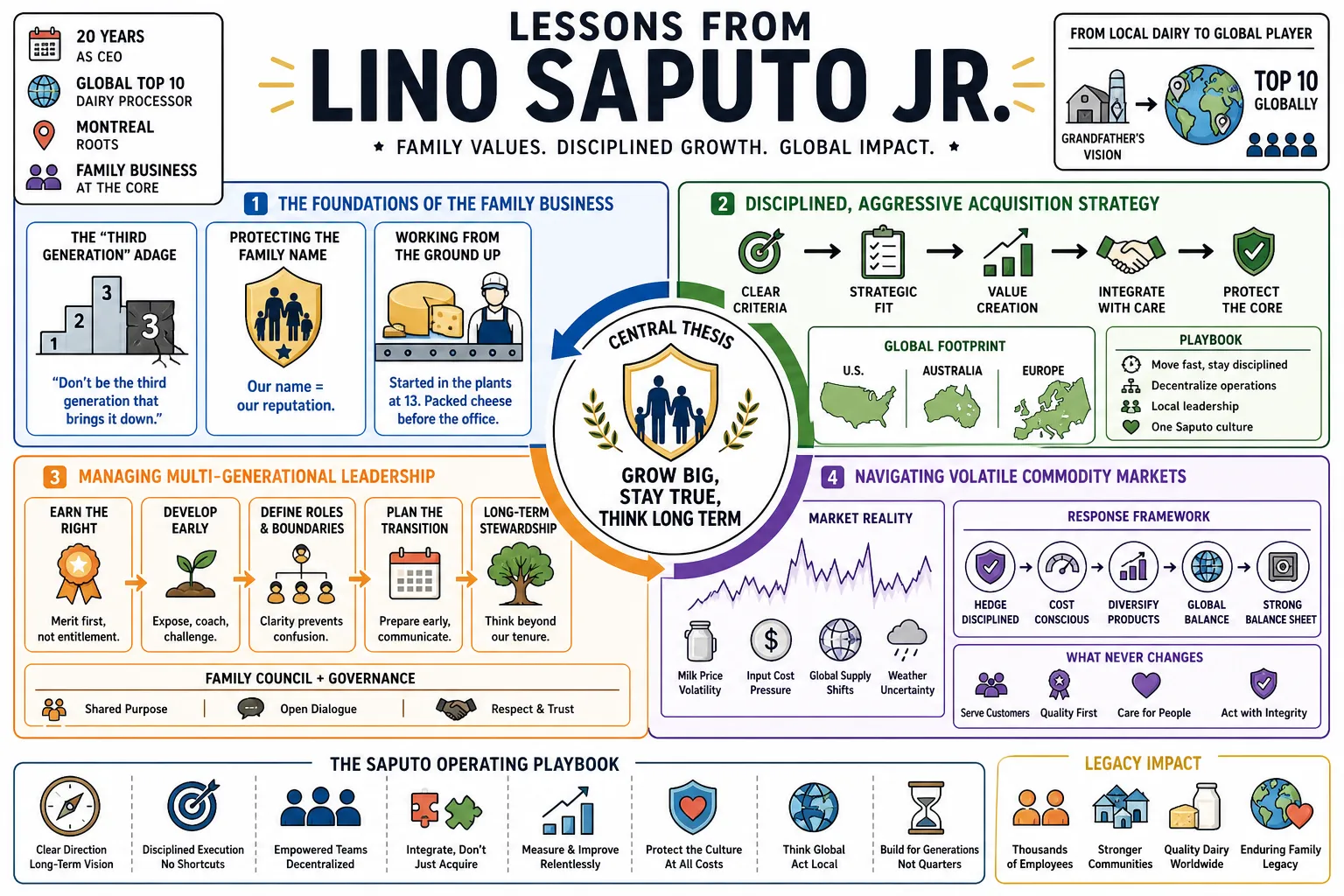
Part 1: The Foundations of the Family Business
- On The "Third Generation" Adage: "You know the adage, 'Rags to riches to rags in three generations,' and I don't want to be the third generation that brings in that factor. I'm mindful of that every single day so I don't take anything for granted at all." — Source: [Financial Post]
- On Protecting the Family Name: "Because our family name is attached to our business' reputation, it's even a greater motivator to do good." — Source: [Saputo Inc. Communications]
- On Working from the Ground Up: "I started working in our plants when I was 13 years old. I remember my first jobs were just packing cheeses, then they had me sweep the floors and then clean the vats." — Source: [Financial Post]
- On Emotional Governance: "Up until 1997, our board of directors was made up of exclusively family members and, as you might appreciate with a family business, not all decisions are based on common sense and logic. There's a lot of emotion." — Source: [Financial Post]
- On the Privilege of Leadership: "I never had the pretension to be CEO, but I always had the desire to be part of this organization because, No. 1, I love the industry, and No. 2, I love the people who are in this organization." — Source: [The CEO Series]
- On Immigrant Roots: The foundation of the business was built on the courage of his grandfather immigrating from Sicily to Canada, an origin story that instilled a permanent culture of hard work and gratitude. — Source: [Forbes]
- On Inheriting Responsibility: "It's not always that simple, as a third generation in a family business, to bring it to a new level or new heights." — Source: [Financial Post]
- On Reputation Over Wealth: A family’s name and reputation are its most valuable assets, far outweighing any financial inheritance you could leave to the next generation. — Source: [Forbes]
- On Evolution vs. Revolution: "When I took over for my father in 2004, I didn't think it was going to be a revolution; it was going to be an evolution." — Source: [BNN Bloomberg]
Part 2: Operational Discipline & Execution
- On Avoiding Analysis Paralysis: "I would have to say that I like to be extremely thorough without paralyzing myself with analysis." — Source: [Financial Post]
- On Crisp Execution: Bold leadership must be paired with crisp execution to ensure that strategy does not remain purely theoretical on the factory floor. — Source: [Dairy Foods]
- On Efficiency Through Simplicity: Using sound judgment and continuously questioning the status quo is the absolute baseline of operational efficiency. — Source: [Saputo Inc. Communications]
- On Navigating Market Noise: "If you look past the market noise, our core business performed very well. Our teams remain focused on the elements within our control to accelerate growth once market dynamics begin to improve." — Source: [Saputo Inc. Investor Relations]
- On Capital Project Investments: "Following three years of investments and optimization of our global network, we completed the bulk of the capital projects under our Global Strategic Plan. We are now ramping up commercial production at several facilities." — Source: [Saputo Inc. Investor Relations]
- On Modernizing the Footprint: Closing older, redundant facilities and consolidating activities into highly automated hubs is a necessary step for long-term margin improvement. — Source: [Just Food]
- On Operational Cost Control: "Irrespective of the markets, we feel much better about our ability to process high quality products at an even lower cost today than we ever have in the history of our company." — Source: [Saputo Inc. Investor Relations]
- On Front-Line Presence: "I like to be in the markets, I like to meet our employees and understand what's going on in the field. I like to meet our customers and understand what's relevant to them." — Source: [Financial Post]
- On Long-Term Operational Confidence: "With most of the heavy lifting behind us, I remain very confident in our long-term strategy." — Source: [Saputo Inc. Investor Relations]
Part 3: Growth, M&A, and Global Strategy
- On the Necessity of Global Expansion: A business can remain very stable in its domestic market, but true growth cannot happen unless you are willing to step onto international platforms. — Source: [Financial Post]
- On Adapting to Regulatory Environments: "We have demonstrated that we can operate extremely well in different regulatory environments." — Source: [Canadian Council of Chief Executives]
- On Taking Calculated Risks: "We're not overly ambitious on the first bite, but once we gain our confidence, then we go for bigger bites after that." — Source: [BNN Bloomberg]
- On Disciplined Deal-Making: "We are hungry for deals... of course we will always be disciplined in our approach. We'll have to make sure that the conditions are right and that the price is right." — Source: [BNN Bloomberg]
- On Personal Involvement in M&A: To secure the Murray Goulburn acquisition in Australia, he personally spent weeks meeting with local farmers at their kitchen tables to build trust and address concerns directly. — Source: [Financial Post]
- On the M&A Mindset: Mergers and acquisitions are not just a growth tactic; they are fundamentally written into the corporate DNA of the business. — Source: [Financial Post]
- On Free Trade vs. Supply Management: While supply management offers domestic stability, operating as a free trade champion is necessary because high domestic raw material costs make it difficult to compete globally. — Source: [Canadian Council of Chief Executives]
- On Cash Flow Generation: "We generated over $1.1 billion of cash from operating activities, a testament to our diversified global platform." — Source: [Saputo Inc. Investor Relations]
- On Post-Acquisition Strategy: The real work begins after a deal closes by applying a proven management model to optimize distressed or underperforming assets. — Source: [Financial Post]
- On Geographic Diversification: Expanding into the U.S., Argentina, Australia, and the U.K. was a deliberate strategy to shield the company from localized market downturns. — Source: [The CEO Series]
Part 4: Managing Through Crisis & Market Volatility
- On Creating Opportunities from Turmoil: "Our cash flows are fantastic... we've got financial flexibility upwards of two billion dollars if not more... this crisis has hit the dairy industry... there's going to be some great opportunities for us to make some acquisitions." — Source: [BNN Bloomberg]
- On Strategic Re-invention During Crisis: "We had a great opportunity to reinvent ourselves... you've got to get creative; you've got to reinvent." — Source: [BNN Bloomberg]
- On Committing to Employees During Lockdowns: Ensuring that employees were paid 100% of their wages during pandemic disruptions was viewed as an essential investment in loyalty, not an operational expense. — Source: [BNN Bloomberg]
- On Weathering Macro-Economic Headwinds: "Fiscal 2024 was a year of continued resilience. Our financial performance reflected our ability to stay the course even amidst a dynamic macro-economic environment which included commodity price volatility, a challenged consumer, and ongoing inflationary pressures." — Source: [Saputo Inc. Investor Relations]
- On Focusing on Controllables: During periods of intense inflation and market unpredictability, leadership must focus exclusively on internal efficiencies and cost containment rather than waiting for macro conditions to improve. — Source: [Saputo Inc. Investor Relations]
- On Defending Against Market Noise: "We delivered a solid performance... despite a negative $61 million impact from USA Market Factors." — Source: [Saputo Inc. Investor Relations]
- On Financial Flexibility as a Moat: Maintaining a pristine balance sheet allows a company to remain aggressive and opportunistic when competitors are forced into defensive postures. — Source: [BNN Bloomberg]
- On Staying the Course: The best response to temporary supply chain shocks is to trust the long-term strategic plan rather than making reactive, short-term pivots. — Source: [Saputo Inc. Investor Relations]
- On Transparency in Tough Times: "There are certain things that we can do and other things that we cannot do, but we take the time to explain why." — Source: [Financial Post]
Part 5: Leadership Style & Accountability
- On Total Accountability: "The puck stops with you. No matter how many mistakes the people in front of you make, if the puck's in the net, it's on you. I love that pressure and I love that responsibility." — Source: [The CEO Series]
- On the Nature of Making Mistakes: "If we make a mistake, whether it's myself or my management team, there's no issue there as long as we turn around quick enough to correct the mistake and try not to repeat the same mistake twice." — Source: [The CEO Series]
- On Working as a Team: "At the end of the day, you've got to work as a team... You've got to work with the team, but at the end of the day, I've got to take those hard decisions." — Source: [BNN Bloomberg]
- On Continuous Entrepreneurship: "As things evolve, as things change, we need to adapt and that's really the true entrepreneurship of what we stand for." — Source: [Financial Post]
- On Maintaining Agility at Scale: "Our industry itself is not static... You need to navigate through the ups and downs of what's going on in our industry and we need to remain entrepreneurial. It's not going to be a carbon copy template that we need to be following." — Source: [Financial Post]
- On Ownership and Commitment: True leadership requires assuming the full consequences of your decisions, both good and bad. — Source: [Saputo Inc. Communications]
- On Staying Grounded: "I hope they don't view me as 'that billionaire from Canada'." — Source: [Financial Post]
- On Hands-On Decision Making: Being proactive and staying closely connected to where the action is happening on the factory floor prevents executive detachment. — Source: [Saputo Inc. Communications]
- On Leading with Passion: Enjoying the work and showing that enthusiasm proudly to your team is a fundamental requirement for executive leadership. — Source: [Saputo Inc. Communications]
- On Embracing Pressure: Leadership is not about avoiding pressure, but learning to thrive under the weight of operational and familial expectations. — Source: [The CEO Series]
Part 6: Corporate Culture & "The Extended Family"
- On the "Family Spirit" at Scale: "We've maintained that family spirit, we've maintained the focus on people, and that's not always easy to do when you're dealing with different countries and different cultures." — Source: [The CEO Series]
- On the "Extended Family" Model: "Every single one of our employees is an extended member of our family and we treat them that way. We don't have a problem speaking frankly and honestly and openly." — Source: [Financial Post]
- On Creating a "Home" Environment: The ultimate key to a company's retention and success is deliberately engineering a work environment that feels like a home for its employees. — Source: [Saputo Inc. Communications]
- On Culture as a Differentiator: "It's the culture that defines it. Its character, who we are, how we treat people first and foremost. A lot of companies say that, but we live it every single day." — Source: [Financial Post]
- On Empowering Local Management: Expanding globally requires trusting local operators while ensuring they understand and integrate the core family values of the parent company. — Source: [The CEO Series]
- On the Importance of the Front Line: "This is a true honor made possible by... the unwavering passion of our over 19,000 loyal employees who continually inspire me by embodying our Saputo values every single day." — Source: [Saputo Inc. Communications]
- On Protecting Culture During Acquisitions: Financial due diligence is critical in M&A, but assessing whether a target company's people can adapt to your internal culture is equally vital for long-term integration. — Source: [Financial Post]
- On Open Dialogue: Fostering a flat hierarchy where an employee on the production floor feels comfortable speaking honestly to the CEO is a non-negotiable standard. — Source: [Financial Post]
- On Employee Well-being: Seeking the physical and emotional well-being of colleagues is a formal corporate value, not just an HR initiative. — Source: [Saputo Inc. Communications]
Part 7: Adapting to Industry Changes & Consumer Trends
- On the Plant-Based Movement: While investing in plant-based dairy alternatives is an important strategic milestone to meet changing consumer demands, traditional dairy is far from dead. — Source: [BNN Bloomberg]
- On Shifting to Value-Added Ingredients: Transitioning away from low-margin commodities toward high-value ingredients like specialty goat whey and WPC80 is essential for capturing the sports nutrition and wellness markets. — Source: [Just Food]
- On Adjusting to Consumer Tastes: Consumer palettes are constantly evolving toward specialty, organic, and health-focused products, requiring legacy producers to pivot quickly. — Source: [BNN Bloomberg]
- On Sustainability as a Responsibility: "Ensuring our business operates with integrity and accountability is not just a priority; it's our responsibility. The Saputo Promise guides our actions and our decisions." — Source: [Saputo Inc. Investor Relations]
- On Environmental Impact: "We recognize that climate change is a universal challenge. Collectively, we must continue to address our use of fossil fuels and embrace sustainable practices relating to agriculture and manufacturing." — Source: [Saputo Inc. Investor Relations]
- On the Future of Dairy Nutrition: Dairy will continue to play a central role in global nutrition, particularly as a superior, natural source of protein compared to highly processed alternatives. — Source: [BNN Bloomberg]
- On Optimizing the Supply Chain: Building automated, modern hubs is not just about cost-cutting; it is about building a supply chain resilient enough to handle unpredictable modern consumer demands. — Source: [Just Food]
- On Strategic Specialization: The acquisition of specialty vegan cheese and premium UK creameries reflects a shift from volume-driven M&A to targeted, high-value specialization. — Source: [Global News]
- On Agility vs. Rigidity: Clinging to a rigid, carbon-copy business model in an era of rapid technological and dietary shifts is a guaranteed path to obsolescence. — Source: [Financial Post]
Part 8: Legacy, Succession, & Philanthropy
- On Passing the Torch: "Effective today, I have transitioned to the role of Executive Chair of the Board, while Carl Colizza officially becomes our new President and CEO... I have no doubt that under your leadership, Saputo's global business and unique culture will continue to flourish." — Source: [Saputo Inc. Investor Relations]
- On the Role of an Executive Chair: Transitioning away from daily operations allows a leader to focus purely on strategic oversight, board governance, and the preservation of institutional knowledge. — Source: [Foodservice and Hospitality]
- On the Caretaker Mentality: "I look at myself as a caretaker for the next generation." — Source: [BNN Bloomberg]
- On Philanthropy and Education: "To contribute to education in a meaningful way is immensely fulfilling." — Source: [Concordia University]
- On the Value of University Research: "University teaching and research provides a path to tackling some of the biggest questions that face the world. Let's help the next generation of students find the answers." — Source: [Concordia University]
- On Supporting the Broader Ecosystem: "This campaign will shape Concordia's destiny... Canada needs Concordia. Our university generates knowledge for the 21st century." — Source: [Concordia University]
- On Mentoring the Next Generation: True industry stewardship involves looking beyond the balance sheet to mentor young professionals and athletes on long-term wealth and corporate citizenship. — Source: [Forbes]
- On the Core Responsibility of a Founder's Grandson: The ultimate goal is to propel the basic culture and values that characterized the original family startup, ensuring they consistently shape the activities of the global enterprise. — Source: [Saputo Inc. Communications]
- On Shaping the Future of the Industry: A modern CEO must advocate for systemic changes—such as fair global trade and sustainable farming practices—that benefit the entire agricultural ecosystem, not just their own margins. — Source: [Canadian Council of Chief Executives]
- On Building a 100-Year Company: Long-term survival requires balancing aggressive, opportunistic growth with a conservative, debt-averse approach to financial management. — Source: [The CEO Series]