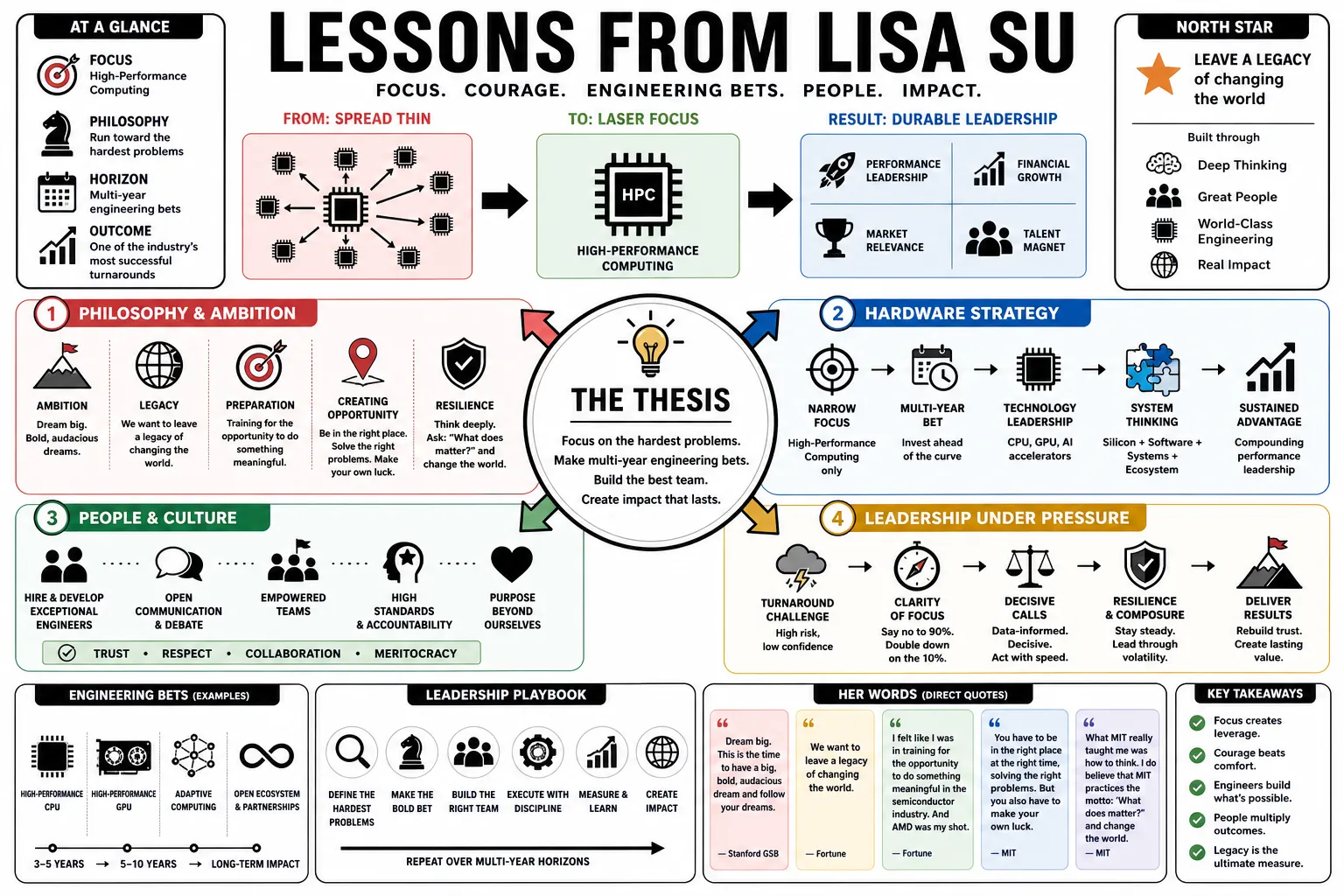
Lessons from Lisa Su
Lisa Su led one of the semiconductor industry's most successful turnarounds by narrowing AMD's focus strictly to high-performance computing. She prefers to run toward the hardest problems, making multi-year engineering bets rather than reacting to short-term market shifts. This profile collects her direct statements on hardware strategy, managing engineers, and operating a multi-billion-dollar company under pressure.
Part 1: Philosophy and Ambition
- On Ambition: "Dream big. This is the time to have a big, bold, audacious dream and follow your dreams." — Source: Stanford GSB
- On Legacy: "We want to leave a legacy of changing the world." — Source: Fortune
- On Preparation: "I felt like I was in training for the opportunity to do something meaningful in the semiconductor industry. And AMD was my shot." — Source: Fortune
- On Creating Opportunity: "People often ask me how I became a CEO or how I got 'lucky.' I tell them that you have to be in the right place at the right time, solving the right problems. But you also have to make your own luck." — Source: MIT
- On Resilience: "What MIT really taught me was how to think. I do believe that MIT practices the motto: 'What doesn’t kill you makes you stronger.'" — Source: MIT
- On Boldness: "The biggest risk is not taking any risk." — Source: Business Insider
- On The Value of Being Underestimated: "Being underestimated can be a powerful advantage." — Source: Fast Company
- On Stepping Up: "When I joined AMD, many of my mentors questioned the decision because of the challenges the company was facing. But I felt I couldn't have a better opportunity." — Source: MIT
- On Pushing Boundaries: "Growth starts at the edge of your comfort zone." — Source: Fast Company
- On Self-Belief: "For all of you completing your doctoral dissertations today, you have created something that nobody else in the world has. That should give you an incredible amount of confidence." — Source: MIT
Part 2: Engineering and Technical Roots
- On The Purpose of Engineering: "Engineering is about solving problems that people care about." — Source: Fast Company
- On Practical Execution: "I wanted to build things. They had to actually work, right?" — Source: Fast Company
- On Motivation: "I've always wanted to tinker with things. I was one of those engineers who thought, 'Why are these people making those dumb decisions?' So it's fun to be the person making them." — Source: Fast Company
- On The Value of Education: "What MIT really taught me was how to think and how to solve really tough problems." — Source: MIT
- On Career Evolution: "My path since leaving MIT has had a few twists and turns. I started as an engineer, but I realized along the way that I wanted to lead." — Source: MIT
- On Empowering Talent: "We're still hiring more and more engineers, because they're the final arbiters of our engineering." — Source: India Times
- On Software Moats: "I’m not a believer in moats. Open ecosystems eventually win out over proprietary ones in the long term." — Source: Stratechery
- On Balancing Tech and Business: "Technology is great, but you also need to drive business outcomes." — Source: Stratechery
- On Identity: "We are a product company. I want to build great products." — Source: WCCFTech
- On Leveraging Capability: "I want to build products that use all of our innovation." — Source: WCCFTech
Part 3: Running Toward Problems
- On Tackling the Difficult: "Run toward the hardest problems. This approach has helped me to learn a tremendous amount from both success and failure." — Source: Time
- On Making an Impact: "I advise you to run towards the hardest problems; that is where you can make the most difference." — Source: MIT
- On Mindset: "I truly believe there is no problem too hard to solve if you have the right mindset, perseverance, and creativity." — Source: MIT
- On Intellectual Curiosity: "I think the most important thing for all of us is to have a deep curiosity of just solving problems." — Source: Stanford GSB
- On The Value of Mistakes: "I'd say my biggest learning moments were the times that I've screwed up the most." — Source: Pear VC
- On Learning from Failure: "You actually learn from your mistakes a lot more than you learn from your successes." — Source: Pear VC
- On The Danger of Success: "Success often obscures the things that almost went wrong, while failure makes them visible." — Source: Workplace Signals
- On Moving Past Errors: "What's the worst thing that's going to happen? Like you make a mistake, okay, fine, get up." — Source: Fast Company
- On Continuous Improvement: "The best thing you can do is learn from those mistakes so that you continue to get better." — Source: Stanford GSB
- On Courage: "Have the courage to take risks, sometimes big risks, but make sure you also enthusiastically learn from your mistakes." — Source: MIT
Part 4: Leadership and Culture
- On Defining Culture: "Culture is not what you write down. It is how leaders behave when things get hard." — Source: Workplace Signals
- On Behavior Under Pressure: "Culture is the decisions that get made under pressure. It is what gets tolerated, what gets celebrated, and what gets ignored every single day." — Source: Workplace Signals
- On Staying Connected: "One of the most important things for a CEO is not to get insulated." — Source: Stanford GSB
- On Institutional Learning: "I also believe very much in a learning culture, which is, we learn from everything that we do." — Source: Stanford GSB
- On Developing Talent: "Giving individuals larger roles before they have fully proven themselves builds mastery through the challenge of the role itself." — Source: Workplace Signals
- On Building Range: "Move high performers across different functions to develop leaders with a broad, systemic understanding of the business." — Source: Workplace Signals
- On Hiring for Vision: "Hire people who believe in the company’s long-term vision and mission, rather than just those with the best technical credentials." — Source: Workplace Signals
- On Setting Standards: "I have extremely high standards." — Source: Stanford GSB
- On The Value of Skill: "If you can learn how to solve problems, you’re going to do great things." — Source: Fast Company
Part 5: The AMD Turnaround
- On Stopping the Chase: "The old AMD would've said, 'Well, what's Intel doing? Let me make sure that I'm doing what they're doing.'" — Source: Chief Executive
- On Forging an Independent Path: "This AMD said, 'Let me do what I think is the right thing, and let's bet on ourselves.'" — Source: Chief Executive
- On Finding the Focus: "That plan was based on one mantra: Push the envelope on high performance computing." — Source: Business Insider
- On Strategic Conviction: "To say that we were going to build our strategy around high performance computing and data centers took conviction that we had the technology to do it." — Source: Business Insider
- On Cost Reduction vs Growth: "In tech, there's no such thing as cutting yourself to be a winner." — Source: Stanford GSB
- On Making Choices: "It is all about making the right bets." — Source: Stanford GSB
- On Industry Timelines: "I think our challenge is related to the fact that we're in an industry that takes three to five years to really fully evaluate." — Source: TechArx
- On Delayed Feedback: "You're not going to know whether I've done a good job until five years from now." — Source: TechArx
- On Market Pressures: "Everybody wants to keep score every quarter. And you know, that's life." — Source: TechArx
Part 6: Strategy and Ecosystems
- On Strategic Value: "If you aren't a major part of your customer's strategic thrusts, any company will then be just reliant on price or the best tech." — Source: Forbes
- On Sustainability: "Being reliant on price or the best tech alone is never sustainable." — Source: Forbes
- On Collaboration: "The way you get the best ideas is when you bring the best of all the different ecosystems together." — Source: Pear VC
- On Being a Partner: "We want to major on being a great partner." — Source: Pear VC
- On the Taiwan Supply Chain: "What is so special about the Taiwan semiconductor ecosystem is it has every part of the ecosystem." — Source: CommonWealth Magazine
- On Geographical Concentration: "The only place in the world that has all of it together is right here in Taiwan." — Source: CommonWealth Magazine
- On the Next Decade: "Taiwan's semiconductor ecosystem will remain central to the next decade of technological transformation." — Source: TCN
- On Geographic Diversification: "We want to have a strong U.S. manufacturing footprint. We want to have multiple sources." — Source: Fox Business
- On Fundamental Competitiveness: "Those are all good things, and we also need to ensure that technologies are competitive." — Source: Fox Business
Part 7: The Future and AI
- On the AI Awakening: "The advent of ChatGPT woke everyone up to, 'Oh wow, this technology is something.'" — Source: Time
- On the Lifecycle of AI: "We're still in the very early innings of it." — Source: Time
- On Product Integration: "AI is going to be throughout our entire product portfolio." — Source: Time
- On Agentic AI Demand: "As AI adoption scales, you need more inferencing and you have more agents and agentic AI." — Source: Moomoo
- On the Role of CPUs in AI: "They all require CPUs for all of the orchestration and the data processing and these other tasks." — Source: Moomoo
- On Compute Diversity: "I view that you're going to have AI end-to-end in different compute sizes." — Source: Stanford GSB
- On Tailored Solutions: "There's no one-size-fits-all in AI." — Source: Stanford GSB
- On Hype vs Reality: "Concerns about an AI bubble are overblown." — Source: Wired
- On Market Approach: "Open capability and allowing customers to choose the best components for their specific needs is how you build trust in the AI era." — Source: Singju Post
Part 8: Long-Term Horizon and Conviction
- On Building New Categories: "When you invest in a new area, it is a five- to 10-year arc to really build out all of the various pieces." — Source: Time
- On Patience in Silicon: "The thing about our business is, everything takes time." — Source: Time
- On the Impact of Semiconductor Bets: "Semiconductor decisions made today show their impact three to five years down the road." — Source: Stanford GSB
- On Forecasting Horizons: "You have to manage the business with a 5-2-5 framework: focus on where the industry is going in five years, the products shipping in two years, and the execution required in the next five months." — Source: TechArx
- On Generational Persistence: "You must commit to multi-generational roadmaps, like we did with Zen, to truly become the best in the industry." — Source: Chief Executive
- On Navigating Crossroads: "When a company is at a crossroads, the most critical decision is answering the question: what do we want to be when we grow up?" — Source: Stanford GSB
- On Empathy for Competitors: "Leading a major semiconductor company is a tough job. I have a lot of respect for my colleagues and competitors navigating these challenges." — Source: WCCFTech
- On Financial Trajectory: "We expect to really inflect in overall revenue growth over the next three to five years." — Source: Barron's
- On Final Advice: "Dream big, believe you can change the world, and work damn hard every day to solve the world’s toughest problems." — Source: MIT