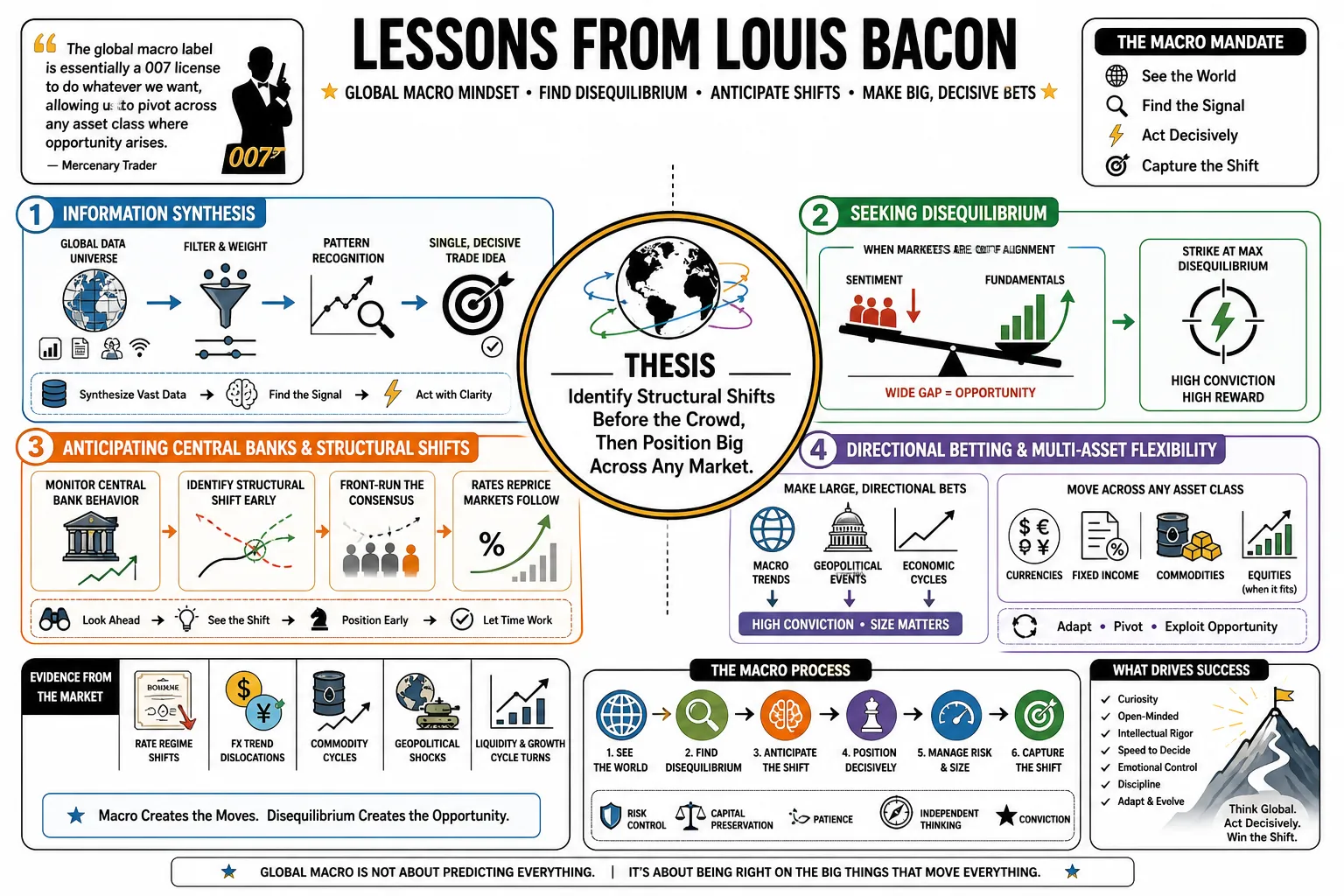
Part 1: The Global Macro Mindset
- On the Macro Mandate: "The global macro label is essentially a 007 license to do whatever we want, allowing us to pivot across any asset class where opportunity arises." — Source: Mercenary Trader
- On Information Synthesis: "The goal is to synthesize vast amounts of global data into a single, decisive trade that captures a major market shift." — Source: Vertex AI Search
- On Seeking Disequilibrium: "I wait for moments where market sentiment and fundamentals diverge violently, striking at points of maximum disequilibrium." — Source: Scribd
- On Anticipating Central Banks: "Success in macro often comes from identifying structural shifts in interest rates before they are fully priced in by the market." — Source: DayTrading
- On Directional Betting: "Macro trading is about making large, directional bets on global economic trends and geopolitical events rather than picking individual stocks." — Source: Institutional Investor
- On Multi-Asset Flexibility: "The ability to move between currencies, fixed income, and commodities is what defines a true global macro approach." — Source: Market Wizards
- On Structural Shifts: "Identifying how central bank behavior will impact currencies is the core of our strategy." — Source: DayTrading
- On Top-Down Analysis: "We look at the big picture first, assessing the economic and political environment before diving into specific market entries." — Source: Mercenary Trader
- On Asset Base Management: "Managing large assets well is like being Michael Jordan or winning the gold in the Olympics; it is what you aspire to as a professional." — Source: Forex Investors
Part 2: The Art of Risk Management
- On Cutting Losses: "If it goes down, you sell it." — Source: Seykota
- On Capital Preservation: "Protect your downside and keep fighting; the next opportunity will always come." — Source: Vertex AI Search
- On the Defensive Mindset: "I view myself as an apex predator who must remain defensive first to survive in the market." — Source: Youtube
- On Losses as Expenses: "A loss is merely a business expense, not a personal failure." — Source: Vertex AI Search
- On Value vs. Price: "If a stock goes from 100 to 90, a value investor might buy more, but I figure I must have been wrong and get out." — Source: Substack
- On Survival vs. Being Right: "Being right in the long run and surviving can be exclusive and non-reinforcing outcomes." — Source: MarketFolly
- On Volatility Control: "There is probably no trader alive who has better risk control on an asset base his size." — Source: Institutional Investor
- On Drawdown Discipline: "I believe in reducing capital allocations to managers if they hit a series of losing trades to enforce a survival culture." — Source: Institutional Investor
- On Rapid Exits: "If a position moves against me, I assume the market knows something I don't and exit immediately." — Source: DayTrading
- On Collateral Damage: "A huge positive year does not absolve you of the collateral damage of much smaller losses in the following." — Source: MarketFolly
Part 3: Technical Analysis and the "Thermometer"
- On the Thermometer Analogy: "For me, technical analysis is like a thermometer... if you are a responsible participant, you want to know if the market is hot or cold." — Source: Scribd
- On Fundamentalists and Charts: "Fundamentalists who ignore charts are like doctors who refuse to take a patient's temperature." — Source: Mercenary Trader
- On Tape Confirmation: "I never enter a trade based on fundamentals alone; I wait for the price action—the tape—to confirm my thesis." — Source: Vertex AI Search
- On Market Reality: "Markets are never wrong—opinions often are." — Source: Forex Investors
- On Surgical Execution: "Technical indicators allow for the surgical use of capital, entering and exiting with precision." — Source: Vertex AI Search
- On Market Health: "Charting is a tool for a health check, showing whether a trend is excitable or stagnant." — Source: Scribd
- On Sensitivity to Price: "Coming from a futures background, I am highly sensitive to every market movement." — Source: TurtleTrader
- On Trend Following: "I combine deep fundamental research with an aggressive trend-following mentality once the tape confirms the move." — Source: DayTrading
- On Gauge of Excitement: "You always want to know if the market is excitable or cold to gauge the potential for a breakout." — Source: Mercenary Trader
Part 4: Psychology and the Speculator's Disposition
- On Embracing Chaos: "As a speculator, you must embrace disorder and chaos." — Source: Forex Investors
- On Hope as a Strategy: "Hope is not an investment strategy." — Source: Vertex AI Search
- On Ego Separation: "I separate my self-worth from my trading results to avoid the trap of hoping a losing trade turns around." — Source: Youtube
- On Obsessive Detail: "Success in this business requires an obsessive attention to detail that others might find taxing." — Source: Institutional Investor
- On Market Instinct: "Investors often describe a successful trader as having an animal-like ability to sense the market." — Source: Institutional Investor
- On Patience: "Success drivers include hard work, patience, and knowing when to hold 'em, fold 'em, or go all in." — Source: DayTrading
- On Market Nature: "Speculation requires a comfort level with uncertainty that most people cannot maintain." — Source: Optional Arm
- On Resilience: "Always stay in the game; the market will always provide another chance to profit if you have capital left." — Source: Vertex AI Search
- On Discipline: "Everything in the environment must be set up to serve the discipline of the trade." — Source: Institutional Investor
Part 5: Tactical Execution and Market Timing
- The 70 to 100 Rule: "If I think something is going from 70 to 100, I will trade in and out 15 times before it gets there." — Source: DayTrading
- On Capturing the Meat: "The goal is to capture the 'meat' of the move while constantly adjusting for short-term volatility." — Source: DayTrading
- On the 1987 Crash: "I shorted stock index futures aggressively ahead of the crash and flipped long during the rebound." — Source: Vertex AI Search
- On the Gulf War Trade: "I anticipated the impact of the Iraqi invasion, betting on oil futures at $17 before they doubled to $40." — Source: Vertex AI Search
- On the ERM Crisis: "Betting against the British pound was a recognition that the currency peg was unsustainable against German rates." — Source: Vertex AI Search
- On Asian Contagion: "Positioning early against emerging market pegs allowed us to profit as the crisis spread through Asia." — Source: Vertex AI Search
- On Entering Equilibrium: "I look for points where price and fundamental value are in violent disagreement to find my entry." — Source: Scribd
- On Market Timing: "The 'itchy trigger finger' is about capturing short-term swings even when the long-term thesis remains intact." — Source: Substack
- On Adjusting for Volatility: "You must constantly recalibrate your position size to account for changing market volatility." — Source: DayTrading
- On Market Divergence: "True opportunity arises when the market stops listening to the fundamentals and reacts only to liquidity." — Source: Vertex AI Search
Part 6: Navigating the Business of Macro
- On Moore's Genesis: "The firm was named after my mother, whose inheritance provided the initial track record that launched Moore Capital." — Source: MarketFolly
- On Returning Capital: "Intense competition for trading talent coupled with client pressure on fees has led to a challenging business model." — Source: Institutional Investor
- On Privacy: "Publicity in no way enhances our ability to deliver for investors or to build our business." — Source: Institutional Investor
- On the Multi-Manager Model: "The multi-manager fund model has become increasingly difficult to sustain in a low-volatility environment." — Source: Institutional Investor
- On Liquidity and Redemptions: "There are times unlimited assets can be put to work... but these are normally times that clients are redeeming." — Source: MarketFolly
- On Macro Performance: "Disappointing results over the last few years obviously inform the decision to return client capital." — Source: Institutional Investor
- On Central Bank Intervention: "Central bank policies have made traditional macro trading much more difficult than in decades past." — Source: Institutional Investor
- On Talent Wars: "The cost of acquiring and retaining top trading talent has fundamentally changed the economics of the business." — Source: Institutional Investor
- On Managing Private Wealth: "Converting to a family office allows for a focus on long-term strategy without the quarterly pressures of outside capital." — Source: Institutional Investor
Part 7: Philanthropy and Landscape-Scale Conservation
- On Landscapes to Development: "We are too quickly losing important landscapes in this country to development." — Source: AZ Quotes
- On Future Generations: "I worry that if we do not act to protect them now, future generations will grow up in a profoundly different world." — Source: AZ Quotes
- On Conservation Urgency: "Wildlife habitats and water systems must be protected now; because once they are lost, they’re gone forever." — Source: Nature.org
- On Water as a Right: "We must guarantee that all citizens have access to clean air and clean water as a basic human right." — Source: Moore Charitable
- On Environmental Justice: "Too often we have failed to protect minority and underserved communities from industrial pollution." — Source: Moore Charitable
- On Investing in Leaders: "There is no better way to support conservation than by investing in the next generation of environmental leaders." — Source: Princeton University
- On Science and Policy: "Effective solutions require rigorous science, informed citizens, and wise policy." — Source: Princeton University
- On Landscape Protection: "Landscape-scale protection is necessary to preserve entire ecosystems rather than just isolated pockets of land." — Source: Moore Charitable
- On Patience in Giving: "Success in conservation philanthropy today requires funding resources and, above all, patience." — Source: Moore Charitable
- On Collaborative Efforts: "I look forward to seeing the impact of many talented people collaborating to protect our environment." — Source: Princeton University
Part 8: Personal Philosophy and the Legacy of Moore
- On Paternal Influence: "My father was the first person to introduce me to the great outdoors and to impart the importance of protecting land." — Source: Nature.org
- On Individual Responsibility: "I believe in the importance of the individual to act as a steward of the land and water." — Source: Nature.org
- On Being a Steward: "The most we can ever do is be a worthy steward of the land for ourselves and future generations." — Source: Tribune 242
- On North Carolina Roots: "Memories of duck hunting in the marshes of the Currituck Sound defined my early understanding of wildlife." — Source: Nature.org
- On Balancing Time: "I have a desire for more time for my large family, philanthropic pursuits, and sports-oriented properties." — Source: Institutional Investor
- On Legacy and Value: "Louis Bacon has always known that stewardship is the highest form of legacy." — Source: Tribune 242
- On Privacy as Value: "Staying out of the spotlight allows for a clearer focus on the long-term mission of the firm and foundation." — Source: Institutional Investor
- On Personal Conviction: "When you know you are right, you must have the courage to go all in, but the humility to exit when the market disagrees." — Source: DayTrading
- On the Nature of Speculation: "Trading is not just a profession; it is an exercise in managing one's own psychology against the chaos of the world." — Source: Optional Arm
END_PROFILE