Louis Tetu is a Quebec City entrepreneur and is currently the Executive Chairman of Coveo, an AI platform for search, recommendations, and personalization. He served as Coveo's CEO until April 2025. Prior to Coveo, Louis co-founded Taleo Corporation, the leading provider of software for talent and human capital management, acquired by Oracle for $1.9B in February 2012.
The Founder’s Operating System
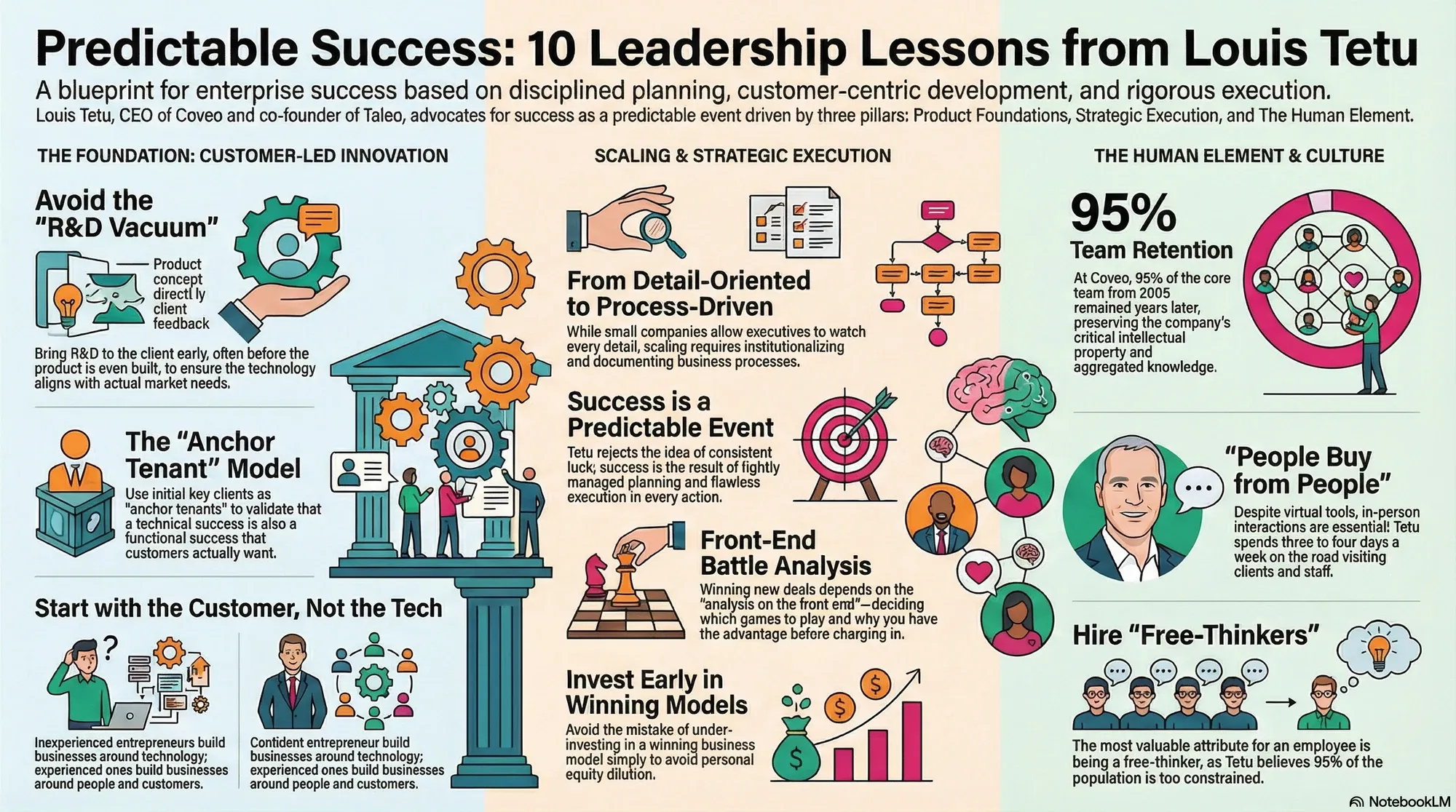
1. On the best way to set and execute a strategy at the beginning: “When you start a company you are physically responsible for both setting and executing the strategy. So I spent a lot of time in the field…talking to large corporations, understanding their needs, forming strategic partnerships and evolving the software and services. I spent a lot of time in the field with various industry pundits, trying to carve out a marketing strategy.”
2. On the best way to deploy R&D: “One of the key mistakes you want to avoid is to build technology at a vacuum. One of the strategies that we consistently try to deploy is bring our R&D to the client very early on, oftentimes, even before the product is built. Truly, align with what clients need. We always work with that notion of the anchor tenant. Many products can be a technical success but that’s not quite what customers want for various reasons.”
3. On starting with the customer: "I think the mistake that many entrepreneurs make is they have a good technology or they have something that is technically differentiated in one way or another but they look at development and customers as a waterfall. The idea is if you want to show adoption of a technology, then why not start with the customer. Inexperienced entrepreneurs will say, “We build business around technology.” Experienced ones would say, “You build businesses without people and very closely, right around customers.”
4. On scaling as an executive: “In a small, entrepreneurial company, you as an executive can watch and follow every single detail. Eventually, you need to make the transition to a company that relies more on processes…document those processes, and institutionalize business processes that let the company become more scalable.”
5. On picking and winning the right battles: “As it relates to winning new deals, I think we are very good at picking the battles we want to engage in. We run our company with the fundamental principle that everything is thoroughly analyzed and strategic. And of course, we strive to execute flawlessly once we’ve decided to engage. Sometimes we win just because our competitors execute poorly. But the key is the analysis on the front end. What is the game we should be in? Why do we know we can win that battle? I think that’s been a big part of it — thinking through our options before charging in to the battle.”
6. On having enough money to fully exploit the opportunity:“I think that’s a mistake that many entrepreneurs make. They don’t put enough investments early on when they have a winning business model because presumably, they don’t want to dilute themselves too much.”
7. On success as a predictable event: “I don’t believe things happen accidentally. When you start getting up into larger numbers, there is no such thing as consistent luck. There is no such thing as consistent bad luck, or consistent good luck. I think success is a very predictable event. It’s a matter of very closely and tightly managed planning and execution in everything you do. And if luck happens, luck happens. But, you know, the law of great numbers says good luck happens just as much as bad luck, so it’s kind of irrelevant to talk about.”
8. On the importance of low employee turnover: “Coming from Taleo, I understand the math of turnover probably more than most. Stability in R&D is extremely important because that’s your IP. At Coveo, of the core team that moved over in 2005 from Copernic, 5% churned and 95% is still there. That’s critical because the aggregated knowledge is kept intact. That’s really important.”
9. On the importance of in-person meetings: " In the day-to-day operations, we use virtual communication, but I am a firm believer of in-person meetings and having people interact. We go and meet customers. I travel literally all the time. I spend three to four days a week on the road visiting clients and our people. My job doesn’t happen in my office. I really believe in in-person interactions. Plane tickets are cheap from that perspective. That’s also one of my key guidance towards the entrepreneurs that I coach. It’s towards the idea that people buy from people at the end of the day."
10. On the most valuable attribute as an employee: “Ninety-five per cent of the population is too constrained, to be a ‘free-thinker’ is the most valuable attribute for our employees.”
Sources :
- Building Large Scale Enterprise Software
- Maison des Entrepreneurs video series
- Sterling-Hoffman CEO Spotlight
- Chicken or Egg Question: What Comes First— A Thriving Company or a Great Culture?
Capital, Governance, and Leadership
- On Smart Capital: “Allow me to say the words, smart capital is an oxymoron. It’s like jumbo shrimp. It doesn’t exist. Capital is not smart. Entrepreneurs are smart. They’re the ones building the business and so on. Capital is an instrument to invest and build business.” — BetaKit
- On Yes-People Boards: “If you put together a board of yes people, who have no experience in your space, who have not done it before, and will just come to the board to listen to you and tell you you’re a genius, in my opinion, that’s a recipe for failure.” — BetaKit
- On Being the Least Knowledgeable Person: Choosing to be the least knowledgeable person in a room is a deliberate decision that opens you up to continuous learning and constructive challenges. — BetaKit
- On Adaptability: In the technology sector, companies must remain extremely agile because the environment is essentially Darwinian, where only the most adaptable survive. — BetaKit
- On Capital Discipline: Having cash on hand should not lead to irresponsible spending; instead, maintaining caution with capital allows a business to outlast and take advantage of competitors who spend recklessly. — BetaKit
- On Selling to the CFO: During tougher economic times, the true buyer for any enterprise solution is the CFO, who will block any purchase that doesn't explicitly save money or generate revenue. — BetaKit
Building Enterprise AI That Works
- On AI Hallucinations: Generative AI models can easily fabricate information and deliver completely incorrect facts with absolute confidence. — BetaKit
- On Proficiency Over Efficiency: The deeper promise of AI is not simply doing the same work faster; it is human augmentation that enables people to handle more on their own. — Coveo AI-Experience Advantage presentation
- On Converging AI Experiences: Search, conversation, answers, personalization, and recommendations are converging into a more powerful advisory experience rather than remaining separate product features. — Coveo AI-Experience Advantage presentation
- On Ethical First-Party Data: Enterprise AI should rely on first-party data in ways that respect intellectual property, privacy rules, and each user's preferences. — Coveo AI-Experience Advantage presentation
- On Traceable Answers: Enterprise AI answers must be accurate, current, and traceable to their source of truth rather than merely sounding plausible. — Coveo AI-Experience Advantage presentation
- On GenAI Economics: Poorly engineered generative AI can cost one hundred or even one thousand times as much as ordinary search processing, so deployment needs optimization, a real business case, and explicit ROI. — Coveo AI-Experience Advantage presentation
- On AI as an Enterprise Capability: Every enterprise needs a shared AI capability that can deliver trusted, connected, individualized experiences while maximizing business outcomes across journeys and content sources. — Coveo AI-Experience Advantage presentation
- On AI Infrastructure: While producing generated answers is becoming commoditized, the true value of generative AI comes from the underlying data sources and "boring plumbing" that make those answers accurate and actionable. — BetaKit
Competing Through Relevance
- On Individualized Experiences: AI makes it possible to replace coarse customer personas with individualized experiences across millions of users and billions of moments. — Coveo AI-Experience Advantage presentation
- On Taking the AI Market: A company should treat AI as an opportunity to take market share through aggressive investment, not merely as a disruption to defend against. — BetaKit AI's new moat interview
- On AI or Die: "AI is going to revolutionize the world of business in ways that have never been seen before. AI or die, it’s my summary. Everything today is a digital interaction and people expect digital interactions that are highly personalized and that are actually even prescriptive that will tell them things they didn’t even ask for." — BetaKit
- On Discovery Beyond Answers: "Generating an answer is not necessarily the only thing that people want. People still want to discover." — BetaKit