Luke Burgis is an entrepreneur, educator, and author whose work applies René Girard’s theory of mimetic desire to everyday life. In his book Wanting and his Anti-Mimetic newsletter, he examines how models shape desire, how rivalry escalates, and how people can cultivate more deliberate and enduring desires. — Mimetic Desire 101
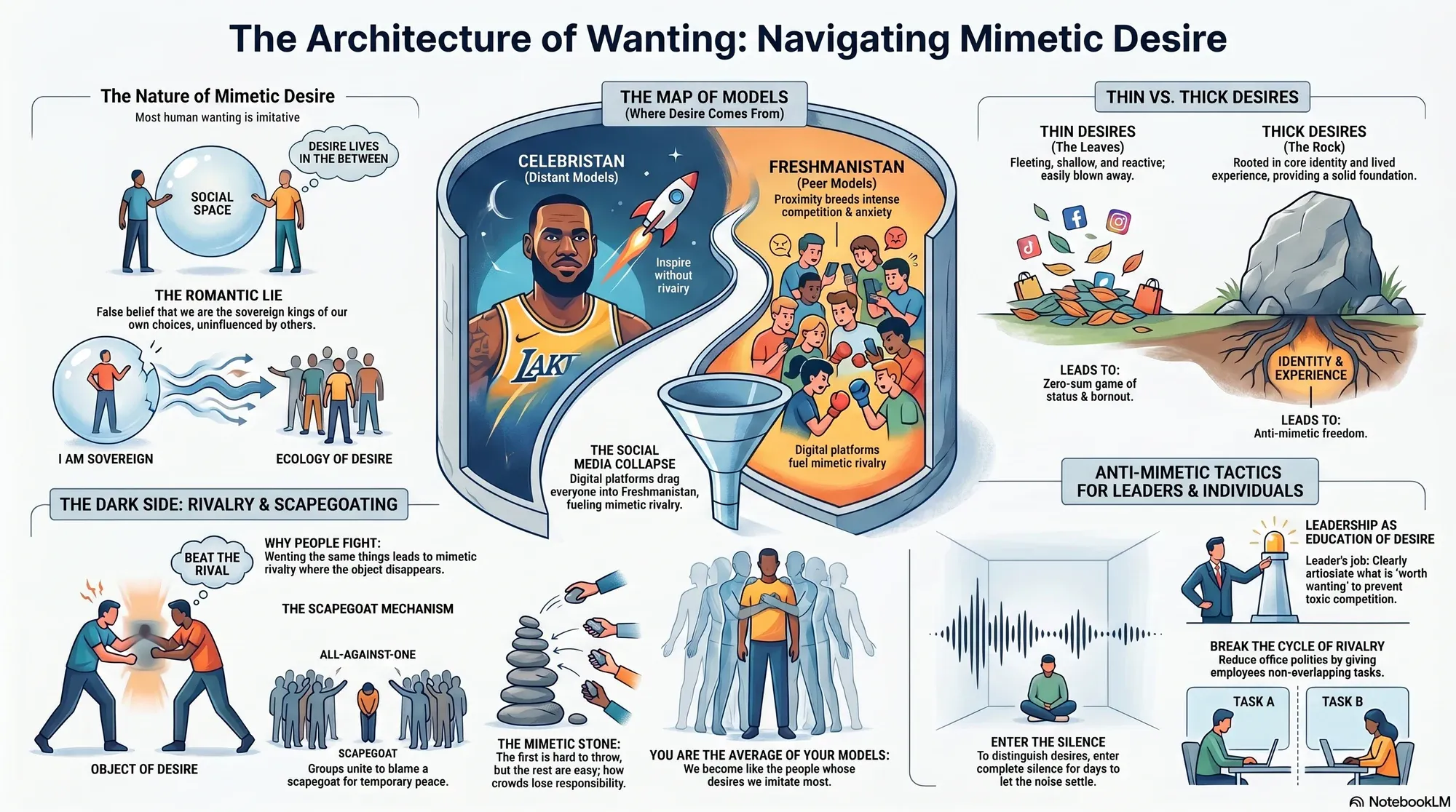
Part 1: The Core of Mimetic Desire
- On Mimetic Desire: Human desire is often mimetic: other people’s desires help shape what we perceive as worth wanting. — Mimetic Desire 101
- On the Nature of Desire: The path between a person and an object of desire is rarely direct; it bends through models who help mediate what appears valuable. — Mimetic Desire 101
- On Human Wanting: Unlike basic needs guided by instinct, abstract desires rely heavily on other people to show us what is worth pursuing. — Mimetic Desire 101
- On Conflict: When unrecognized mimetic desire turns peers into rivals, comparison can escalate toward conflict. — Art of Manliness Podcast
- On Needs vs. Wants: Needs such as food, warmth, and security are guided by instinct; more abstract desires rely on models. — Infinite Loops Transcript
- On Desire as a Process: Desires are path dependent: following one desire changes our position and what becomes possible or attractive next. — The Knowledge Project
- On Legitimacy: A model is a person, group, or thing that helps show us what is worth wanting. — Mimetic Desire 101
Part 2: The Illusion of Independent Choice
- On The Romantic Lie: The “romantic lie” is the belief that we choose what is desirable autonomously, without the influence of models. — Mimetic Desire 101
- On Myth-Making: Innovation and imitation are not opposites; original work commonly develops through imitation, variation, and differentiation. — Art of Manliness Podcast
- On Acknowledging Influence: Recognizing that we are mimetic creatures requires humility and is a necessary step toward choosing better models. — Art of Manliness Podcast
- On Self-Deception: People often rationalize desires as autonomous choices while overlooking the social models that helped generate them. — Mimetic Desire 101
- On Autonomy: Being anti-mimetic does not mean eliminating influence; it means gaining enough freedom and self-possession to counteract destructive imitation. — 25 Anti-Mimetic Ideas
Part 3: Models and Mediation
- On Choosing Models: Intentionally choosing the people closest to us is one of the strongest ways to influence what we learn to want. — The Knowledge Project
- On Intentional Imitation: Positive models and mentors can kindle healthier desires by making virtues and worthwhile ways of living visible. — Art of Manliness Podcast
- On Contagious Behavior: Rivalrous behavior in a leadership team can spread through an organization because ways of operating are contagious. — Infinite Loops Transcript
- On Transcendent Models: Transcendent models outside a local status game can help people redirect desire toward virtues and goods that do not depend on beating a peer. — Art of Manliness Podcast
- On Positive Mimesis: Mimesis can be constructive: seeing other people pursue virtue or meaningful work can kindle the same desire in us. — Art of Manliness Podcast
Part 4: Freshmanistan vs. Celebristan
- On Celebristan: “Celebristan” is Burgis’s name for the world of socially distant models whose desires can be imitated without direct competition. — Mimetic Desire 101
- On Freshmanistan: “Freshmanistan” is Burgis’s name for a world of similar, proximate models who can compete for the same things. — Mimetic Desire 101
- On Peer Competition: The people most like us often generate the strongest comparison and rivalry because we can plausibly compete for the same objects and status. — Art of Manliness Podcast
- On the Collapse of Distance: Social media blurs the boundary between distant celebrities and nearby peers, placing far more models inside our comparison set. — Art of Manliness Podcast
- On Status Games: When peers become models for one another, imitation can escalate into a rivalry where comparison matters more than the original object. — Art of Manliness Podcast
- On Distance as a Virtue: Creating boundaries with unhealthy models can interrupt environments that repeatedly trigger destructive comparison. — 25 Anti-Mimetic Ideas
Part 5: Thin Desires
- On the Nature of Thin Desires: Thin desires are highly mimetic and ephemeral: they can appear today and disappear when a new model arrives. — Big Think: Mimetic Desire
- On the Leaf Metaphor: Burgis compares thin desires to leaves lying above rock: a change in the mimetic wind can sweep them away. — Big Think: Mimetic Desire
- On the Engine of Mimesis: Social media greatly enlarges the field of models and accelerates comparison, desire shifting, and rivalry. — Art of Manliness Podcast
- On Cultural Defaults: A culture saturated with rapidly changing models makes thin desires the default unless people create time for recollection. — Big Think: Mimetic Desire
- On Satisfaction: No particular object permanently satisfies desire; when one pursuit loses its hold, desire readily attaches to another model or object. — Mimetic Desire 101
Part 6: Thick Desires
- On the Nature of Thick Desires: Thick desires have continuity: they are built over time and remain connected to enduring goods rather than changing with every new model. — Big Think: Mimetic Desire
- On Core Identity: Thick desires are connected to a person’s history and core and can be oriented toward perennial goods such as beauty, goodness, and human dignity. — Big Think: Mimetic Desire
- On the Rock Metaphor: Burgis compares thick desires to layers of rock built over a lifetime: more stable than the thin desires resting above them. — Big Think: Mimetic Desire
- On Fulfillment: Distinguishing thick from thin desires helps people decide which desires to cultivate and which to let go. — Big Think: Mimetic Desire
- On the Innermost Sanctum: Anti-mimetic choices draw on conscience, vocation, and deliberate judgment rather than merely reacting to the crowd. — 25 Anti-Mimetic Ideas
- On Self-Discovery: Recollection and listening to one’s life help reveal how long-standing desires and relationships have developed. — Big Think: Mimetic Desire
Part 7: Scapegoating and Conflict Resolution
- On the Scapegoat Mechanism: Scapegoating transfers blame and unwanted conflict onto a target so the group can avoid confronting what is happening within itself. — Big Think: Scapegoating
- On Unification Through Hate: A community in mimetic crisis can achieve temporary unity by converging against one person or group. — Infinite Loops Transcript
- On Catharsis: Scapegoating produces catharsis and relief because it lets people project suffering and responsibility onto someone else. — Big Think: Scapegoating
- On Subconscious Action: Scapegoats are selected through an unconscious process, sometimes because they deviate from a norm or threaten the social order. — Big Think: Scapegoating
- On the Blindness of the Crowd: Once one person identifies a target as the problem, it becomes easier for others to accept the target’s guilt. — Big Think: Scapegoating
- On Self-Reflection: A practical anti-scapegoating question is to ask who we or our group habitually blame for problems we do not want to face. — Big Think: Scapegoating
- On Marginal Targets: Scapegoats may be chosen because they differ from the group, break a taboo, or are vulnerable at the wrong moment. — Big Think: Scapegoating
- On Breaking the Cycle: Interrupting scapegoating begins by examining our own complicity and the systems of desire that make a target seem guilty. — Big Think: Scapegoating
Part 8: Silence, Truth, and Anti-Mimetic Tactics
- On Finding Peace: Silence creates space for self-awareness and for recognizing experiences that noise can keep us from understanding. — The Case for Silence
- On Extended Silence: Because reflective silence rarely emerges on its own, people and institutions need to create deliberate spaces for it. — The Case for Silence
- On the Pandemic of Noise: A culture of constant noise weakens reflection by pushing people to add more words before experience has had time to settle. — The Case for Silence
- On Meditative Thought: Reflection requires enough patience to sit with experience before immediately reacting or producing more content. — The Case for Silence
- On Swimming Upstream: Anti-mimetic freedom includes the ability to swim against a destructive social current when necessary. — 25 Anti-Mimetic Ideas
- On Meaningful Freedom: Being anti-mimetic means having the freedom to counteract forms of imitation that lead to envy, polarization, and empty striving. — 25 Anti-Mimetic Ideas
- On the Ditch of Rebellion: Contrarianism is not freedom: simply rejecting the crowd can leave a person governed by the same crowd in reverse. — 25 Anti-Mimetic Ideas
- On Deep Communication: Cultural change may require better spaces of encounter and reflection, not simply more content or louder argument. — The Case for Silence
Part 9: Entrepreneurship and Building on Solid Rock
- On Me-Too Innovation: Founders should be wary when incubators, competitions, and recognition become substitutes for doing the work and letting the market validate what they build. — 25 Anti-Mimetic Ideas
- On Manufactured Competition: Competition can spur innovation, but founders should know when a rivalry is consuming the business and opt out of the game. — Art of Manliness Podcast
- On Principled Entrepreneurship: Entrepreneurship should create durable value rather than seek short-lived mimetic recognition. — 25 Anti-Mimetic Ideas
- On the Trap of Status: Recognition contests can turn status into the goal and distract founders from building something the market itself values. — 25 Anti-Mimetic Ideas
- On Choosing Co-founders: A rivalrous cofounder can spread a damaging way of operating through the entire company culture. — Infinite Loops Transcript
- On Perception vs. Reality: Expert status can be mimetically inflated when a small number of influential people confer recognition on someone without sufficient substance. — Infinite Loops Transcript
- On Market Obsession: A competitor can quietly become a model whose choices shape your own; differentiation requires keeping rivalry from determining the company’s direction. — Art of Manliness Podcast
Part 10: Leadership and the Education of Desire
- On the Role of a Leader: Leadership requires shaping positive patterns of imitation and learning how to de-escalate destructive mimetic cycles. — 25 Anti-Mimetic Ideas
- On Transcendent Goals: Leaders can redirect local rivalry by pointing toward transcendent models and goods that are not reducible to defeating a peer. — Art of Manliness Podcast
- On the Burden of Influence: Leaders act as models inside systems of desire, so what they attend to and reward can become contagious. — 25 Anti-Mimetic Ideas
- On Resolving Conflict: A leader facing mimetic conflict needs the ability to de-escalate rather than intensify the rivalry. — 25 Anti-Mimetic Ideas
Learn more:
- Mimetic Desire 101
- The Knowledge Project: The Power of Mimetic Desire
- Art of Manliness: Why Do We Want What We Want?
- Infinite Loops: What Drives Human Desire? — Transcript
- 25 Anti-Mimetic Ideas
- Big Think: How to Know What You Really Want
- Big Think: The Ugly Psychology Behind Scapegoating
- The Case for Silence