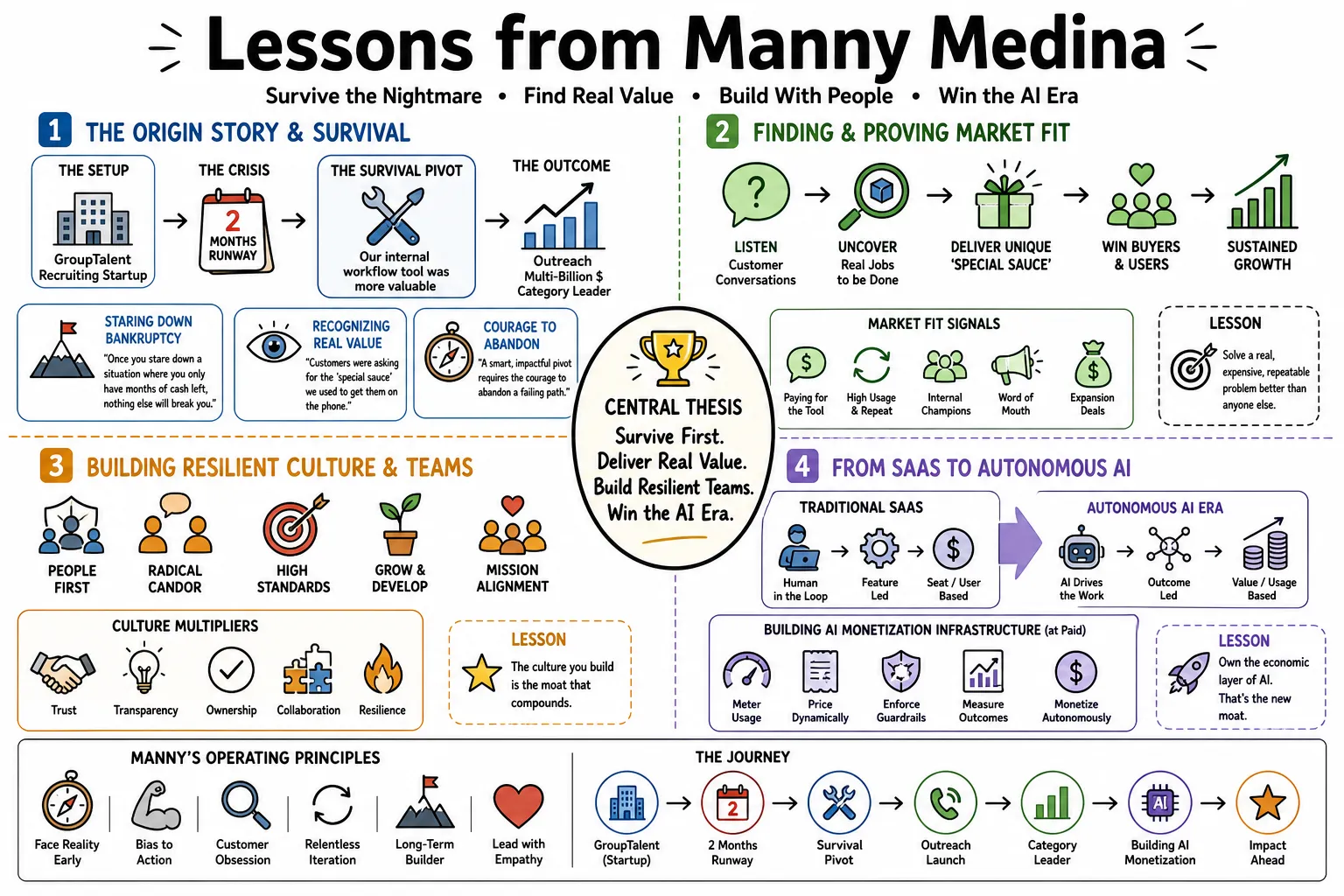
Manny Medina is best known for orchestrating one of the most successful survival pivots in modern software, turning a failing recruiting startup with two months of runway into Outreach, a multi-billion dollar platform that defined the sales engagement category. Now building AI monetization infrastructure at Paid, he brings a deeply operational and human-centric approach to scaling technology businesses. This profile captures his hard-won lessons on finding market fit, building resilient cultures, and navigating the transition from traditional SaaS to autonomous AI.
Part 1: The Origin Story & Survival
- On the Survival Pivot: "A smart, impactful pivot requires the courage to abandon a failing path. When we were running out of cash at GroupTalent, we realized our internal workflow tool was more valuable than our actual product." — Source: [The Tech Tribune]
- On Staring Down Bankruptcy: "Once you stare down a situation where you only have months of cash left, nothing else will break you. Now, nothing fazes me personally or freaks me out." — Source: [Forbes]
- On Recognizing Real Value: "Customers were asking for the 'special sauce' we used to get them on the phone. When buyers want your internal tool more than your service, you listen and pivot." — Source: [SaaStr]
- On Humility in Failure: "You have to be humble enough to admit when the original idea isn't working. Failure has a place and it should be used; you don't get to invent if you're not failing." — Source: [GeekWire]
- On Hustle and Urgency: "In life, you become what you think about the most. When we had only $1M left in the bank, we had to stop any negativity and just focus entirely on generating revenue." — Source: [GeekWire]
- On High Friction Problems: "My partners and I were looking for ideas that were broken and that software could fix. We wanted workflows with very high friction and very high price." — Source: [DFJ Growth]
- On the Regret of Inaction: "The regret of not trying is always far greater than the regret of failure. You have to take the swing." — Source: [Medium]
- On Extreme Customer Proximity: "In the early days, I physically walked door-to-door in San Francisco’s SOMA district to sell our software. You have to watch how users interact with the product in real-time." — Source: [From Pivot to Powerhouse]
- On Grit: "Growing up working on my aunt's shrimp farm in Ecuador instilled an unshakeable grit in me. That work ethic translates directly to surviving the startup grind." — Source: [Tanya Prive Interview]
Part 2: Product Philosophy & Market Fit
- On Product-Market Fit: "Product-market fit is simple: take your product, sell it. If you can sell it to a lot of people, you got fit. Don't over-intellectualize the street game." — Source: [SaaStr]
- On the Value of Code: "Code is cheap. Code is replaceable. Customers are not. The road map is for your customers; your customers are not for the road map." — Source: [Heavybit]
- On the Hedgehog Approach: "We are in hedgehog land right now. If you take up a very narrow problem, hedgehog into it, and become the absolute best at that one thing, you will print money." — Source: [Sequoia Capital]
- On Ignoring TAM: "Stay focused on a very narrow set of customers and disregard VC advice about massive Total Addressable Markets. Small TAMs become big TAMs if you deliver a superb experience." — Source: [Substack]
- On Iteration: "You iterate towards a product. If you don't begin with testing it in front of live users immediately, you just don't get to a good product that has fit." — Source: [Sequoia Capital]
- On Quality Scaling: "Find the narrowest profile that you can sell to without a lot of friction. If you really nail it for a small audience, that quality will eventually scale to a larger one." — Source: [Sequoia Capital]
- On Dogfooding Limitations: "We ate our own dog food, but because we were a small startup, we didn't experience enterprise-grade pain. You must intentionally simulate the complex friction your largest customers feel." — Source: [YouTube]
- On Vibe Coding in AI: "You don't debug vibe code; you throw it away, put the new version in production, and when it breaks, you start over. It's wonderful because you can always start fresh." — Source: [Sequoia Capital]
- On Solving One Thing Well: "The scaling of all other operations is actually easier when you have one type of customer that you're serving with excellence. Word of mouth happens organically from there." — Source: [Sequoia Capital]
Part 3: Go-to-Market Strategy & Execution
- On Founder-Led Sales: "Founders should not hire a VP of Sales until they have personally sold at least $500k to $1M of the product themselves. You have to discover the repeatable motion first." — Source: [SaaStr]
- On the $5M ARR Rule: "Hiring a VP of Sales too early is a common mistake. Until you hit roughly $5M ARR, you are in an evangelism phase where the founder’s vision is the primary driver." — Source: [The Official SaaStr Podcast]
- On Sales Specialization: "SDRs should focus 100% on lead generation, while Account Executives focus entirely on closing. Specialization is required to keep the pipeline flowing." — Source: [SaaStr]
- On Managing the Funnel: "Not managing the top of the funnel aggressively leads to lumpy revenue. You must track pipeline coverage constantly as a core health metric." — Source: [Substack]
- On Flipping Competitors: "In our early GTM motion, it was far easier to flip a competitor's customer than to educate a brand new one on the category. We made it our business to go after them." — Source: [Sequoia Capital]
- On Landing and Expanding: "Reduce your land and accelerate your expand. Our job is to land as fast as we can in the smallest thing possible. The moment you make them a customer, the magic shows up." — Source: [Sequoia Capital]
- On the Essence of Sales: "Sales is basically one human making another human aware of exchanging goods for money. An innovator can build something, but eventually, you have to get it into somebody's hands." — Source: [Medium]
- On Problem Solving: "Human connection and the ability to create trust while problem-solving is a quintessential human faculty that software simply enables." — Source: [Medium]
- On Customer Success: "If your success professional is truly anticipating needs, then you will have transaction expansion being driven naturally by customer success." — Source: [YouTube]
- On the Role of Outbound: "Outbound isn't dead, even in the AI era. The core motion of reaching out and capturing attention remains essential, even if the tools executing it change." — Source: [GeekWire]
Part 4: Scaling the Business
- On Scaling Operations: "Make sure the systems you're spending most of your time and money on scaling have a direct, measurable correlation to additional cash flow." — Source: [Medium]
- On Systems Thinking: "As a company scales, the CEO must evolve from personal intervention to systems thinking. You can't just run in to fix a bug; you must diagnose why the system allowed it." — Source: [SaaStr]
- On the Limits of Evangelism: "A VP of Sales is a scaler, not a builder of the initial motion. You bring them in when the evangelism phase ends and the rigorous scaling phase begins." — Source: [SaaStr]
- On Taking Support Tickets: "Even as a CEO, I personally take support tickets. It is the only way to truly understand the friction customers feel and ensure the roadmap reflects reality." — Source: [GeekWire]
- On Elevating the Trajectory: "Founders get into the details to elevate the company from its current trajectory into a completely new orbit of performance, achievement, and growth." — Source: [GeekWire]
- On Building for Enterprises: "To move upmarket, you have to systematically eliminate the roadblocks that cause friction for large organizations, not just add features for your early adopters." — Source: [YouTube]
- On Lessons from Amazon: "At AWS, if something goes wrong on the weekend, we jump on it. If you have a problem, you own it and you run it all the way through to its resolution." — Source: [GeekWire]
- On Finding the Right Leader: "As a founder, finding the right human and the right leader to hand over the reins to and continue your life's work is incredibly hard." — Source: [GeekWire]
- On Continuous Learning: "The business changes every time you double in revenue. The thing that I try to do to keep up is to intentionally learn something new every single day." — Source: [GeekWire]
Part 5: Leadership & The Founder's Role
- On Founder Vision: "Founders lead with vision. They see into the future and make others believe it, acting as the primary catalyst for the company's reality." — Source: [GeekWire]
- On Transparency: "I try to be as open and transparent as I can be with the entire company, so everyone knows it's encouraged to have an honest dialogue with each other." — Source: [GeekWire]
- On Empathy as a Tool: "I’m empathetic because I’m naturally curious about what drives people. As a leader, I am fundamentally a collector of motivations." — Source: [YouTube]
- On Gathering Strength: "I love the Thomas Paine philosophy: I love the man that can smile in trouble, that can gather strength from distress, and grow brave by reflection." — Source: [GeekWire]
- On Humanizing the Executive: "To maintain culture during rapid growth, I make it a habit to personally greet employees in the morning and learn their names to humanize the CEO role." — Source: [Sapphire Ventures]
- On Vulnerable Leadership: "Writing a weekly email of personal thoughts to the entire company helps break down the walls of the executive suite and invites people to share their own struggles." — Source: [Forbes]
- On Running into Fires: "The moment Pegasus was born, he flew into thunder and lightning without fear. As a leader, that's my nature. We run into fires, and we invite others to run with us." — Source: [Kids Alive]
- On Hiring A+ Generalists: "In the early stages, hire A+ generalists—curious people willing to learn from first principles—over rigid specialists who rely purely on past playbooks." — Source: [The Tech Tribune]
- On Delegating the Details: "Eventually, you have to let go of the interventionist mindset. If you are fixing every broken deal, you are bottlenecking the company's ability to operate autonomously." — Source: [SaaStr]
- On Sustainable Leadership: "Leadership requires stamina. I often speak at conferences in second-hand shirts to promote consuming less, because sustainability applies to how we live and work, too." — Source: [Forbes]
Part 6: Building Resilient Culture
- On the Soup Metaphor: "A lot of people use culture to create uniformity. But culture is like making soup—each new person brings their own flavor, and it must evolve as you grow." — Source: [Sapphire Ventures]
- On Celebrating Failure: "Failure is the only good teacher. We established traditions to celebrate failures visibly, which keeps the team agile and unafraid to take necessary risks." — Source: [The Tech Tribune]
- On Psychological Safety: "People need to feel safe that they can voice their opinion when something isn't working or boldly highlight areas where the company could be doing better." — Source: [GeekWire]
- On Friday Highs and Lows: "Hosting company-wide Friday Highs and Lows meetings creates a community where we share not just the wins, but the brutal realities of the week." — Source: [Forbes]
- On Authenticity: "We ask employees to show up as their authentic selves to rally the culture in service of the company's broader mission." — Source: [Sapphire Ventures]
- On Rejecting Conformity: "Your organization has to embrace inclusion in order to evolve your flavor. You must foster diversity of thought instead of strict cultural conformity." — Source: [Latino Donor Collaborative]
- On Technology's Real Purpose: "Technology is supposed to buy us time so we can spend more of our day doing actual, meaningful human things." — Source: [Business Insider]
- On Fostering Dialogue: "If the CEO is vulnerable first, it sets a precedent. It proves to the front-line workers that transparency won't be punished." — Source: [Breakline]
- On Enduring Hardship Together: "A team that survives a near-death business experience together builds a resilient tissue that no amount of team-building exercises can replicate." — Source: [GeekWire]
Part 7: Diversity & The Immigrant Experience
- On Imposter Syndrome: "Imposter syndrome isn't a weakness; it's a positive motivator that keeps founders grounded and prevents them from blindly drinking their own Kool-Aid." — Source: [Forbes]
- On Sacrificing Identity: "My name is Manuel. An early boss couldn't remember it and called me 'Manny.' I lived with it to fit in—a sacrifice of identity common to the immigrant experience." — Source: [Business Insider]
- On Diversity as a Catalyst: "A large part of our early team came from the immigrant community. Without all that diversity of background, we wouldn't have been able to get to where we are." — Source: [Business Insider]
- On Representation at the Top: "I believe D&I starts at the top. Employees fundamentally need to see themselves reflected in their leadership and at the board level." — Source: [Sapphire Ventures]
- On Immigration Policy: "Capping tech immigration is ridiculous. Innovation will happen regardless, and if policies create a climate of fear, that innovation will just happen in another country." — Source: [Business Insider]
- On Differing Perspectives: "Having a founding team with entirely different cultural lenses and backgrounds makes the company structurally stronger and more adaptable." — Source: [YouTube]
- On the Immigrant Hustle: "When you come to a new country on a student visa, failure means having to leave. That baseline reality creates a unique, relentless drive to succeed." — Source: [Business Insider]
- On Building Global Products: "You cannot build a product for a diverse, global market if everybody in the room making the decisions looks and thinks exactly the same." — Source: [Sapphire Ventures]
- On Overcoming Stereotypes: "You have to work twice as hard to prove your intellectual capability when people make assumptions based on your accent or background." — Source: [Breakline]
Part 8: The Next Era & AI Monetization
- On the Death of SaaS: "When I look at the landscape now, I see no traditional SaaS companies—they are all transforming into a collection of AI agents." — Source: [GeekWire]
- On the Definition of an Agent: "It's simple: if it can execute a workflow autonomously without a human being intervening at every single step, then it is an agent." — Source: [Heavybit]
- On the End of Seat-Based Pricing: "The per-seat pricing model is dying. In the AI era, you cannot charge by the user when the software itself is replacing the user." — Source: [YouTube]
- On the AI Pricing Curve: "AI monetization moves through a maturity curve: from charging for activity, to charging for workflows, to outcome-based pricing, and finally to agent-based flat fees." — Source: [Medium]
- On Outcome-Based Pricing: "We’re in software’s third act. Act 1 was systems of record. Act 2 was workflows. Act 3 is outcomes. In this new world, software must deliver receipts, not dashboards." — Source: [Medium]
- On AI Infrastructure: "To transition to the agent economy, you need new billing infrastructure that allows the agent to calculate and charge for the computational work it is doing autonomously." — Source: [YouTube]
- On Replacing Labor Budgets: "With AI agents, you aren't fighting for software budget anymore. You are replacing a human salary line item, like hiring an AI SDR for $20k instead of a human for $90k." — Source: [20VC]
- On the Real AI TAM: "If an AI agent can successfully complete tasks that replace human effort, your Total Addressable Market isn't software spend—it's global labor spend." — Source: [Heavybit]
- On Elevating the Sales Rep: "AI will elevate human workers by automating the drudgery of prospecting, giving reps the bandwidth to truly diagnose problems and empathize with buying committees." — Source: [GeekWire]
- On the Future of Work: "The goal of AI isn't to remove the human from the equation, but to handle the execution layer so the human can focus purely on strategy, trust, and relationship building." — Source: [20VC]