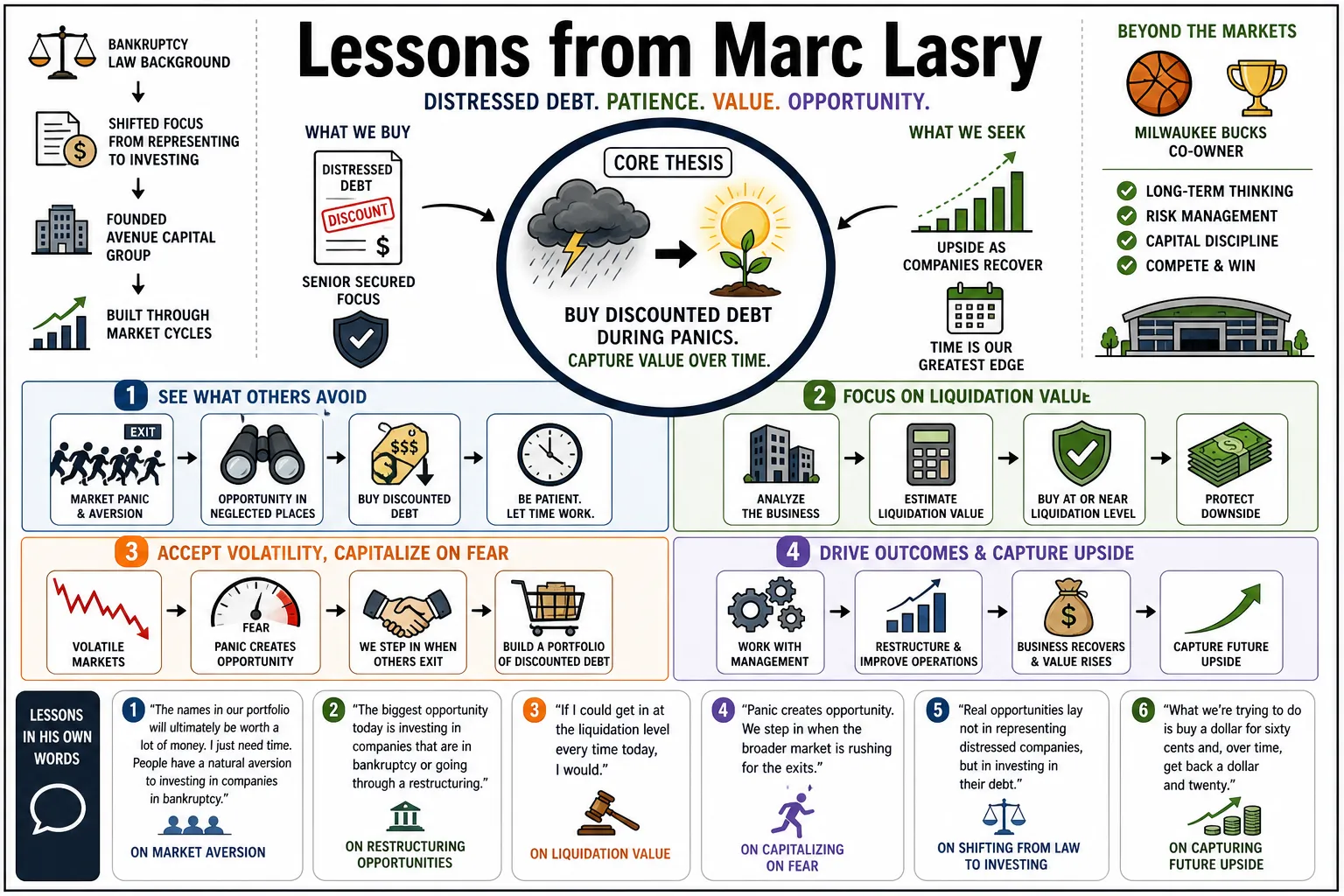
Lessons from Marc Lasry
Marc Lasry built Avenue Capital Group by buying the debt of distressed companies after traditional lenders walked away. He used his background in bankruptcy law to price risk in volatile markets, a strategy he later brought to the Milwaukee Bucks as co-owner. This collection details his methods for valuing businesses and managing capital through market panics.
Part 1: The Core of Distressed Investing
- On market aversion: "The names in our portfolio will ultimately be worth a lot of money. I just need time. People have a natural aversion to investing in companies in bankruptcy." — Source: [Washington Post]
- On restructuring opportunities: "The biggest opportunity today is investing in companies that are in bankruptcy or going through a restructuring." — Source: [Business Insider]
- On liquidation value: "If I could get in at the liquidation level every time today, I would." — Source: [Business Insider]
- On capitalizing on fear: "Panic creates opportunity. We step in when the broader market is rushing for the exits." — Source: [Daily Planet]
- On shifting from law to investing: "Real opportunities lay not in representing distressed companies, but in investing in their debt." — Source: [The Investors Podcast]
- On capturing future upside: "What we're trying to do is find assets that are undervalued and invest in those so that five years from now... that's when you'll capture the upside." — Source: [Sports Business Journal]
- On market breakdowns: "When things break down, the market is no longer efficient, and that is precisely when we can find the most mispriced assets." — Source: [Insider Monkey]
- On legal advantages: "I think you’ve got to understand bankruptcy law because what ends up happening now is you’re going to have a number of restructurings." — Source: [Insider Monkey]
- On structural analysis: "We make our best investments when we are willing to do the deep structural analysis that other investors are too afraid to undertake." — Source: [Hedge Fund Alpha]
Part 2: Managing Risk and Volatility
- On keeping composure: "Stay calm and buy when everybody is panicking; over time, you will end up doing well." — Source: [The Sales Machine]
- On buying the dip: "Is it better today than it was six months ago? Absolutely. Of course it is. But still, six months ago was a really good time and now’s a really good time, so you just keep buying." — Source: [Financial Times]
- On trusting analysis over noise: "If you believe in your analysis and you invest, you’ll do well regardless of short-term noise." — Source: [Market Folly]
- On avoiding complex risk management: "Don't try to spread your money across fifty small bank accounts just to stay under insurance limits; put it in stable assets like U.S. Treasuries." — Source: [Entrepreneur]
- On pricing danger: "Our job isn't to eliminate risk, it's to price it correctly when the market is overestimating the danger." — Source: [Forbes]
- On market resilience: "I am consistently surprised at how resilient the market is, even when sentiment suggests we should be bracing for a prolonged downturn." — Source: [CNBC]
- On foundational optimism: "One of our greatest strengths is simply the belief that if the underlying math is sound, things are going to work out." — Source: [Washington Post]
- On paper losses: "You don't let a temporary paper loss shake you out of a position if the fundamental thesis hasn't changed." — Source: [Real Vision]
- On ignoring headlines: "The world will be a safer place within a year, so don't fear investing even when headlines are terrifying." — Source: [Fox Business]
- On extending your timeline: "Our long-term view is over the course of the next two or three years, everything is going to work itself out." — Source: [Market Folly]
Part 3: The Milwaukee Bucks and Sports Ownership
- On the emotional tie to sports: "In business and in life, people tend to drop things that are no longer beneficial... There is an emotional connection, though, that keeps people invested in sports, during the ups and downs. Sports breaks all the rules." — Source: [University of New Haven]
- On viewing franchises as media: "When I bought the Bucks, I thought we were buying a media company... I think it's been the best investment I've ever made." — Source: [Business Insider]
- On trading for Jrue Holiday: "We got panned in the press that we gave up too much for Jrue Holiday... but we really believed that Jrue was the missing piece." — Source: [Basketball Network]
- On spending to win: "There is a tension in sports between making money and winning. To build a championship team, you have to prioritize spending to win." — Source: [Citadel Securities]
- On selling his stake: "The team was getting older, and would Giannis stay? I thought it was going to be hard to recapture everything, so I sort of looked at it like now may be a good time to sell." — Source: [Front Office Sports]
- On player injuries: "When Giannis went down in the Eastern Conference Finals, it looked horrible from where I was sitting. I just hoped that he was all right as a person." — Source: [Clark University]
- On women's sports: "Women's sports have the most upside in terms of investment opportunities and future valuation growth." — Source: [YouTube]
- On loyal customer bases: "You have to look at a sports franchise as an undervalued media property with a built-in, intensely loyal customer base rather than merely a team." — Source: [Sports Business Journal]
- On fan scrutiny: "Running a sports team means every customer thinks they can do your job better than you can, which is a dynamic you don't face in distressed debt." — Source: [Bloomberg]
Part 4: The Value of Patience and Timing
- On timing the market: "Everybody’s trying to time this thing, and you can’t. So our view is, look, it’s time to invest." — Source: [Financial Times]
- On the cost of certainty: "If you wait for the perfect moment when all the clouds have cleared, you will end up paying a premium for that certainty." — Source: [Institutional Investor]
- On identifying catalysts: "We don't buy and hope; we look for a specific event or legal catalyst that will unlock the value within a set timeframe." — Source: [PE Hub]
- On enduring slow processes: "You have to be willing to sit on an asset for years, knowing that the restructuring process is agonizingly slow but ultimately rewarding." — Source: [Tweak Your Biz]
- On contrarian patience: "When everyone else is rushing to deploy capital, that is usually the time to sit on your hands and wait for the cycle to turn." — Source: [Bookey]
- On averaging down: "You don't need to catch the exact bottom; if it was a good asset six months ago and it's cheaper today, you just keep adding to your position." — Source: [Financial Times]
- On cyclical downturns: "Economic downturns are a feature of the system. You have to endure the quiet periods to capitalize on the chaos." — Source: [Fox Business]
- On geographic growth rates: "You always want to be investing in a region that's growing 5 to 6 percent. You just do, because the rising tide helps fix a lot of mistakes." — Source: [Forbes]
- On holding through doubt: "The hardest part of investing isn't finding the right asset, it's having the discipline to hold it while the rest of the market tells you you're wrong." — Source: [Join Colossus]
Part 5: Assessing True Business Value
- On looking beyond financials: "Don't rely solely on financial statements; you must examine the underlying structure, obligations, and specific drivers of a business." — Source: [Tweak Your Biz]
- On buried value: "A company in bankruptcy is rarely worthless. The value is just buried under a bad capital structure that needs to be cleared away." — Source: [Insider Monkey]
- On financial rigor: "We look for areas where we can apply financial rigor to assets that may not have been run like traditional businesses." — Source: [Citadel Securities]
- On understanding priority: "Understanding the nuances of bankruptcy law gives you an edge in valuing an asset because you know exactly how the pieces will be divided." — Source: [Insider Monkey]
- On management issues: "You can fix a broken balance sheet, but it is incredibly difficult to fix a broken management culture." — Source: [Institutional Investor]
- On structural edges: "The best investments are those where you possess an informational or structural advantage that the broader market simply won't take the time to understand." — Source: [Hedge Fund Alpha]
- On future revenue streams: "People thought sports valuations were stretched years ago, but they didn't factor in the explosive growth of global media rights and sports betting." — Source: [Pulse 2]
- On demanding growth catalysts: "We actively search for undervalued opportunities that have a clear, undeniable catalyst for future growth." — Source: [Sports Business Journal]
- On worst-case scenarios: "Before we invest, we always ask: what is the absolute floor for this asset if everything goes wrong? If we can stomach the floor, we make the trade." — Source: [The Investors Podcast]
- On market exhaustion: "A company's current stock price during a restructuring is often a reflection of investor exhaustion rather than the actual value of the underlying business." — Source: [Business Insider]
Part 6: Understanding Markets and the Fed
- On central bank bailouts: "The Fed screwed us, it was horrible. They decided to come in and save the country. What we should have done was put all our money to work in those three weeks before they intervened." — Source: [Business Insider]
- On expensive capital: "The higher the cost of money, the lower the competition for distressed deals." — Source: [Institutional Investor]
- On harsh economies: "It’s ugly out there, but that environment is rosy for us because the lack of cheap capital makes it harder for others to compete." — Source: [Business Insider]
- On stepping in for banks: "If you can't borrow from banks, then you've got to deal with folks like me. And if you are doing that, we are able to charge 12 to 15 percent." — Source: [Insider Monkey]
- On zero-rate risk premiums: "It was kind of odd. A zero rate environment yet we were still able to charge double digits because traditional banks wouldn't touch the risk." — Source: [Insider Monkey]
- On intervention risks: "You always have to factor in what the central banks might do; sometimes your biggest risk isn't the company failing, it's the government bailing them out before you can buy the debt." — Source: [Business Insider]
- On rate hikes cleansing the system: "When rates rise rapidly, it cleanses the system of zombie companies that only survived because debt was virtually free." — Source: [Market Folly]
- On shifting lending terms: "Before, whenever we would tell somebody 'Hey, we’re at an eight percent rate,' they would laugh and hang up the phone. Now, the market has finally accepted the real price of risk." — Source: [Business Insider]
- On credit cycles: "Credit markets operate on a predictable pendulum of greed and fear. Our entire business is built on waiting for the swing toward fear." — Source: [Institutional Investor]
Part 7: Leadership, Partnership, and Building a Firm
- On sibling partnerships: "Building Avenue Capital with my sister meant we had a baseline of absolute trust, which allowed us to move faster than our competitors." — Source: [Hedge Fund Alpha]
- On complementary pessimism: "You need someone in the room who sees the glass as half empty to balance out the person who sees it as half full." — Source: [Quoteswise]
- On firm culture: "We built a culture where the analytical rigor of a bankruptcy law firm meets the aggressive deployment of a hedge fund." — Source: [Bookey]
- On family disputes: "When you run a business with family, you resolve disagreements quickly because you have no other choice but to sit across from them at dinner." — Source: [Celebrity Talent]
- On scaling operations: "The hardest transition is moving from being a great investor to being a great manager of other investors." — Source: [The Investors Podcast]
- On reputational currency: "In the credit world, your reputation for honoring your word during a messy restructuring is the only currency that actually matters." — Source: [Hedge Fund Alpha]
- On negotiation boundaries: "You have to be willing to push hard in negotiations, but always know exactly where the legal boundaries are drawn." — Source: [PA.gov]
- On hiring criteria: "We look for people who are comfortable operating in gray areas where the answers aren't cleanly provided in a textbook." — Source: [Bookey]
- On defending your name: "You have to fiercely defend your firm's reputation against unfounded rumors, because trust is the foundation of our ability to raise capital." — Source: [Business Insider]
- On institutional adaptability: "Avenue Capital wasn't built for a single market cycle; it was built to continuously adapt to wherever distress inevitably surfaces." — Source: [Institutional Investor]
Part 8: Practical Wealth Advice and Life Lessons
- On managing sudden wealth: "Pretend you don't have any money... The minute they make money everybody is always asking for money. Just tell everyone you have no money." — Source: [Business Insider]
- On setting boundaries with family: "Say: 'Look I get paid, but money goes automatically to here and I don't have access to that money.'" — Source: [Business Insider]
- On the immigrant advantage: "Coming to America with nothing gives you a distinct advantage: you are inherently less afraid of losing everything because you know you can survive it." — Source: [YouTube]
- On private investments: "Athletes frequently lose their money on terrible, illiquid private investments pitched by friends rather than on wild spending." — Source: [Entrepreneur]
- On simple wealth preservation: "The most effective wealth preservation strategies are usually the most boring ones. Stick to liquid, high-quality assets." — Source: [Entrepreneur]
- On taking losses: "You will make bad investments. The key is recognizing them early, taking the loss, and not letting your ego drag you down with the ship." — Source: [Real Vision]
- On evolving markets: "The market is constantly evolving. The moment you think you have it perfectly figured out is exactly when you are about to get run over." — Source: [Sloan Sports Conference]
- On finding your niche: "Don't try to compete where everyone else is playing. Find a complex, unglamorous niche and become the absolute best at it." — Source: [Harry Walker Agency]
- On fundamental optimism: "Ultimately, to be a successful investor over decades, you have to possess an underlying optimism that human ingenuity will solve our current crises." — Source: [Washington Post]