Lessons from Marissa Mayer
Marissa Mayer joined Google as its 20th employee and later ran Yahoo, building a reputation for obsessive UI standards and a management style that demanded data over intuition. This profile examines how she scaled global platforms by enforcing rigorous organizational discipline.
Part 1: Product Strategy and Constraints
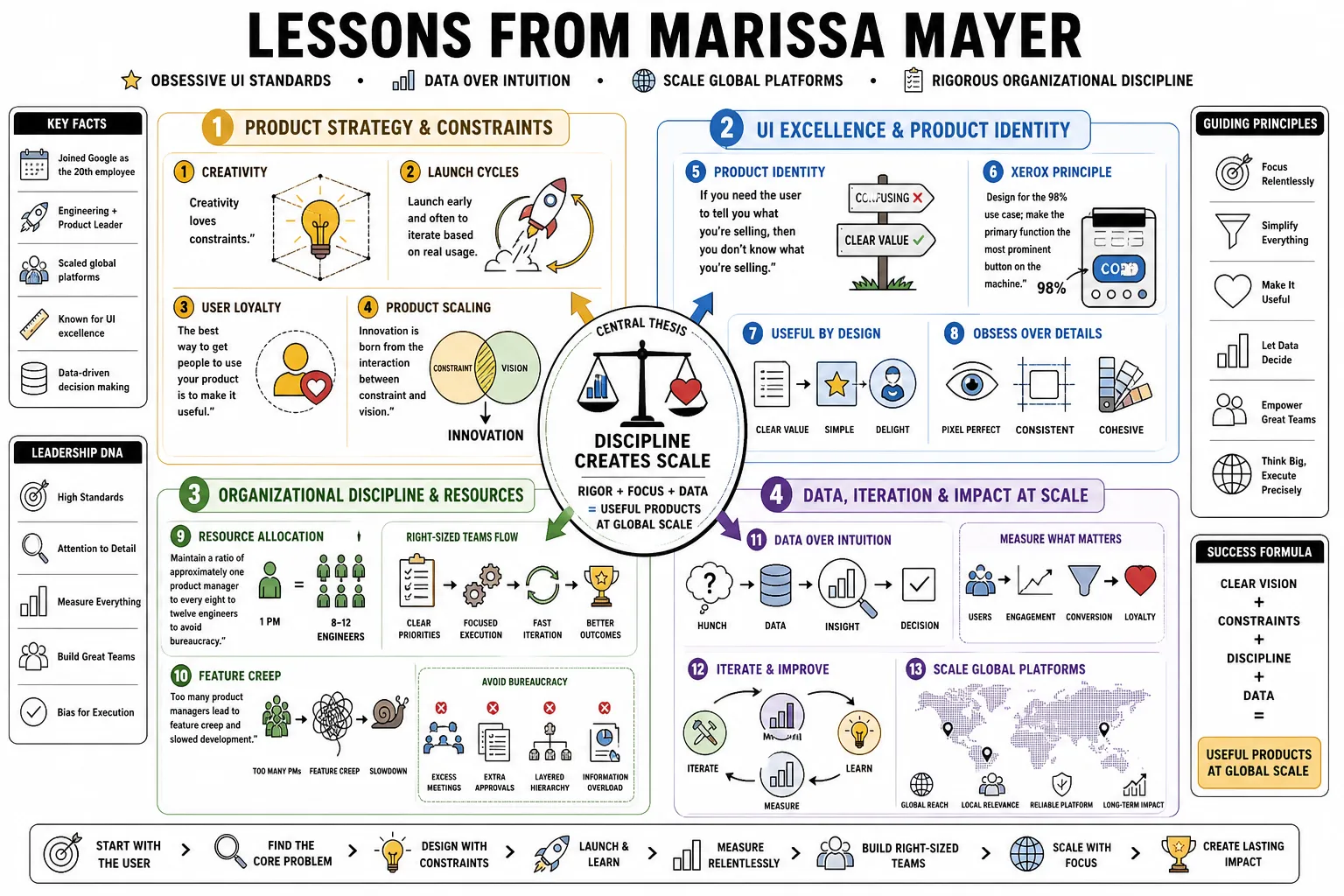
- On Creativity: "Creativity loves constraints." — Source: [Fast Company]
- On Launch Cycles: "Launch early and often to iterate based on real usage." — Source: [Business Insider]
- On User Loyalty: "The best way to get people to use your product is to make it useful." — Source: [Fast Company]
- On Product Scaling: "Innovation is born from the interaction between constraint and vision." — Source: [Stanford University]
- On Resource Allocation: "Maintain a ratio of approximately one product manager to every eight to twelve engineers to avoid bureaucracy." — Source: [Masters of Scale]
- On Product Identity: "If you need the user to tell you what you're selling, then you don't know what you're selling." — Source: [DDSN]
- On the Xerox Principle: "Design for the 98% use case; make the primary function the most prominent button on the machine." — Source: [Human Deluxe]
- On Feature Creep: "Too many product managers lead to feature creep and slowed development." — Source: [Masters of Scale]
- On Competitive Positioning: "Speed is a feature; if a search result is slow, it doesn't matter how accurate it is." — Source: [Google Blog]
- On Market Entry: "Solve a problem that people have every single day." — Source: [TechRadar]
Part 2: User Experience and Design Principles
- On Visual Clutter: "The 5-Point Rule: Assign one point for every different font, size, and color on a page; if it exceeds five, redesign it." — Source: [New York Times]
- On Interaction Depth: "The 2-Tap Rule: A user should be able to perform the primary action of an app within two taps." — Source: [TechRadar]
- On White Space: "Maintaining the Google homepage's sparse design was about protecting the user's focus." — Source: [Fast Company]
- On Design Logic: "A user interface should feel intuitive and discoverable, not like something that requires a manual." — Source: [Stanford GSB]
- On the 95th Percentile: "Design your products for the 95th percentile of users who just want the basics." — Source: [Masters of Scale]
- On Consistency: "A design language must be consistent across an entire suite of applications to build user trust." — Source: [TechCrunch]
- On Aesthetic Rigor: "The gatekeeper's role is to ensure that no single pixel is out of place across the global brand." — Source: [Business Insider]
- On Color Selection: "Even something as small as the shade of blue on a link can impact click-through rates significantly." — Source: [The Guardian]
- On Mobile Design: "Mobile-first means designing for the smallest screen and the shortest attention span first." — Source: [Yahoo News]
- On User Feedback: "Watch what users do with a product, because what they say they want is often different from how they actually behave." — Source: [Stanford eCorner]
Part 3: The Science of Data and Testing
- On Decision Thresholds: "When new information might make you better informed but won't change your mind, it’s time to stop searching and decide." — Source: [Stanford GSB]
- On Continuous Improvement: "If you can't measure it, you can't improve it." — Source: [Forbes]
- On Data as a Tool: "Data is the sword of the 21st century; those who wield it best will win." — Source: [Inc. Magazine]
- On A/B Testing: "We tested 41 different shades of blue to see which one users responded to most." — Source: [The Guardian]
- On Quantitative Discipline: "Using a math-based approach to design removes personal bias from the product process." — Source: [New York Times]
- On Metric Transparency: "Metrics provide a common language that allows engineers and designers to collaborate without friction." — Source: [Stanford University]
- On Gut Feeling: "Roll around in the data until you understand it, but for the final call, trust your first thought upon waking up." — Source: [Masters of Scale]
- On Experiment Frequency: "Run hundreds of experiments simultaneously to find the small wins that aggregate into big gains." — Source: [Business Insider]
- On Speed Data: "We found that even a 400-millisecond delay resulted in a 0.59% decrease in search volume." — Source: [Google Research]
- On Information Gaps: "Third parties often have only a fraction of the information you have; do not let their data-less opinions dictate your path." — Source: [Stanford GSB]
Part 4: Leadership, Hiring, and The APM Program
- On Leadership as Service: "Leadership is defense; your job is to clear the pathway and remove obstacles for your team." — Source: [Masters of Scale]
- On Manufacturing Talent: "If the market doesn't provide the hybrid talent you need, you must build an internal factory to manufacture it." — Source: [Masters of Scale]
- On Hiring Standards: "Hire for raw intelligence, aptitude, and intuition over specific years of experience." — Source: [Illinois Tech Speech]
- On Bureaucracy: "Appoint a 'Red Tape Machete'—someone whose only job is to cut through rules that slow down engineers." — Source: [Masters of Scale]
- On Information Power: "Power in modern companies comes from sharing information broadly, not from hoarding it." — Source: [YouTube/Stanford]
- On Cultural Feedback: "The PB&J (Process, Bureaucracy, and Jams) program allowed employees to vote on and fix office frustrations." — Source: [ASI Central]
- On Team Quality: "Surround yourself with people who are smarter than you; they will elevate your thinking." — Source: [Illinois Tech Speech]
- On Communication: "Friday afternoon all-hands meetings are essential for maintaining alignment in a rapidly changing culture." — Source: [Business Insider]
- On Mentorship: "Mentorship is not a single person; it is a collection of people, including your peers, who give you specific advice." — Source: [Stanford GSB]
Part 5: The Yahoo Turnaround and Corporate Strategy
- On Strategic Focus: "The MaVeNS strategy (Mobile, Video, Native, Social) was designed to catch the biggest waves in tech." — Source: [Forbes]
- On Company Identity: "Yahoo is the mobile company; we need to build for the device that is always in the user's hand." — Source: [TechCrunch]
- On Talent Acquisitions: "Acqui-hiring is a valid strategy for injecting fresh talent and a startup mindset into a legacy company." — Source: [AllThingsD]
- On Turnaround Scarcity: "In a turnaround, time is the scarcest and most precious resource you have." — Source: [Entrepreneur]
- On Ruthless Prioritization: "Identify which business units are savable and prioritize your best talent toward those areas." — Source: [Masters of Scale]
- On Workplace Collaboration: "People are more collaborative and innovative when they are physically together in the office." — Source: [Business Insider]
- On The Hourglass Analogy: "A declining company is like an hourglass; you have a finite amount of time to flip it before the sand runs out." — Source: [Masters of Scale]
- On Brand Revival: "Reviving a brand starts with fixing the products that people use every day." — Source: [Vogue]
- On Global Impact: "Success is building a company that changes the lives of hundreds of millions of people for the better." — Source: [CNBC]
Part 6: Productivity, Burnout, and "Rhythm"
- On Burnout Root Causes: "Burnout isn't caused by long hours; it's caused by resentment from missing things that matter to you." — Source: [Masters of Scale]
- On Work-Life Rhythm: "Don't seek work-life balance; seek to find your own personal rhythm." — Source: [Bloomberg]
- On Protecting Joy: "Identify the one or two things you cannot miss to stay happy and protect those ruthlessly." — Source: [Masters of Scale]
- On Effort Levels: "You can work arbitrarily hard for long periods as long as you maintain your personal rhythm." — Source: [Bloomberg]
- On Passion and Productivity: "Deep passion for the work is a gender-neutralizing force that makes traditional labels irrelevant." — Source: [The Guardian]
- On To-Do Lists: "Success is never getting to the bottom of your to-do list; it's about making progress on the right things." — Source: [Fast Company]
- On Professional Identity: "I’m not a woman at Google, I’m a geek at Google." — Source: [CNN]
- On Capacity: "In the end, we are all capable of so much more than we think if we push our limits." — Source: [Illinois Tech Speech]
- On Sleep Habits: "I can get by on four to six hours of sleep, but the rhythm of the work is what actually sustains me." — Source: [Vogue]
Part 7: Career Strategy and Risk-Taking
- On Career Growth: "I always did something I was a little not ready to do; that is how you grow." — Source: [Illinois Tech Speech]
- On Decision Overthinking: "Smart people often analyze decisions as if there is only one right choice; in reality, there are many good paths." — Source: [Stanford GSB]
- On Filtering Noise: "Negativity is just noise; believe in your vision and filter out the critics who don't see the potential." — Source: [Zapier]
- On Professional Allies: "Seek allies who will be honest and point out your mistakes, not adorers who only offer praise." — Source: [Illinois Tech Speech]
- On Decision Commitment: "The success of a choice depends more on your commitment to it after you've made it than the choice itself." — Source: [Stanford GSB]
- On External Validation: "Don't let good press or bad press influence your strategy; you have more information than the writers do." — Source: [Stanford GSB]
- On Environment: "Work for the smartest people you can find; they will challenge you to be your best." — Source: [Illinois Tech Speech]
- On Breakthroughs: "Breakthroughs happen when you push through the moments of 'I'm not really sure I can do this.'" — Source: [Illinois Tech Speech]
- On Career Commitment: "Make a decision and then work hard to make it the right decision." — Source: [Masters of Scale]
Part 8: Artificial Intelligence and Sunshine
- On Product Mission: "Sunshine is about making the mundane tasks of everyday life feel magical." — Source: [TechRadar]
- On AI Reliability: "For utility apps like contacts, AI must be 100% reliable; hallucinations are product failures." — Source: [The Information]
- On AI Expression: "The current breakthrough in AI is in expression—language and images—more than just reasoning." — Source: [Business Insider]
- On Human-AI Interaction: "AI should take a human-centered view; it should assist humans as opposed to replacing them." — Source: [Washington Post]
- On Technological Optimism: "AI is going to be the engine that propels us forward out of economic downturns." — Source: [Washington Post]
- On Building Trust: "By applying AI to mundane problems, you build user familiarity and ultimately trust in the technology." — Source: [Washington Post]
- On Utility Optimization: "Optimize the technology people use for small amounts of time every day to save them hours in the long run." — Source: [TechRadar]
- On Lifelong Learning: "I have been a lifelong student of AI, betting that it would be huge once we got the expression right." — Source: [Business Insider]
- On Personal Time: "Technology’s ultimate goal should be to save people time and make them happier in their relationships." — Source: [Washington Post]