Mark Spitznagel is the founder and chief investment officer of Universa Investments, a firm focused on tail-risk mitigation. Influenced by Austrian economics, he treats investing as a problem of long-term compounding: accept ordinary risk, avoid ruinous losses, and judge every hedge by its effect on the whole portfolio.
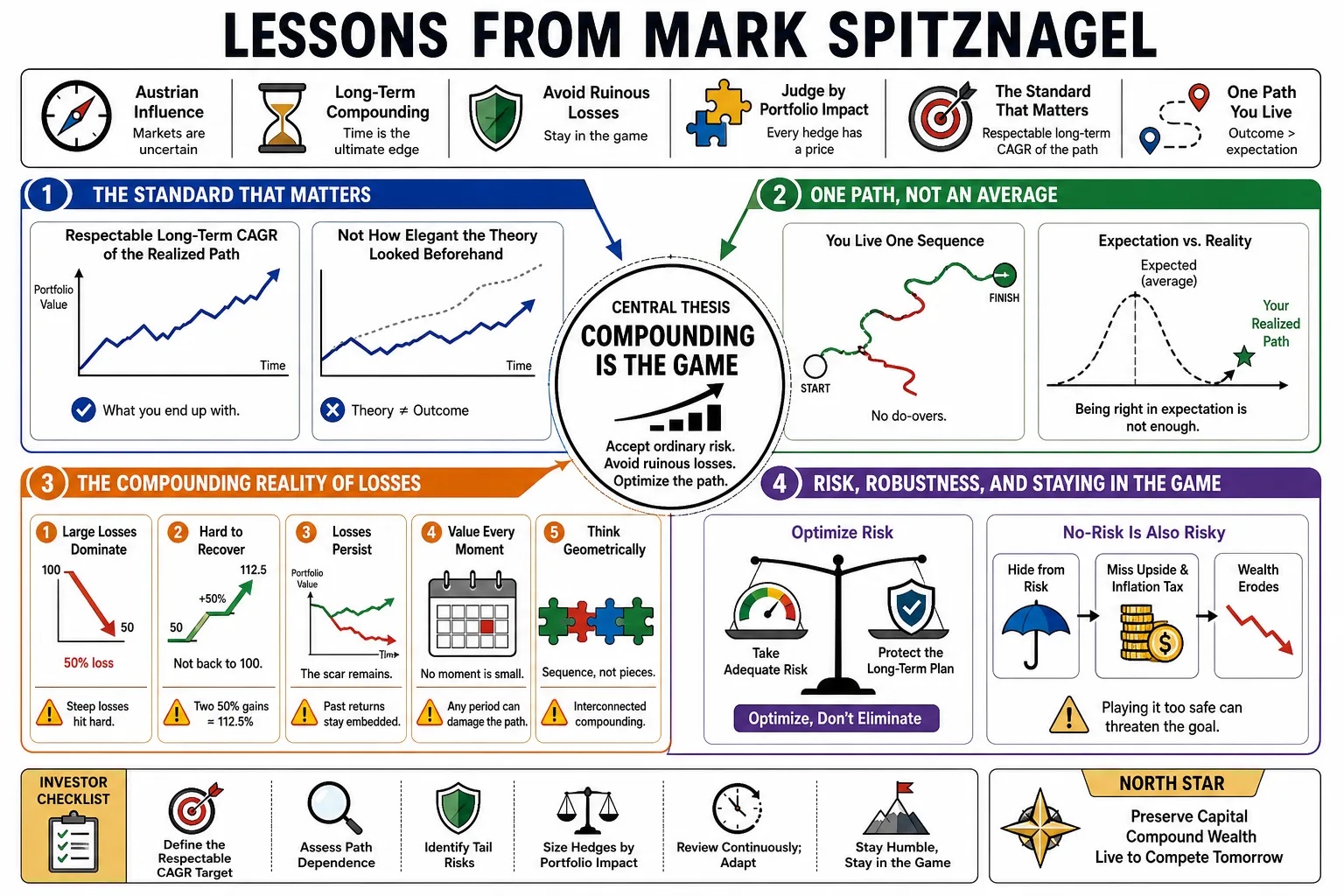
Compounding and the Realized Path
- On The Standard That Matters: Evaluate an investment path by the respectable long-term compound annual growth rate it leaves you with, not by how elegant the theory looked beforehand. — Reference: Universa Investments — Amor Fati
- On One Path, Not an Average: Investors live through one realized sequence of gains and losses, so being correct only in expectation is not enough. — Reference: Universa Investments — Amor Fati
- On Large Losses Dominate: Steep losses matter disproportionately to compounding; a 50 percent loss requires nearly two 50 percent gains to recover. — Reference: Universa Investments — Amor Fati
- On Losses Persist: A major loss permanently depresses the compounded path because past returns remain embedded in present and future wealth. — Reference: Universa Investments — Amor Fati
- On Value Every Moment: Any single period can damage the whole compounding path, so no moment should be dismissed as merely part of an average outcome. — Reference: Universa Investments — Amor Fati
- On Think Geometrically: Assess gains and losses as an interconnected sequence rather than as isolated arithmetic returns. — Reference: Universa Investments — Amor Fati
Risk, Robustness, and Staying in the Game
- On Optimize Risk: The objective is not to avoid risk altogether but to optimize it without allowing one disaster to destroy the long-term plan. — Reference: Universa Investments — Amor Fati
- On No-Risk Is Also Risky: Hiding from risk can itself undermine long-term wealth; robustness requires exposure to upside as well as protection from ruin. — Reference: Universa Investments — Amor Fati
- On Protect the Capital Base: Risk mitigation should protect the capital you have to work with so that temporary adversity does not force you out of the game. — Reference: Universa Investments — Amor Fati
- On Choose What You Can Endure: Before making an investment, ask whether you could live with its realized consequences indefinitely; if not, rethink the position. — Reference: Universa Investments — Amor Fati
- On Temperament Before Technique: The specific strategy matters less than developing a disposition that can withstand uncertainty without abandoning the plan at the worst time. — Reference: Universa Investments — Amor Fati
- On Avoid Ruin: The practical heart of robust investing is avoiding steep losses and staying in the game. — Reference: Universa Investments — Amor Fati
How to Judge Risk Mitigation
- On One Objective: Investing and risk mitigation share the same objective: maximize the rate at which the entire portfolio compounds wealth over time. — Reference: Universa Investments — Why Do People Still Invest in Hedge Funds?
- On Portfolio Effect: Judge a hedge by whether it raises the geometric return of the whole portfolio after mitigating systematic risk, not by how it performs in isolation. — Reference: Universa Investments — Why Do People Still Invest in Hedge Funds?
- On Volatility Is Not the Goal: Lower volatility can be a bad trade when it also lowers the portfolio's compound annual growth rate. — Reference: Universa Investments — Why Do People Still Invest in Hedge Funds?
- On Leverage Is Not a Free Repair: Adding leverage does not reliably restore the compounding lost to a weak diversifier because volatility imposes its own tax. — Reference: Universa Investments — Why Do People Still Invest in Hedge Funds?
- On Insurance Must Pay for Itself: A hedge adds value only when its benefit during severe declines exceeds the premium-like drag it creates in normal markets. — Reference: Universa Investments — Why Do People Still Invest in Hedge Funds?
- On Measure the Full Cycle: Risk mitigation should be evaluated across both crashes and quiet periods; a spectacular crisis return can still fail to improve long-run wealth. — Reference: Universa Investments — Why Do People Still Invest in Hedge Funds?
- On Allocation Size Changes the Tradeoff: A weak hedge requires a larger allocation to matter during a crash, which also magnifies its carrying cost during ordinary markets. — Reference: Universa Investments — Why Do People Still Invest in Hedge Funds?
- On Crash Payoff Versus Carry: Effective protection balances crash payoff against ongoing drag: the stronger the payoff per dollar, the less capital must be sacrificed to the hedge. — Reference: Universa Investments — Why Do People Still Invest in Hedge Funds?
Market Cycles and Recent Warnings
- On Do Not Call the Peak Too Early: A long-term crash thesis does not justify an immediate market-timing call; speculative blow-off rallies can continue before the reversal arrives. — Reference: Moneywise — Mark Spitznagel on a Blow-Off Rally
- On Policy Effects Arrive with a Lag: The consequences of extraordinary monetary intervention may take years to become visible, so the absence of immediate damage is not proof that the distortion was harmless. — Reference: Moneywise — Mark Spitznagel on a Blow-Off Rally
- On Hype Can Detach from the Idea: A valuable underlying technology does not prevent a market bubble; speculative hype can become independent of the idea that first attracted investors. — Reference: Business Insider — Mark Spitznagel on Bubbles and Market Cycles
- On Goldilocks Can Be Transitional: An apparently benign phase of rate cuts and rising markets can be a transition toward larger reversals rather than a durable equilibrium. — Reference: The Wealth Advisor — Mark Spitznagel on Risk and Diversification
- On Diversification Needs a Portfolio Test: Diversification should not be treated as automatically beneficial; it earns its place only when it improves the portfolio's long-term compounding after costs and drawdowns. — Reference: The Wealth Advisor — Mark Spitznagel on Risk and Diversification