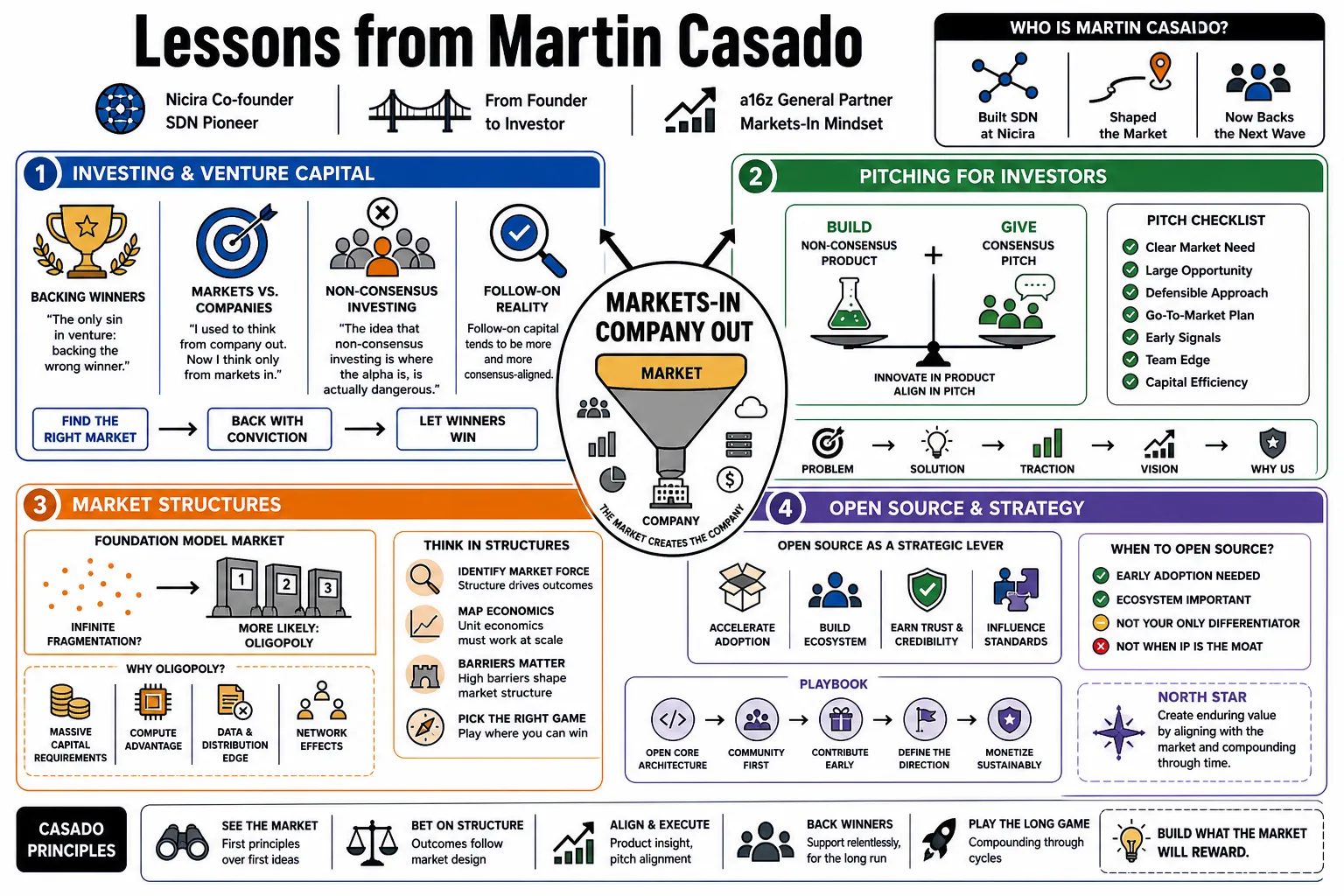
Lessons from Martin Casado
Martin Casado co-founded Nicira and helped establish software-defined networking before becoming a general partner at Andreessen Horowitz. Having shifted from technical founder to investor, he pushes a "markets-in" approach to company building. This profile covers his advice on early enterprise markets, pricing new technology, and open source.
Part 1: Investing and Venture Capital
- On Backing Winners: "The only sin in venture: backing the wrong winner." — Source: [Andreessen Horowitz]
- On Markets vs. Companies: "I used to think from company out. I’ve stopped that. Now I think only from markets in. The reality is the market creates the company, in most cases, not the other way round." — Source: [The Generalist]
- On Non-Consensus Investing: "The idea that non-consensus investing is where the alpha is, is actually quite dangerous in the early stage. Follow-on capital tends to be more and more consensus-aligned." — Source: [20VC]
- On Pitching: "You need to build a non-consensus product but you need to give a consensus pitch to investors." — Source: [Newcomer]
- On Market Structures: The foundation model market may tend toward an oligopoly rather than infinite fragmentation due to the massive capital requirements to compete. — Source: [Inside AI's $10B+ Capital Flywheel]
- On Media in VC: Venture capital has evolved into an industry where owning a media strategy is an essential component of reaching founders and shaping technical narratives. — Source: [Uncapped]
- On AGI Research vs. Revenue: There is a constant tension in modern AI investing between funding long-term research for general intelligence and demanding near-term product revenue. — Source: [a16z Podcast]
- On Infrastructure Investing: Software infrastructure is shifting dramatically, requiring investors to understand the specific demand forces that drive enterprise purchasing decisions today. — Source: [Invest Like the Best]
- On the AI Capital Market: The AI industry is driven by an unprecedented capital flywheel that requires continuous funding simply to keep up with compute costs. — Source: [Inside AI's $10B+ Capital Flywheel]
- On Early vs. Late Stage: The dynamics of venture capital shift significantly from early to late stage, where follow-on capital relies heavily on established market momentum rather than contrarian bets. — Source: [20VC]
Part 2: Artificial Intelligence and Technology Cycles
- On the Current AI Era: "This feels like 1996." — Source: [The Generalist]
- On AI's Potential: The current AI boom is comparable to the early internet; there is massive hype, but the foundational value creation is just beginning. — Source: [Podwise]
- On Coding Models: AI coding models are rapidly changing the baseline of software development, challenging long-held assumptions about programmer output. — Source: [20VC]
- On AGI Discourse: Focusing heavily on artificial general intelligence distracts from the immediate, practical applications and limitations of current models. — Source: [The Generalist]
- On Agentic Systems: AI is moving beyond simple text generation into agentic systems that can interact with real-world data structures and execute complex workflows. — Source: [Invest Like the Best]
- On the Value Stack: The locus of value in the technology stack is shifting as AI models commoditize certain layers of software while making data layers more valuable. — Source: [20VC]
- On Practical Constraints: The scale of AI is currently limited by physical constraints like energy availability and data center infrastructure. — Source: [The Six Five Pod]
- On AI's Broader Impact: AI fundamentally alters how enterprises think about software, shifting the focus from application logic to data orchestration. — Source: [Demand Forces Behind AI]
- On Developer Productivity: The integration of AI agents into full-stack coding workflows will force a complete reevaluation of how software teams are sized and managed. — Source: [a16z.com]
- On Near-Term Use Cases: The most immediate economic value in AI comes from augmenting existing enterprise workflows rather than trying to replace human reasoning entirely. — Source: [Invest Like the Best]
Part 3: Go-to-Market and Category Creation
- On the Widget Fallacy: "One of the biggest logical fallacies that technical founders do is... they think that if you create a widget, it has intrinsic value." — Source: [a16z News]
- On Intrinsic Value: "The reality is that no matter how cool your widget is, especially in the enterprise space until you go through go-to-market, it's like it doesn't even exist." — Source: [a16z News]
- On Mature vs. New Markets: "Most material on go-to-market that you'll find in the general literature is around mature markets... but none of that applies in market category-creation scenarios." — Source: [a16z News]
- On Creating Pull: "Pre-chasm companies have to create a pull-based market, not a push based one, before they can truly engage the broader ecosystem." — Source: [a16z.com]
- On Educating the Market: Founders must act as educators, actively teaching prospective customers how to value their innovation rather than assuming its benefits are self-evident. — Source: [a16z.com]
- On the Illusion of Distribution: A common mistake is thinking the hard part of a startup is distribution, leading founders to optimize for reach over establishing a strong price point. — Source: [a16z News]
- On Pricing Aggressively: Founders should price their new products aggressively from the start, as technical creators inherently underestimate the perceived commercial value of their work. — Source: [Future.com]
- On Magic Beans: Innovative technology is like magic beans; the primary challenge is convincing a skeptical market of the magic, alongside engineering the bean. — Source: [a16z Show]
- On Early Market Sales: In nascent categories, early sales motions act as a feedback mechanism to test product-market fit. — Source: [a16z.com]
- On Building the Category: If you invent a new software category, nobody is searching for your product yet, which means you have to generate the initial demand manually. — Source: [a16z News]
Part 4: Open Source and Strategic Assets
- On National Security: "Open source is a national security weapon and we're losing." — Source: [YouTube]
- On Chinese Models: "I'd say there's an 80% chance [startups are] using a Chinese open-source model." — Source: [Reddit]
- On the Lifeblood of Innovation: "Every set of the software stack has benefited from open source and it's been the lifeblood of innovation, private innovation." — Source: [Aarthi and Sriram]
- On Foundational Ecosystems: Without open source serving as a bedrock, massive technological shifts like cloud computing and mobile ecosystems would likely never have materialized. — Source: [Aarthi and Sriram]
- On Open Core Models: The software industry has evolved past the era where a single open-core business model is the only viable path to commercialization. — Source: [a16z.com]
- On Developers vs. IT: The open-source nature of a product appeals primarily to developers, but building a sustainable business requires selling to operations teams who care about reliability. — Source: [a16z News]
- On Open Source Competition: The proliferation of highly capable open-source AI models exerts intense competitive pressure on proprietary model providers to justify their pricing. — Source: [36Kr]
- On Personal Contribution: Actively contributing to open-source projects keeps you connected to the ground reality of software development, even if your day job is allocating capital. — Source: [Latent Space]
- On Platform Agnosticism: Successful infrastructure platforms usually need to remain hypervisor-agnostic and avoid getting locked into a single vendor's ecosystem to achieve broad adoption. — Source: [IT20]
Part 5: Startups and Company Building
- On Productivity Hacks: Obsessing over productivity hacks is a trap that creates the illusion of progress but frequently leads to burnout. — Source: [YourStory]
- On Doing vs. Being: Founders should focus on executing difficult tasks rather than expending energy trying to maintain the appearance of being a productive entrepreneur. — Source: [YourStory]
- On Changing Goals: "You're unlikely to achieve your goals... a better goal is likely to smack you while you're looking the other way, and you'd be an idiot not to follow it." — Source: [Business Insider]
- On Technical Founders: Technical founders often struggle early on because they assume superior engineering architecture naturally translates directly to business success. — Source: [Forbes]
- On the Nicira Impact: Building a category-defining company requires introducing your product to the market like a cannonball hitting placid water. — Source: [Business Insider]
- On First-Time Missteps: "I made many, many missteps as the first-time founder of a company." — Source: [Business Insider]
- On Embracing Failure: The path to building a successful company is rarely linear; learning how to recover from failed attempts is a valuable skill. — Source: [Business Insider]
- On Founder Well-being: Prioritizing personal well-being is a structural necessity for surviving the multi-year marathon of company building. — Source: [YourStory]
- On Focus: Enduring success comes from prioritizing the specific work that fundamentally moves the needle rather than just clearing a daily to-do list. — Source: [YourStory]
- On False Proxies: Many early-stage teams rely on false proxies for success, like press mentions or headcount, instead of focusing on whether the market actually values their product. — Source: [a16z.com]
Part 6: Sales and Enterprise Markets
- On Enterprise Sales: Traditional enterprise sales can feel like a baroque tribal ritual bloodletting due to complex procurement cycles and entrenched third-party consultants. — Source: [Business Insider]
- On B2B Convergence: "A new wave of B2B companies... shows that enterprise businesses have started to look a lot more like their consumer counterparts." — Source: [a16z.com]
- On Product-Led Growth: "When the initial route to market is focused on how much a product sells itself, the winners are the product visionaries, not veteran sales leaders pushing outdated software." — Source: [a16z.com]
- On Bottom-Up Adoption: Bottom-up developer adoption is a powerful wedge, but it does not eliminate the eventual necessity of a structured, top-down sales process to secure enterprise-wide deals. — Source: [a16z.com]
- On the Dull Thud: Without a repeatable go-to-market motion, even the most technically promising enterprise products will simply land with a dull thud. — Source: [a16z.com]
- On Sales as a Tool: "It's all about striking the right balance, using an incremental sales approach both as a tool to drive into the market, and as an indicator of how strong the fit actually is." — Source: [a16z.com]
- On Mature Market Playbooks: Playbooks written for selling into established software categories usually fail entirely when applied to new technological paradigms. — Source: [a16z News]
- On Procurement Frictions: Startups have to learn to navigate the byzantine procurement departments of large corporations if they ever hope to scale their revenue reliably. — Source: [Business Insider]
- On Shifting Power: The consumerization of IT has gradually shifted software purchasing power away from traditional IT gatekeepers and toward individual developers. — Source: [a16z.com]
Part 7: Policy, Regulation, and Security
- On AI Policy: "Base AI policy on evidence, not existential angst." — Source: [a16z.com]
- On Existential Risk: Focusing regulation heavily on theoretical long-term risks distracts policymakers from addressing the immediate, marginal harms of technology. — Source: [a16z.com]
- On Evidence-Based Rules: Effective technology regulation must be grounded in empirical data and current technical realities, rather than science fiction scenarios. — Source: [a16z.com]
- On Strategic Competition: Regulating open-source development too harshly on a domestic level risks ceding technological leadership to foreign adversaries. — Source: [YouTube]
- On Open Source Security: The transparency inherent in open-source software can act as a forcing function for improving security, despite general fears about its wide availability. — Source: [YouTube]
- On Regulatory Capture: Overly burdensome AI regulations often serve to protect incumbent technology companies at the expense of new startups and open ecosystems. — Source: [a16z.com]
- On the Global Arms Race: The software industry is in a global competition for artificial intelligence dominance, making open-source models a core component of that struggle. — Source: [YouTube]
- On the Cost of Compliance: Heavy-handed regulatory frameworks disproportionately harm early-stage companies that lack the legal resources to navigate complex compliance rules. — Source: [a16z.com]
Part 8: Career, Failure, and Mindset
- On Academic Struggles: "I only found computer science because I couldn’t hack it as a physicist and then I failed as a microbiology student." — Source: [Business Insider]
- On Getting Good at Failure: Instead of striving for a pristine track record, ambitious individuals should learn to embrace and get good at failure as a natural part of professional growth. — Source: [Business Insider]
- On Non-Linear Paths: Career trajectories are rarely straightforward; outsized success often comes from adapting to unexpected opportunities and inevitable dead ends. — Source: [Business Insider]
- On Hustle Culture: Blindly subscribing to hustle culture can actively distract you from doing the deep, quiet work required to build something technically lasting. — Source: [YourStory]
- On Technical Debates: Engaging vigorously in technical debates in public is essential for pushing the industry forward and stress-testing new architectural assumptions. — Source: [IPSpace]
- On Defying Expectations: Some of the most important infrastructure innovations come from actively rejecting the established consensus of how networking should be done. — Source: [IPSpace]
- On the Value of Missteps: The myriad mistakes made during a first venture are simply the necessary tuition paid for the wisdom required to succeed in subsequent ones. — Source: [Business Insider]
- On Staying Grounded: It is vital to maintain a direct connection to fundamental engineering challenges even as your career moves toward venture capital and high-level strategy. — Source: [Latent Space]
- On Serendipity: Being open to serendipity, allowing a better goal to unexpectedly take over your life, is often more fruitful than rigidly adhering to a ten-year plan. — Source: [Business Insider]