Martin Lau Chi-ping, the President and Executive Director of Tencent Holdings, is one of the most influential and forward-thinking executives in the global technology industry. While known for being media-shy and less public-facing than his chairman, Pony Ma, Lau's strategic vision has been the driving force behind Tencent's transformation from a messaging app company into a sprawling digital empire spanning gaming, social media, fintech, and global investments.
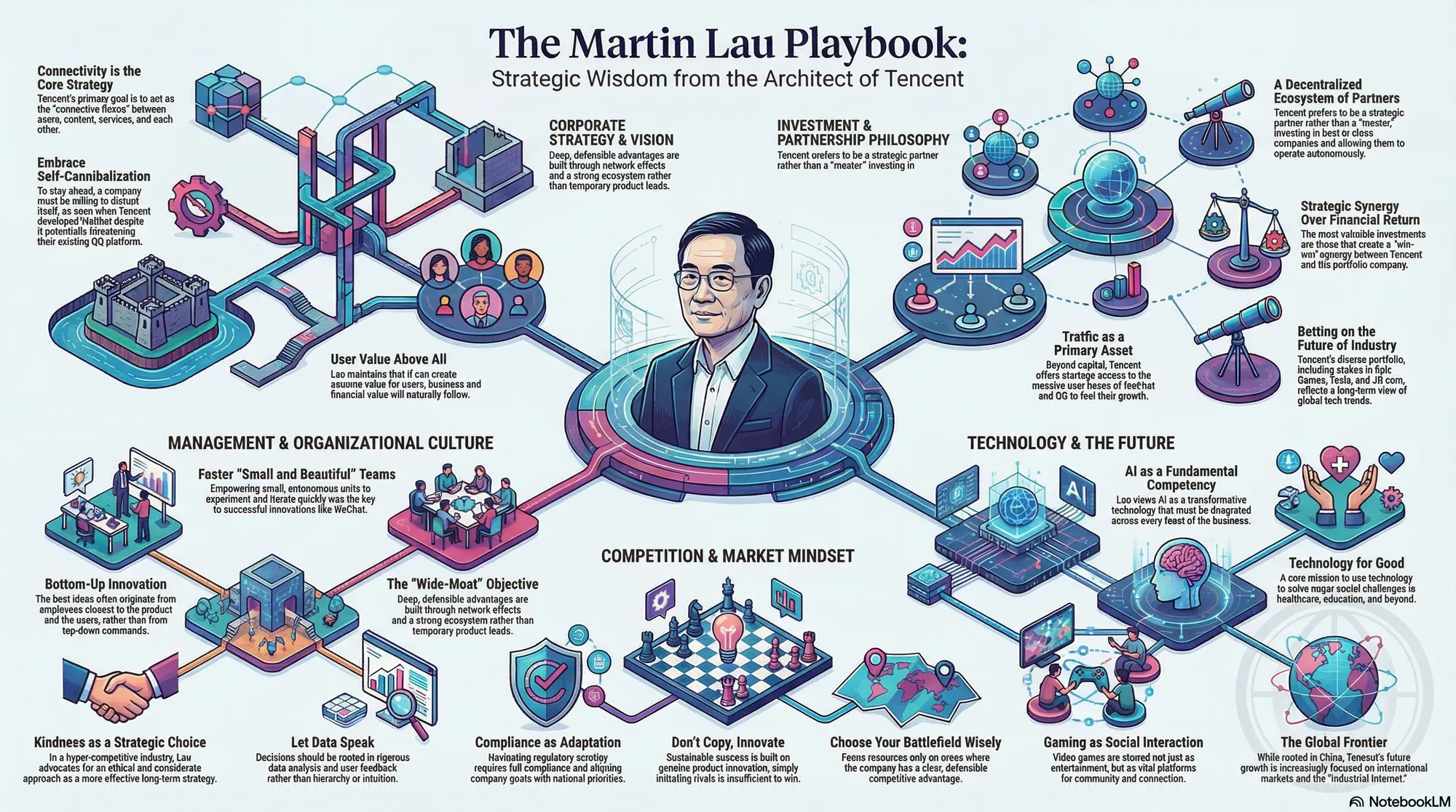
On Corporate Strategy and Vision
- Martin Lau said Tencent's strategic goal is 'Connection,' with using internet services to improve people's quality of life as its mission -- the driving forces behind Tencent's continued progress. [3]
- Lau has said trying to control and do everything itself would not be an aspiration but a fantasy for Tencent -- instead, investing lets the company focus on its core platform business while letting partner companies do what Tencent isn't good at, making the relationship complementary rather than one of outright ownership. [6]
- "Our lifeblood is innovation." Complacency is the biggest threat. The company must constantly evolve and create new products and services to stay relevant. (Source: General theme from internal speeches)
- "We need to be a 'wide-moat' company." The goal is to build deep, defensible advantages through network effects, technology, and a strong ecosystem, not just temporary product leads.
- Lau has framed this as embracing a long-term oriented corporate culture centered on user value, social responsibility, technology innovation, and compliance -- the elements he says are key to sustainable, healthy growth, even as short-term revenue growth slows. [7]
- Announcing Tencent's reorganization, Martin Lau said the company had built deep strengths in the first stage of the internet era that positioned it to embrace the second stage -- the shift toward the Industrial Internet -- while staying humble and seeking new opportunities. [4]
- "Our business is not an empire. It's a group of partners." This quote perfectly encapsulates the company's open, collaborative approach to building its ecosystem.
- "We want to be the 'most respected internet company'." This internal goal emphasizes ethics, user value, and social responsibility over pure financial success.
- "User value is our first priority." If you create genuine value for users, business value will naturally follow. This is a foundational principle at Tencent.
- "We have to cannibalize our own products sometimes." To stay ahead, you must be willing to disrupt yourself. The creation of WeChat, which could have threatened QQ, is the prime example of this philosophy in action.
On Investment and Partnerships
- "Our investment strategy is to find the best-of-breed companies in vertical and core sectors and help them grow." Tencent acts as a strategic investor, providing capital, traffic, and expertise.
- "We invest in people." The quality and vision of the founding team are the most critical factors in any investment decision.
- "We don't want to be the master. We want to be a good partner." Lau emphasizes that Tencent's goal is to support its portfolio companies, not to control them.
- "Traffic is the most valuable asset we can offer." For many startups, gaining access to WeChat's and QQ's massive user base is more valuable than capital alone.
- "Investment is our way of exploring new opportunities." It allows Tencent to maintain a presence in emerging sectors without having to build everything in-house.
- "The world is so big. We can’t do everything ourselves." This pragmatic view is the basis for Tencent's sprawling investment portfolio, which includes stakes in companies like JD.com, Pinduoduo, Epic Games, and Tesla.
- "We look for companies with a 'flywheel effect'." Businesses that gain momentum as they grow, with each new user or service adding more value to the network, are the most attractive.
- "A good investment is not just about financial return; it’s about strategic synergy." The best partnerships create value for both Tencent and the portfolio company.
- Tencent framed the JD.com divestment as good timing rather than retreat: the e-commerce firm, long backed by Tencent, had reached a stage where it could self-finance its own growth. [8]
- "When we invest, we are betting on the future of the industry." Tencent's investments are a reflection of its long-term view on where technology and consumer behavior are headed.
On Management and Culture
- "The biggest challenge for a large company is to stay agile and innovative." He constantly stresses the need to avoid bureaucracy and maintain a "startup mentality."
- "We need to foster a culture of 'small and beautiful' teams." Empowering small, autonomous teams to experiment and iterate quickly is key to innovation. This was a core principle behind the development of WeChat.
- "Let data speak." Decisions should be based on rigorous data analysis and user feedback, not just on hierarchy or gut feeling.
- "As a manager, your job is to create an environment where the best ideas can win." It's about enabling talent, not commanding it.
- "We must have 'bottom-up' innovation." The best ideas often come from the employees who are closest to the products and the users.
- "In the Internet industry, the most valuable asset is talent." Attracting, retaining, and empowering the best minds is the ultimate competitive advantage.
- "You have to be very patient with new initiatives." It can take years for a new product or business line to mature. He often cites the long, multi-year journey of Tencent's payment business (Tenpay/WeChat Pay) as an example.
- "Review and learn from your failures." Tencent has a culture of conducting deep post-mortems on failed projects to extract valuable lessons.
- "Kindness is a choice." In a fiercely competitive environment, he advocates for a more considerate and ethical approach to business, which he believes is a more advanced and effective strategy in the long run. (Source: Tencent Internal Document)
On Technology and The Future
- "AI is a fundamental technology that will transform every industry." He sees AI as a core competency that must be integrated across all of Tencent's businesses.
- Martin Lau said building the metaverse would probably take longer than people expected and require many iterations, signaling patience rather than a rush to hype it. [1]
- "Cloud computing is the backbone of the Industrial Internet." Tencent is heavily invested in building out its cloud infrastructure to serve businesses and public services.
- "Short-form video is a massive trend that is here to stay." The rise of platforms like Douyin (TikTok) prompted a major strategic response from Tencent, including the development of WeChat Channels.
- "Gaming is not just entertainment; it's a new form of social interaction." He views games as platforms for connection and community.
- Tencent's own guiding principle, adopted as part of its mission and vision, is to use technology for good, applying its products to major social challenges like healthcare and education. [2]
- "The digital and real worlds are merging." The future is not about online versus offline, but about how technology can seamlessly integrate with and enhance our physical lives.
- "Data security and privacy are paramount." In the age of big data, earning and maintaining user trust is non-negotiable.
- "We are still in the early days of the internet." Despite all the progress, he believes the potential for technology to reshape the world has only just begun to be realized.
- "The next frontier is global." While Tencent has a strong base in China, its long-term growth will increasingly come from international markets.
On Competition and The Market
- "Competition is a good thing. It keeps us on our toes." He believes that strong rivals force the company to innovate and better serve its users.
- "You can't win by copying. You have to innovate." While Tencent was once accused of being a copycat, its modern success is built on genuine product innovation like WeChat.
- "Understand the 'why' behind your competitor's success." Don't just look at what they are doing; analyze the underlying user needs they are fulfilling.
- "The market is always changing. You can't be complacent." The rise of new competitors like ByteDance served as a major wake-up-call for Tencent.
- Tencent has consistently treated compliance as a top priority, Lau said, after meeting government regulators several times over anti-monopoly concerns -- part of an effort toward a healthier environment for innovation as the company navigated intense regulatory scrutiny in China. [5]
- "Don't fight battles you can't win. Choose your battlefield wisely." This reflects a strategic focus on areas where Tencent has a clear competitive advantage.
- "Sometimes, the best competitive move is to partner." Investing in competitors or adjacent players, like JD.com in the e-commerce space, can be more effective than competing directly.
- "The biggest risk is not seeing the next big thing." The fear of being disrupted by a new technology or business model is a constant motivator.
- "Listen to the market, but don't be led by it." You need to have your own long-term vision and not just react to short-term market fluctuations.
- "Be confident but not arrogant." A humble and open mindset is crucial for continuous learning and adaptation in a fast-moving industry.
Learn more:
- Tencent shares its metaverse vision for the first time, TechCrunch
- Our Story, Tencent Official
- Tencent Announces Strategic Upgrade, PRNewswire
- Tencent Announces Strategic Upgrade, PRNewswire
- Tencent boss vows 'compliance' with China regulators, Malay Mail (Mar 2021)
- Tencent defends investment spree as core strategy amid venture 'capital winter' concerns, SCMP (Feb 2019)
- Tencent says it's all for 'sustainable, healthy growth', China Daily (Mar 2022)
- Tencent hands shareholders $16.4 billion windfall in the form of JD.com stake, Euronews (Dec 2021)