Mary Barra is the Chair and CEO of General Motors. She became CEO in January 2014, becoming the first woman to lead a major automaker, and has served as Chair since 2016. At the time of her appointment as CEO, she had worked at GM for 33 years.
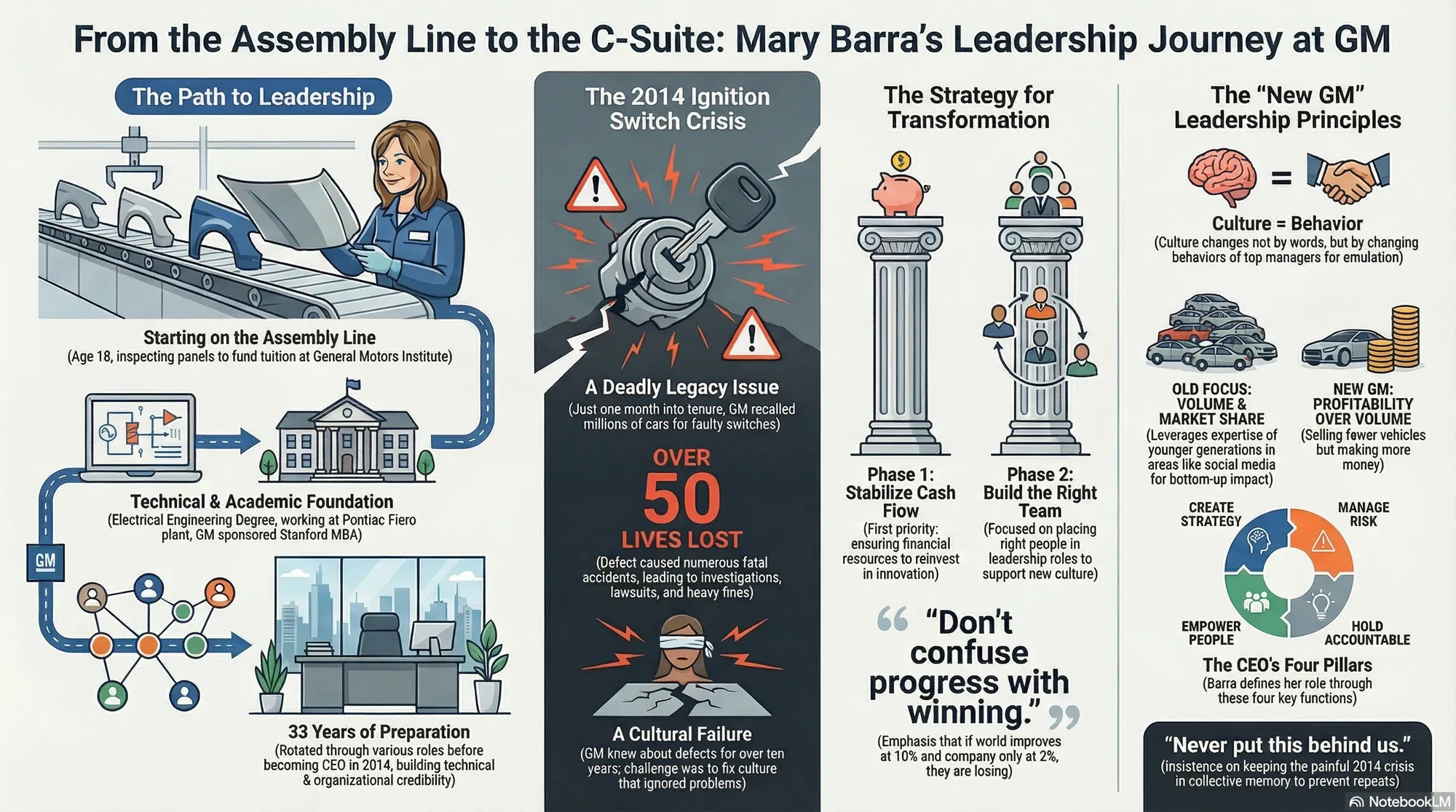
Barra began working on a GM assembly line at age 18, inspecting fender and hood panels to help pay for college. She earned a degree in electrical engineering from the General Motors Institute, now Kettering University, and later worked as an engineer at a Pontiac Fiero plant.
GM subsequently identified Barra as a potential manager and sponsored her MBA at Stanford. After Stanford, she rotated through several roles across the company.
Soon after Barra became CEO, GM recalled millions of cars with faulty ignition switches that could shut off vehicles and disable air bags during a crash. The company had known about the defects for years and faced fines, criminal investigations, and lawsuits. Barra’s long operating experience, technical knowledge, and internal credibility positioned her to lead GM through the crisis.
Crisis Leadership and Accountability
- On Remembering Failure: “I never want to put this behind us, I want to put this painful experience permanently in our collective memories.”
- On Raising Problems Early: “The easiest time to solve a problem is when it’s small, we talk to everybody about that: Raise issues (early) so you can get the help to solve them.”
- On the CEO’s Role: “creating strategy, managing risk, empowering people to execute, and making sure we hold people accountable.”
- On Public-Test Ethics: “There’s no decision you should ever make that would embarrass you if it became public.”
- On Enterprise Truth: Barra asks teams to optimize for the whole enterprise rather than their own function, using data and the full truth to make decisions quickly. — How Leaders Lead: Mary Barra
- On Acting Before Hesitation: When an industry is changing rapidly, having the right team, technology, resources, and scale is not enough; leaders must also act before hesitation becomes the constraint. — General Motors 2018 Sustainability Report Release
Culture, Listening, and Inclusion
- On Contribution and Forward Motion: “I have a fundamental belief that everyone wants to contribute and do a good job and I am always action-oriented because there’s always a way to move forward.”
- On Changing Behavior: “To change a culture, you have to change behaviors. It’s not what you say, it’s what you do.”
- On Leading by Example: “Mary believes that if we change the behaviors [of top managers], people who work for us will see that and emulate it.”
- On Reverse Mentoring: “The skills and assets they bring, their expertise in social media, all these things are having a real impact throughout the company. In some cases, there’s reverse mentoring going on.”
- On Effort Over Talent: Mary Barra believes that in the long run, dedicated effort matters more than innate talent. — Duke Today
- On Making Room: One of Barra's core lessons from her upbringing is the importance of welcoming others and intentionally making room for them in your work and life. — Duke Today
- On Listening to Understand: “Listening is foundational to everything. And not just listening to respond or defend, but listening to understand.” — Duke Today
- On Everyday Inclusion: Inclusion becomes real when people consistently seek out and value opinions that differ from their own. — Harvard Business Review IdeaCast
Strategy, Performance, and Capital Discipline
- On Profitability Over Volume: "GM used to be all about sales volume and market share,” Autotrader senior analyst Michelle Krebs said. “Now, if they don’t see a path to profitability and leadership, they get out. The goal is to sell fewer vehicles and make more money. It’s a new GM.”
- On Relative Progress: “Don’t confuse progress with winning, if the world is improving at 10 percent and you’re improving at 2 percent, you might be improving, but you’re losing.”
- On Funding Innovation: “First, stabilize cash flow so we would have the resources to put toward innovation. Second, was to make sure we had the right team in place around ourselves and the right culture upon which to build.”
- On Ambidextrous Leadership: Leaders must run today's business while also setting tomorrow's strategy, rather than concentrating only on perfecting current operations. — How Leaders Lead: Mary Barra
- On Balanced Capital Allocation: Strong cash generation should support the business and its people, preserve balance-sheet strength, and return capital to owners rather than serving only one constituency. — General Motors Q4 2025 Shareholder Letter
- On Capital-Efficient Strategic Pivots: Leaders should redirect technology bets when scaling costs and competitive conditions change, combining teams and concentrating investment where existing brands, manufacturing, and distribution create an advantage. — General Motors Autonomous-Driving Strategy Refocus
Teams and the Operating System
- On Combining New and Established Expertise: Technology transformations work best when outside software and battery expertise is deliberately paired with the people who already know how to build excellent products. — How Leaders Lead: Mary Barra
- On Cross-Functional Respect: Cross-functional integration improves when people spend time together, respect one another's craft, and understand that winning requires joint work. — How Leaders Lead: Mary Barra
- On Avoiding Insularity: Established companies must keep studying competitors, technology shifts, and outside industries because past success becomes dangerous when it turns the organization inward. — How Leaders Lead: Mary Barra
- On Distributed Innovation: Innovation accelerates when every employee sees customer problems as theirs to solve rather than assuming a separate group owns invention. — How Leaders Lead: Mary Barra
- On Transferring Manufacturing Learning: A second facility should ramp faster than the first by deliberately carrying forward the operating lessons learned during the initial launch. — General Motors Q1 2024 Shareholder Letter
Purpose, Products, and Transformation
- On Integrated Experiences: Product integration should reduce the distraction and friction created when users must move between disconnected phone and vehicle systems. — Decoder Podcast
- On a Unifying Vision: Barra relies on a clear, long-term environmental and safety vision to galvanize employees around a singular purpose. — Harvard Business Review
- On Purpose as a Talent Magnet: A credible long-term purpose can attract employees who want their work to contribute to a mission larger than the company itself. — Harvard Business Review
- On Platform Economics: A common platform can serve multiple brands and customer segments while creating scale, reducing complexity, and preserving product flexibility. — General Motors Ultium Strategy Release
- On Multiple Growth Engines: A large incumbent can reduce dependence on its traditional business by combining hardware and software platforms to add customers and diversify revenue. — General Motors 2021 Growth Roadmap
Sources for the original lessons
- GM CEO Mary Barra says too many women quit their jobs for the wrong reason (February 6, 2018), Leah Fessler, Quartz at Work.
- GM Gets Ready for a Post-Car Future (May 23, 2018), Rick Tetzeli, Fortune.
- CEO Mary Barra shakes up GM (June 4, 2017), Mark Phelan, Detroit Free Press.
- Mary Barra was called a ‘lightweight’ when she became CEO of GM — here’s how she transformed the company and silenced her doubters (January 11, 2018), Mark Matousek, Business Insider.
- Mary Barra Is Remaking GM’s Culture—And The Company Itself. Rick Tetzeli, Fast Company.