Mati Staniszewski co-founded ElevenLabs with Piotr Dąbkowski. In interviews, he has described how the company went from an idea for better dubbing to building tools for generating and using speech. — Sequoia Training Data.
In Interviews
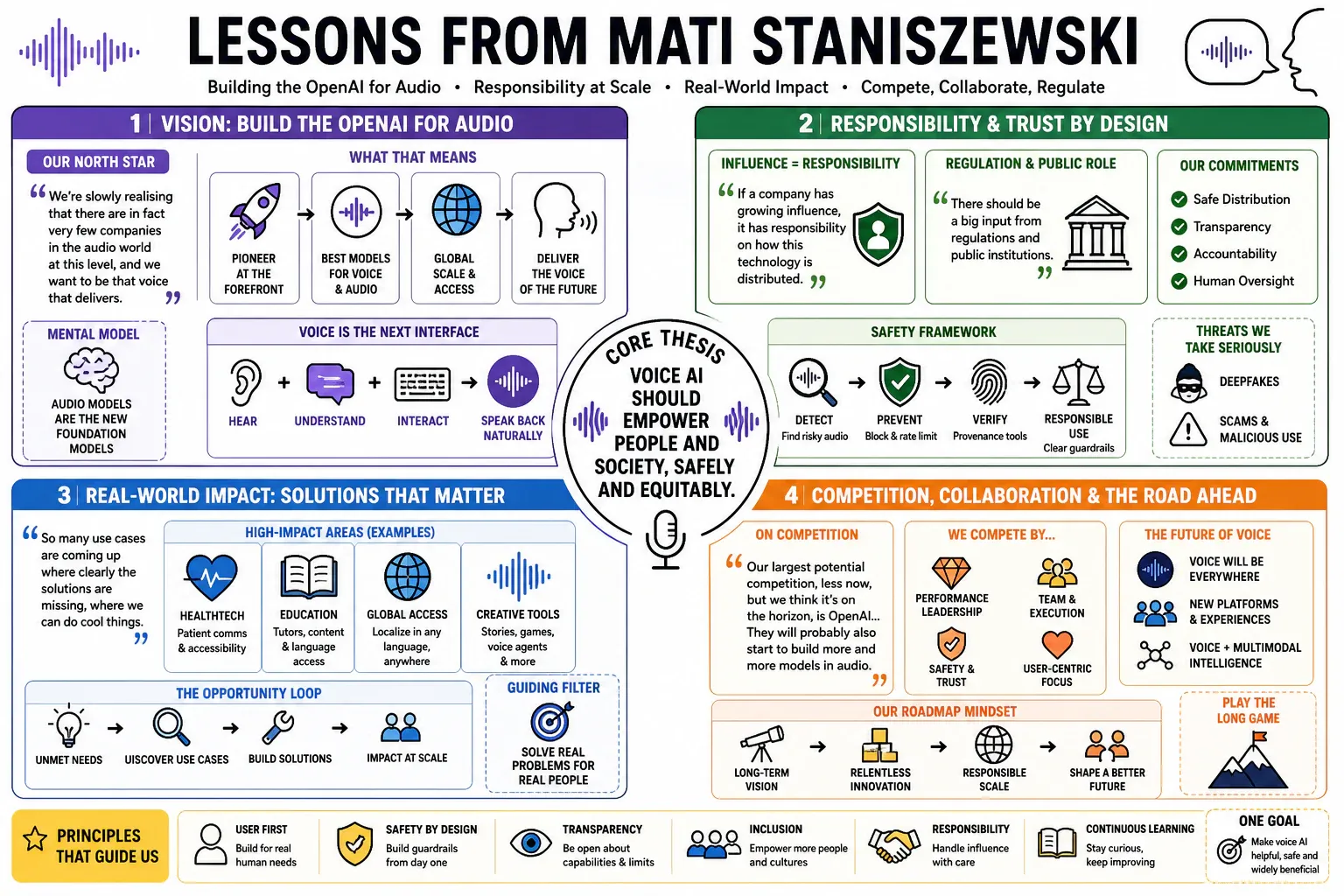
- Safeguards for generated audio: Staniszewski argued that companies building generative audio should also build safeguards against misuse. He singled out authenticating human recordings and identifying generated content. — My Company Polska Interview.
- Competing with OpenAI in audio: In September 2024, Staniszewski said ElevenLabs competed with OpenAI for both technical quality and talent. He saw a dedicated focus on audio as ElevenLabs’ advantage. — My Company Polska Interview.
- Context changes how speech sounds: Staniszewski described using the context of a passage to produce speech with more fitting tone and emotion. — Sequoia Training Data.
- A partnership that began in school: Staniszewski met Piotr Dąbkowski in high school in Warsaw. He recalled that they bonded over mathematics and began spending time together outside school. — Sequoia Training Data.
- Voice tutors: Staniszewski imagined voice tutors that could talk learners through math notes or help them practice pronunciation in another language. — Sequoia Training Data.
- A target for conversational voice: Staniszewski set a goal for voice agents to become hard to distinguish from a person in conversation. He was describing a target for the technology. — Sequoia Training Data.
- An early demo that attracted users: When ElevenLabs posted a demo of a speech model laughing, Staniszewski recalled that the reaction brought in early users. — Sequoia Training Data.
- A starting point for support automation: Staniszewski pointed to customer support as a recurring efficiency opportunity for both text and voice agents, since companies can train them using what they already know about their operations. — ElevenLabs at Stripe Sessions.
- An audio library for creators: Staniszewski wanted ElevenLabs to give both independent creators and large media companies access to a library of voices with different styles, languages, and accents. — My Company Polska Interview.
- Real-time speech and control over delivery: Staniszewski identified real-time generation and finer control over a performance as challenges for audio models. He gave the example of directing a line to sound sarcastic. — My Company Polska Interview.
Learnings
- Protect the company’s focus: Staniszewski said founders hear plenty of requests to go in new directions. He described learning to protect the company’s focus when deciding what to pursue. — Warm Intro Interview.
- The problem with one-voice dubbing: The idea for ElevenLabs grew out of watching Polish films and shows where a single narrator read every character’s dialogue. The founders wanted dubbed audio to preserve the original performances. — Sequoia Training Data.
- Apply advances from other fields: The team applied transformers and diffusion models to speech at a time when Staniszewski saw more researchers working on text and images. — Sequoia Training Data.
- Start with text-to-speech: ElevenLabs began with text-to-speech before tackling the larger problem of dubbing. Its first system used context to work out how a line should sound, such as how to intone a question. — My Company Polska Interview.
- Build a product around the model: Once ElevenLabs could generate speech with more fitting tone, the team built a product around the model so people could use it. — Sequoia Training Data.
- Combine models for real-time translation: Staniszewski said OpenAI’s work combining models prompted ElevenLabs to think about multimodal audio, especially for real-time translation. — My Company Polska Interview.
- Preserve a voice after speech loss: Tim Green used old recordings to recreate his voice after losing the ability to speak. ElevenLabs said he used that voice on his podcast. — ElevenLabs Impact Program.
- Set clear rules for AI: Staniszewski said ElevenLabs was open to working on AI regulation. He wanted clear, consistent rules and argued that responsibility should extend beyond the companies building the tools. — My Company Polska Interview.
- Make voice a way to use technology: Staniszewski expected voice to become a major way of interacting with technology. He thought that would depend on making the back-and-forth feel as natural as a conversation. — Sequoia Training Data.
- Keep researchers close to deployment: ElevenLabs kept researchers close to deployment so they could see how their work performed in use. Research engineers helped adapt and deploy the models at scale. — Sequoia Training Data.
- Move on from the first prototype: The founders first built an accent detection prototype. They then shifted their attention to automated dubbing. — Warm Intro Interview.
- Build things people want to use: Staniszewski and Dąbkowski started building projects on weekends because they enjoyed making products people wanted to use. — Warm Intro Interview.
- Match product readiness with customer demand: Staniszewski described choosing markets where ElevenLabs’ technology was ready and customers had a concrete need for it. — My Company Polska Interview.
- Build a model when the available tools fall short: The founders experimented with existing speech models and then developed their own approach to bring transformers and diffusion into audio. — Sequoia Training Data.
- AI assistants and tutors: In an October 2026 interview, Staniszewski predicted that people would use several AI agents, including tutors and assistants. — La Nación Interview.
- Build with your own company content: Staniszewski suggested using a company’s own content and intellectual property to build an interactive experience that reflects its brand. — ElevenLabs at Stripe Sessions.
- Learn from unexpected early users: Early users showed ElevenLabs what its technology could do. Staniszewski recalled an author who turned his manuscript into an audiobook and brought other authors to the product. — Sequoia Training Data.
- Hire globally and give researchers ownership: ElevenLabs hired remotely to reach audio specialists wherever they lived. Staniszewski said researchers needed enough independence to take ownership of a research direction. — Sequoia Training Data.
- Use open source to test what is possible: The open-source Tortoise TTS model showed the founders that voice replication and speech generation were feasible, even though its output was unstable. — Sequoia Training Data.
- Make spoken content accessible across languages: Staniszewski described the company’s mission as making spoken content accessible across languages and voices. — Warm Intro Interview.
- Give people less reason to look at a screen: Staniszewski imagined using voice to access technology without giving a screen his attention. He hoped that would make it easier to focus on learning and other people. — Sequoia Training Data.
Learn more:
- Ponaddźwiękowi — My Company Polska’s Interview with Mati Staniszewski
- ElevenLabs Impact Program Aims to Empower 1 Million Voices through AI Audio
- ElevenLabs’ Mati Staniszewski: Why Voice Will Be the Fundamental Interface for Tech
- ElevenLabs at Stripe Sessions — Mati Staniszewski on Customer Support and Company Data
- Mati Staniszewski: “En 2030, todos tendremos varios agentes de IA trabajando en nuestro nombre”
- Mati Staniszewski (#047) — Warm Intro