Lessons from Matt Dixon
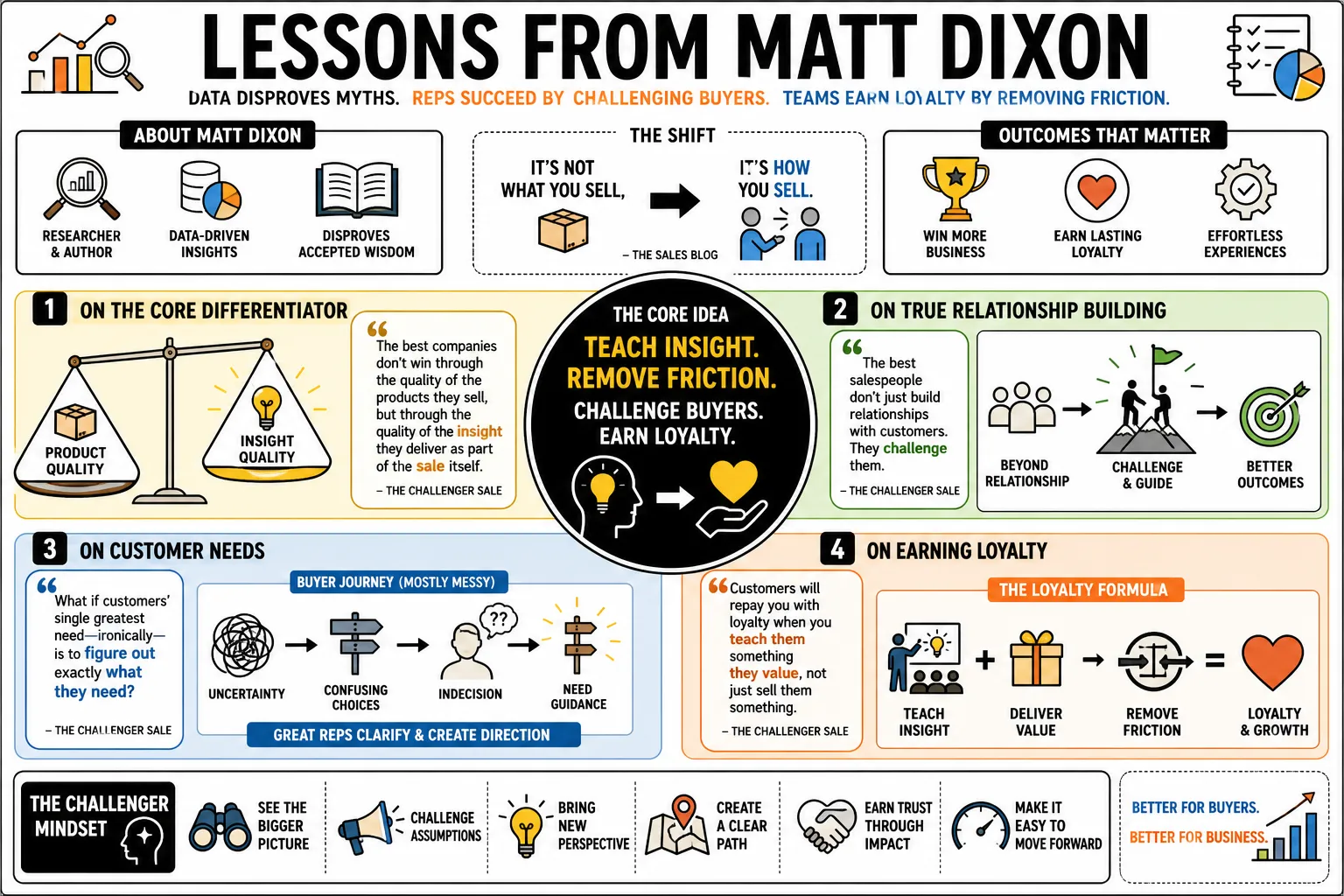
Researcher and author Matt Dixon uses data to disprove accepted wisdom in sales and customer service. His work shows that reps succeed by challenging buyers rather than prioritizing relationships, and support teams build loyalty by removing friction instead of trying to delight people. This profile outlines his frameworks for breaking through buyer indecision and designing effortless experiences.
Part 1: The Challenger Sale Paradigm
- On the core differentiator: "The best companies don't win through the quality of the products they sell, but through the quality of the insight they deliver as part of the sale itself." — Source: The Challenger Sale
- On the shift in methodology: "It’s not what you sell, it’s how you sell." — Source: The Sales Blog
- On true relationship building: "The best salespeople don't just build relationships with customers. They challenge them." — Source: The Challenger Sale
- On customer needs: "What if customers' single greatest need—ironically—is to figure out exactly what they need?" — Source: The Challenger Sale
- On earning loyalty: "Customers will repay you with loyalty when you teach them something they value, not just sell them something they need." — Source: The Challenger Sale
- On taking control: Top performers succeed because they are comfortable with tension, pushing back on pricing, and taking control of the entire decision-making process. — Source: The Sales Blog
- On the teacher mindset: "Challengers aren't so much world-class investigators as they are world-class teachers." — Source: Goodreads
- On the death of solution selling: Traditional solution selling is losing its effectiveness because modern buyers are often 60% through their purchase journey before engaging a rep. — Source: Harvard Business Review
- On delivering value: "What sets the best suppliers apart is not the quality of their products, but the value of their insight—new ideas to help customers either make money or save money in ways they didn't even know were possible." — Source: SuperSummary
- On driving differentiation: A successful sales strategy requires reps to provide unique perspectives that actively reframe how the customer views their own business problem. — Source: Maximizer
Part 2: Breaking the Relationship Builder Myth
- On the lowest performing profile: In complex B2B environments, the traditional "Relationship Builder" profile is consistently the least effective among the five core sales types. — Source: Sales Enablement Collective
- On agreement vs. progress: Relationship Builders focus on resolving tension and achieving agreement, whereas Challengers know that constructive tension is necessary for driving a sale forward. — Source: The Sales Blog
- On false alignment: Acquiescing to every customer demand to save the relationship often stalls the deal because it fails to introduce the urgency of a new perspective. — Source: Maximizer
- On diagnosing vs. teaching: Diagnosing a customer's stated problem is insufficient; top performers identify unconsidered needs the customer hadn't even realized they had. — Source: Harvard Business Review
- On the limits of discovery: Asking what keeps the customer up at night is a flawed strategy; a true Challenger tells the customer what should be keeping them up at night. — Source: The Sales Blog
- On sales experience loyalty: Fully 53% of B2B customer loyalty is driven by the sales experience itself, not the brand, product, or service. — Source: Harvard Business Review
- On moving past investigations: Reps must transition from simply investigating a customer's world to actively teaching them something new and highly relevant about it. — Source: Goodreads
- On constructive tension: Coaching a sales team effectively means helping relationship-oriented reps become comfortable introducing healthy, disruptive ideas. — Source: HubSpot
- On shifting focus: Modern sales teams need to stop obsessing over product parity and start focusing entirely on the quality of their commercial insights. — Source: SuperSummary
Part 3: The Architecture of Commercial Teaching
- On the pitch framework: A successful pitch starts by building credibility, reframing the problem, causing rational drowning, delivering emotional impact, introducing a new way, and only then introducing the product. — Source: Flow State Sales
- On the Warmer: High performers begin their pitch by proving they understand the customer's world, establishing the credibility necessary to challenge them. — Source: The Sales Blog
- On the Reframe: The critical turning point of a sale is the reframe, where the seller introduces a completely new perspective on a problem the customer thought they understood. — Source: Maximizer
- On Rational Drowning: Sellers must use hard data to quantify the hidden costs of the customer's current approach, effectively drowning their status quo with facts. — Source: Flow State Sales
- On Emotional Impact: Data alone doesn't sell; the insight must be made personal and urgent to the specific stakeholders involved in the deal. — Source: HubSpot
- On delaying the product: A core tenet of commercial teaching is outlining the solution and the new way completely before ever mentioning your specific product. — Source: The Sales Blog
- On tailoring the message: Challengers excel because they customize their insights to resonate specifically with the different economic and political drivers of each stakeholder. — Source: Sales Enablement Collective
- On building consensus: By tailoring the message to multiple decision-makers within an organization, top reps build the internal consensus required to close complex deals. — Source: Maximizer
- On leading to, not with: Commercial teaching demands that sellers lead to their solution by highlighting a unique problem, rather than leading with their solution's features. — Source: Harvard Business Review
Part 4: The Effortless Experience and Customer Service
- On the myth of delight: "The role of customer service is to mitigate disloyalty by reducing customer effort." — Source: The Effortless Experience
- On service interactions: "Customer service should be less about offense—bending over backwards to please customers—and more about defense, in the sense of preventing frustration and delay." — Source: Harvard Business Review
- On exceeding expectations: "Instead of getting customers to say, 'You exceeded my expectations,' we really ought to be trying to get customers to say, 'You made that easy.'" — Source: Harvard Business Review
- On disloyalty drivers: Customer service interactions are statistically four times more likely to drive disloyalty than they are to drive loyalty. — Source: CX Wheel
- On the 96/9 rule: "96% of customers who experience a high-effort interaction become disloyal, compared to only 9% of those who have a low-effort experience." — Source: RateNow
- On repurchase behavior: Data shows that 94% of customers who report low-effort experiences will repurchase, compared to a mere 4% who experience high effort. — Source: RateNow
- On plain-vanilla service: "Loyalty has a lot more to do with how well companies deliver on their basic, even plain-vanilla promises than on how dazzling the service experience might be." — Source: Reddit Review
- On the Customer Effort Score: The Customer Effort Score is a far more accurate predictor of loyalty and repurchase behavior than the widely used Net Promoter Score. — Source: The Tech Bag
- On giving fewer reasons to leave: "You need to give your customers fewer reasons to be disloyal, and the best way to make that happen is to reduce customer effort." — Source: The Effortless Experience
Part 5: Minimizing Customer Friction
- On channel switching: Forcing customers to switch from self-service web portals to a live phone call is one of the single largest drivers of customer effort and frustration. — Source: Loyally AI
- On Next Issue Avoidance: The best service teams don't just fix the immediate issue; they proactively solve the next problem the customer is statistically likely to encounter. — Source: CEO Coaching International
- On Experience Engineering: Reps can reduce a customer's perceived effort by up to 40% simply by using careful language and managing the emotional state of the interaction. — Source: CEO Coaching International
- On positive positioning: Telling a customer what you can do, rather than bluntly stating what you cannot do, significantly lowers the psychological friction of a service call. — Source: Harvard Business Review
- On abandoning rigid scripts: Companies must move away from rigid scripts and arbitrary handle-time metrics, instead empowering frontline agents to use their judgment. — Source: The Tech Bag
- On repeating information: Having to repeat account information or issues to multiple different agents is a primary trigger for intense customer disloyalty. — Source: SoBrief
- On first-contact resolution: Solving a problem comprehensively on the very first contact is the foundational metric for building low-effort loyalty. — Source: CX Wheel
- On seamless transitions: When channel switching is unavoidable, loyalty is preserved only when the transition is utterly seamless and the agent already has the customer's context. — Source: Max Mednik
- On proactive defense: Customer service must operate defensively, structuring their entire operational model around anticipating and eliminating friction before the customer feels it. — Source: Harvard Business Review
Part 6: The JOLT Effect and Overcoming Indecision
- On the real enemy of sales: "The worst thing you can hear from a customer isn't 'no.' It's 'I need to think about it.'" — Source: BuddyCRM
- On the nature of indecision: "Beating the status quo is about dialing up the fear of not purchasing; overcoming customer indecision is about dialing down the fear of purchasing." — Source: Same Side Selling
- On FOMO vs. FOMU: "It’s not the fear of missing out (FOMO), it’s the fear of messing up (FOMU)." — Source: Roger Dooley
- On the No Decision crisis: Between 40% and 60% of all sales opportunities ultimately end in no decision rather than a definitive win or loss. — Source: Jolt Effect
- On the root of inaction: Data reveals that 56% of deals lost to inaction are caused by the customer's inability to make a choice, even when they know their current situation is flawed. — Source: Principus
- On post-decision anxiety: "Making a decision is often not the end of a customer's indecision; it's just the beginning." — Source: BuddyCRM
- On Omission Bias: "People actually feel more regret when bad things result from their actions as opposed to when bad things happen as a result of their inactions." — Source: Principus
- On failed playbooks: "The well-worn playbook most sellers use to overcome indecision fails to do so—in fact, it fails dramatically [84% of the time]." — Source: Jolt Effect
- On the role of the seller: To conquer indecision, high performers stop acting as mere order takers and transform into buyer's agents who navigate the customer through psychological risk. — Source: SoBrief
- On the drop in win rates: Average performers see their win rates plummet from 39% to 6% when facing indecision, whereas JOLT-capable sellers maintain a 31% win rate in identical scenarios. — Source: SoBrief
Part 7: Managing the Fear of Messing Up (FOMU)
- On Judging Indecision: Top sellers aggressively qualify prospects not just on their financial ability to buy, but on their psychological ability to decide. — Source: Blinkist
- On the Valuation Problem: One of the primary sources of indecision is when a customer simply cannot determine which of the available options is the absolute best. — Source: Max Mednik
- On Information Overload: A lack of confidence often stems from the customer feeling they haven't done enough homework, leading to endless analysis paralysis. — Source: Blinkist
- On Outcome Uncertainty: Customers frequently stall deals because they possess a deep-seated fear that the proposed solution will fail to deliver the promised results. — Source: Max Mednik
- On Offering Recommendations: Instead of asking buyers what they want to do, high performers take a firm stand and offer a concrete recommendation to share the burden of choice. — Source: Jolt Effect
- On Limiting Exploration: To prevent endless evaluation, top reps proactively limit the flow of information, utilizing radical honesty about what the customer does not need to review. — Source: SoBrief
- On the danger of more data: Providing more information and more options to an indecisive buyer typically increases their anxiety rather than their confidence. — Source: Jolt Effect
- On Taking Risk off the table: "The best way to get a customer off the fence? Get to know them... and take risk off the table." — Source: Roger Dooley
- On safety nets: High performers mitigate the fear of failure by offering opt-out clauses, guarantees, and starting with smaller, incremental commitments. — Source: BuddyCRM
Part 8: The Future of Sales, Coaching, and AI
- On the volume crisis: AI-driven outbound automation has created a flood of low-quality outreach, destroying buyer trust and making it infinitely harder for legitimate sellers to break through. — Source: YouTube Insight
- On AI as a co-pilot: Rather than merely automating pitches, AI should be utilized by sellers as a decision-support tool to help judge buyer indecision and formulate data-backed recommendations. — Source: Principus
- On buyer-side AI: Because buyers now use large language models to conduct their own pre-purchase research, sellers must provide a level of contextual business acumen that an AI cannot replicate. — Source: YouTube Insight
- On the Activator profile: In professional services, the new high-performing "Activator" profile succeeds by selling their deep expertise and activating the customer's thinking long before a contract exists. — Source: YouTube Insight
- On coaching the "How": Sales managers must evolve from inspecting the pipeline to rigorously coaching the specific conversational behaviors required to challenge the status quo. — Source: HubSpot
- On role-playing objections: Effective sales coaching involves practical exercises, such as requiring reps to prepare at least two unique ways to overcome expected objections before walking into an account. — Source: HubSpot
- On mapping strategic objectives: Managers must train their reps to draw direct, unignorable lines between the proposed solution and the customer's long-term strategic goals. — Source: HubSpot
- On reframing drills: Coaching must prioritize the warm-up and reframe stages of the conversation to ensure reps are actively leading with insight rather than reverting to product pitches. — Source: Maximizer
- On the value of human selling: As basic product information becomes entirely commoditized by AI, the seller's ultimate value lies entirely in understanding the customer's business better than the customer does. — Source: YouTube Insight