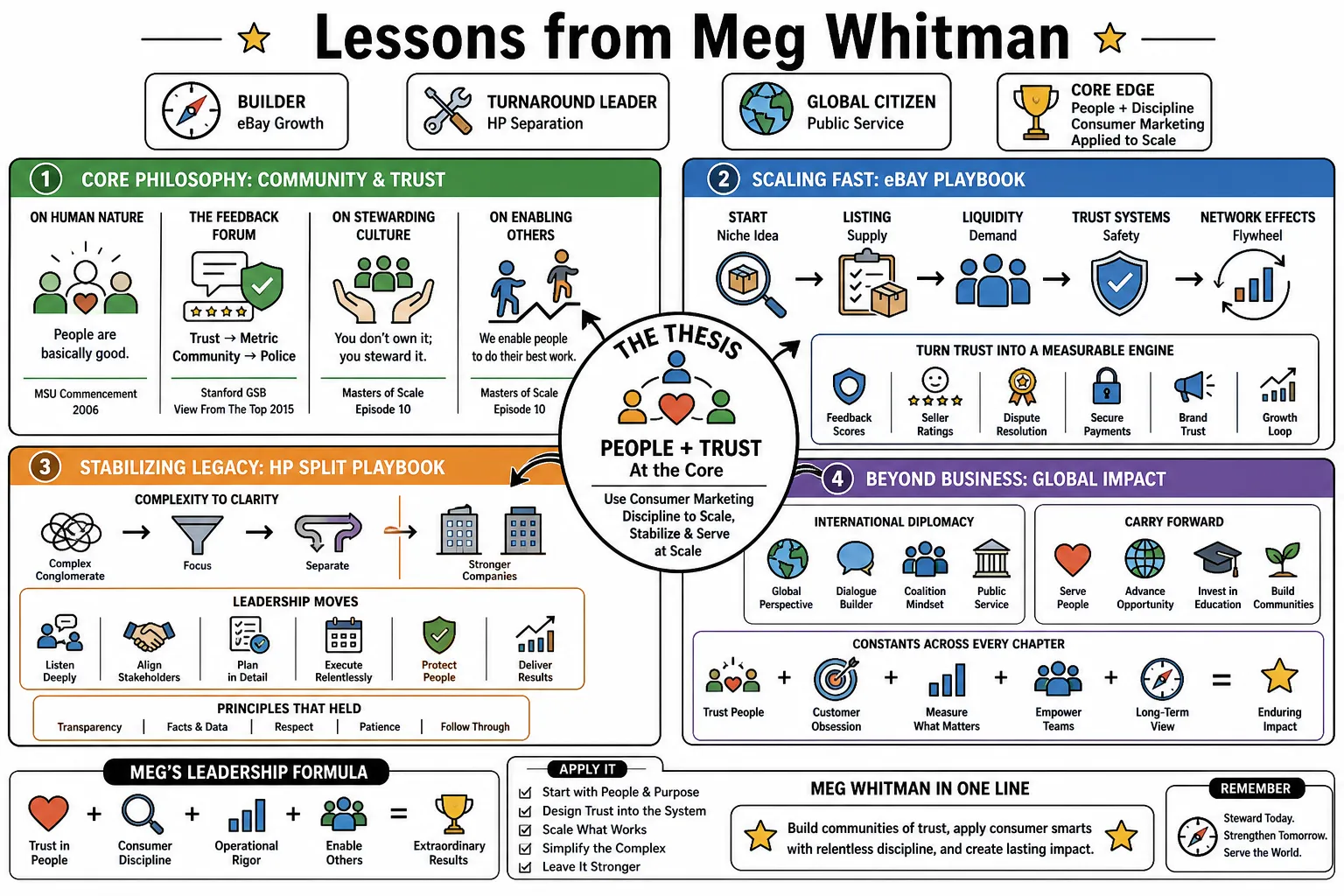
Lessons from Meg Whitman
Whitman grew eBay from a niche auction site into a global standard and later managed the massive, multi-year split of Hewlett-Packard. She built her career on a fundamental trust in people and the disciplined application of consumer marketing to corporate salvage. This breakdown covers her methods for scaling fast, stabilizing legacy giants, and moving into international diplomacy.
Part 1: The Core Philosophy of Community and Trust
- On Human Nature: "We believe people are basically good. This isn't just a nice sentiment; it was the functional architecture that allowed a community of strangers to trade with one another safely." — Source: Michigan State University Commencement 2006
- On the Feedback Forum: "Trust is a brand’s most valuable asset, but in a digital community, you have to turn that trust into a measurable metric that the community can use to police itself." — Source: Stanford GSB View From The Top 2015
- On Stewarding Culture: "As a leader, you don’t own the culture; you are the steward of it. The community built eBay's culture, and my job was to ensure we didn't break it while scaling." — Source: Masters of Scale Episode 10
- On Enabling Others: "We enable, not direct. The most powerful organizations are those where the leadership provides the platform and then gets out of the way of the users." — Source: The Power of Many
- On Values-Based Leadership: "You have to codify your values early. If you don't write them down, they will get diluted as soon as you move from the first floor to the second floor of a growing company." — Source: Masters of Scale Episode 10
- On Individual Contribution: "We recognize and respect everyone as a unique individual and believe everyone has something to contribute to the whole." — Source: Michigan State University Commencement 2006
- On Golden Rule Management: "We encourage people to treat others the way they want to be treated. It’s the simplest rule for managing a massive, decentralized workforce." — Source: The Power of Many
- On Authenticity: "You cannot buy integrity. It is the one thing you have that, once lost, can almost never be recovered in the eyes of your team or your customers." — Source: Stanford GSB View From The Top 2015
- On Collective Intelligence: "The 'power of many' is real. A group of people with shared interests and a common set of values can solve problems faster than any single genius at the top." — Source: The Power of Many
Part 2: Scaling Growth and Navigating eBay
- On Hiring for the Future: "Never hire for the job you have today. Hire for the job that will exist eighteen months from now, or the complexity will eventually crush your leadership team." — Source: Masters of Scale Episode 10
- On Revenue vs. Community: "In the early days of eBay, we realized that if we ever put short-term revenue goals ahead of the health of the community, the entire system would collapse." — Source: HBR Interview
- On Strategic Acquisitions: "The PayPal acquisition wasn't about buying a payment company; it was about removing the single biggest point of friction in our users' lives." — Source: Masters of Scale Episode 10
- On Managing Hyper-Growth: "When you are growing at 70% a month, you have to be comfortable with a certain level of chaos, provided the core systems remain stable." — Source: Stanford GSB ETL 2017
- On Technology Infrastructure: "You can’t scale a business on a fragile back-end. We had to learn the hard way that infrastructure investment must lead growth, not follow it." — Source: The Power of Many
- On Listening to Feedback: "Our users were our best R&D department. They told us what features they wanted, what categories they liked, and what they hated about the site." — Source: Masters of Scale Episode 10
- On Categorization: "The way we organized the site was a reflection of how people naturally collect and trade. We didn't impose a structure; we observed one." — Source: Britannica Profile
- On Global Expansion: "When we went into Germany or Japan, we had to balance our global brand standards with the very specific local trading customs of those markets." — Source: The Power of Many
- On Staying Focused: "Scaling is as much about what you decide NOT to do as it is about what you choose to build next." — Source: The Power of Many
Part 3: Operational Excellence and the HP Turnaround
- On the Turnaround Timeline: "Most turnarounds in American industry take four to five years. You cannot rush the structural repair of a company that has lost its way." — Source: HP 2012 Analyst Meeting
- On the Frozen Middle: "The 'frozen middle' is a layer of management that resists change. You have to identify them quickly and either win them over or move them out of the way." — Source: Stanford GSB View From The Top 2015
- On Strategic Focus: "You have to put real wood behind the arrow. HP was spread too thin across too many products; we had to focus on a few core areas where we could actually win." — Source: HPE Press Release 2012
- On the Great Split: "Separating HP into two companies allowed each entity to be more nimble and focused. Smaller is often better for innovation and speed." — Source: HBR IdeaCast
- On Winning Hearts and Minds: "If you only talk about what’s wrong, you will lose the morale of the workforce. You have to provide a roadmap for how you are going to win again." — Source: Stanford GSB View From The Top 2015
- On Operational Discipline: "If you can’t measure it, you can’t control it. We brought a level of data-driven accountability back to HP that had been missing for years." — Source: The Power of Many
- On Asking Questions: "Don't be afraid to ask 'dumb' questions. The technologists will try to hide behind jargon; your job is to force them to explain the business value." — Source: Stanford GSB ETL 2017
- On Managing a Technical Company: "I am not a technologist, but I am a student of how technology changes markets. You lead by understanding the 'what' and the 'why,' even if you aren't writing the 'how.'" — Source: HBR Interview
- On Stability: "Consistency of leadership is essential for a turnaround. HP had four CEOs in six years; the first thing I had to provide was the certainty that I was staying." — Source: Fortune Interview
- On Cost Reduction: "You have to cut costs where the customer doesn't see it, so you can reinvest in R&D where they do." — Source: HP 2012 Analyst Meeting
Part 4: Decision Making and the Bias for Action
- On Speed as a Strategy: "The price of inaction is far greater than the cost of a mistake. In a fast-moving world, the worst thing you can do is stand still." — Source: Duke Fuqua Distinguished Speaker Series 2015
- On the 80% Rule: "I’d rather make a decision with 80% of the data today than wait for 100% of the data tomorrow. By then, the opportunity has usually passed." — Source: The Power of Many
- On Problem Solving: "Run to the fire. Tackle the biggest, hardest problems first. If you solve those, everything else becomes significantly easier." — Source: Stanford GSB View From The Top 2015
- On Correcting Mistakes: "Problems are good, as long as you solve them quickly. Don't hide from a bad decision; admit it, fix it, and move on." — Source: Masters of Scale Episode 10
- On Perfectionism: "'Perfect' is the enemy of 'good enough.' If you wait for perfection, you will never ship anything or change any outcome." — Source: The Power of Many
- On Courageous Decisions: "Being brave means taking calculated risks and having the stamina to see them through when the path gets difficult." — Source: The Power of Many
- On Situational Leadership: "I lead according to the circumstances. The 'community-led' style of eBay would have failed at HP, and the 'strong-hand' style of HP would have crushed eBay." — Source: Stanford GSB ETL 2017
- On Decision Memos: "Writing down a decision forces a level of clarity that verbal discussions simply cannot achieve. It creates a permanent record of the 'why' for the organization." — Source: The Power of Many
- On Accountability: "Results matter. You have to take personal responsibility for the outcomes of your decisions, whether they are successes or failures." — Source: The Power of Many
Part 5: Career Trajectory and Early Lessons
- On the Shampoo Cap: "My first job at P&G was deciding the size of the hole in a shampoo cap. I learned that if you do the very best job you can at the small tasks, people will give you the big ones." — Source: Stanford GSB ETL 2017
- On Mentorship: "I worked for Mitt Romney at Bain and Frank Wells at Disney. They taught me the importance of analytical rigor and high-pressure brand management." — Source: Encyclopedia.com Career Biography
- On Revitalizing Brands: "At Hasbro, we took Mr. Potato Head and made him relevant again by listening to kids and running focus groups to see what they actually wanted in a toy." — Source: Business Insider Hasbro History
- On the Teletubbies: "Importing the Teletubbies from the UK to the US taught me that cultural phenomena can scale across borders if the core emotional hook is universal." — Source: Britannica Profile
- On Career Risks: "Leaving a stable job at Hasbro for a 30-person startup called eBay was a risk, but I believed in the potential of the internet to change how people interact." — Source: HBR Interview
- On Gender in the Workplace: "I never spent much time thinking about being a 'woman leader.' I just focused on being a 'great leader' and delivering results." — Source: Duke Fuqua Distinguished Speaker Series 2015
- On Early Influence: "My mother taught me to be adventurous and to have a bias for action. She believed that anything was possible if you were willing to work for it." — Source: The Power of Many
- On Strategy at Bain: "Consulting teaches you how to break complex problems down into manageable pieces. It’s a toolkit I’ve used in every job since." — Source: Britannica Profile
- On Global Retail: "Launching Disney Stores in Japan taught me that global brands must respect local execution to truly succeed." — Source: Encyclopedia.com Career Biography
Part 6: Leadership Values and Ethics
- On Integrity as an Asset: "Everything can go away—your job, your wealth, your status—but if you still have your integrity, you can build everything back." — Source: Stanford GSB View From The Top 2015
- On Frugality: "Conserve resources for the things that matter to the customer. We didn't have fancy offices at eBay because the money belonged in the platform." — Source: The Power of Many
- On Active Listening: "Everyone has something to contribute. If you don't listen to the person closest to the problem, you will likely miss the solution." — Source: The Power of Many
- On Validating the Team: "Enfranchise and validate. People will work harder and smarter if they feel their contribution is seen and valued by the leadership." — Source: The Power of Many
- On Optimism: "Cynics and pessimists do not change the world. You have to believe that a better outcome is possible to inspire a team to build it." — Source: Michigan State University Commencement 2006
- On Handling Lies: "Be defenders of truth in an age marked by lies. Authentic open-mindedness is a liberating force for any organization or nation." — Source: Carnegie Mellon University Commencement 2017
- On Civility: "Success happens when good people with good intentions cooperate. We must stop viewing those we disagree with as enemies." — Source: Carnegie Mellon University Commencement 2017
- On Reputation Management: "Reputation is like a fine china vase—once it's cracked, it can be glued back together, but it never looks the same." — Source: Stanford GSB View From The Top 2015
- On Being Present: "The most important thing a leader can do is show up. Be there for the outages, the crises, and the celebrations." — Source: The Power of Many
Part 7: Brand Building and Strategic Innovation
- On Brand Resilience: "A brand is not a logo; it's a promise to the consumer. If you keep that promise, the brand can survive almost anything." — Source: HBR IdeaCast
- On User-Generated Innovation: "The 'Buy It Now' button on eBay didn't come from a boardroom; it came from watching how our users were already trying to hack the system to buy things faster." — Source: Masters of Scale Episode 10
- On Positioning: "At Stride Rite, we realized that we weren't just selling shoes; we were selling the safety and health of a child's developing feet." — Source: Encyclopedia.com Career Biography
- On Scaling Innovation: "Innovation at scale requires a different set of rules. You have to create small, protected environments where new ideas can grow without being killed by the corporate antibodies." — Source: HBR IdeaCast
- On Market Timing: "The best idea in the world will fail if the market isn't ready for it. Understanding timing is as important as understanding the product." — Source: Quibi Shutdown Statement
- On Competitive Differentiation: "If you can't be first, you have to be better or different. Trying to copy a competitor is a recipe for second-place finishes." — Source: Fortune Interview
- On Licensing: "Licensing characters like Mr. Potato Head for television was a way to move the brand from a toy box to the center of the cultural conversation." — Source: Business Insider Hasbro History
- On Pruning Distractions: "Pruning is essential for growth. You have to cut away the dying branches of a business so the healthy ones can thrive." — Source: The Power of Many
- On R&D Investment: "You cannot save your way to growth. Eventually, you have to reinvest in the future of the product." — Source: HP 2012 Analyst Meeting
Part 8: Resilience, Adaptability, and Public Service
- On Graceful Failure: "When we realized Quibi wasn't going to work, the right thing to do was to return the remaining capital to investors rather than burning it all to the ground." — Source: Quibi Shutdown Statement
- On Learning from Failure: "Failure is no longer a black mark in business; it’s proof that you’ve been in the arena and learned lessons you couldn't get anywhere else." — Source: Stanford GSB View From The Top 2015
- On the Silicon Savannah: "Kenya is the tech hub of East Africa. I see the same components here—super smart engineers and a young workforce—that I saw in Silicon Valley decades ago." — Source: US Embassy Kenya "Why Kenya" Speech
- On Economic Diplomacy: "My job as Ambassador is to be an economic diplomat. We want to improve influence by creating jobs and fostering technology trade." — Source: Theodore Roosevelt Presidential Library Podcast
- On M-Pesa: "M-Pesa is one of the most impressive companies I have ever seen. It didn't just innovate; it revolutionized how an entire continent moves money." — Source: US Embassy Kenya Press Release
- On Perspective: "In business, no one dies at HP. Keeping that perspective helps you manage the stress of a $100 billion company." — Source: Stanford GSB View From The Top 2015
- On Politics vs. Business: "In business, the CEO decides and the organization moves. In politics, you have to build coalitions across constituencies that may never agree on anything." — Source: Theodore Roosevelt Presidential Library Podcast
- On Climate and Tech: "Kenya’s green energy grid is a major competitive advantage. Tech companies want to be where the power is both reliable and renewable." — Source: US Embassy Kenya "Why Kenya" Speech
- On the Value of Experience: "Running HP felt like being back in my swimming lane. Everything I learned at eBay prepared me for the scale of a global giant." — Source: Fortune Interview
- On Building Legacy: "A leader's legacy is the strength of the organization after they leave. If it collapses without you, you haven't truly led." — Source: The Power of Many
- On the Next Generation: "This country needs your ideals as much as your skills. Use what you have learned to be a defender of truth and a builder of communities." — Source: Carnegie Mellon University Commencement 2017