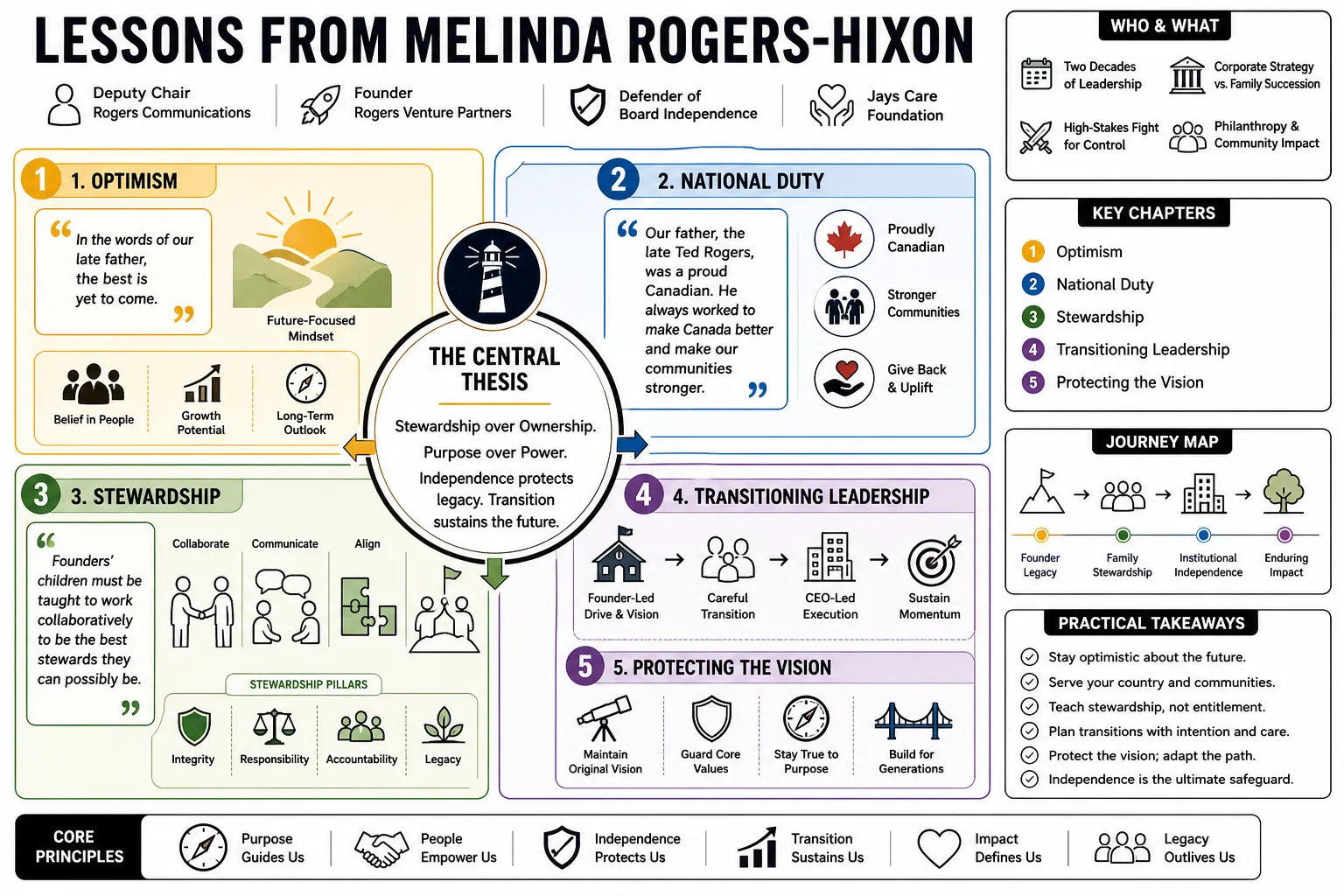
Lessons from Melinda Rogers-Hixon
As Deputy Chair of Rogers Communications and founder of Rogers Venture Partners, Melinda Rogers-Hixon spent two decades managing the friction between corporate strategy and family succession. She drew national attention for defending board independence during a bitter, highly public fight for control of the telecom giant. Beyond her philanthropic work with the Jays Care Foundation, her career offers a practical study in handling generational wealth and surviving high-stakes institutional disputes.
Part 1: The Founder's Legacy & Stewardship
- On Optimism: "In the words of our late father, the best is yet to come." — Source: [CityNews]
- On National Duty: "Our father, the late Ted Rogers, was a proud Canadian. He always worked to make Canada better and make our communities stronger." — Source: [Billboard]
- On Stewardship: Founders' children must be taught to work collaboratively to be the best stewards they can possibly be. — Source: [Generation Trust Advisors]
- On Transitioning Leadership: The complex nature of leading founder-led organizations requires a careful transition to CEO-led businesses without losing the original drive. — Source: [Generation Trust Advisors]
- On Protecting the Vision: A founder's legacy is protected by maintaining the company's core values, not just by holding onto control at all costs. — Source: [The Guardian]
- On Entrepreneurial Drive: What makes the struggle of entrepreneurship worthwhile is the passion, the drive, and the dream that you have. — Source: [YouTube: Melinda Rogers-Hixon]
- On Recognizing Roots: Remembering where a family business started is essential to guiding its future trajectory. — Source: [Rogers Communications]
- On Moving Forward: With family differences settled, the focus must immediately return to supporting the success of the business. — Source: [MarketScreener]
- On The Relentless Spirit: Upholding a founder's legacy means maintaining a relentless voice for innovation across the entire company. — Source: [The Fast Mode]
Part 2: Corporate Governance & Board Independence
- On Information Access: "I cannot properly perform my duties as a director if information that is provided to the rest of the directors is being withheld from me." — Source: [CTV News]
- On Dangerous Precedents: Allowing independent directors of a public company to be removed with the stroke of a pen is a black eye for good governance. — Source: [The Guardian]
- On Shareholder Rights: Capital markets rely on the protection of shareholder rights against unilateral board changes. — Source: [The Guardian]
- On Professional Management: A strong, independent board and professional management serve a public company better than direct intervention by family members. — Source: [TechDirt]
- On Resolving Disputes: It is always preferable to find a resolution that respects the employees and avoids negative publicity. — Source: [CTV News]
- On Board Authority: "No other group of individuals has any authority to purport to act as the Board of Directors." — Source: [CTV News]
- On Fiduciary Duty: A director's primary responsibility is to the company's stability and its tens of thousands of employees. — Source: [CityNews]
- On Retiring with Grace: Knowing when to step down from a board is a necessary step in ending disputes and allowing a company to heal. — Source: [Rogers Communications]
- On Oversight: Developing pathways to success requires focusing heavily on structured governance and oversight. — Source: [Generation Trust Advisors]
Part 3: Family Business Dynamics & Succession
- On Family Differences: Public family disputes can be settled, but they require all parties to eventually prioritize the business over personal grievances. — Source: [MarketScreener]
- On Personal Vendettas: Personal conflicts within a family trust can easily spill over and damage the public company if governance boundaries are breached. — Source: [CTV News]
- On Intergenerational Success: Navigating from the first generation to the second requires deliberate planning and clear pathways. — Source: [Generation Trust Advisors]
- On The Control Trust: The mechanisms designed to keep a company within a family can become the very tools that fracture it if consensus fails. — Source: [MobileSyrup]
- On Mother's Legacy: "To have our recognition in a place dedicated to providing care, empathy, and hope feels like a fitting tribute to my mother's legacy." — Source: [Humber River Health Foundation]
- On Sibling Dynamics: In family businesses, siblings must find ways to balance their inherited power with their individual professional capacities. — Source: [Generation Trust Advisors]
- On Public Scrutiny: Family enterprises face the unique challenge of having their internal disagreements play out in the national media. — Source: [The Wire Report]
- On Staying Committed: You can retire from a board while remaining a proud and committed shareholder of the family business. — Source: [TelecomPaper]
- On Generational Wealth: Wealth must be managed with a focus on transition, ensuring the next generation understands their role as stewards. — Source: [Generation Trust Advisors]
Part 4: Venture Capital & Technology Innovation
- On Looking Outside: Expanding a company's capabilities requires looking beyond its walls for outside talent and ideas to fund. — Source: [YouTube: Melinda Rogers-Hixon]
- On Next-Generation Tech: To keep a legacy company at the forefront, you must actively invest in early-stage, disruptive technologies. — Source: [Simply Wall St]
- On Partnership: "This is not vendor, this is partner. I do not believe in a vendor relationship." — Source: [YouTube: Melinda Rogers-Hixon]
- On Self-Awareness in Tech: "You have to be insightful enough to know what you can do and what you can't do... what support you need and what support you don't need." — Source: [YouTube: Melinda Rogers-Hixon]
- On Customer-Centric Building: "Whether we build it ourselves or we partner with the best of the best, our reason for being here is always our responsibility to our customer." — Source: [YouTube: Melinda Rogers-Hixon]
- On Failure: Being an entrepreneur means you are going to fail at some point; passion is what gets you through it. — Source: [YouTube: Melinda Rogers-Hixon]
- On Venture Strategy: Corporate venture capital is about broadening innovation horizons, not just financial returns. — Source: [The Fast Mode]
- On Digital Media: Investing in digital media requires anticipating consumer behavior shifts before they hit the mainstream market. — Source: [Simply Wall St]
- On Corporate Strategy: Moving a telecommunications giant forward requires acting as a relentless voice for internal innovation. — Source: [Rogers Communications]
Part 5: Philanthropy & The Responsibility of Wealth
- On Core Values: "Philanthropy is a core value for our family. It serves as a reminder of our interconnectedness." — Source: [Humber River Health Foundation]
- On Shared Responsibility: Giving back "allows us to engage with the world beyond ourselves, fostering a sense of shared responsibility to uplift others." — Source: [Humber River Health Foundation]
- On Recognizing Privilege: Philanthropy is "about recognizing the privileges we have and using them to uplift others." — Source: [Humber River Health Foundation]
- On Filling Gaps: "We feel a strong sense of responsibility to step in where we can help provide the funding and resources that go beyond what government support alone can achieve." — Source: [Humber River Health Foundation]
- On Crisis Response: When a pandemic hits, families with means have a duty to create solutions to support those disproportionately affected. — Source: [MLB]
- On National Community: "At Rogers, we consider all Canadians to be part of our extended family and we believe we have a responsibility to give back." — Source: [Rogers Communications]
- On Targeted Giving: Donations should target the root causes of suffering, such as food insecurity, homelessness, and domestic violence. — Source: [Billboard]
- On Empathy: Funding spaces dedicated to care and empathy is a direct way to honor family members who valued those traits. — Source: [Humber River Health Foundation]
- On Long-Term Commitment: Philanthropy is not a one-time event; it is a continuous commitment to nurturing the community. — Source: [MLB]
- On Extended Impact: The goal of wealth is to engage with the world and foster environments where people can develop into their best selves. — Source: [Huron University]
Part 6: Empowering Youth Through Sports (Jays Care)
- On Unity: "Tonight, we stand together. United together so that these children can pursue their dreams." — Source: [Sportsnet]
- On Imagination: We must create a future for our country that only children can imagine. — Source: [Sportsnet]
- On Determination: "Whether it is about being the best player you can be, the best person you can be – it is always about finding your passion and being relentless about pursuing it." — Source: [Rogers Communications]
- On Marginalized Youth: Programs must specifically target children and youth in marginalized communities who face significant barriers. — Source: [MLB]
- On Sports as a Tool: Baseball is not just a game; it is a vehicle to teach life skills and create opportunities. — Source: [MLB]
- On Pride and Support: "Our passion is supporting all Canadians, by making them proud as their team and being there to support them when they need us most." — Source: [Rogers Communications]
- On Stepping Up: Initiatives like 'Step Up to the Plate' demonstrate how sports organizations can pivot to address immediate community crises like hunger. — Source: [Rogers Communications]
- On Mental Health: "Supporting [mental health] programs aligns with our commitment to nurturing the next generation by prioritizing their mental and emotional well-being." — Source: [Humber River Health Foundation]
- On Breaking Barriers: The pandemic disproportionately affected vulnerable youth, making targeted intervention more necessary than ever. — Source: [MLB]
- On Team Effort: The success of a charity relies on the entire organization coming together to create innovative solutions. — Source: [MLB]
Part 7: Healthcare Advocacy & Support
- On the Pandemic as an Information Crisis: "While most people think of COVID-19 as a health problem, it is also an information problem." — Source: [YouTube: Melinda Rogers-Hixon]
- On Facts and Decisions: "I’m a huge believer in knowledge and gathering facts... to help us as business leaders and individuals to make informed decisions." — Source: [YouTube: Melinda Rogers-Hixon]
- On Rapid Testing: Advocating for rapid antigen testing was a critical step in keeping businesses open and communities safe during the pandemic. — Source: [YouTube: Melinda Rogers-Hixon]
- On Funding Innovation: Donating to hospital programs, such as robotic surgery, pushes the boundaries of what local healthcare systems can provide. — Source: [Humber River Health Foundation]
- On Urgent Care: Investing in Child and Adolescent Mental Health Urgent Care Clinics directly addresses the immediate crises facing modern families. — Source: [Humber River Health Foundation]
- On Physical Spaces: Funding physical spaces, like Cancer Care Lounges, provides tangible comfort to patients undergoing grueling treatments. — Source: [Humber River Health Foundation]
- On Institutional Support: Sitting on boards like the University Health Network Foundation ensures that business acumen is applied to healthcare administration. — Source: [Generation Trust Advisors]
- On Government Limits: Private philanthropy must step in where government funding for healthcare falls short. — Source: [Humber River Health Foundation]
- On Prioritizing Well-being: Emotional and mental well-being must be treated with the same urgency as physical health. — Source: [Humber River Health Foundation]
Part 8: Leadership, Resilience & Strategy
- On Influencing People: "Crunching numbers isn't what contributes most to my success; it's my capacity for looking toward the future and for understanding and influencing people." — Source: [Huron University]
- On Diversity of Voices: We must "create more space for a variety of voices to be heard and for people, from every background, to develop into their best selves." — Source: [Huron University]
- On Hard Work: Being a leader, much like being an entrepreneur, is hard work that requires a clear vision to sustain. — Source: [YouTube: Melinda Rogers-Hixon]
- On Independence: Serving as an independent director on outside boards provides necessary perspective outside the family business bubble. — Source: [Bombardier]
- On Strategy vs. Tactics: Strategic development is about anticipating consumer needs before they arise, not just reacting to current market conditions. — Source: [Simply Wall St]
- On Enduring Crises: When faced with a public crisis or negative publicity, maintaining focus on the company's employees and long-term health is paramount. — Source: [CTV News]
- On Defending Principles: Sometimes, standing up for governance principles requires engaging in uncomfortable and public legal battles. — Source: [TechDirt]
- On Future Capacity: The capacity to look toward the future is the most essential skill a leader can cultivate. — Source: [Huron University]
- On Execution: Finding your passion is only the first step; you must be relentless in executing it. — Source: [Rogers Communications]
- On Letting Go: Stepping away from a powerful position is sometimes the best strategic move to ensure the survival of the enterprise. — Source: [MarketScreener]