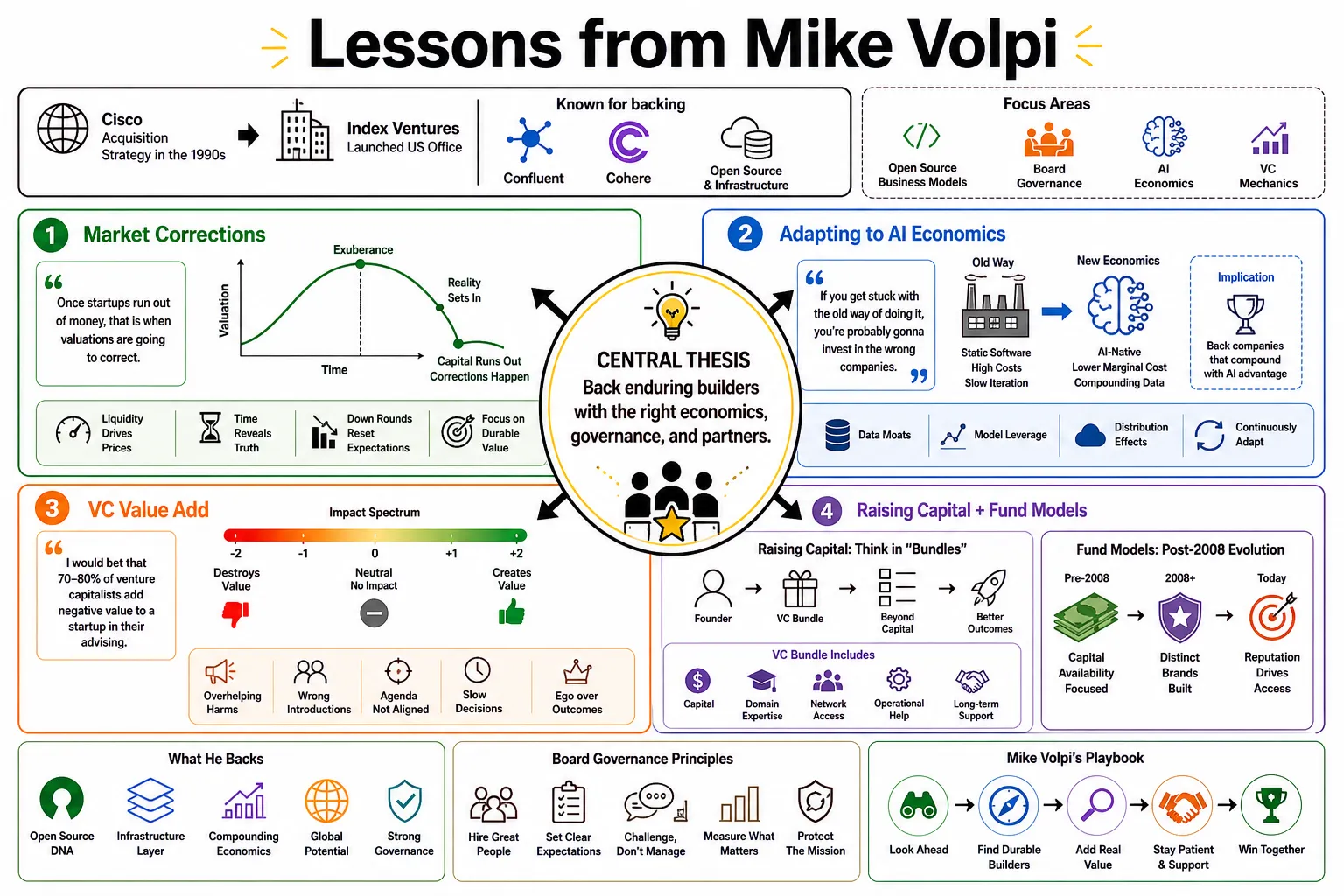
Lessons from Mike Volpi
Mike Volpi ran Cisco's acquisition strategy in the 1990s before launching the US office for Index Ventures. He made his name as an investor by backing open-source and infrastructure companies like Confluent and Cohere. This profile collects his direct takes on venture capital mechanics, open-source business models, board governance, and AI economics.
Part 1: The Evolution of Venture Capital
- On Market Corrections: "Once startups run out of money, that is when valuations are going to correct." — Source: [LiveMint]
- On Adapting to AI Economics: "If you get stuck with the old way of doing it, you're probably gonna invest in the wrong companies." — Source: [Complete AI Training]
- On VC Value Add: "I would bet that 70–80% of venture capitalists add negative value to a startup in their advising." — Source: [Quora]
- On Raising Capital: "The biggest mistake entrepreneurs make when looking to raise money is to approach this process as an exchange of stock for money... My best advice is to approach VCs as 'bundles' of value." — Source: [Quora]
- On Fund Models: "The venture industry has professionalized significantly since 2008, forcing firms to build distinct brands rather than relying purely on capital availability." — Source: [Turpentine VC: Mike Volpi]
- On Stage Agnosticism: "Stage-centric investing is becoming obsolete in a market where early companies require massive compute and mature companies still face high technical risk." — Source: [The Logan Bartlett Show]
- On Partner Selection: "Founders should view funding as an integration of networks, picking partners based on their operational history rather than just the term sheet." — Source: [Quora]
- On High Conviction: "Investors must have compassion for themselves when they are mistaken while retaining the self-confidence to trust their internal logic." — Source: [Microsoft]
- On Structural Shifts: "Artificial intelligence breaks traditional venture capital because it shifts software economics toward lower margins and higher upfront capital requirements." — Source: [Big Technology Podcast: Mike Volpi]
- On Geographics: "European founders expanding to the US need a deep, long-term commitment and physical presence, rather than treating it as a satellite market." — Source: [Index Ventures]
Part 2: Open Source and Commercialization
- On Business Viability: "Five years ago, there was an ample dose of skepticism about the viability of open source as a business model... Fast forward to today, and open source has become the hot place to be." — Source: [Index Ventures]
- On Moral Authority: "It’s got to be the folks who found that the project... at the end of the day, they are the fathers and mothers of this thing. And they kind of have the moral authority over the project." — Source: [Medium]
- On Developer Evangelism: "Modern open source companies develop software internally to preserve moral authority over the base... but you still have to build a product that appeals to the wider community of software developers." — Source: [Index Ventures]
- On Commoditization: "Open source AI models risk driving price points down and commoditizing the enterprise side of the software market." — Source: [The Logan Bartlett Show]
- On Open Core Evolution: "The most durable open-source businesses transition from support-and-services to Gen 3 models that pair an open core with managed cloud services." — Source: [Index Ventures]
- On Community Balance: "Nurturing an open-source community requires a delicate balance between empowering organic growth and providing incentives that sustain the ecosystem." — Source: [Index Ventures]
- On Frictionless Adoption: "Open source succeeds because it allows developers to adopt and test software without navigating complex procurement cycles." — Source: [Index Ventures]
- On Infrastructure Default: "Open source is no longer an alternative; it is the default starting point for massive, enterprise-grade infrastructure." — Source: [Index Ventures]
- On Market Leaders: "It’s been a privilege to work with Kong and its fantastic team, and see them evolve from a small company to a market leader, with the potential to become the 800-pound gorilla in open core development." — Source: [PR Newswire]
- On SaaS Bridges: "Managed SaaS offerings like Confluent Cloud allow users to avoid deployment complexities while providing a revenue engine for the creators." — Source: [Index Ventures]
Part 3: Artificial Intelligence and Compute
- On Pilot Purgatory: "While AI is undeniably powerful, a major challenge for enterprises is moving AI applications out of pilot mode and into scalable production." — Source: [Index Ventures]
- On Compute as a Moat: "In the current AI wave, access to vast amounts of compute serves as a primary competitive advantage for early-stage companies." — Source: [Apple Podcasts: Mike Volpi]
- On AI Commoditization: "There is a distinct possibility that open-source models will drive down pricing and commoditize certain layers of the enterprise AI stack." — Source: [The Logan Bartlett Show]
- On Frontier Labs: "Proprietary AI companies must constantly out-innovate open-source alternatives to justify their premium pricing and closed architecture." — Source: [Mike Volpi interview]
- On Data Infrastructure for AI: "The success of AI depends directly on the real-time data infrastructure underlying it, creating a new generation of data engineering demands." — Source: [Index Ventures]
- On Software Margins: "AI companies naturally have lower gross margins than traditional SaaS companies due to the persistent cost of inference." — Source: [Uncapped Podcast: Mike Volpi]
- On the AI Hype Cycle: "Identifying true value in AI requires looking past the consumer hype cycle and focusing on interconnected developer networks." — Source: [Index Ventures]
- On Model Rough Edges: "Open-source AI models are not an automatic threat to enterprise software because they still have rough edges that make immediate enterprise deployment difficult." — Source: [The Logan Bartlett Show]
- On Hardware Investment: "Investors must adapt to funding massive upfront hardware and compute clusters rather than merely software development headcount." — Source: [Uncapped Podcast: Mike Volpi]
Part 4: The Founder-Investor Relationship
- On Ignoring Investors: "Most venture capitalists secretly wish founders were more willing to say no to them and ignore bad advice." — Source: [Quora]
- On Founder Prominence: "The venture capital firm should never be the star of the show; all attention and focus belong entirely to the entrepreneur." — Source: [StrictlyVC]
- On Shaping Founders: "When backing younger entrepreneurs, investors are implicitly signing up to help shape who those founders become alongside the business." — Source: [The Logan Bartlett Show]
- On People Over Tech: "Technology is just like a photograph, capture of a moment. It's the people inside the photograph which make it a memory. Just like in any organisation, it's not the technology but the people who make the real difference." — Source: [Medium]
- On Transactional Relationships: "Founders fail when they treat term sheets as simple financial transactions rather than the beginning of a decade-long partnership." — Source: [Quora]
- On Operator Experience: "Investors who have spent time operating complex companies can offer founders practical empathy rather than just financial theory." — Source: [Microsoft]
- On Pacing Growth: "Founders must balance the pressure to scale rapidly with the operational realities of building durable teams." — Source: [Index Ventures]
- On Vulnerability: "The best founder-investor relationships allow the founder to be open about what is failing without fear of losing board support." — Source: [Mike Volpi interview]
- On Evaluating Advice: "Entrepreneurs need the discernment to extract useful network connections from VCs while filtering out misaligned product feedback." — Source: [Quora]
Part 5: Board Leadership and Governance
- On Board Membership: "Board members should not view board membership as a list of icons on their LinkedIn profile, but as a subtle yet massively impactful role they play in the creation of great businesses." — Source: [Forbes]
- On Board Dynamics: "A functional board operates quietly behind the scenes, providing structural support without attempting to manage the company." — Source: [Forbes]
- On Independent Logic: "Board members must be willing to stand by their own conclusions even when they diverge from consensus or prevailing market trends." — Source: [Microsoft]
- On Sustained Support: "A director's true value is tested during market downturns or product failures, not during high-growth upswings." — Source: [Forbes]
- On Guiding Strategy: "Boards serve best as sounding boards for complex, multi-year strategic decisions rather than arbiters of quarterly tactics." — Source: [Confluent]
- On the Limits of Control: "Directors must recognize that they cannot force a company to succeed; they can only remove obstacles and provide resources." — Source: [Forbes]
- On Accountability: "Good governance requires holding founders accountable to their own stated goals without imposing arbitrary external metrics." — Source: [Forbes]
- On Long-Term Horizon: "Board decisions should be made with a five-to-ten-year time horizon, ignoring the immediate noise of venture capital cycles." — Source: [Confluent]
- On Operator Boards: "Boards composed of former operators tend to ask more practical execution questions than boards composed entirely of career financiers." — Source: [Microsoft]
Part 6: M&A Strategy (The Cisco Era)
- On Buy vs. Build: "Companies should treat the broader startup ecosystem as an extended R&D lab, acquiring technology rather than building it if they are already behind." — Source: [Y Combinator]
- On Target Maturity: "The ideal acquisition target is old enough to have a proven, tested product, but young enough to be integrated seamlessly into a larger corporation." — Source: [Y Combinator]
- On Customer-Driven M&A: "Acquisitions should be dictated directly by customer demands and technological gaps rather than theoretical banking models." — Source: [Y Combinator]
- On Assessing Talent: "The soft issues of an acquisition—leadership quality, engineering talent, and cultural fit—are just as critical as the technical audit." — Source: [Y Combinator]
- On Rapid Integration: "Success in M&A requires integrating the new company quickly, aiming to ship the acquired product under the parent brand within three to six months." — Source: [Strategy+Business]
- On Avoiding Hostility: "Acquisitions are fundamentally about collaboration and talent retention; hostile takeovers destroy the value of the underlying engineering team." — Source: [Strategy+Business]
- On Acqui-hiring: "Purchasing a company for its talent pool is a valid strategy, provided the parent company has standardized systems to onboard those engineers immediately." — Source: [Y Combinator]
- On Due Diligence Speed: "Empowering corporate development teams to conduct deep technical diligence before involving senior management keeps the M&A engine efficient." — Source: [Strategy+Business]
- On Market Expansion: "Aggressive, disciplined acquisitions allow large companies to enter entirely new market segments faster than internal development cycles permit." — Source: [Innovators Under 35]
- On Standardization: "Post-acquisition success depends on migrating the acquired company to standardized IT, sales, and communication systems on day one." — Source: [Strategy+Business]
Part 7: Building Infrastructure and Scaling
- On Single Infrastructure: "Confluent's opportunity stems from building an interconnected system of all data because most businesses will only dedicate one infrastructure to that task." — Source: [Confluent]
- On Developer Entry Points: "Software developers act as a startup's entry point, evangelists, marketing department, and product management team all at once." — Source: [Index Ventures]
- On B2B Strategies: "Selling infrastructure requires proving that the software fundamentally accelerates the customer's internal engineering velocity." — Source: [Mike Volpi interview]
- On Real-Time Data: "The shift from batch processing to real-time data streaming is as significant an architectural change as the move to the cloud." — Source: [Index Ventures]
- On Category Creation: "Defining a new infrastructure category requires patience, as enterprise adoption cycles lag significantly behind early developer enthusiasm." — Source: [Index Ventures]
- On Scaling Sales: "Moving from a bottom-up developer adoption model to top-down enterprise sales is the hardest transition an infrastructure company will make." — Source: [Mike Volpi interview]
- On Defensibility: "The best infrastructure companies build high switching costs organically by becoming entangled in the customer's core daily operations." — Source: [Index Ventures]
- On Network Effects: "Open-source infrastructure benefits from strong network effects; as more developers use a tool, the ecosystem of integrations makes the tool exponentially more valuable." — Source: [Index Ventures]
- On Managing Cloud Transitions: "Infrastructure providers must seamlessly abstract away the complexity of cloud deployments so customers can focus on data, not servers." — Source: [Index Ventures]
Part 8: Market Dynamics and Economic Shifts
- On Financial Discipline: "Startups that maintain lean operations during funding booms are the ones positioned to dominate during subsequent market corrections." — Source: [LiveMint]
- On Seed Capital: "The proliferation of seed capital has lowered the barrier to starting a company, but it has not lowered the barrier to building a successful one." — Source: [Turpentine VC: Mike Volpi]
- On Defense Tech: "Geopolitical shifts have forced venture capital to reconsider defense and government technology as a viable, necessary sector for innovation." — Source: [Uncapped Podcast: Mike Volpi]
- On Robotics: "Advances in machine learning are finally allowing robotics to move out of structured factory environments and into unpredictable real-world applications." — Source: [Index Ventures Audio]
- On Societal Impact: "Investors have a responsibility to consider the un-biasing of AI machines and the broader societal implications of the technology they fund." — Source: [Index Ventures]
- On Valuation Hangovers: "High valuations from peak market cycles persist only until cash reserves run dry, forcing companies to face actual market clearing prices." — Source: [LiveMint]
- On Capital as a Moat: "While compute access is a moat in AI, capital itself is rarely a sustainable competitive advantage in traditional software." — Source: [Uncapped Podcast: Mike Volpi]
- On Generational Technology: "True generational shifts in technology, like networking in the 90s or AI today, require rebuilding the entire underlying physical and software supply chain." — Source: [Behind the Tech: Mike Volpi]
- On the Pace of Innovation: "Despite market cycles, the fundamental velocity of technological change continues to accelerate, punishing companies that slow their internal R&D." — Source: [Index Ventures]