Lessons from Mike Weinberg
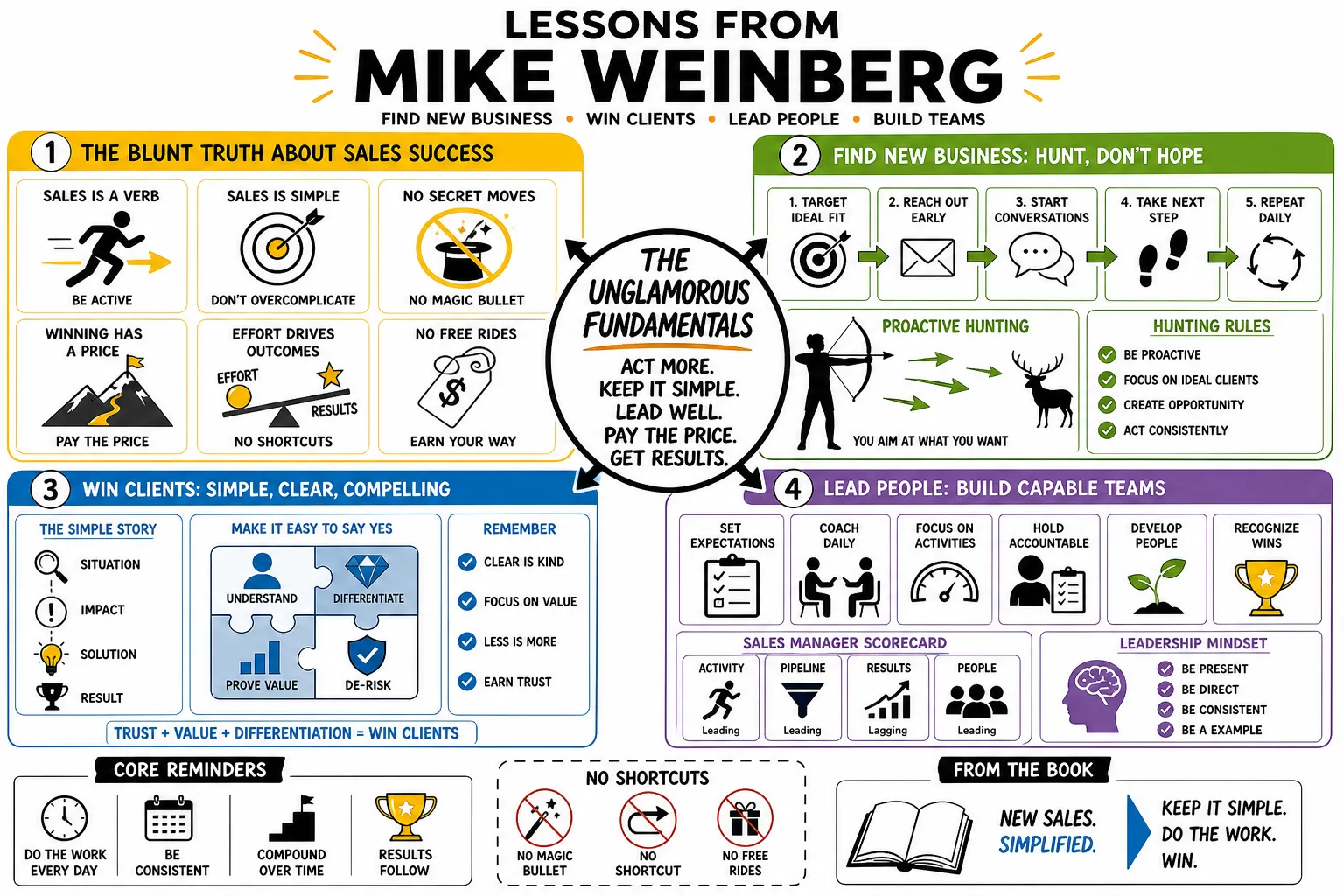
Sales consultant and author Mike Weinberg focuses strictly on the unglamorous fundamentals of finding new business and managing teams. In books like New Sales. Simplified., he argues for proactive hunting, straightforward storytelling, and disciplined leadership. This profile outlines his core principles for winning clients and building capable sales organizations.
Part 1: The Blunt Truth About Sales Success
- On the core action: "Sales is a verb. The dictionary would argue otherwise, but experience shows that the most successful new business salespeople tend to be the most active salespeople." — Source: New Sales. Simplified.
- On the illusion of complexity: "Sales is simple. Why everyone wants to complicate it today is what confuses me." — Source: New Sales. Simplified.
- On the absence of shortcuts: "The truth is that there are no secret sales moves. There is no magic bullet. As badly as we all want one, it does not exist." — Source: New Sales. Simplified.
- On paying the toll: "Winning has a price. There are no free rides to the top. You have to pay the price!" — Source: New Sales. Simplified.
- On effort and outcomes: "Salespeople regularly fall short of delivering their numbers because Little Effort = Little Results. It’s not that they’re not working. They’re just working on the wrong things." — Source: New Sales. Simplified.
- On presenting vs. selling: "Presenting is not the same thing as selling." — Source: New Sales. Simplified.
- On the role of the salesperson: "My dad continually reminded salespeople that their main job was to help the customer win." — Source: New Sales. Simplified.
- On victim mentality: "Lazy, complacent, excuse-making salespeople with a victim mentality lose." — Source: New Sales. Simplified.
- On personal belief: "If you're not excited about what you are selling, how in the world will you get a prospect interested?" — Source: New Sales. Simplified.
- On taking the hard path: "The elevator to success is broken; you have to take the stairs." — Source: New Sales. Simplified.
Part 2: Prospecting and New Business Development
- On the resistance to prospecting: "No one ever defaults to prospecting." — Source: New Sales. Simplified.
- On the danger of patience: "Waiting is a key ingredient in the recipe for new business failure." — Source: New Sales. Simplified.
- On scheduled action: "Only salespeople that dedicate blocks of time on their calendar for prospecting activity consistently succeed at acquiring new business." — Source: New Sales. Simplified.
- On proactive attack: "Top performers in sales don’t wait for anything or anyone... Top performers act. In fact, they proactively attack target accounts even if it means getting into trouble because they’re so far out in front of the support curve." — Source: New Sales. Simplified.
- On the prisoner of hope: "Salespeople often stop prospecting when they have a few hot deals in the pipeline, becoming prisoners of hope who are left empty-handed if those deals fail to close." — Source: New Sales. Simplified.
- On hunting vs. zoo keeping: "Distinguishing between Hunters who bring in new business and Zookeepers who manage existing accounts is essential for structuring a successful sales team." — Source: Mike Weinberg
- On continuous sharpening: "Salespeople are famous for lack of discipline and losing focus. They attempt to call on an account (once), but don't get anywhere. Instead of sharpening their weapons and continuing to attack the same strategically selected targets, they turn and pursue a new set of prospects." — Source: Mike Weinberg
- On creating demand: "In today's market, sellers must focus on proactively creating demand rather than simply fulfilling it when a lead appears." — Source: Sales Management. Simplified.
- On the value of a hunter: "You can bring tremendous value to your business, your customers, and yourself by becoming proficient at bringing in new business." — Source: Mike Weinberg
Part 3: The Power of the Sales Story
- On the greatest sin in sales: "Is there a greater sin in sales than boring your audience? So often what comes out of a salesperson’s mouth is self-focused. It’s all about the salesperson and his great company or offering." — Source: New Sales. Simplified.
- On customer disinterest: "Prospective customers are not interested in what you do; they are only interested in what you can do for them." — Source: New Sales. Simplified.
- On leading with pain: "Stop talking about yourself and your company and begin leading with the issues, pains, problems, opportunities, and results that are important to your prospect." — Source: New Sales. Simplified.
- On dialogue vs. monologue: "New business development success results from creating a sales dialogue, not perfecting a monologue." — Source: New Sales. Simplified.
- On speaking their language: "When you speak the account's language and frame the sales story around what is most meaningful to the client, you stand out from the competition." — Source: New Sales. Simplified.
- On the bridge line: "A highly effective tactical transition is framing the conversation by saying, Customers turn to us when they are struggling with a specific problem or looking to achieve a specific result." — Source: New Sales. Simplified.
- On concise messaging: "Salespeople fail to attract new customers because beyond being self-focused, they’re long-winded and their message is often confusing." — Source: New Sales. Simplified.
- On starting the story: "Stop leading with what you and your company do, and start your story with the issues already on their mind!" — Source: New Sales. Simplified.
- On subservience vs. value: "Contrary to what many weak salespeople believe, customers are not looking for subservient order takers; they are seeking help and value." — Source: New Sales. Simplified.
Part 4: Sales Leadership and Accountability
- On the leader's ceiling: "The level of a team rarely, if ever, exceeds the level of the leader." — Source: Sales Management. Simplified.
- On top-down failure: "If it’s broken at the top, then it’s broken, and the team will never do better than the leader." — Source: Sales Management. Simplified.
- On the purpose of the role: "You were not hired to do work; you were put in your position to produce results." — Source: Sales Management. Simplified.
- On objective reality: "In sales, results are everything, and they do not lie." — Source: Sales Management. Simplified.
- On winning through others: "The successful sales manager doesn’t win on her own; she wins through her people by helping them succeed." — Source: Sales Management. Simplified.
- On the hero trap: "A common failure occurs when managers jump in to close deals themselves, acting as the hero instead of acting as the hero-maker for their team." — Source: Sales Management. Simplified.
- On necessary meetings: "Accountability and coaching meetings are absolutely critical and it’s usually not happening enough!" — Source: Sales Management. Simplified.
- On managing top producers: "Leaders must retain and maximize their best people by deliberately over-investing time and resources in their top producers." — Source: Sales Management. Simplified.
- On handling underperformers: "Managers have a strict responsibility to either remediate struggling reps through intense coaching or replace them entirely." — Source: Sales Management. Simplified.
- On the first step to improvement: "Transparency and honesty are healthy first steps on the path to performance improvement." — Source: Sales Management. Simplified.
Part 5: Creating and Defending Sales Culture
- On taking responsibility for culture: "You have exactly the sales culture you deserve—the one you’ve created, whether by design or neglect." — Source: Sales Management. Simplified.
- On the foundation of success: "Sales culture is the foundation of success. Everything flows from culture." — Source: Sales Management. Simplified.
- On top-down culture: "A healthy sales culture starts at the executive and managerial levels." — Source: Sales Management. Simplified.
- On the manager's energy: "As goes the leader, so goes the organization." — Source: Sales Management. Simplified.
- On effective sales meetings: "Salespeople should look forward to team meetings because they benefit from being there and leave more energized and better equipped to win." — Source: Sales Management. Simplified.
- On the three sales verbs: "A sales manager's job boils down to ensuring the team is consistently executing three verbs: Create, Advance, and Close." — Source: Sales Management. Simplified.
- On recruiting as a lifestyle: "Recruiting for the manager is much like prospecting for the salesperson. It’s very important but typically not perceived as urgent." — Source: Sales Management. Simplified.
- On buckets of blame: "Executives must routinely audit their culture, talent, and processes to identify the true bottlenecks holding back new business development." — Source: Sales Management. Simplified.
- On protecting the team's mission: "Sales leaders must establish clear targets and rules of engagement so the team isn't derailed by ambiguous internal expectations." — Source: Sales Management. Simplified.
Part 6: Time Management and Relentless Focus
- On protecting selling time: "We must take back control of our calendars, stop allowing others to put work on our desks, and selfishly guard our selling time." — Source: Mike Weinberg
- On the selfishness of top producers: "The successful individual sales producer wins by being as selfish as possible with her time." — Source: Mike Weinberg
- On getting out of the CRM: "The sales manager has to get out from behind their desk and stop living with their head buried in the CRM screen and in spreadsheets." — Source: Mike Weinberg
- On the danger of meetings and email: "When you’re blasted with over 200 emails per day; trapped in meetings that keep you from your primary job... you are not leading anyone anywhere." — Source: Mike Weinberg
- On ruthless prioritization: "Sales managers must ruthlessly prioritize their time to focus on activities that directly impact sales performance." — Source: Mike Weinberg
- On avoiding non-sales work: "Salespeople often fail because they allow themselves to be buried under administrative and customer support tasks rather than focusing on acquiring new revenue." — Source: Mike Weinberg
- On the necessity of time blocking: "The hardest part of the job, prospecting, requires making a non-negotiable appointment with yourself to execute outbound activities." — Source: Mike Weinberg
- On managing attention: "High-performing sellers are intensely protective of their focus, actively resisting internal distractions that pull them away from client-facing work." — Source: Mike Weinberg
- On the illusion of working hard: "Many salespeople believe they are working hard when they are actually just busy with tasks that yield zero commercial value." — Source: Mike Weinberg
Part 7: Targeting and Strategic Execution
- On executing strategy: "The job of the sales force is to execute the company’s strategy to perfection, not to create it on the fly." — Source: New Sales. Simplified.
- On the magic of ideal targets: "Good things happen when a talented salesperson with a potential solution gets in front of a prospective customer who looks and smells a lot like your other customers." — Source: New Sales. Simplified.
- On list discipline: "When it comes to targeting, and even more so when specifically hunting for new business, less is often more." — Source: New Sales. Simplified.
- On defining the target: "A highly effective salesperson must work from a finite, focused, written, and workable list of strategic accounts." — Source: New Sales. Simplified.
- On understanding the path to a sale: "Salespeople who don’t have a clear mental picture of the 'path to a sale' or can’t articulate their sales process usually struggle to acquire new pieces of business." — Source: New Sales. Simplified.
- On competing with giants: "Bigger is not always better. Bigger is bigger. Sometimes bigger is harder. It certainly is often slower, clumsier, inflexible, arrogant, and complacent." — Source: New Sales. Simplified.
- On avoiding shiny objects: "Sales success requires sticking to the designated strategic target market rather than chasing every random inbound lead that appears." — Source: New Sales. Simplified.
- On the danger of broad targeting: "Attempting to sell to everyone dilutes the sales story and guarantees you will resonate with almost no one." — Source: New Sales. Simplified.
- On proactive account planning: "Success requires mapping out a distinct attack plan for each high-value target rather than treating all prospects with a generic, automated cadence." — Source: Sales Management. Simplified.
Part 8: Debunking Modern Sales Myths
- On social selling hype: "I’ve never witnessed a buzzword take an entire profession hostage like social selling has." — Source: Mike Weinberg
- On the endurance of fundamentals: "What has worked exceedingly well in sales and sales management for the past couple of decades is still the (not so) secret to sales success today." — Source: Mike Weinberg
- On popularity vs. utility: "Popularity does not equate to the helpfulness/usefulness/effectiveness of the information presented. In fact, it’s often quite the opposite." — Source: Mike Weinberg
- On false teachers: "Salespeople must actively ignore experts who promise that passive inbound marketing or social media engagement can completely replace the need for proactive outbound effort." — Source: Mike Weinberg
- On misleading data: "99% of statistics only tell 49% of the story." — Source: Mike Weinberg
- On the cold calling myth: "The idea that cold calling is dead is a fiction perpetuated by people trying to sell alternative, unproven methodologies to salespeople looking for an easy way out." — Source: Mike Weinberg
- On the limits of technology: "No CRM, automation sequence, or sales enablement tool can replace the necessity of a salesperson having a competent, human conversation with a prospect." — Source: Mike Weinberg
- On inbound reliance: "Relying entirely on marketing to provide leads strips the salesperson of their agency and effectively makes them an order-taker rather than a revenue generator." — Source: Mike Weinberg
- On playing on LinkedIn: "Spending hours tweaking a profile or commenting on posts without actually picking up the phone to book meetings is the ultimate modern sales avoidance tactic." — Source: Mike Weinberg
- On the unchanging human element: "Despite rapid technological shifts, the fundamental mechanics of human trust, uncovering pain, and solving business problems remain exactly the same." — Source: Mike Weinberg