Lessons from Murray Edwards
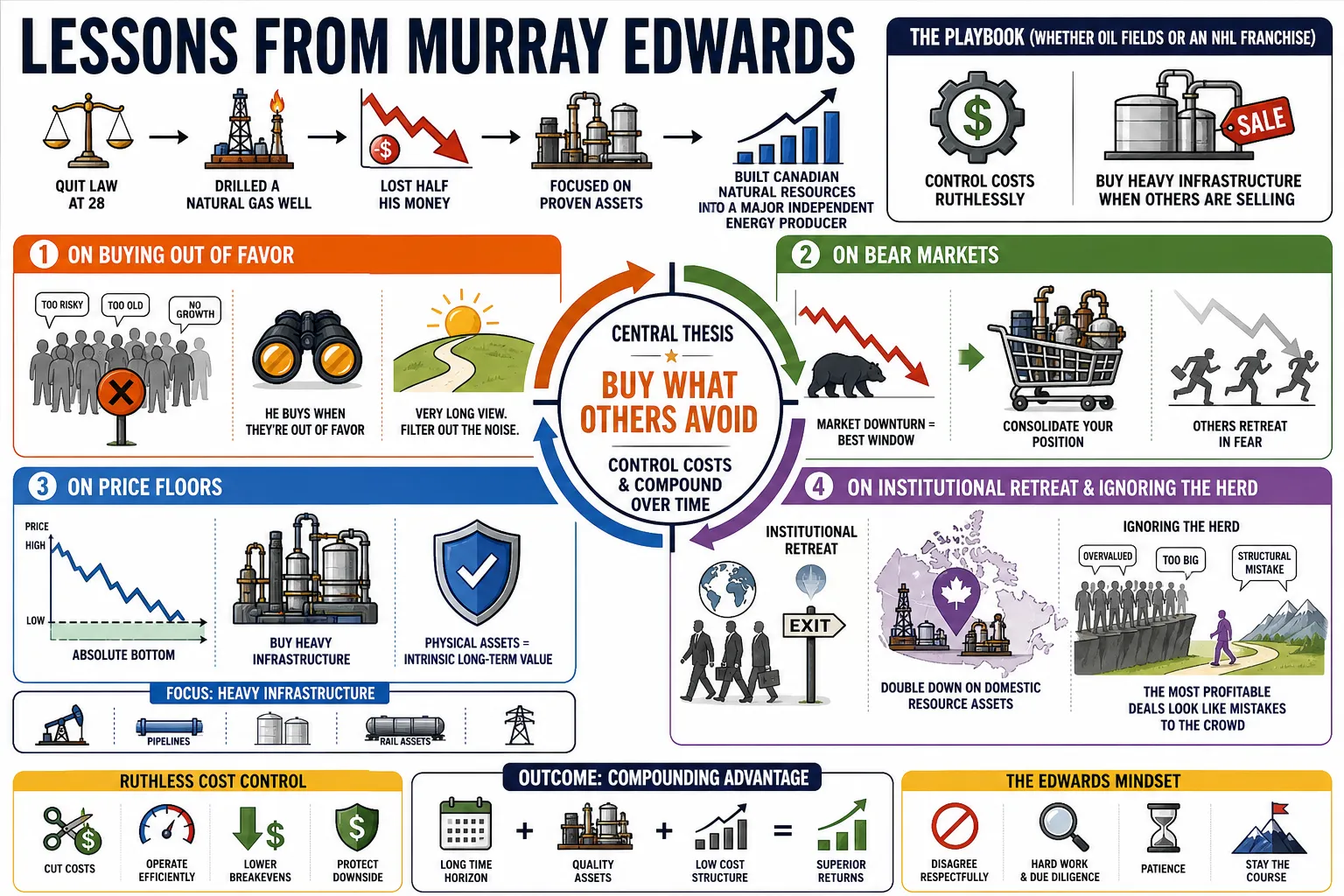
Murray Edwards quit law at 28 to drill a natural gas well and immediately lost half his money. That failure pushed him to abandon risky exploration for proven assets, a shift that eventually built Canadian Natural Resources Limited into a massive independent energy producer. Whether running oil fields or an NHL franchise, his playbook is straightforward: control costs ruthlessly and buy heavy infrastructure when the rest of the market is selling.
Part 1: Contrarian Investing & Market Cycles
- On Buying Out of Favor: "He tends to buy things when they're out of favour... taking the very long view and filtering out the noise." — Source: [BNN Bloomberg]
- On Bear Markets: Treat market downturns as the best window to consolidate your position while others retreat in fear. — Source: [Forbes]
- On Price Floors: Acquire heavy infrastructure when commodity prices are at their absolute bottom, knowing the physical assets hold intrinsic long-term value. — Source: [BNN Bloomberg]
- On Institutional Retreat: Double down on domestic resource assets precisely when global majors are exiting the region. — Source: [BNN Bloomberg]
- On Ignoring the Herd: The most profitable corporate acquisitions often look like structural mistakes to the public at the time they are made. — Source: [Forbes]
- On Filling Vacuums: Look for the market vacuums left behind when major companies step back from a region or a sector. — Source: [University of Saskatchewan]
- On Unglamorous Businesses: Do not be afraid to pursue industries that lack glamour if the underlying economics and cash flows are strong. — Source: [Horatio Alger Association]
- On Pacing: Have the absolute confidence to walk while others run, or run while others walk. — Source: [University of Saskatchewan]
- On Time Horizons: View capital-intensive investments in multi-decade increments, rather than traditional quarterly earnings cycles. — Source: [BNN Bloomberg]
- On Geographic Distance: Being from outside the country brings a different, often much clearer perspective on the true value of domestic assets. — Source: [BNN Bloomberg]
Part 2: Asset Acquisition & Capital Allocation
- On Proven Reserves: Shift capital away from high-risk wildcat exploration and channel it directly toward acquiring existing, producing assets. — Source: [Forbes]
- On Resource Plays: Target low-risk, high-volume resource plays that offer predictable, long-term production metrics. — Source: [Forbes]
- On Synergistic Growth: Grow a micro-cap firm by continuously bolting on undervalued adjacent assets that larger competitors ignore. — Source: [Horatio Alger Association]
- On Diversifying Wealth: Consolidate holdings across multiple distinct industries to structurally insulate capital from single-commodity volatility. — Source: [Forbes]
- On Reinvesting Cash Flow: Prioritize the heavy reinvestment of free cash flow back into the core business rather than issuing immediate, high-yield payouts. — Source: [CNRL]
- On Counter-Cyclical Buying: Use severe financial downturns to aggressively acquire distressed physical assets at a steep discount. — Source: [BNN Bloomberg]
- On Skin in the Game: Management must maintain significant personal equity to ensure their daily operational interests align entirely with long-term shareholders. — Source: [Matrix BCG]
- On Discouraging Options: Require corporate leaders to buy shares with their own money rather than relying on risk-free director stock options. — Source: [Matrix BCG]
- On Patient Capital: Wait for the underlying intellectual and financial thesis of a heavy-industry deal to play out over years. — Source: [BNN Bloomberg]
Part 3: Operational Discipline & Cost Control
- On Owner-Led Discipline: Run massive public conglomerates with the exact same tight cost control of a private, founder-led business. — Source: [Matrix BCG]
- On Surviving the Floor: Maintain a corporate cost structure low enough to survive and thrive during commodity crashes that bankrupt competitors. — Source: [CNRL]
- On Scale and Efficiency: Use sheer operational scale to forcefully drive down per-unit extraction costs in capital-intensive environments. — Source: [Forbes]
- On Solving Problems: The ability to think on your feet and solve immediate operational bottlenecks is infinitely more valuable than abstract academic theory. — Source: [University of Saskatchewan]
- On Execution Over Strategy: A brilliant strategic plan is utterly useless without a rigorous, uncompromising budget process to execute it. — Source: [Horatio Alger Association]
- On Resource Management: Treat every barrel of oil or cubic foot of gas as a precious, finite asset that must be extracted with maximum efficiency. — Source: [CNRL]
- On Operational Autonomy: Give seasoned operational leaders the absolute autonomy to make day-to-day site decisions without boardroom micromanagement. — Source: [Daily Hive]
- On Lean Structures: Systematically avoid the bloated, top-heavy corporate structures that typically plague massive energy conglomerates. — Source: [CNRL]
- On Continuous Improvement: Always look for the marginal, unglamorous technical gains in daily extraction and production processes. — Source: [Horatio Alger Association]
Part 4: Building & Leading Teams
- On The First Pillar of Success: You must actively surround yourself with a cohesive team of people possessing coordinated, diverse skill sets. — Source: [Horatio Alger Association]
- On Rectangular Boxes: View modern management as coordinating distinct rectangular boxes of specialized talent where the collective output overwhelms the individual. — Source: [Horatio Alger Association]
- On Avoiding Top-Down Leadership: Move firmly away from the traditional, dictatorial CEO model in favor of horizontal, team-based decision-making. — Source: [Horatio Alger Association]
- On The Homesteading Ethos: Foster a deep sense of collaboration and gritty entrepreneurship within the firm, mirroring early pioneer homesteaders. — Source: [University of Saskatchewan]
- On Outworking the Room: You cannot control who is the smartest person in the room, but you have total control over your ability to outwork everyone else in it. — Source: [University of Saskatchewan]
- On Critical Mentors: Find mentors who offer painful, critical advice and a necessary kick in the behind, rather than those who just offer praise. — Source: [University of Saskatchewan]
- On Education as an Equalizer: Use formal education not merely to pass written exams, but to train your mind how to think critically under intense pressure. — Source: [University of Saskatchewan]
- On Hiring Technical Experts: Always back your aggressive financial strategies with the highest-caliber technical and engineering talent available on the market. — Source: [Forbes]
- On Shared Vision: Ensure every single team member intimately understands the multi-decade plan and their highly specific role in executing it. — Source: [Horatio Alger Association]
Part 5: Energy Strategy & Economic Policy
- On Economic Sovereignty: A country's true economic independence relies heavily on its unencumbered ability to develop and export its natural resources. — Source: [CNRL]
- On Energy Superpowers: Democratic nations should actively strive to be global energy superpowers to provide reliable, secure energy to their allies. — Source: [CNRL]
- On The Regulatory Burden: Complex and infinitely prolonged impact assessments act as the single greatest impediment to critical national infrastructure development. — Source: [CNRL]
- On Approval Timelines: Major industrial projects must be reviewed and definitively approved in months, not years, to maintain any semblance of investor confidence. — Source: [CNRL]
- On Being Part of the Solution: The traditional energy sector must actively fund decarbonization and clearly position itself as part of the solution to global energy needs. — Source: [CNRL]
- On Carbon Capture Networks: Large-scale, collaborative carbon capture infrastructure is the most viable, realistic path to aligning heavy industrial growth with environmental targets. — Source: [CNRL]
- On Provincial Regulation: Environmental regulations are consistently more effectively managed at the provincial level to protect specific regional industrial competitiveness. — Source: [CNRL]
- On Indigenous Partnerships: Massively scale indigenous loan guarantee programs to enable local communities to become true equity partners in resource projects. — Source: [CNRL]
- On The Competitiveness Gap: Nations must urgently address their stagnant industrial productivity to avoid permanently falling behind on the global economic stage. — Source: [CNRL]
- On The Grand Bargain: Governments should offer streamlined regulations and total fiscal certainty in direct exchange for massive private-sector investment and emissions reductions. — Source: [CNRL]
Part 6: Navigating Risk & Early Failure
- On The Dry Well: Losing half your initial capital on a single bad drill early on teaches you to avoid speculation and ruthlessly focus on proven assets. — Source: [Forbes]
- On Mitigating Risk: Take bold, aggressive risks, but only after they have been mathematically analyzed and mitigated to the absolute greatest degree possible. — Source: [University of Saskatchewan]
- On Moving Past Failure: The ability to absorb a total financial loss, extract the lesson, and immediately move forward is the essential trait of an entrepreneur. — Source: [University of Saskatchewan]
- On Financial Foundations: Use a deep, structural understanding of corporate finance and law to build deals that explicitly protect your downside. — Source: [Forbes]
- On Discipline in Downturns: Maintain your strict strategic discipline specifically during the roughest spots in the market when industry panic sets in. — Source: [Horatio Alger Association]
- On Hanging In There: Often, corporate survival simply comes down to having the robust financial structuring to hang in there until macroeconomic conditions turn. — Source: [Horatio Alger Association]
- On Avoiding Wildcatting: The romantic allure of massive, speculative oil discoveries usually destroys far more capital than it ever actually creates. — Source: [Forbes]
- On The Intellectual Challenge: Focus entirely on the intellectual puzzle of structuring a deal rather than the emotional fear of the capital risk involved. — Source: [BNN Bloomberg]
- On Rebuilding Capital: If you lose your initial financial stake, rebuild it meticulously through smaller, highly probable successes before taking big swings again. — Source: [Forbes]
Part 7: Ownership, Stewardship & Sports
- On Community Stewardship: View the ownership of professional sports franchises not just as a private business, but as the deep stewardship of a vital community asset. — Source: [The Hockey News]
- On Arena Environments: Design new stadiums with steep-pitched seating specifically to keep fans close to the action and manufacture an intimidating home-ice advantage. — Source: [The Hockey News]
- On Competitive Balance: Vigorously support league economic models that enforce competitive balance over raw, large-market financial dominance. — Source: [The Hockey News]
- On Expansion Caution: Stabilize the core on-ice product and secure reliable broadcasting rights before rapidly expanding a sports league into unproven markets. — Source: [The Hockey News]
- On The Canadian Disadvantage: Acknowledge and strategically manage the inherent broadcasting revenue challenges faced by Canadian franchises compared to their American counterparts. — Source: [The Hockey News]
- On Resisting Scorched Earth: Avoid constant, multi-year deep rebuilds in favor of fielding a consistently competitive, hardworking team for the local fanbase. — Source: [Daily Hive]
- On Hands-Off Management: As an ownership group, hire highly competent hockey operations staff and explicitly refuse to interfere in their daily roster decisions. — Source: [Daily Hive]
- On Valuations vs. Support: Focus entirely on generating authentic local community support rather than obsessing over the speculative paper valuation of the franchise. — Source: [The Hockey News]
- On Quiet Influence: Exercise your influence in league governance quietly and methodically behind the scenes rather than through loud public posturing. — Source: [Daily Hive]
- On Public Silence: Accept that taking a public beating during complex civic arena negotiations is often necessary to secure a viable, long-term deal for the city. — Source: [Daily Hive]
Part 8: Personal Philosophy & Long-Term Thinking
- On Vocation as a Hobby: "Happiest is the man who has his vocation for his hobby." When your daily work feels like play, sustaining long hours becomes effortless. — Source: [Horatio Alger Association]
- On Seeking Success: Success does not simply seek you out; you have to actively wake up and seek out success every single day of your life. — Source: [University of Saskatchewan]
- On The Private Billionaire: Let the quarterly and annual results of your companies speak for themselves while actively, intentionally avoiding the public spotlight. — Source: [Forbes]
- On Changing Paths: Do not be afraid to walk away from a lucrative, incredibly safe career path if you have a burning desire to build something of your own. — Source: [Forbes]
- On Leaving a Legacy: Focus your capital on building physical companies and heavy infrastructure that will outlast your direct, day-to-day involvement. — Source: [BNN Bloomberg]
- On Adapting to Change: Maintain your core business principles, but constantly adapt your operational tactics as global markets and extraction technologies evolve. — Source: [CNRL]
- On The Value of Luck: Recognize with humility that sustained, multi-decade success requires hard work, intense discipline, and inevitably, a little bit of luck. — Source: [Horatio Alger Association]
- On Grounded Roots: Never forget the entrepreneurial, hardworking values of your early background, no matter how massive the global enterprise grows. — Source: [University of Saskatchewan]
- On Quiet Confidence: True, lasting business confidence is demonstrated through patient, counter-cyclical capital allocation, not through public boardroom bravado. — Source: [BNN Bloomberg]