Nathalie Cargill is the founder and co-CEO of Longview Philanthropy, where she advises major donors on allocating capital to the world's most pressing and neglected problems. Drawing from her background as a barrister and her deep involvement in the effective altruism community, she champions a rigorous, evidence-based approach to tackling global catastrophic risks. Her framework provides actionable strategies for maximizing philanthropic impact, protecting future generations, and navigating the complexities of emerging technologies.
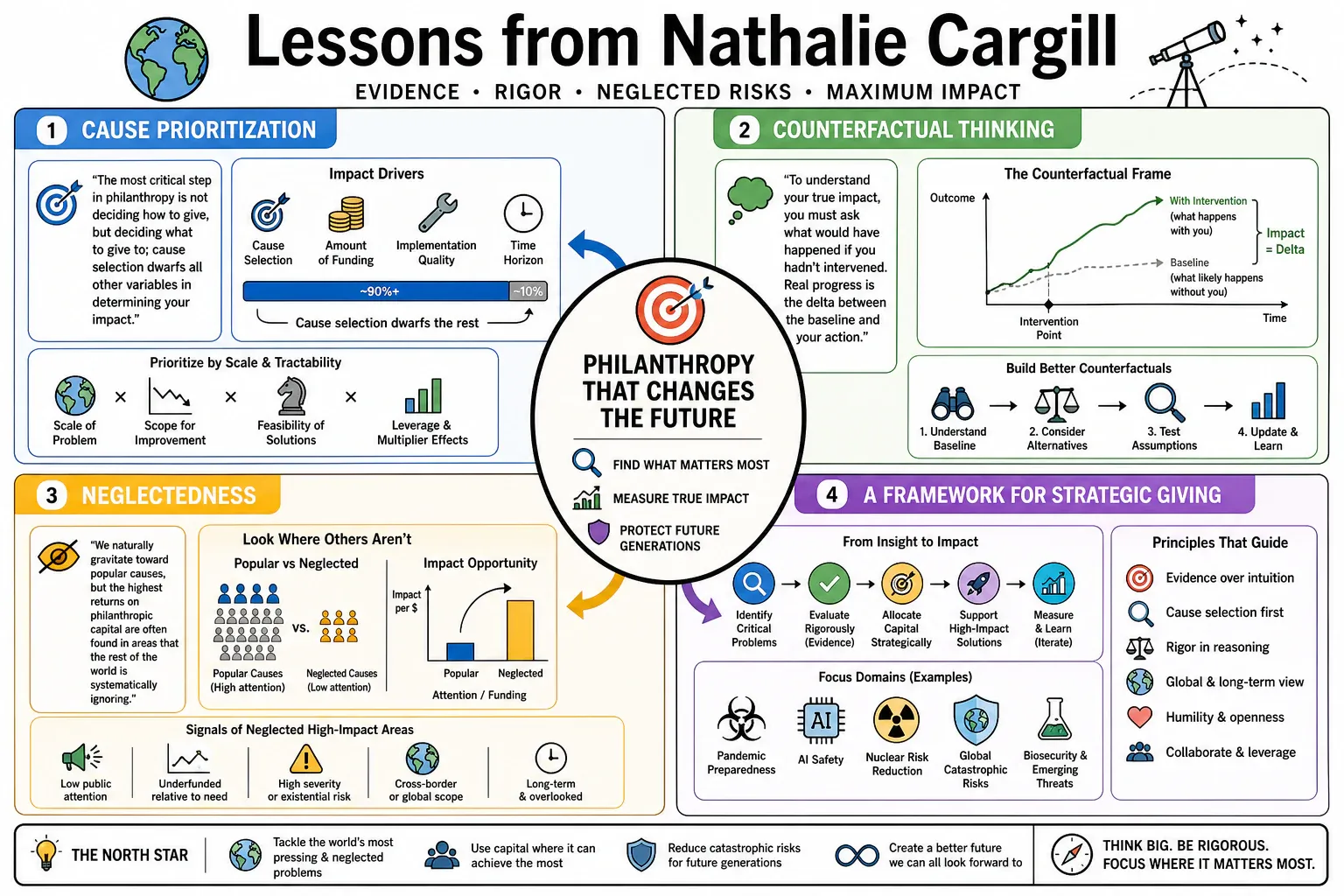
Part 1: Effective Philanthropy & Strategic Giving
- On Cause Prioritization: "The most critical step in philanthropy is not deciding how to give, but deciding what to give to; cause selection dwarfs all other variables in determining your impact." — Source: [Longview Philanthropy Strategy]
- On Counterfactual Thinking: "To understand your true impact, you must ask what would have happened if you hadn't intervened. Real progress is the delta between the baseline and your action." — Source: [TED Talk: How to make a bigger impact with your giving]
- On Neglectedness: "We naturally gravitate toward popular causes, but the highest returns on philanthropic capital are often found in areas that the rest of the world is systematically ignoring." — Source: [Effective Altruism Global]
- On Room for More Funding: "A cause can be important and neglected, but if it cannot effectively absorb additional capital, your marginal donation will yield diminishing returns." — Source: [Longview Philanthropy Strategy]
- On Emotional Giving vs. Rational Giving: "Empathy is the engine that drives us to help, but reason must be the steering wheel that directs our resources to where they can do the most good." — Source: [TED Talk: How to make a bigger impact with your giving]
- On Donor Influence: "Major donors have a unique comparative advantage: they can fund high-risk, high-reward interventions that governments and traditional grantmakers are too risk-averse to touch." — Source: [Longview Philanthropy Insights]
- On Measuring Impact: "Impact measurement isn't about creating perfect metrics; it's about reducing uncertainty enough to make confidently better resource allocations." — Source: [Natalie Cargill Website]
- On Hits-Based Philanthropy: "If every philanthropic grant you make succeeds, you are likely not taking enough risk. We must accept failure as the price of finding systemic solutions." — Source: [Longview Philanthropy Strategy]
- On Overhead Myths: "Fixating on overhead ratios is a mistake. What matters is the cost-effectiveness of the outcome, not how much an organization spends on administrative capacity." — Source: [TED Talk: How to make a bigger impact with your giving]
- On Systemic Change: "Direct relief alleviates immediate suffering, but long-term philanthropy must focus on altering the structural incentives that cause the suffering in the first place." — Source: [Effective Altruism Global]
Part 2: The Philosophy of Longtermism
- On Future Generations: "Future people matter just as much as people alive today. Distance in time should not dictate our moral obligations any more than distance in space." — Source: [Longview Philanthropy Insights]
- On Existential Risk: "An existential catastrophe doesn't just destroy the present; it irreversibly forecloses the vast potential of all future generations." — Source: [80,000 Hours Podcast]
- On Institutional Myopia: "Our political and economic systems are structurally biased toward the short term, making it the responsibility of private philanthropy to advocate for the deep future." — Source: [Natalie Cargill Website]
- On Moral Trajectories: "We must ask not just how to make tomorrow slightly better, but how to ensure the long-term trajectory of human civilization arcs toward flourishing." — Source: [Longview Philanthropy Strategy]
- On Value Lock-In: "Decisions made in this century, particularly regarding new technologies and governance models, may lock in values that constrain humanity for millennia." — Source: [Effective Altruism Global]
- On Option Value: "When facing unprecedented global risks, preserving the option for future generations to choose their own destiny is a profound moral imperative." — Source: [Longview Philanthropy Insights]
- On Existential Hope: "Focusing on catastrophic risk is not inherently pessimistic; it is an act of profound optimism about how good the future could be if we navigate the present carefully." — Source: [TED Talk: How to make a bigger impact with your giving]
- On Intergenerational Equity: "We are temporary stewards of the planet and civilization. Our duty is to pass the baton intact, without having consumed the resources or ruined the environment required for the next leg of the race." — Source: [80,000 Hours Podcast]
- On Tail Risks: "We dramatically under-prepare for low-probability, high-severity events, treating them as statistical anomalies rather than the primary drivers of historical disruption." — Source: [Longview Philanthropy Strategy]
- On Patience: "True longtermism requires the discipline to fund research and institution-building that may not yield visible dividends in our own lifetimes." — Source: [Natalie Cargill Website]
Part 3: Safeguarding the Future: AI Safety
- On Transformative AI: "The development of artificial general intelligence will likely be the most important transition in human history, and we are not adequately prepared for its arrival." — Source: [Longview Philanthropy Insights]
- On the Alignment Problem: "Creating systems vastly more intelligent than humans is not the primary challenge; ensuring those systems fundamentally share and act upon human values is." — Source: [Effective Altruism Global]
- On Capabilities vs. Safety: "The commercial incentives to increase AI capabilities far outpace the resources dedicated to ensuring those capabilities are safe, creating a dangerous and destabilizing overhang." — Source: [80,000 Hours Podcast]
- On Regulatory Frameworks: "We need governance structures that can adapt to the exponential curve of technological progress rather than reacting sluggishly to outdated milestones." — Source: [Natalie Cargill Website]
- On International Coordination: "AI safety is not a competitive race to be won by a single nation; it is a global coordination problem that requires unprecedented international cooperation to avoid disastrous arms races." — Source: [Longview Philanthropy Strategy]
- On Technical Research: "Funding technical AI alignment research is one of the highest-leverage opportunities available to donors today, given the bottleneck of talent and resources in the field." — Source: [Effective Altruism Global]
- On Warning Signs: "We should not wait for catastrophic failures to implement safety protocols. By the time an advanced system displays deceptive alignment, it may be too late to correct it." — Source: [Longview Philanthropy Insights]
- On Epistemic Humility in AI: "We must remain humble about our ability to predict the behavior of systems that outpace human cognition. Uncertainty is an argument for caution, not complacency." — Source: [80,000 Hours Podcast]
- On Corporate Governance: "The boardrooms of leading AI labs hold more sway over the future of humanity than most nation-states. Designing proper incentive structures within these labs is a critical safety intervention." — Source: [Natalie Cargill Website]
Part 4: Biosecurity and Pandemic Preparedness
- On Engineered Pathogens: "The democratization of biotechnology is an incredible boon for medicine, but it dramatically lowers the barrier to entry for the creation of engineered pathogens." — Source: [Longview Philanthropy Strategy]
- On Global Health Security: "COVID-19 was a stress test that humanity barely passed. We must view pandemic preparedness not as a cyclical health issue, but as a permanent pillar of national and global security." — Source: [Effective Altruism Global]
- On Early Detection: "Investing in ubiquitous, pathogen-agnostic early warning systems is the most cost-effective way to extinguish biological threats before they escalate into global catastrophes." — Source: [Longview Philanthropy Insights]
- On Biosafety Norms: "We need to cultivate a culture of rigorous safety within the biological sciences, ensuring that researchers understand the dual-use potential of their work." — Source: [80,000 Hours Podcast]
- On Medical Countermeasures: "The ability to rapidly sequence, design, test, and distribute vaccines and therapeutics within 100 days of an outbreak is a vital defense mechanism we must prioritize." — Source: [Natalie Cargill Website]
- On Indoor Air Quality: "Just as we revolutionized public health by securing clean water in the 19th century, we must now engineer our environments to guarantee clean, pathogen-free indoor air." — Source: [TED Talk: How to make a bigger impact with your giving]
- On Laboratory Leaks: "Whether an outbreak is natural, accidental, or deliberate, the consequences are indistinguishable. We must secure our research facilities with the same rigor we apply to nuclear silos." — Source: [Longview Philanthropy Insights]
- On Bio-surveillance: "Passive environmental surveillance, such as wastewater monitoring, offers a scalable, privacy-preserving method for tracking the emergence of novel threats." — Source: [Longview Philanthropy Strategy]
- On Supply Chain Resilience: "Our biomedical supply chains are fragile and overly centralized. Building redundant, distributed manufacturing capacities for PPE and therapeutics is a necessary hedge against global disruption." — Source: [Effective Altruism Global]
Part 5: Navigating Nuclear Risk and Geopolitics
- On Great Power Conflict: "The probability of a conflict between great powers is low in any given year, but over the span of a century, it represents one of the greatest threats to the continuation of human progress." — Source: [Longview Philanthropy Strategy]
- On Nuclear Deterrence: "Relying perpetually on nuclear deterrence is a strategy that demands perfection. Given human fallibility and institutional decay, perfection is not a sustainable long-term plan." — Source: [80,000 Hours Podcast]
- On Accidental Escalation: "The history of the Cold War reveals that we survived less by strategic brilliance and more by sheer luck. We cannot continue to rely on luck to prevent accidental nuclear escalation." — Source: [Effective Altruism Global]
- On De-escalation Mechanisms: "Investing in track-two diplomacy and robust crisis communication channels is essential for ensuring that misunderstandings do not spiral into irreversible conflicts." — Source: [Longview Philanthropy Insights]
- On the Taboo of Use: "The normative taboo against the use of nuclear weapons is a fragile social construct that must be vigorously defended and reinforced by every generation." — Source: [Natalie Cargill Website]
- On Nuclear Winter: "The primary threat of a nuclear exchange isn't just the initial blast radius; it is the secondary effects of a nuclear winter that would decimate global agriculture and induce mass starvation." — Source: [TED Talk: How to make a bigger impact with your giving]
- On Technological Convergence: "The integration of AI into early warning and command-and-control systems introduces new vulnerabilities, increasing the risk of flash conflicts triggered by algorithmic error." — Source: [Longview Philanthropy Strategy]
- On Multilateral Treaties: "While arms control treaties are difficult to enforce, they remain the most viable architectural frameworks we have for systematically reducing global stockpiles." — Source: [Effective Altruism Global]
- On Geopolitical Empathy: "Effective diplomacy requires understanding the security anxieties of adversarial nations. We cannot build lasting peace on a foundation of mutual incomprehension." — Source: [80,000 Hours Podcast]
Part 6: Expanding the Moral Circle: Animal Welfare
- On Moral Blind Spots: "Future generations will likely look back on our treatment of animals in factory farms with the same moral revulsion we reserve for the greatest atrocities of the past." — Source: [Longview Philanthropy Strategy]
- On the Scale of Suffering: "The sheer number of animals confined in industrial agriculture makes it one of the most pressing moral emergencies of our time, yet it receives a fraction of philanthropic attention." — Source: [TED Talk: How to make a bigger impact with your giving]
- On Sentience: "If an entity can experience pain and suffering, it warrants moral consideration. The species barrier is increasingly irrelevant in the face of physiological evidence." — Source: [Effective Altruism Global]
- On Alternative Proteins: "We cannot rely solely on moral persuasion to end factory farming. We must innovate out of the problem by funding the development of cheaper, tastier alternative proteins." — Source: [Longview Philanthropy Insights]
- On Corporate Campaigns: "Targeted corporate welfare campaigns have proven to be incredibly cost-effective, improving the lives of billions of animals by securing cage-free and welfare commitments from major buyers." — Source: [Natalie Cargill Website]
- On Wild Animal Suffering: "The suffering of animals in the wild is immense and historically neglected. As our technological capacity grows, we must carefully consider our responsibility to alleviate natural suffering." — Source: [80,000 Hours Podcast]
- On Institutional Change: "Personal dietary choices are important, but dismantling industrial agriculture requires structural interventions—lobbying, legal challenges, and shifting government subsidies." — Source: [Longview Philanthropy Strategy]
- On Cross-Cause Benefits: "Advancing animal welfare, particularly through alternative proteins, yields massive compounding benefits for pandemic risk reduction and climate change mitigation." — Source: [TED Talk: How to make a bigger impact with your giving]
- On Interspecies Ethics: "Expanding our moral circle to include non-human animals is not just an exercise in compassion; it is a fundamental test of our civilization's ethical maturity." — Source: [Effective Altruism Global]
Part 7: High-Impact Careers and Agency
- On Career Capital: "Your career is your most valuable resource for doing good. Optimizing your professional trajectory for impact requires treating your time with the same rigor an investor treats their capital." — Source: [80,000 Hours Podcast]
- On Comparative Advantage: "You don't need to work on the absolute most important problem if you have a unique, disproportionate skill set suited for the second most important problem." — Source: [Longview Philanthropy Insights]
- On Earn to Give: "For some, the highest impact path is not working directly at a non-profit, but excelling in a lucrative career and aggressively directing that wealth toward highly effective organizations." — Source: [TED Talk: How to make a bigger impact with your giving]
- On Building Agency: "Agency is the ability to look at the world, recognize that its systems are malleable, and take deliberate action to reshape them. It is a muscle that must be actively trained." — Source: [Natalie Cargill Website]
- On Taking Risks: "Ambitious altruism requires a tolerance for failure. If you design your career strictly to avoid making mistakes, you will inherently limit your ceiling for positive impact." — Source: [Effective Altruism Global]
- On Talent Bottlenecks: "In many high-impact fields, particularly AI safety and biosecurity, the limiting factor is not a lack of funding, but a desperate shortage of specialized, dedicated talent." — Source: [Longview Philanthropy Strategy]
- On Exploration vs. Exploitation: "Early in your career, prioritize exploring different paths and building adaptable skills. Later, ruthlessly exploit that capital in the niche where you can exert the most leverage." — Source: [80,000 Hours Podcast]
- On Institutional Entrepreneurship: "Sometimes the best way to solve a problem is not to join an existing organization, but to have the audacity to build a new institution specifically tailored to address a neglected gap." — Source: [Longview Philanthropy Insights]
- On Burnout: "Sustainable impact requires sustainable effort. Sacrificing your mental and physical health in the short term diminishes your long-term capacity to contribute to the causes you care about." — Source: [Natalie Cargill Website]
Part 8: Rationality, Evidence, and Decision Making
- On Epistemic Rigor: "Good intentions are insufficient. Without a commitment to epistemic rigor and a willingness to follow the evidence—even when it contradicts our intuitions—we risk causing harm." — Source: [TED Talk: How to make a bigger impact with your giving]
- On Expected Value: "When dealing with massive uncertainties, expected value calculations—weighing the magnitude of an outcome by its probability—are the most robust tools we have for rational decision-making." — Source: [Longview Philanthropy Strategy]
- On Changing Your Mind: "The willingness to publicly change your mind when presented with new evidence is not a sign of weakness; it is the hallmark of intellectual honesty and effective leadership." — Source: [Effective Altruism Global]
- On the Scout Mindset: "We must train ourselves to seek out the truth of a situation rather than merely defending our pre-existing beliefs. We need to be scouts, not soldiers." — Source: [80,000 Hours Podcast]
- On Forecasting: "Improving our ability to forecast geopolitical and technological trends is crucial. Better predictions lead directly to better policy and more effective philanthropic interventions." — Source: [Longview Philanthropy Insights]
- On Cognitive Biases: "Scope insensitivity causes us to feel the same emotional response to one tragedy as we do to a million. We must use reason to scale our efforts to match the actual size of the problem." — Source: [TED Talk: How to make a bigger impact with your giving]
- On Information Diets: "The quality of your decisions is constrained by the quality of your inputs. Cultivating a high-signal, low-noise information environment is a prerequisite for effective action." — Source: [Natalie Cargill Website]
- On Nuance and Complexity: "The world's most pressing problems do not have simple, silver-bullet solutions. Embracing complexity and rejecting reductive narratives is necessary for finding genuine leverage points." — Source: [Longview Philanthropy Strategy]
- On Constructive Disagreement: "A healthy intellectual ecosystem requires robust, good-faith debate. We refine our strategies not by living in echo chambers, but by engaging with our most articulate critics." — Source: [Effective Altruism Global]
- On Pragmatism: "Theoretical elegance must ultimately yield to real-world applicability. The goal of all this reasoning is not to be perfectly right in a vacuum, but to be practically effective in the world." — Source: [80,000 Hours Podcast]