Niels Hoven, the founder of Mentava, an ed-tech startup focused on accelerated learning for young children, has shared numerous insights into his educational philosophy, parenting strategies, and entrepreneurial journey. His perspectives often challenge conventional approaches to childhood education, advocating for a system that caters to the potential of high-achieving students.
On the State of Education
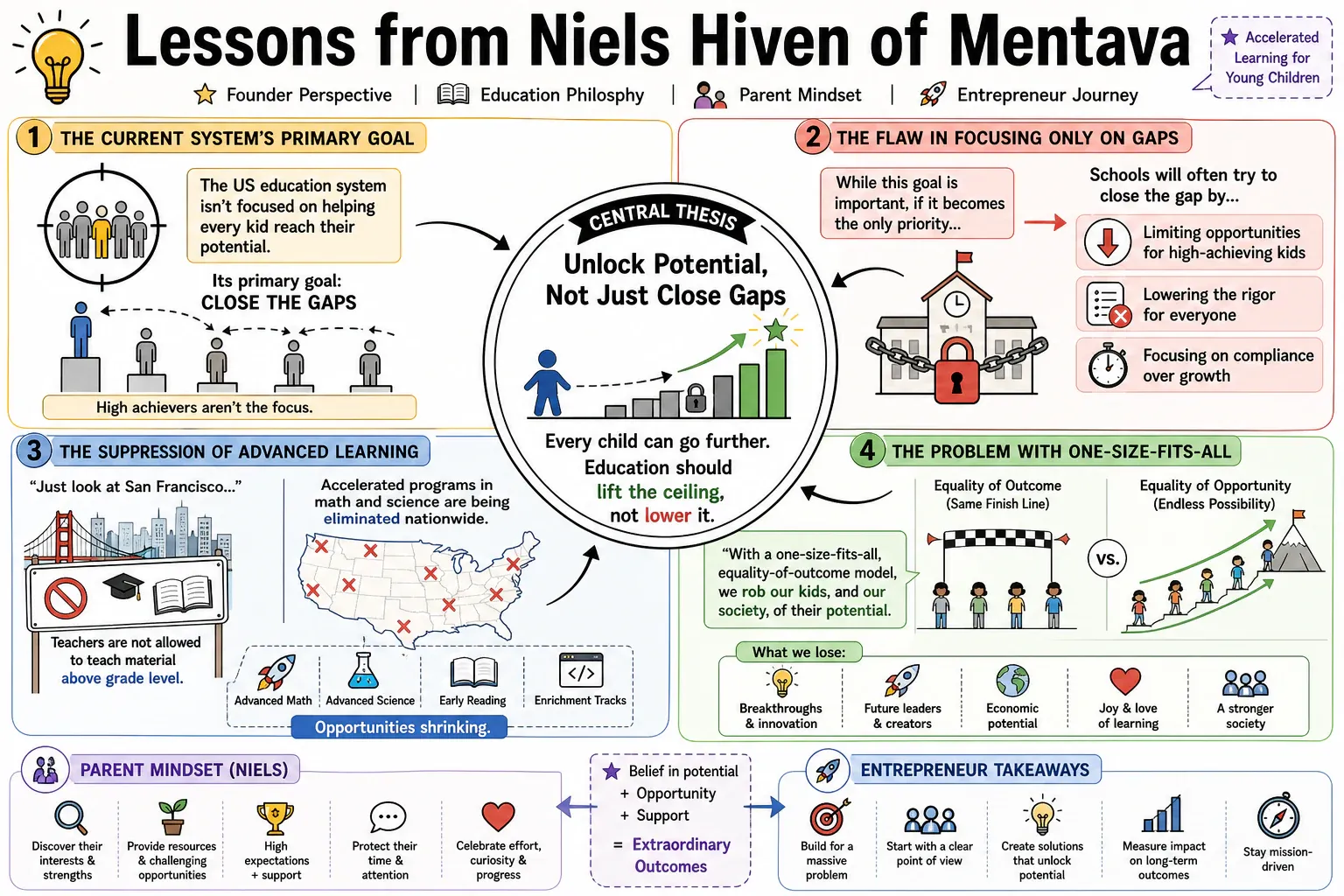
- On the primary goal of the current education system: "The US education system isn't focused on helping every kid reach their potential. Instead, its primary goal is to close the gaps between high achievers and low performers."[1]
- The flaw in focusing only on closing gaps: "While this goal is important, if it becomes the only priority, then schools will often try to close the gap by limiting opportunities for high-achieving kids."[1]
- On the suppression of advanced learning: "Just look at San Francisco, where teachers are not allowed to teach material above grade level. Accelerated programs in math and science are being eliminated nationwide."[1]
- The problem with a one-size-fits-all approach: "With a one-size-fits-all, equality-of-outcome model, we rob our kids, and our society, of their potential."[2]
- On the two competing views of education: "Most people believe education should provide opportunity for everyone. But some policymakers see education as a way to optimize for equal outcomes."[1]
- The irony of policies that limit opportunities: By limiting opportunities in public schools, the families who are hurt the most are those without the financial resources to seek outside enrichment.[3]
- On ability grouping: "The idea that you should take kids and give them material based on their ability and allow them to progress based on their ability is just a non-starter with some of the most powerful educational organizations in the world."[3]
- The impact on high-achieving kids: "There's this whole segment of high-achieving kids who want to be learning more, who actually want to be going to school and learning more, and their learning needs are not being met."[3]
- On the perception of school: For children who are not challenged, they will "sit in the class and be bored out of their minds. and that's what they're going to think that school is."[3]
- The origin of Mentava: Hoven founded Mentava, an education startup, with the goal of teaching 2-year-olds to read at a 2nd-grade level.[4]
On Accelerated Learning and High Achievers
- Mentava's mission: "Our mission with Mentava is to throw a lifeline to those kids who are bored and stifled in their current educational environment, and show the world how fast children are capable of learning."[5]
- The potential of children: "Parents have no idea what their kids are capable of doing, especially parents of high-achieving kids."
- The importance of independent study: "For a high-achieving student whose learning needs aren't being supported, independent study can be a lifeline to finally learning as fast as they want."[5]
- His personal experience with independent study: "Independent study worked great for me: I got to learn as fast as I wanted and I never had any homework."[5]
- The vision for accelerated learning: "We should see more kids reading in preschool, we should see more kids doing algebra in fourth grade, more kids doing calculus in eighth grade."[6]
- Learning to read is the first step: Hoven realized that to accelerate math learning, they first needed to teach children to read.
- The simplicity of teaching reading: "Teaching reading isn't rocket science. It's phonics: letters make sounds, you memorize them, and learn to blend them together."
- The challenge of teaching young children: "The challenge is keeping a 2-4 year old engaged and focused for those 100 hours" it takes to learn to read.
- Academics should be treated like sports: "When it comes to sports, everybody is basically aligned that the goal here is helping every kid reach their potential...And for some reason, when it comes to academics, we throw all of that out the window."[2]
- The societal benefit of nurturing top talent: "Our progress as a society depends a lot on the brilliant ideas of our greatest thinkers. To improve our way of life, we should be promoting our best and brightest to the highest heights of their potential."[2]
On Parenting High-Achieving Kids
- A parent's primary role in education: "Understand that schools aren't set up to support your kids... Schools won't fully support your child's learning needs. That's your role as a parent."[1]
- Advocate for your child: "Never be ashamed of advocating for your child. If your child is capable of more, you need to push for opportunities."
- Advocacy is necessary in all school types: "This isn't just a public school issue – it affects private schools too."
- Don't feel guilty for advocating: "Schools may also try to make you feel guilty about advocating for your child, saying other kids have needs too. But this is your child — it's your responsibility to advocate for them."
- Homeschooling as an alternative: Even parents with unlimited resources may find themselves homeschooling to meet their child's needs.
- The efficiency of homeschooling: "Looking at homeschoolers, they typically spend just a few hours a day on academics. The rest of the time they're playing and socializing."
- Balance is key: "Spend a little time each day supporting their academic needs, then let them enjoy their childhood and have fun."
- Motivation is a key focus: The philosophy behind Mentava's software centers on making learning engaging and intuitive for very young children.
- Parental encouragement is still needed: While the software does the teaching, parents typically need to encourage 20-30 minutes of daily practice.
- Reading unlocks curiosity: "Once children can read, they can explore their curiosity and read whatever interests them."
On Startups and Ed-Tech
- The failure of many ed-tech founders: "I think the reason that most edtech founders fail is because of an oversupply of idealism."[6]
- Build for the real world: "A lot of people design education products for the world that they wish we lived in rather than the world that we do live in."[6]
- The hard part of education isn't the curriculum: "Our thesis at Mentava has always been that the hard part of education isn't the teaching or curriculum."
- We know how to teach: "We know how to teach reading - it's phonics. We know how to teach math - we've been doing it for hundreds of years."
- The real challenge is motivation: "We're not really solving for curriculum, we are solving for motivation."[7]
- Unbundling school: "School combines childcare and academics – we're not trying to replace the childcare aspect... Instead, we're focusing on allowing kids to support their own learning needs through independent study."[1]
- From gaming to education: Hoven spent most of his career in the gaming industry before founding Mentava, a career he left because he "wasn't building a product that I was passionate about, and eventually I started to feel like a digital drug dealer."[5]
- The power of a viral "hater": An online critic inadvertently helped Mentava go viral by posting pages from an early investor pitch deck, leading to a surge in sign-ups.[6]
- On the role of AI in education: Hoven believes the core learning pathways for reading and math are fairly linear and that the real power of AI is in adaptability, acting as a coach to guide students back to the main path.[1]
- AI is not a silver bullet (yet): "Maybe someday AI will be good enough that you won't need to optimize the core pathway, but for now, that's our approach."[1]
Personal Reflections and Learnings
- Early experiences shaped his views: In kindergarten, a teacher accused Hoven's mother of pushing him too hard academically.[5]
- The value of accelerated opportunities: These early opportunities to accelerate "fostered a lifelong love of learning that I've come to rely on during the ups and the downs of both my professional career and my personal life."[5]
- The pandemic as a catalyst: "During the pandemic, my wife and I worked full-time jobs while having 2 kids and a newborn at home... The only solution was to give them the skills to teach themselves."
- Children can learn to teach themselves faster than we think: "Kids can build those skills much faster than you think, especially with modern software tools."
- On the importance of math and computer science: Hoven sees these as vocational skills that directly contribute to an individual's ability to create value in the world.
- His personal educational journey: Hoven took calculus in middle school and achieved perfect scores on his SATs.[5]
- The decline of programs that benefited him: "I had an amazing public school education, but over the years, I'd seen all the programs that I benefited from get cut or even banned."[5]
- A passion for education over gaming: "What I did care about was education."[5]
- The goal is to unlock potential: "How do we unlock the kids who want to move that fast and you know support kids across the whole range of of abilities."[6]
- Showing the world what's possible: A core tenet of Mentava is to "Show the world how fast children are capable of learning.”[5]
Sources