Lessons from Peter Lynch
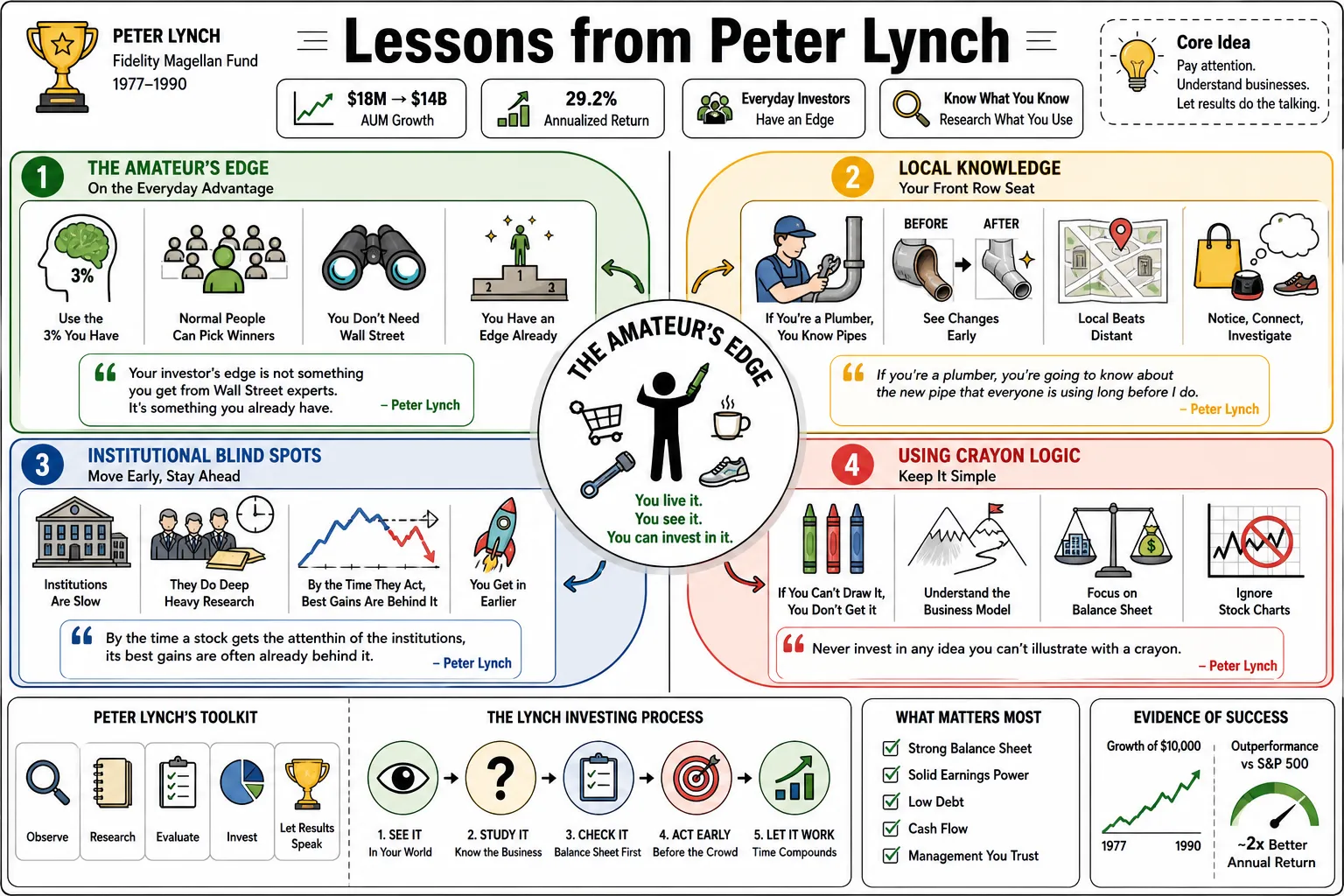
Peter Lynch ran the Fidelity Magellan Fund from 1977 to 1990, turning $18 million into $14 billion with a 29.2% annualized return. He argued that everyday investors can beat Wall Street simply by paying attention to consumer habits and researching businesses they actually understand. This collection breaks down his methods for categorizing companies, ignoring macroeconomic noise, and prioritizing balance sheets over stock charts.
Part 1: The Amateur's Edge
- On the Everyday Advantage: "Your investor’s edge is not something you get from Wall Street experts. It’s something you already have." — Source: [Beating the Street]
- On the Myth of Professional Dominance: "Any normal person using the customary three percent of the brain can pick stocks just as well, if not better, than the average Wall Street expert." — Source: [One Up on Wall Street]
- On Local Knowledge: "If you’re a plumber, you’re going to know about the new pipe that everyone is using long before I do." — Source: [One Up on Wall Street]
- On Institutional Blind Spots: "By the time a stock gets the attention of the institutions, its best gains are often already behind it." — Source: [One Up on Wall Street]
- On Using Crayon Logic: "Never invest in any idea you can't illustrate with a crayon." — Source: [Beating the Street]
- On Consumer Research: "If you like the store, chances are you’ll love the stock." — Source: [Beating the Street]
- On Simple Math: "All the math you need in the stock market you get in the fourth grade." — Source: [One Up on Wall Street]
- On Personal Observations: "You can outperform the experts if you use your edge by investing in companies or industries you already understand." — Source: [Beating the Street]
- On Ground-Level Research: "The person that turns over the most rocks wins the game." — Source: [One Up on Wall Street]
- On Ignoring the Herd: "The stock market is dominated by a herd of professional investors. You can beat the market by ignoring the herd." — Source: [Beating the Street]
Part 2: Identifying Great Companies
- On Management Quality: "Go for a business that any idiot can run, because sooner or later any idiot probably is going to be running it." — Source: [One Up on Wall Street]
- On Boring Businesses: "A company that does boring things is almost as good as a company that has a boring name, and both together is a terrific combination." — Source: [One Up on Wall Street]
- On Niche Dominance: "If you’ve got the only gravel pit in Brooklyn, you’ve got a virtual monopoly." — Source: [One Up on Wall Street]
- On Avoiding Imitators: "Beware of the next something. The next IBM, the next McDonald's, etc. It usually isn't." — Source: [One Up on Wall Street]
- On Unpleasant Industries: "It’s better if the company does something disagreeable. A company that handles toxic waste is almost guaranteed to be ignored by Wall Street for years." — Source: [One Up on Wall Street]
- On Consistent Demand: "Invest in products people have to keep buying, like razor blades or soft drinks." — Source: [One Up on Wall Street]
- On Real Corporate Reality: "Behind every stock is a company. Find out what it's doing." — Source: [Beating the Street]
- On Uncorrelated Success: "Often, there is no correlation between the success of a company’s operations and the success of its stock over a few months or even years. In the long run, the correlation is 100%." — Source: [Beating the Street]
- On Beneficiaries of Technology: "Invest in the companies that use the technology, rather than the ones that produce it." — Source: [One Up on Wall Street]
- On Cold Industries: "Avoid hot stocks in hot industries. Great companies in cold, non-growth industries are consistently big winners." — Source: [Beating the Street]
Part 3: Categories of Stocks
- On Tenbaggers: "A tenbagger is a stock that appreciates ten times its purchase price. You only need a few of these in a lifetime to make a fortune." — Source: [One Up on Wall Street]
- On Fast Growers: "Fast growers are small, aggressive new enterprises growing at 20 to 25 percent a year. If you choose wisely, this is the land of the tenbaggers." — Source: [One Up on Wall Street]
- On Stalwarts: "Multi-billion-dollar giants offer 10 to 12 percent earnings growth and provide excellent downside protection during recessions." — Source: [One Up on Wall Street]
- On Slow Growers: "Large and aging companies typically grow slightly faster than the gross national product. You buy them mostly for their generous and regular dividends." — Source: [One Up on Wall Street]
- On Cyclicals: "With cyclicals, timing is everything. You have to buy when things look their worst and sell when earnings peak." — Source: [One Up on Wall Street]
- On Turnarounds: "Turnarounds are battered, depressed companies. If they recover, the upside is massive because their stock prices have been beaten down so far." — Source: [One Up on Wall Street]
- On Asset Plays: "An asset play is any company that's sitting on something valuable that Wall Street has overlooked, like real estate, oil, or a patent." — Source: [One Up on Wall Street]
- On Company Size and Movement: "Big companies have small moves, small companies have big moves." — Source: [One Up on Wall Street]
- On Spinoffs: "Spinoffs often result in astoundingly lucrative investments because the parent company usually wants them to succeed." — Source: [One Up on Wall Street]
- On Recognizing Growth Limits: "There is no such thing as a company that can grow at 25 percent forever." — Source: [One Up on Wall Street]
Part 4: Financials and Fundamental Analysis
- On Debt: "Companies that have no debt can't go bankrupt." — Source: [One Up on Wall Street]
- On Earnings as Gravity: "If you can follow only one bit of data, follow the earnings. Sooner or later earnings make or break an investment." — Source: [One Up on Wall Street]
- On Corporate Gloss: "All else being equal, invest in the company with the fewest color photographs in the annual report." — Source: [One Up on Wall Street]
- On Balance Sheets: "Never invest in a company without understanding its finances. The biggest losses come from companies with poor balance sheets." — Source: [Beating the Street]
- On Insider Buying: "Insiders might sell their shares for any number of reasons, but they buy them for only one: they think the price will go up." — Source: [One Up on Wall Street]
- On Share Buybacks: "When a company buys back its own shares, it's taking shares out of circulation, which increases the earnings per share and rewards the remaining owners." — Source: [One Up on Wall Street]
- On Proving the Concept: "Look for small companies that are already profitable and have proven that their concept can be replicated." — Source: [One Up on Wall Street]
- On Waiting for Profits: "With small companies, you are better off waiting until they turn a profit before you invest." — Source: [Beating the Street]
- On Valuation Ratios: "Any company that is priced at a price-to-earnings ratio that is double its growth rate is very expensive." — Source: [One Up on Wall Street]
Part 5: Market Timing and Volatility
- On Predicting Corrections: "Far more money has been lost by investors preparing for corrections or trying to anticipate corrections than has been lost in the corrections themselves." — Source: [One Up on Wall Street]
- On Normalizing Crashes: "A decline in stocks is not a surprising event, it's a recurring event. As normal as frigid air in Minnesota." — Source: [Beating the Street]
- On Rearview Mirrors: "You can’t see the future through a rearview mirror." — Source: [Beating the Street]
- On Ignoring Macroeconomics: "If you spend more than 13 minutes analyzing economic and market forecasts, you've wasted 10 minutes." — Source: [One Up on Wall Street]
- On Fair-Weather Investors: "Everybody in the world is a long-term investor until the market goes down." — Source: [One Up on Wall Street]
- On Buying Opportunities: "A drop in the market is just a chance to buy great companies at a lower price, like a department store sale." — Source: [One Up on Wall Street]
- On Staying the Course: "The real key to making money in stocks is not to get scared out of them." — Source: [One Up on Wall Street]
- On Desperation Selling: "When you sell in desperation, you always sell cheap." — Source: [One Up on Wall Street]
- On Readiness: "You know the drop is coming, and you're ready to ride it out." — Source: [Beating the Street]
Part 6: Psychology and Discipline
- On Gut Feelings: "The trick is not to learn to trust your gut feelings, but rather to discipline yourself to ignore them." — Source: [One Up on Wall Street]
- On True Risk: "If you invest $1,000 in a stock, all you can lose is $1,000, but you stand to gain $10,000 or even $50,000 over time if you're patient." — Source: [One Up on Wall Street]
- On Doing the Work: "Investing is fun and exciting, but dangerous if you don’t do any work." — Source: [Beating the Street]
- On Fundamental Confidence: "Stand by your stocks as long as the fundamental story of the company hasn't changed." — Source: [One Up on Wall Street]
- On Knowing Why: "You have to know what you own and why you own it. 'This baby is a winner' doesn't count." — Source: [Beating the Street]
- On Stomach vs. Brain: "In the stock market, the most important organ is the stomach. It’s not the brain." — Source: [Beating the Street]
- On Long Shots: "Long shots almost always miss the mark." — Source: [Beating the Street]
- On Market Reality: "In this business, if you're good, you're right six times out of ten. You're never going to be right nine times out of ten." — Source: [One Up on Wall Street]
- On Self-Deception: "There are no undiscovered gems waiting to be found by someone who hasn't put in the hours of research." — Source: [One Up on Wall Street]
Part 7: Portfolio Management
- On Concentration vs. Diversification: "Owning stocks is like having children. Don’t get involved with more than you can handle." — Source: [Beating the Street]
- On Diworsification: "Acquisitions made purely for the sake of diversification usually end up as 'diworsification,' sapping the core business." — Source: [One Up on Wall Street]
- On Holding Cash: "If you can’t find any companies that you think are attractive, put your money in the bank until you discover some." — Source: [Beating the Street]
- On Cutting Flowers: "Selling your winners and holding your losers is like cutting the flowers and watering the weeds." — Source: [One Up on Wall Street]
- On Existing Holdings: "The best stock to buy may be the one you already own." — Source: [Beating the Street]
- On Re-evaluating Categories: "If a fast grower gets too big, it becomes a stalwart. You have to adjust your expectations accordingly." — Source: [One Up on Wall Street]
- On Averaging Down: "Averaging down on a stock that has fundamentally deteriorated is throwing good money after bad." — Source: [One Up on Wall Street]
- On Patience with Winners: "The typical big winner in the Lynch portfolio generally takes three to ten years or more to play out." — Source: [One Up on Wall Street]
- On Managing Turnover: "Don't constantly trade in and out. Find the right companies and let them do the work for you." — Source: [One Up on Wall Street]
Part 8: Wisdom, Patience, and the Long Game
- On Understanding the Mission: "An important key to investing is to remember that stocks are not lottery tickets." — Source: [Beating the Street]
- On Time Horizon: "If you’re a long-term investor, time is on your side." — Source: [Beating the Street]
- On The Odds of Success: "If you study 10 companies, you’ll find 1 for which the story is better than expected. If you study 50, you’ll find 5." — Source: [Beating the Street]
- On Simplifying Explanations: "If you can’t explain why you own a stock to a 10-year-old in two minutes or less, you shouldn't own it." — Source: [One Up on Wall Street]
- On the Price of Waiting: "The worst thing you can do is hold a slow grower for ten years, wondering why you haven't become wealthy." — Source: [One Up on Wall Street]
- On Unpredictable Catalysts: "You never know exactly what event will cause a stock to rise, but if the fundamentals are sound, the market will eventually recognize it." — Source: [One Up on Wall Street]
- On Independent Thinking: "You can't buy what is popular and expect to beat the market." — Source: [One Up on Wall Street]
- On Acknowledging Mistakes: "When you realize you've made a mistake in assessing a company, sell it and move on. Don't wait to break even." — Source: [One Up on Wall Street]
- On the Ultimate Lesson: "The stock market is a forgiving place. You can be wrong more often than you are right and still make a fortune, as long as your winners are big and your losers are small." — Source: [One Up on Wall Street]