Praveer Melwani is the Chief Financial Officer and Treasurer of Figma, a design platform that he helped guide through its initial public offering in 2025. Melwani joined Figma in July 2017 as the company’s first business operations and finance hire, later serving as Head of Business Operations and Finance before stepping into the CFO role in March 2022. Prior to his time at Figma, he held roles in business operations at NerdWallet, strategic finance at Dropbox, and investment banking at Union Square Advisors. He holds a Bachelor of Arts in Business Administration from the Ivey Business School at Western University.
Finance Strategy, Capital Allocation and CFO Craft
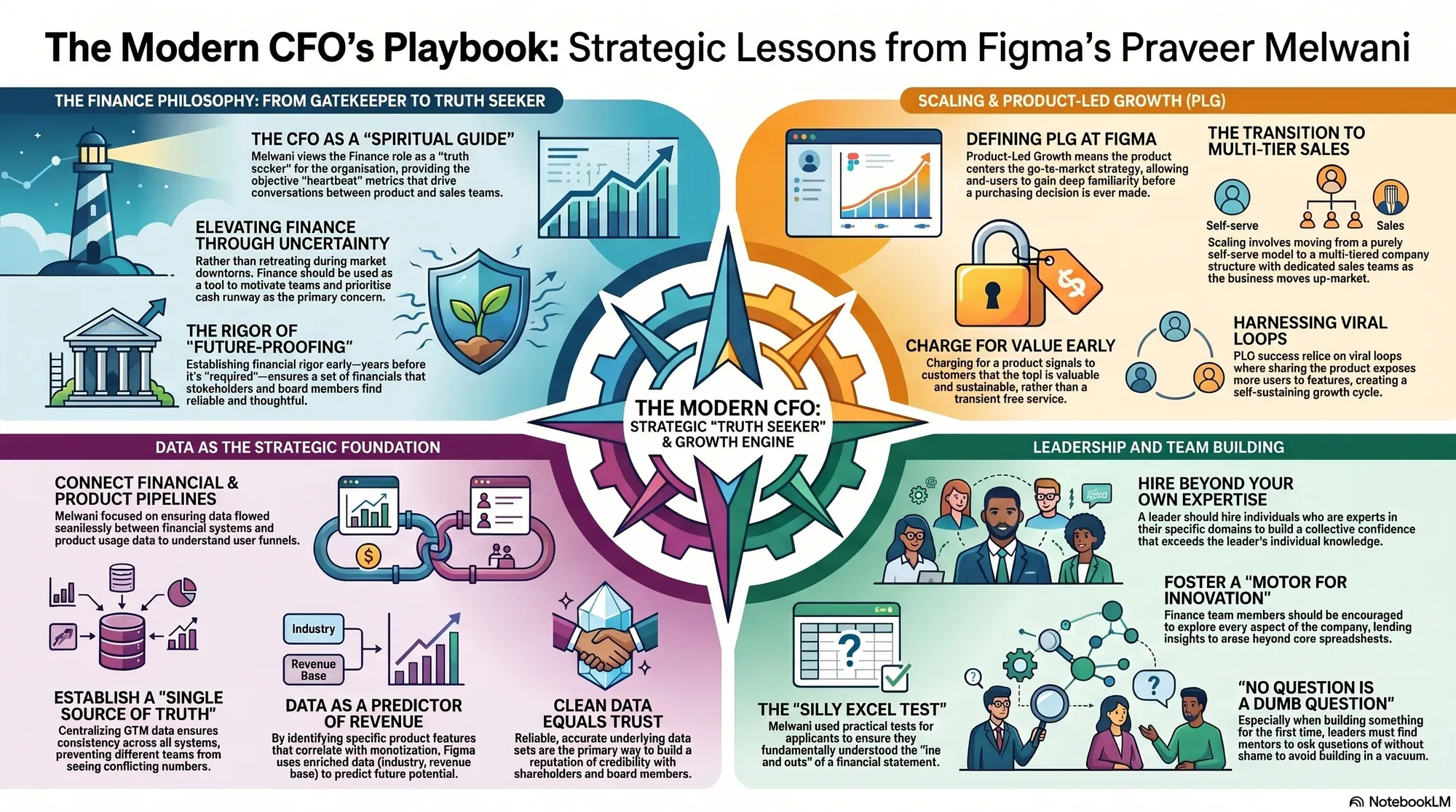
- On the CFO as a Truth Seeker: "I view the role of Finance as a truth seeker or spiritual guide for the organization." [1]
- On the Evolving Perception of Finance: "The role of Finance hasn't changed as much as people's understanding of its importance. All of a sudden, a lot more people want to know what EBITDA stands for." [1]
- On Driving Conversations with Data: "I pushed my org to always have a pulse on the core sets of drivers and metrics for what is actually the heartbeat of Figma and how can we use that to help drive conversations with the product or to go-to-market teams." [2]
- On Elevating Finance in Uncertainty: Melwani aims to "elevate the role of Finance under the guise of uncertainty, as a tool to motivate and drive his team." [1]
- On Providing Strategic Insights: "I found myself being able to provide insights and it actually informed some of the product decisions and the ways in which we structured our sales orgs." [2]
- On Cash Runway: "Cash runway should be the number one cause of concern for CFOs. It's crucial for leaders and teams to understand their key metrics, therefore, to ensure runway and be nimble and flexible." [1]
- On Finance as a Motor for Innovation: He created a culture where finance could be a "motor for innovation" and encouraged his team to explore every aspect of the company to lend insight. [2]
- On the Future of the CFO Role: The role is changing, especially in high-growth tech companies, requiring a deeper understanding of business drivers and metrics. [3]
- On Second- and Third-Order Finance: World-class finance leaders ask second- and third-order questions about the drivers behind the statements, turning finance into a strategic investment partner rather than a traffic cop. First Round: Figma’s CFO on Going Public, AI, and Working Alongside Dylan Field
- On More Product Bets After AI: When AI lowers development costs, use the new economics to place more product bets and use an active customer base as a rapid feedback loop. First Round: Figma’s CFO on Going Public, AI, and Working Alongside Dylan Field
- On Finance-Plus Professionals: Build finance-plus professionals who combine core domain expertise with data fluency, systems thinking, and product sense. Lumera: Betting on Yourself, Building From First Principles
- On Free Cash Flow per Share: Use durable free cash flow per share as the long-term value lens rather than optimizing isolated short-term operating metrics. Run the Numbers: Inside Figma’s Financial Playbook
Scaling, Product-Led Growth and Pricing
- On Charging for a Valuable Product: "Customers explained, 'The only way that we can continue to invest in Figma as a tool for our broader design team is to know that you guys are actually charging for it because that's how we can know this tool isn't going to go away.' And so, part of our story is: if you've got something, charge for it, because people will know that you see value in it." [2]
- On Defining Product-Led Growth: "Product-led growth to me is... your product is almost centering around your go-to-market strategy... for us, it's taking the form of having your end users having had a ton of familiarity with the tool prior to having to make a purchasing decision." [4]
- On PLG Viral Loops: "The more people that they're then sharing it with, you continue to get more features that they're getting exposed to, you end up with these viral loops that build off each other all again centered around your product." [4]
- On Harnessing Data for Upmarket Growth: A key to Figma's success has been not just collecting, but "actually harnessing their data to drive revenue growth, particularly as they moved up-market." [4]
- On Investing in Systems Early: "I wanted to be really thoughtful about investing in the systems early so that they can scale with you over time. I didn't want to penny-pinch there." [4]
- On Balancing Manual and Automated Processes: "You're going to have some manual processes early but you want to build automation into it so that it isn't a headache for you to manage if your business just kind of goes through the roof." [4]
- On Moving from Self-Serve to Sales: "Over the next couple of years, we then went from a one-tier company to having a couple of tiers. We went from purely self-serve to having a sales team." [2]
- On Expanding the Product Suite: "We started as a design tool but have since expanded to serve more parts of the software development process." [5]
- On Clean Data for Scaling: "Without consistent, clear data, you miss opportunities. If your conversion is lagging and you don't have a clear understanding of your sales and pipeline data, then you're not going to see the early indicators and know how to respond." [6]
- On AI and Product Development: "We believe AI has the potential to lift the ceiling for what's possible in design and product development, while lowering the floor to participate." [5]
- On AI Consumption Pricing: Before committing to AI consumption pricing, combine external market evidence, scenario-based financial analysis, and observed user behavior. First Round: Figma’s CFO on Going Public, AI, and Working Alongside Dylan Field
- On Outcome-Based Pricing: Do not force outcome-based pricing onto an iterative product until the customer outcome can be defined clearly enough to anchor the model. Run the Numbers: Inside Figma’s Financial Playbook
Leadership, Team Building and Executive Judgment
- On Hiring for Expertise: "I still would say that today, I'm by no means an expert, but I have tried to hire around myself so that I can feel confident in the collective expertise at Figma." [2]
- On Empowering the Finance Team: "Individuals were getting rewarded for it. They were seeing that the conversations that they were getting pulled into were really unique... The experiences that they were having at Figma were materially different than they had in other places because they were pushed to do more." [2]
- On Asking Questions Without Shame: "When someone asks me what they should do when they're new in a role, I always say: find that individual that you can ask questions to and not feel any shame. Honestly, no question is a dumb question, especially when you're trying to build something for the first time." [2]
- On the Value of a Professional Network: "Being able to just pick up the phone and learn from folks, whether it's an idea either for benchmarking or for the type of person to hire, I don't think I could have been able to do it without having folks in my corner." [2]
- On Hiring the Right People: This is a key piece of advice for CFOs fighting market downturns. [1]
- On Fostering Curiosity: "I've always had that desire and excitement to go and learn about an area that you may not necessarily need to know everything about for your core craft on the finance team." [2]
- On Testing Financial Fluency: He would give applicants a "silly Excel test" to see if they "understood the ins and outs of the financial statement." [2]
- On Building an Adaptable Finance Team: He built out a team that could "tackle any financial task that was thrown their way." [2]
- On Communicating Across Functions: This is a key aspect of the evolving CFO role. [3]
- On Over-Communicating: "It's best to over-communicate and do what it takes to be viewed as competent." [1]
- On Building Alignment from Their Seat: Analysis alone rarely persuades. Build alignment by understanding colleagues’ motivations, reasoning from their seat, and using that context to influence. First Round: Figma’s CFO on Going Public, AI, and Working Alongside Dylan Field
- On Reversible Decisions: Move quickly and experiment on reversible, two-way-door decisions. Reserve much greater care for choices that will be genuinely difficult to unwind. First Round: Figma’s CFO on Going Public, AI, and Working Alongside Dylan Field
- On Choosing the Right Altitude: Dive into details when they materially affect the broader framework. Demanding perfection on low-impact work wastes the team’s time. First Round: Figma’s CFO on Going Public, AI, and Working Alongside Dylan Field
- On First-Principles Leaders: Hire senior leaders who reason from first principles, live in the work, and put the team first rather than merely repeating a familiar playbook. First Round: Figma’s CFO on Going Public, AI, and Working Alongside Dylan Field
- On Generalists Before Specialists: Begin with adaptable finance generalists, then add specialist depth as transaction volume, geography, regulation, and technical accounting make the business more complex. Lumera: Betting on Yourself, Building From First Principles
Data, Systems and AI-Enabled Finance
- On Financial Data Pipelines: "I spent a lot of my energy making sure that the data pipelines were really flowing between our financial systems and what we were seeing on the product side." [2]
- On a Single Source of GTM Truth: This was a crucial step for Figma in operationalizing its data. [4]
- On Activating Dormant Data: "The data was there but the individuals and teams that were going and spending time going and looking at it did not really exist." [4]
- On Data Consistency: "You get consistency across systems and no one is seeing one number in one place and having it look differently in a different place." [4]
- On Assigning Data Ownership: "Structure a team that is owning those derived set of tables and has to go and then take ownership of what they look like." [4]
- On Clean Data Everywhere: "Data had to be clean everywhere." [4]
- On Understanding User Behavior: His early work focused on "how our users are navigating our funnel and what they're doing once they're actually on one of our paid plans." [2]
- On Predicting Monetization: Figma identified "a few very specific features that were unique to our business that were good predictors of future monetization potential." [4]
- On Enriching Data for Better Insight: "We enrich our enrich the domain to have an understanding of like where are they, what industry, what is their total employee size or Revenue base to help us understand what potential could look like." [4]
- On Trust Through Reliable Data: "I'm able to build a reputation of credibility and trust with the broader company and our shareholders with the confidence that our underlying data set and systems are clean and accurate." [6]
- On Auditable AI Work: Require AI-generated financial work to expose its reasoning and underlying data so people can audit assumptions rather than trust an opaque output. Lumera: How Praveer Runs Figma’s Finance Team
Public Company Readiness and Employee Stewardship
- On Financial Rigor from the Start: "We had aspirations of where we wanted to go. We felt that if things keep going, we're going to be in a position where we're going to have wanted to have the rigor a couple of years prior, so that we have a set of financials that folks feel are reliable and thoughtful." [2]
- On Board Transparency: "Regularly presenting your board with key health indicators is one of the ways to maintain transparency." [1]
- On Operating Public Before the IPO: Operate like a public company before an IPO is immediate by building the people, processes, planning discipline, and rehearsal cadence years in advance. Ramp: Figma CFO Shares His IPO Playbook
- On Employee Liquidity Support: Treat an IPO as a life event for employees by giving them access to tax, legal, and wealth-planning expertise before liquidity arrives. Ramp: Figma CFO Shares His IPO Playbook
Career and Personal Growth
- On Structured Thinking: "I view my capabilities as someone who can come in as a structured thinker and help someone frame a problem in a thoughtful way." [2]
- On Building a Broader Footprint: "I get excited about learning and I get excited about having a much broader footprint than just like the core spreadsheet and operating model." [2]
- On Learning from Mistakes: "Mistakes are inevitable. Be upfront about them but make sure you use them as learning opportunities to get to know the business really well." [1]
- On the Role of Luck: "It was just a little bit of luck and good fortune." [2]
- On Life’s Timing: "It's funny how timing works out. My wife's due date was the same day we were scheduled to announce [the Adobe acquisition]." [2]
- On Figma After the IPO: "The fundamental business direction of Figma will be maintained, and we will continue to consider small-scale talent acquisitions." [8]
- On Candor in Unfamiliar Scope: Be candid about what you know and do not know, surround yourself with advocates who cover your gaps, and remain a constant learner when growing into unfamiliar executive scope. First Round: Figma’s CFO on Going Public, AI, and Working Alongside Dylan Field
- On Vulnerability Under Pressure: Transparency about uncertainty earns trust under pressure when it is paired with trusted experts, attentive listening, and visible learning. Ramp: Figma CFO Shares His IPO Playbook
Learn more:
- Praveer Melwani - CFO at Figma - The Org
- Figma's Praveer Melwani on Dropbox, Scaling & the Adobe Sale | Neo.Tax
- Praveer Melwani from Figma–The Hard Part with Evan McCann - Apple Podcasts
- Live Q&A How Figma operationalizes data across its $20B PLG business - YouTube
- How a disparate trio of business leaders are unlocking gateways to growth - Fast Company
- How Figma's finance team uses Stripe for its $10B business
- Governance - Executive Management | Figma, Inc.
- Figma IPO windfall: VCs net billions, who bagged how much? - The Economic Times
- First Round: Figma’s CFO on Going Public, AI, and Working Alongside Dylan Field
- Ramp: Figma CFO Shares His IPO Playbook
- Lumera: How Praveer Runs Figma’s Finance Team
- Lumera: Betting on Yourself, Building From First Principles
- Run the Numbers: Inside Figma’s Financial Playbook