Robert Greene is an author known for examining power, strategy, mastery, seduction, and human behavior through history and psychology. His books are _The 48 Laws of Power_, _The Art of Seduction_, _The 33 Strategies of War_, _The 50th Law_, _Mastery_, _The Laws of Human Nature_, and _The Daily Laws_. This collection distills his practical ideas about influence, purpose, self-command, relationships, and the search for meaning.
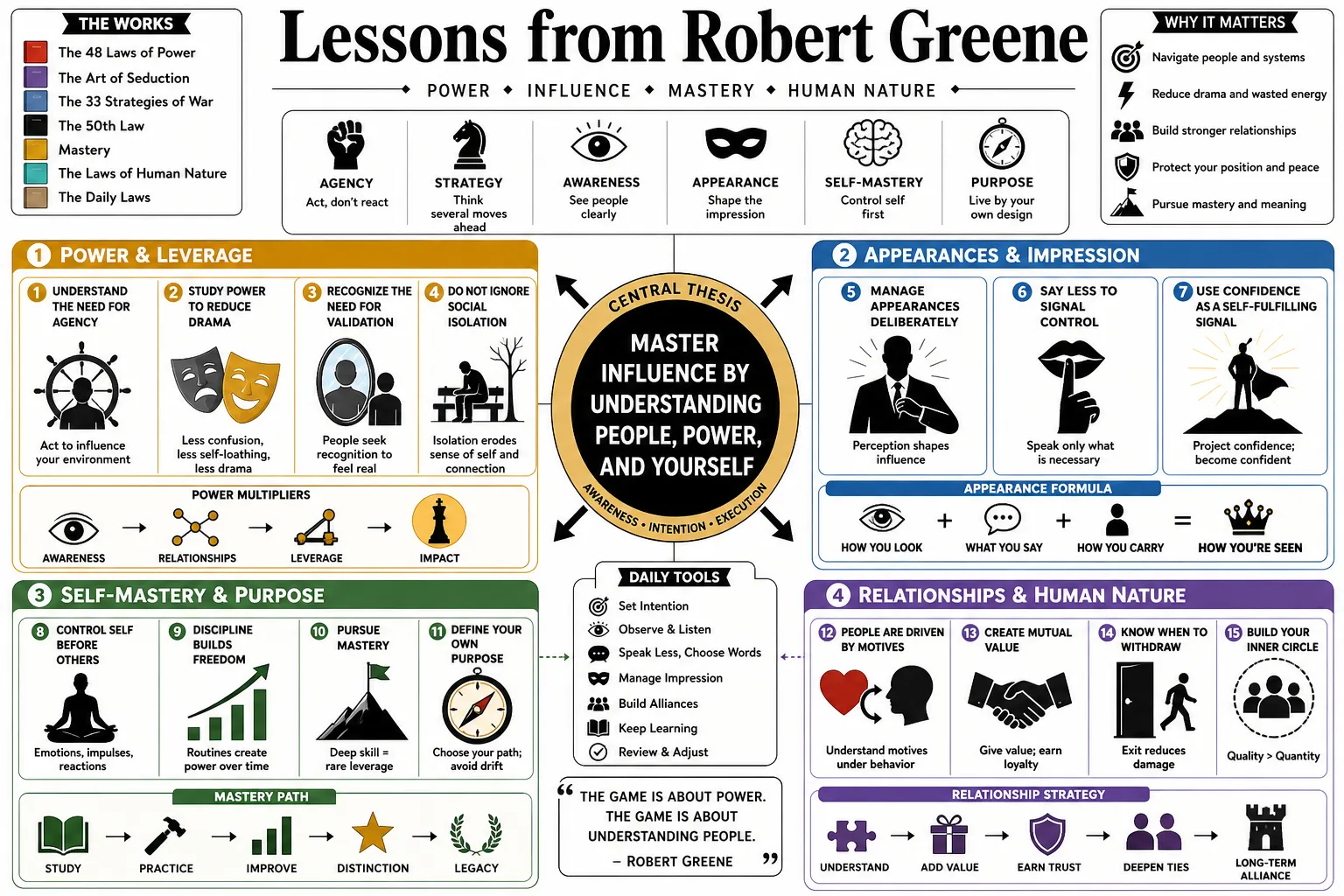
Power, Leverage, and Appearances
- On Understand the Need for Agency: A persistent sense of having no influence over one's environment or relationships produces deep misery and reactive behavior. — Reference: Triggernometry — Robert Greene Interview Transcript
- On Study Power to Reduce Drama: Understanding influence can save energy otherwise lost to self-loathing, confusion, and recurring interpersonal drama. — Reference: Triggernometry — Robert Greene Interview Transcript
- On Recognize the Need for Validation: Recognition and validation are powerful human motives because people build their sense of self through social reflection. — Reference: Triggernometry — Robert Greene Interview Transcript
- On Do Not Ignore Social Isolation: Extended isolation can destabilize a person's sense of being seen and connected as a human being. — Reference: Triggernometry — Robert Greene Interview Transcript
- On Manage Appearances Deliberately: Power depends partly on how others perceive confidence and control, not only on private feelings of strength. — Reference: Triggernometry — Robert Greene Interview Transcript
- On Say Less to Signal Control: Speaking beyond what is necessary can weaken the impression of self-command and increase the chance of an avoidable mistake. — Reference: Triggernometry — Robert Greene Interview Transcript
- On Use Confidence as a Self-Fulfilling Signal: Projected confidence can attract attention and resources because observers often assume it rests on real capability. — Reference: Triggernometry — Robert Greene Interview Transcript
- On Know Your Real Leverage: Before negotiating, distinguish image from the concrete resources, alternatives, or commitments that actually create bargaining power. — Reference: Triggernometry — Robert Greene Interview Transcript
- On Preserve the Ability to Walk Away: A credible willingness to leave a deal establishes a boundary and can shift the balance of a negotiation. — Reference: Triggernometry — Robert Greene Interview Transcript
- On Find the Power You Still Have: Even in an unequal situation, step back and identify the small action or leverage point that remains available. — Reference: Triggernometry — Robert Greene Interview Transcript
- On Clarify the End Goal: Effective negotiation requires a clear view of who holds power, what leverage exists, and what outcome actually matters. — Reference: Triggernometry — Robert Greene Interview Transcript
Human Nature in the Social Media Age
- On Expect Tools to Amplify Human Nature: New platforms do not replace ancient motives; they intensify envy, irrationality, self-absorption, and other existing tendencies. — Reference: Triggernometry — Robert Greene Interview Transcript
- On See Curation as an Envy Machine: Curated displays of other people's best moments can manufacture envy by hiding the ordinary and difficult parts of life. — Reference: Triggernometry — Robert Greene Interview Transcript
- On Distinguish a Facade from Character: An online persona can be carefully manufactured because observers cannot directly inspect the character behind the presentation. — Reference: Triggernometry — Robert Greene Interview Transcript
- On Value Nonverbal Information: In-person contact reveals energy and nonverbal cues that are largely absent from an invisible online environment. — Reference: Triggernometry — Robert Greene Interview Transcript
- On Resist Simplified Either-Or Thinking: A media environment built around fast reactions erodes nuance and encourages people to reduce complex questions to two opposing answers. — Reference: Triggernometry — Robert Greene Interview Transcript
- On Guard Attention from Triviality: Constant attention to banal updates narrows the mind and crowds out questions beyond the immediate social circle. — Reference: Triggernometry — Robert Greene Interview Transcript
Purpose, Mastery, and Craft
- On Study Childhood Interests: Early fascinations and emotionally engaging activities can provide clues to a person's distinctive life direction. — Reference: Huberman Lab — Finding and Achieving Your Unique Purpose
- On Learn from Attraction and Aversion: Both energizing and frustrating experiences reveal information about the kind of work that fits or repels a person. — Reference: Huberman Lab — Finding and Achieving Your Unique Purpose
- On Look Beneath the Surface: A mastery mindset keeps asking what is happening underneath visible behavior instead of accepting the first explanation. — Reference: Finding Mastery — Robert Greene on Mastery and Research
- On Connect the Life Task to Mastery: Long-term mastery becomes more sustainable when the craft is connected to a personally meaningful life task. — Reference: Finding Mastery — Robert Greene on Mastery and Research
- On Let Craft Reveal the Self: A serious craft is not only a productive skill; it becomes a method for discovering one's own character and inclinations. — Reference: Finding Mastery — Robert Greene on Mastery and Research
- On Pivot When the First Dream Fails: Commitment to purpose does not require clinging to the first form it takes; a failed initial path can point toward a better expression. — Reference: Finding Mastery — Robert Greene on Mastery and Research
- On Build Toward Intuitive Fluency: The endpoint of mastery is an intuitive feel for the work that reduces the need for conscious calculation. — Reference: Finding Mastery — Robert Greene on Mastery and Research
- On Choose Mentors and Models Deliberately: Role models and mentors should be selected for how well they illuminate the purpose and capabilities one is trying to develop. — Reference: Huberman Lab — Finding and Achieving Your Unique Purpose
- On Use Anxiety as Creative Material: Anxiety can be examined and redirected into active thinking and creative work instead of treated only as an obstacle. — Reference: Huberman Lab — Finding and Achieving Your Unique Purpose
Meaning, Scale, and the Sublime
- On Protect Long-Term Thinking: Quarterly performance pressure can make an organization incapable of looking far enough ahead to adapt its brand or strategy. — Reference: Triggernometry — Robert Greene Interview Transcript
- On Know When Growth Dilutes Meaning: Expansion can destroy the identity that made a company valuable when scale outruns the coherence of its brand and mission. — Reference: Triggernometry — Robert Greene Interview Transcript
- On Acknowledge the Hunger for Something Larger: Human beings retain a spiritual need to connect with something beyond ego, money, and mere survival. — Reference: Triggernometry — Robert Greene Interview Transcript
- On Do Not Reduce Life to Data: A worldview limited to rationality, data, algorithms, and programs neglects needs that remain part of human nature. — Reference: Triggernometry — Robert Greene Interview Transcript
- On Use Mortality to Clarify Priorities: An encounter with death can strip away trivial concerns and force attention toward what genuinely matters. — Reference: Triggernometry — Robert Greene Interview Transcript
- On Seek Experiences Beyond Convention: The sublime begins outside the familiar circle of social conventions and expands the range of what the mind can perceive. — Reference: Triggernometry — Robert Greene Interview Transcript
- On Let Science Expand Awe: Questions about consciousness, life, and the universe can widen the mind and recover a sense of awe without abandoning rigorous thought. — Reference: Triggernometry — Robert Greene Interview Transcript
Adversity and Urgency
- On Convert Constraint into a New Process: When illness removed the ability to type, Greene rebuilt his writing process around repeated handwritten drafts and dictation. — Reference: Triggernometry — Robert Greene Interview Transcript
- On Persist Without the Old Escape Routes: Creative endurance may require continuing even when physical limits remove the routines once used to clear the mind. — Reference: Triggernometry — Robert Greene Interview Transcript
- On Measure Success by What Was Overcome: The deepest pride in a project can come from overcoming its obstacles, independent of how well it eventually sells. — Reference: Triggernometry — Robert Greene Interview Transcript
- On Use Death Ground to Create Urgency: A vivid sense of limited time can generate urgency, appreciation, and focused action that ordinary comfort does not. — Reference: Huberman Lab — Finding and Achieving Your Unique Purpose