On the open road of philosophical inquiry, Robert M. Pirsig’s "Zen and the Art of Motorcycle Maintenance" and "Lila: An Inquiry into Morals" have served as guideposts for generations of readers. His exploration of "Quality," the intersection of reason and romanticism, and the art of mindful living continues to resonate.
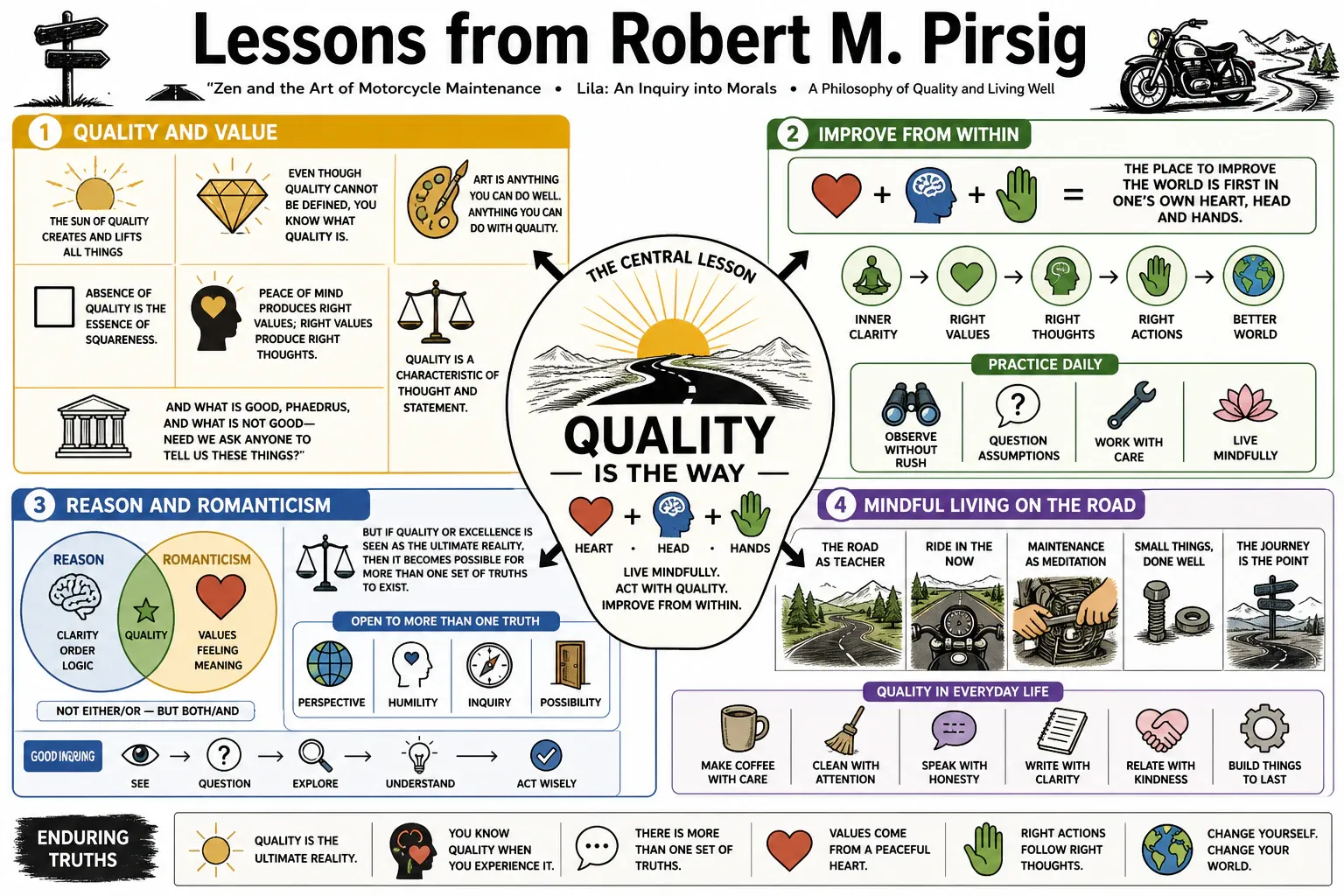
On Quality and Value
- "The place to improve the world is first in one's own heart and head and hands."[1][2][3]
- "Even though quality cannot be defined, you know what quality is."[4]
- "Art is anything you can do well. Anything you can do with quality."[1]
- "Peace of mind produces right values, right values produce right thoughts."[5]
- "Absence of Quality is the essence of squareness."[6]
- "And what is good, Phaedrus, And what is not good— Need we ask anyone to tell us these things?"[1][4][6]
- "But if Quality or excellence is seen as the ultimate reality then it becomes possible for more than one set of truths to exist."[7]
- "Quality is a characteristic of thought and statement that is recognized by a nonthinking process."[8]
- "The sun of quality does not revolve around the subjects and objects of our existence. It is not just passively illuminate them. It is not subordinate to them in any way. It has created them."[9]
- "My personal feeling is that this is how any further improvement of the world will be done: by individuals making quality decisions and that's all."[10]
On Technology and Modern Life
- "In a car you're always in a compartment, and because you're used to it you don't realize that through that car window everything you see is just more TV. You're a passive observer and it is all moving by you boringly in a frame. On a cycle the frame is gone. You're completely in contact with it all. You're in the scene, not just watching it anymore, and the sense of presence is overwhelming."[2][3][5]
- "This divorce of art from technology is completely unnatural. It's just that it's gone on so long you have to be an archaeologist to find out where the two separated."[2]
- "The real evil isn't the objects of technology but the tendency of technology to isolate people into lonely attitudes of objectivity."[4]
- "The Buddha, the godhead, resides quite as comfortably in the circuits of a digital computer or the gears of a cycle transmission as he does at the top of a mountain or in the petals of a flower."[9]
- "The true system, the real system, is our present construction of systematic thought itself, rationality itself, and if a factory is torn down but the rationality which produced it is left standing, then that rationality will simply produce another factory."[5]
On the Journey of Life
- "To live only for some future goal is shallow. It's the sides of the mountain that sustain life, not the top."[1][3][6]
- "The only Zen you can find on the tops of mountains is the Zen you bring up there."[3][4][6]
- "Mountains should be climbed with as little effort as possible and without desire. The reality of your own nature should determine the speed."[1][2]
- "Sometimes it's a little better to travel than to arrive."[11]
- "You look at where you're going and where you are and it never makes sense, but then you look back at where you've been and a pattern seems to emerge."[5][11]
- "We want to make good time, but for us now this is measured with the emphasis on ‘good’ rather than on ‘time’…"[4][6]
- "Plans are deliberately indefinite, more to travel than to arrive anywhere."[9]
On Truth and Understanding
- "The truth knocks on the door and you say, 'Go away, I'm looking for the truth,' and so it goes away. Puzzling."[2][3][5][11][12]
- "For every fact there is an infinity of hypotheses."[3][4][6]
- "When analytic thought, the knife, is applied to experience, something is always killed in the process."[6]
- "To define something is to subordinate it to a tangle of intellectual relationships. And when you do that you destroy real understanding."[7]
- "Familiarity can blind you too."[6]
- "Follow these little discrepancies long enough and they sometimes open up into huge revelations."[9]
On the Self and the Mind
- "The real cycle you're working on is a cycle called yourself."[6][8]
- "When one person suffers from a delusion, it is called insanity. When many people suffer from a delusion it is called a Religion."[3][5]
- "Stuckness shouldn't be avoided. It's the psychic predecessor of all real understanding."[4]
- "If your mind is truly, profoundly stuck, then you may be much better off than when it was loaded with ideas."[2]
- "You want to know how to paint a perfect painting? It's easy. Make yourself perfect and then just paint naturally."[4][8]
- "Boredom always precedes a period of great creativity."[4]
- "The past exists only in our memories, the future only in our plans. The present is our only reality."[1][4]
- "We take a handful of sand from the endless landscape of awareness around us and call that handful of sand the world."[3][4][6]
On Attitude and Approach
- "Is it hard?' Not if you have the right attitudes. Its having the right attitudes thats hard."[1][3][5][11]
- "When you want to hurry something, that means you no longer care about it and want to get on to other things."[1][9]
- "Anxiety, the next gumption trap, is sort of the opposite of ego. You're so sure you'll do everything wrong you're afraid to do anything at all."[2]
- "Gumption is the psychic gasoline that keeps the whole thing going."[2]
- "The ultimate test's always your own serenity."[4]
- "It's so hard when contemplated in advance, and so easy when you do it."[1][4]
On Society and Sanity
- "A person isn't considered insane if there are a number of people who believe the same way. Insanity isn't supposed to be a communicable disease. If one other person starts to believe him, or maybe two or three, then it's a religion."[1]
- "Sanity is not truth. Sanity is conformity to what is socially expected."[7]
- "Civilization, or 'the system' or 'society' or whatever you want to call it, is best served not by mules but by free men."[1]
- "Laws of nature are human inventions, like ghosts."[2][3]
On Learning and Knowledge
- "The best students always are flunking. Every good teacher knows that."[1]
- "The more you read, the more you calm down."[4][6]
- "every answer one finds leads to ten more questions. The more we learn the less we know."[1]
- "You are never dedicated to do something you have complete confidence in."[1][3]
Key Learnings from Robert M. Pirsig
- The Metaphysics of Quality: Pirsig's central philosophical concept is that "Quality" (or "value") is a fundamental force in the universe, preceding and shaping both subjects and objects. It is an indefinable yet recognizable characteristic of excellence and rightness.
- The Integration of the Classical and the Romantic: Pirsig argues for a reconciliation of the "classical" worldview (reason, logic, and technology) and the "romantic" worldview (emotion, intuition, and art). He believed that a fulfilling life involves embracing both perspectives.
- Mindful Engagement with Technology: Rather than rejecting technology, Pirsig advocated for a deeper, more mindful engagement with it. Understanding and caring for a machine, like a motorcycle, can be a path to inner peace and a deeper understanding of oneself.
- The Importance of "Gumption": Pirsig coined the term "gumption" to describe the vital, enthusiastic energy needed to overcome obstacles and see a task through. He identified various "gumption traps" (both internal and external) that can deplete this essential quality.
- The Journey Over the Destination: Pirsig emphasized that the process of life, the "sides of the mountain," is more important than reaching any particular goal or "the top." True fulfillment is found in the present moment and the journey itself.
- Inner Change as the Catalyst for Outer Change: Pirsig believed that any meaningful improvement to the world must begin within the individual. By cultivating one's own sense of Quality and right values, one can then extend that positive influence outward.
The sources for these quotes and learnings are primarily Pirsig's two major works:
- Zen and the Art of Motorcycle Maintenance: An Inquiry into Values
- Lila: An Inquiry into Morals
Sources
- Zen and the Art of Motorcycle Maintenance (1974 Text Edition)
- Zen and the Art of Motorcycle Maintenance (William Morrow Edition)
- Robert Pirsig Association Primary Resources & Bibliography
- Robert Pirsig 1974 NPR Interview with Connie Goldman
- Robert Pirsig 1974 Minneapolis College of Art and Design Lecture
- Robert Pirsig Association Papers & Historical Archives
- The Life and Work of Robert Pirsig: An Introduction
- Robert Pirsig Association Online Research Directory
- Lila: An Inquiry into Morals (1991 First Edition)
- Robert Pirsig Association Conversations & Inquiries into Quality
- Robert Pirsig Association Comprehensive Resource Index
- Lila: An Inquiry into Morals (Bantam Books Edition)