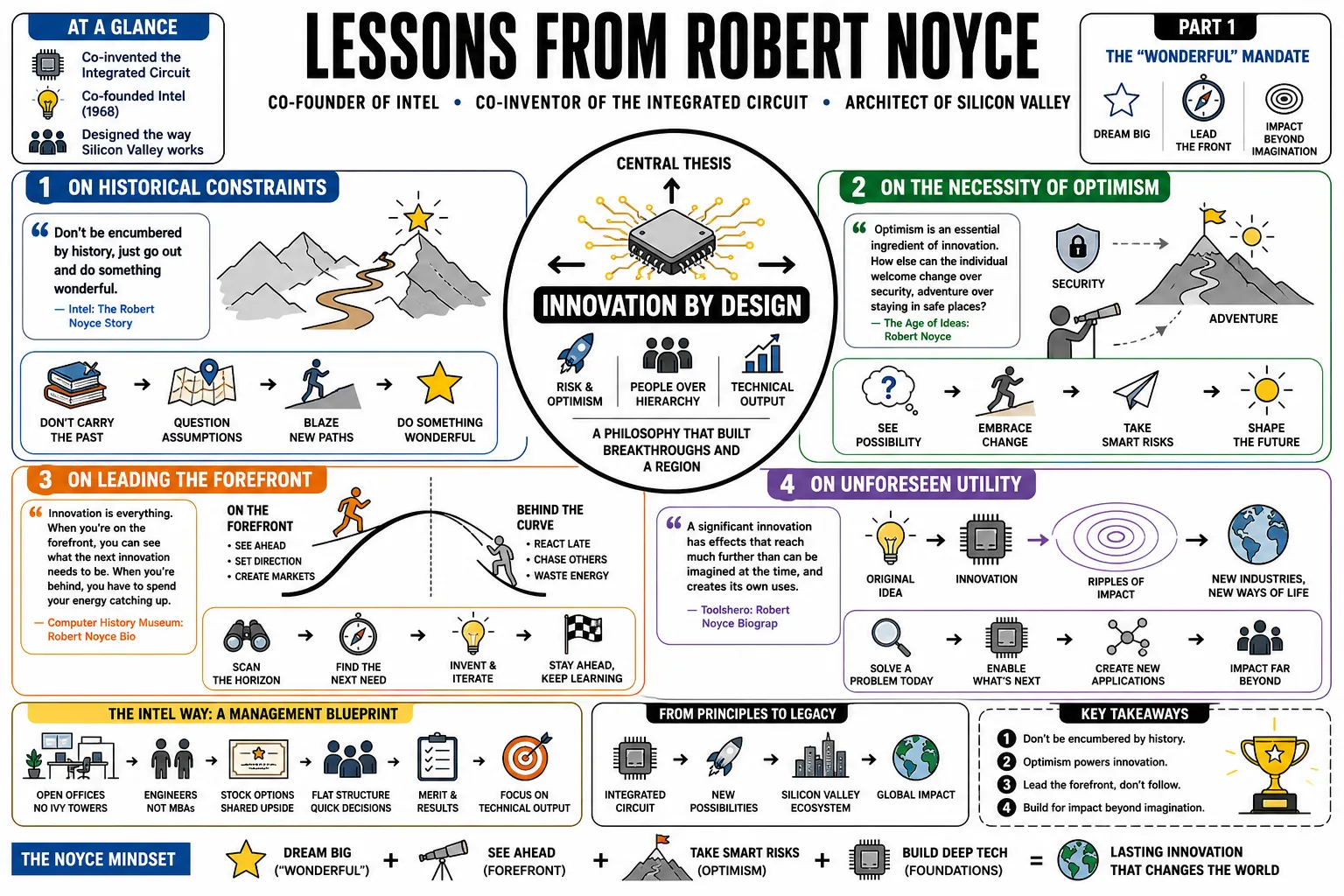
Lessons from Robert Noyce
Robert Noyce co-founded Intel and co-invented the integrated circuit, but he also designed the way Silicon Valley works. He traded corporate ladders for open offices and stock options, setting a management blueprint that prioritized technical output over rank. This profile examines the philosophy of risk and innovation that made it possible.
Part 1: The "Wonderful" Mandate
- On Historical Constraints: "Don't be encumbered by history, just go out and do something wonderful." — Source: Intel: The Robert Noyce Story
- On the Necessity of Optimism: "Optimism is an essential ingredient of innovation. How else can the individual welcome change over security, adventure over staying in safe places?" — Source: Leslie Berlin: The Man Behind the Microchip
- On Leading the Forefront: "Innovation is everything. When you're on the forefront, you can see what the next innovation needs to be. When you're behind, you have to spend your energy catching up." — Source: Computer History Museum: Silicon Engine
- On Unforeseen Utility: "A significant innovation has effects that reach much further than can be imagined at the time, and creates its own uses." — Source: Leslie Berlin: The Man Behind the Microchip
- On the Tyranny of Numbers: "Putting those 20,000 wires on those 10,000 chips of silicon seemed like it was the hard way to me." — Source: Computer History Museum: Silicon Engine
- On Creative Destruction: "If you really want to innovate, you have to be willing to throw away some of your best ideas." — Source: Leslie Berlin: The Man Behind the Microchip
- On Forward Momentum: "What you leave behind is not usually worth looking over your shoulder for." — Source: Leslie Berlin: The Man Behind the Microchip
- On the Nature of Risk: "There is risk in entrepreneurship, but it is usually a calculated risk." — Source: Leslie Berlin: The Man Behind the Microchip
- On Knowledge Multiplication: "Knowledge is power. Knowledge shared is power multiplied." — Source: Leslie Berlin: The Man Behind the Microchip
- On Future Ubiquity: "Computing power will eventually become a biological dimension in its ubiquity, effectively becoming part of our sensory systems." — Source: Computer History Museum: Silicon Engine
Part 2: The Architecture of Culture
- On Management's Role: "The job of the manager is an enabling, not a directive job." — Source: Leslie Berlin: The Man Behind the Microchip
- On Knowledge Power: "Position power is not as important as knowledge power." — Source: Intel: Corporate Culture History
- On Shared Incentives: "People needed to live for research breakthroughs rather than short-term profits, which required giving them a real stake in the outcome." — Source: The Silicon Valley Edge (Stanford University Press)
- On Rejecting Hierarchy: "I didn't want any employee to look at the structure of the company and see a complex set of hurdles." — Source: Esquire: The Tinkerings of Robert Noyce by Tom Wolfe
- On Physical Openness: "The lack of doors and reserved parking spaces was designed to ensure that the best idea won, regardless of who it came from." — Source: Wikipedia: Robert Noyce Profile
- On Management by Consensus: "People given enough freedom will usually choose to do the right thing." — Source: Esquire: The Tinkerings of Robert Noyce
- On Corporate Character: "A company is just a collection of people. If the individuals are of high character, the company will be as well." — Source: Intel: Robert Noyce and the Intel Culture
- On Executive Perks: "The corporate jet and the executive dining room are signs of a company that has lost its way and stopped listening to its engineers." — Source: Stanford Libraries: Robert Noyce Papers
- On the 'No Doors' Policy: "Working in a cubicle just like everyone else prevents the isolation that kills innovation." — Source: Computer History Museum: Silicon Engine
Part 3: The Entrepreneurial Spirit
- On the Economic Hero: "Look around who the heroes are. They aren't lawyers, nor are they even so much the financiers. They're the guys who start companies." — Source: The New York Times: Robert Noyce Obituary
- On Audacious Planning: "From the beginning at Intel, we planned on being big." — Source: Intel: Foundation and Growth Archives
- On Choosing the Stream: "Start with a growing market. Swim in a stream that becomes a river and ultimately an ocean." — Source: Leslie Berlin: The Man Behind the Microchip
- On Defection Capital: "The ability for talent to leave and start something new is the primary engine of progress in our industry." — Source: Esquire: The Tinkerings of Robert Noyce
- On Small Town Self-Reliance: "In a small town, when something breaks down, you don't wait around for a new part... You make it yourself." — Source: Tom Wolfe: The Tinkerings of Robert Noyce
- On Capitalizing Talent: "The primary asset of a high-tech company goes home every night in the shoes of its employees." — Source: Computer History Museum: Silicon Engine
- On the Startup Vehicle: "The startup is the most efficient machine ever devised for turning an idea into a product." — Source: Stanford Libraries: Robert Noyce Papers
- On the Traitorous Eight Mentality: "Leaving a secure position to pursue a better way is not betrayal; it is the fundamental duty of the engineer." — Source: Leslie Berlin: The Man Behind the Microchip
- On Calculated Risks: "Experimentation in the lab is just a way to fail faster so you can succeed sooner." — Source: Intel: 50 Years of Innovation
- On Market Leadership: "Be a leader in your market, not a follower, and constantly build the best products possible." — Source: Leslie Berlin: The Man Behind the Microchip
Part 4: Engineering and Problem Solving
- On Concept Visualization: "If I hit a wall, I'd back up and then find a path, conceptually, all the way through to the end." — Source: Leslie Berlin: The Man Behind the Microchip
- On the Mental Map: "Once you get to the point that you can see the top of the mountain, then you know you can get there." — Source: Intel: Robert Noyce Quotes
- On Design Efficiency: "If you have n transistors, we have improved the design efficiency by n factorial through the integrated circuit." — Source: Computer History Museum: Silicon Engine
- On Eliminating Complexity: "The goal of the integrated circuit was to eliminate the labor-intensive process of hand-wiring individual components." — Source: Computer History Museum: Who Invented the IC?
- On the Planar Process: "Merging the transistor with the protective oxide layer allowed us to stop making individual components and start making systems." — Source: Computer History Museum: Silicon Engine
- On Tinkering Habits: "Most of my best work happened when I was just playing around with how things might fit together differently." — Source: Esquire: The Tinkerings of Robert Noyce
- On Technical Intuition: "You have to have a feel for the material before you can tell it what to do." — Source: Leslie Berlin: The Man Behind the Microchip
- On the Microprocessor Impact: "The microprocessor turned the computer from a destination into a tool that could be embedded in everything." — Source: Intel: Evolution of the Microprocessor
- On Solving the 'Hard Way': "I was motivated by the fact that the way we were doing things was clearly the wrong way and too difficult to sustain." — Source: Computer History Museum: Who Invented the IC?
Part 5: Mentorship and Legacy
- On the Duty to Mentorship: "I feel like I’m restocking the stream I’ve fished from." — Source: Leslie Berlin: The Man Behind the Microchip
- On Visionary Persistence: "If a product is truly revolutionary, don't worry about the price; people will find a way to pay for it." — Source: Steve Jobs: The Lost Interview (Referring to Noyce)
- On the Lay of the Land: "I wanted to give the younger guys a historical perspective so they didn't waste time reinventing the wheel." — Source: Computer History Museum: Silicon Engine
- On Preparing the Next Generation: "We must make sure we are preparing our next generation to flourish in a high-tech age, from the poorest to the graduate level." — Source: Wikipedia: Robert Noyce Final Interview
- On the Engineering Conscience: "Engineers have a responsibility to shape a society where technology enhances rather than detracts from human life." — Source: Intel Museum: Robert Noyce
- On the Mayor of Silicon Valley: "My role is to be the interface between the technical world and the rest of society." — Source: Intel: The Legacy of Robert Noyce
- On Shared Success: "Giving stock options to everyone ensures that when the company wins, the community wins." — Source: Leslie Berlin: The Man Behind the Microchip
- On Second Chances: "A failure in college or early in your career should be a learning experience, not a life sentence." — Source: Computer History Museum: Silicon Engine
- On the Pied Piper Effect: "A leader's job is to make the vision so compelling that everyone wants to follow of their own accord." — Source: Leslie Berlin: The Man Behind the Microchip
Part 6: Silicon Valley and Ecosystems
- On the Region's Ethos: "Silicon Valley is not a place, it’s a state of mind focused on the future." — Source: Intel: Silicon Valley History
- On Collaborative Statesmanship: "In a global market, the enemy isn't your domestic competitor; it's the loss of the entire industry's edge." — Source: SEMATECH: Founding Vision Statement
- On Industry Collaboration: "SEMATECH is a model for how government and industry can work together to maintain a competitive advantage." — Source: New York Times: Noyce at Sematech
- On the Ecosystem Stream: "Swim in a stream that becomes a river; the growth of the surrounding companies is what carries you forward." — Source: Leslie Berlin: The Man Behind the Microchip
- On First-Name Culture: "Breaking down formal titles allows information to flow at the speed of the technology itself." — Source: The Silicon Valley Edge (Stanford University Press)
- On the Dissenting Protestant Roots: "Each person should be their own priest, communicating directly with the problem rather than through a hierarchy." — Source: Tom Wolfe: The Tinkerings of Robert Noyce
- On Regional Competition: "Competition between local companies is what keeps the entire valley sharp enough to compete globally." — Source: Computer History Museum: Silicon Engine
- On Knowledge Spillover: "When an engineer leaves one company for another, they take a way of thinking that benefits the whole ecosystem." — Source: Leslie Berlin: The Man Behind the Microchip
- On Creating Uses: "We don't just build components; we build the infrastructure upon which the rest of the world builds their dreams." — Source: Intel: 1980 Annual Report
Part 7: Strategy and Market Leadership
- On Pricing the Future: "Lowering the price of the IC to $1.00 before we could afford it was the only way to create the market volume we needed." — Source: Computer History Museum: Silicon Engine
- On Market Timing: "The time to enter a market is when you can see it is just about to explode, not after it has already done so." — Source: Intel: Strategy Archives
- On Building to Win: "If you're going to play, play it to win." — Source: Leslie Berlin: The Man Behind the Microchip
- On Scaling Ambition: "Don't build for the company you are today; build for the company you intend to be in five years." — Source: Intel: The Intel Trinity
- On First-Mover Advantage: "When you are first, you define the rules. When you are second, you follow them." — Source: Computer History Museum: Silicon Engine
- On the 'Butterfly' Mind: "You have to be able to jump from one technical thought to another without getting bogged down in the minutiae." — Source: Computer History Museum: Silicon Engine
- On Manufacturing Excellence: "Innovation without the ability to manufacture at scale is just an expensive hobby." — Source: SEMATECH: Final Speeches of Robert Noyce
- On Competitive Drive: "Winning by less than the maximum spread possible is still a missed opportunity." — Source: Esquire: The Tinkerings of Robert Noyce
- On the Intel Trinity: "Gordon Moore provides the technology, Andy Grove provides the discipline, and I provide the vision." — Source: Leslie Berlin: The Man Behind the Microchip
Part 8: Personal Philosophy and Values
- On the Essential Ingredient: "Optimism is a functional requirement for a high-tech business." — Source: Leslie Berlin: The Man Behind the Microchip
- On Character at Scale: "A large organization is just a magnification of the values of its founders." — Source: Intel: Corporate Values Documents
- On Adventure Over Security: "I would always choose adventure over staying in a safe place." — Source: Leslie Berlin: The Man Behind the Microchip
- On the Responsibility of Wealth: "Wealth is just a tool to be reinvested into the next wonderful thing." — Source: Leslie Berlin: The Man Behind the Microchip
- On the 'Tinkerer' Label: "I am first and foremost a tinkerer who happened to find a very big problem to solve." — Source: Tom Wolfe: Esquire Profile
- On Pushing for More: "When someone shows me a success, my first question is always: 'That's all you've got?'" — Source: Leslie Berlin: The Man Behind the Microchip
- On Integrity in All Things: "Ethical behavior in all dealings, within the company and between companies, is the only way to build lasting trust." — Source: Esquire: The Tinkerings of Robert Noyce
- On Remote Work (1981): "There is no reason why people will not eventually live where it is conducive to live, rather than where it is conducive to work." — Source: Tomorrow/Today: 1981 Interview (KTEH/PBS)
- On the Final Goal: "The goal is not to be the richest man in the cemetery, but to have done something that changed the world for the better." — Source: Stanford Libraries: Robert Noyce Papers