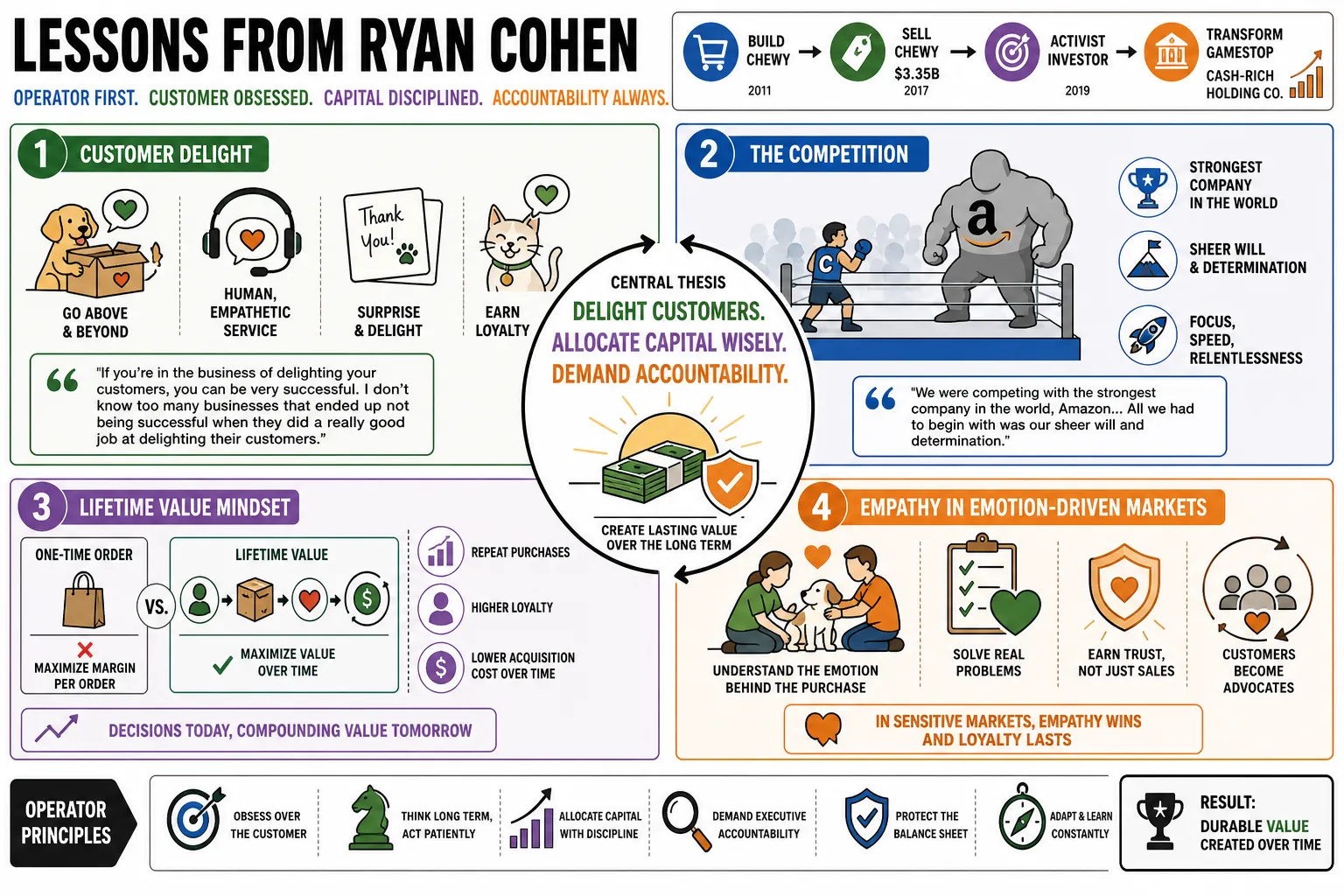
Ryan Cohen co-founded Chewy, sold it for $3.35 billion, and then transformed from an e-commerce operator into an activist investor. He is best known for acquiring a massive stake in GameStop, ousting its legacy board, and turning the struggling retailer into a cash-rich holding company. This profile documents his philosophy on customer service, capital allocation, and executive accountability.
Part 1: The Chewy Era and Customer Obsession
- On Customer Delight: "If you’re in the business of delighting your customers, you can be very successful. I don’t know too many businesses that ended up not being successful when they did a really good job at delighting their customers." — Source: [Inc. Magazine]
- On The Competition: "We were competing with the strongest company in the world, Amazon... All we had to begin with was our sheer will and determination." — Source: [GMEdd Interview]
- On Lifetime Value: Cohen built Chewy by optimizing for the long-term lifetime value of a customer rather than attempting to maximize the profit margin on a single order. — Source: [Forbes]
- On Empathy: He believed that in sensitive, emotion-driven markets like pet care, customers ultimately make their buying decisions based on which company demonstrates that they care the most. — Source: [Marketing Examples]
- On Surprise: Chewy employed hundreds of staff members specifically to write millions of personalized holiday and welcome cards to customers by hand. — Source: [Medium]
- On Emotional Connections: The company commissioned artists to paint custom oil portraits of customers' pets, which were then mailed to them as unprompted surprises. — Source: [Marketing Examples]
- On Grief: If a customer mentioned to a representative that their pet had passed away, Chewy's standard protocol was to send a bouquet of flowers and a handwritten condolence note. — Source: [Forbes]
- On Returns: When customers bought the wrong pet food, Chewy often refunded the purchase price entirely and instructed the customer to donate the food to a local animal shelter rather than ship it back. — Source: [Medium]
- On Urgency: If a customer needed a critical item faster than Chewy could deliver it, support representatives advised them to buy it at a local store and reimbursed them for the cost. — Source: [Try Maverick]
- On Accessibility: He established a strict "6-second rule," mandating that customer service phone calls be answered within six seconds by a live human being, completely bypassing automated phone trees. — Source: [Inc. Magazine]
Part 2: Execution and Scaling
- On Growth Constraints: "Free cash flow was the governor of growth. It wasn’t growth at any cost." — Source: [Inc. Magazine]
- On Fulfillment: Chewy built a massive, internal logistics infrastructure to ensure fast, reliable delivery, proving that operational capability was more important than marketing budget. — Source: [Forbes]
- On Service as Marketing: Cohen argued that hyper-personalized, high-cost customer service operations were actually a highly effective marketing strategy that paid for itself through word-of-mouth. — Source: [Medium]
- On Retention Economics: Because pet food is a recurring, predictable purchase, Cohen calculated that a consistently delighted customer could spend up to $70,000 over a pet's lifetime. — Source: [Marketing Examples]
- On Building a Moat: By prioritizing empathy and high-touch personalization, Chewy built an emotional moat that highly optimized but faceless competitors could not replicate. — Source: [Inc. Magazine]
- On The Finish Line: "As an entrepreneur, I felt my work was complete. I left knowing we built a durable business." — Source: [GMEdd Interview]
- On Work Ethic: Cohen frequently described the "ultimate sacrifice" required to build Chewy, noting that he worked relentlessly for years to ensure the startup survived its vulnerable early phases. — Source: [Inc. Magazine]
- On Organic Reach: Customers regularly shared their pet portraits and condolence flowers on social media, generating free advertising that carried significantly more trust than traditional ads. — Source: [Try Maverick]
- On Retail Execution: He understood early on that executing the unglamorous parts of retail—specifically warehouse management and supply chain reliability—was where market share was actually won. — Source: [Forbes]
Part 3: The GameStop Turnaround
- On Taking Over: "GameStop is different. We inherited a bunch of legacy... everything. Decades of neglect. I like tough things." — Source: [GMEdd Interview]
- On Promises: "You won’t find us talking a big game, making a bunch of lofty promises, or telegraphing our strategy to our competition." — Source: [GameStop Annual Shareholder Meeting 2021]
- On Judging Leadership: "Moving forward we want you to judge GameStop based on our actions and not our words." — Source: [GameStop Annual Shareholder Meeting 2021]
- On Preparation: "As my dad would say, 'Buckle up.'" — Source: [GameStop Annual Shareholder Meeting 2021]
- On The 2020 Board: "Regrettably, Mr. Sherman appears committed to a twentieth-century focus on physical stores and walk-in sales despite the transition to an always-on digital world." — Source: [RC Ventures Letter to GameStop Board]
- On Lack of Strategy: "GameStop currently lacks the mindset, resources and plan needed to become a dominant sector player." — Source: [RC Ventures Letter to GameStop Board]
- On Value Destruction: "It is not enticing to become an isolated stockholder advocate on a Board that has overlooked years of digital revenue opportunities and presided over massive value destruction." — Source: [RC Ventures Letter to GameStop Board]
- On The Digital Economy: "GameStop’s challenges stem from internal intransigence and an unwillingness to rapidly embrace the digital economy." — Source: [RC Ventures Letter to GameStop Board]
- On Infrastructure: "If GameStop takes practical steps to cut its excessive real estate costs and hire the right talent, it will have the resources to begin building a powerful e-commerce platform." — Source: [RC Ventures Letter to GameStop Board]
- On Ambition: In an interview regarding his CEO mandate, he stated his intention to turn GameStop into a "$100 billion-plus juggernaut," signaling a move far beyond video games. — Source: [Wall Street Journal]
Part 4: Activism and Board Accountability
- On Director Alignment: "Directors should comprise of owners who bought shares with their own money. I’m aligned with shareholders." — Source: [GMEdd Interview]
- On Performance Ties: "If I don’t hit the thresholds, then I don’t get anything." — Source: [GMEdd Interview]
- On Corporate America: "I don’t understand what’s going on in Corporate America... it’s like some kind of Fantasyland." — Source: [GMEdd Interview]
- On Executive Failure: "You can lose shareholder money and still make a lot of money. It happens all the time." — Source: [GMEdd Interview]
- On Bed Bath & Beyond: In a formal letter, he heavily criticized the BBBY board for awarding nearly $36 million in compensation to top executives while the company's market capitalization rapidly declined. — Source: [RC Ventures Letter to BBBY Board]
- On Scattershot Plans: He described BBBY's turnaround strategy as overly complex and "scattershot," noting it completely failed to fix the company's core supply chain and inventory issues. — Source: [RC Ventures Letter to BBBY Board]
- On Asset Value: Cohen identified the "buybuy BABY" division as BBBY's most valuable asset, suggesting it could be worth "several billion dollars" as a standalone entity and urging a spin-off. — Source: [RC Ventures Letter to BBBY Board]
- On Wall Street Focus: He argued that modern corporate boards lack a true "ownership mentality" and are far too focused on accommodating Wall Street analysts rather than executing operational improvements. — Source: [RC Ventures Letter to BBBY Board]
- On Simplification: He advised struggling legacy retailers to narrow their focus entirely to "fortifying the infrastructure," modernizing the store fleet, and ensuring high-demand inventory is actually in stock. — Source: [RC Ventures Letter to BBBY Board]
Part 5: Capital Allocation and Investment Philosophy
- On Conviction: "I like to go all in. When I find something I believe in, I make concentrated bets." — Source: [GMEdd Interview]
- On Scale: "I like scale, I like disruption." — Source: [GMEdd Interview]
- On Transformative Deals: Regarding GameStop's cash reserves, he expressed a willingness to make massive acquisitions, noting that such a move is "ultimately either going to be genius or totally, totally foolish." — Source: [Wall Street Journal]
- On Short Sellers: In 2020, he pointed out that GameStop being one of the most heavily shorted stocks in the market spoke volumes about investors’ total lack of confidence in the incumbent leadership team. — Source: [RC Ventures Letter to GameStop Board]
- On Apple: As one of the largest individual shareholders of Apple, he advocates for buying structurally sound companies with massive consumer loyalty and holding those shares long-term. — Source: [Bloomberg]
- On Market Timing: A core philosophy he promotes to retail investors is that "real money is made through time in the market, not timing the market." — Source: [Teddy Publishing]
- On Michael Burry: Cohen has publicly expressed respect for Michael Burry, recognizing the value of contrarian, deep-value investing strategies that challenge consensus narratives. — Source: [Wall Street Journal]
- On Full Sales: When evaluating heavily distressed companies, he urged boards to run formal processes to sell the entire company to financial sponsors if the public markets repeatedly failed to value them correctly. — Source: [RC Ventures Letter to BBBY Board]
- On Evolving Business Models: He demonstrated through GameStop that a legacy brand's core cash flow and massive retail footprint can be used as a financial vehicle to pivot into entirely new sectors. — Source: [Forbes]
Part 6: Leadership and Hiring
- On The Ideal Candidate: "I look for someone who’s got a chip on their shoulder... someone who was bullied as a kid, someone who is an immigrant and really has had to fight." — Source: [GMEdd Interview]
- On Hunger: He specifically targets candidates who are "incredibly hungry" rather than those who simply possess a polished, traditional corporate resume. — Source: [GMEdd Interview]
- On Empathy in Staff: At Chewy, Cohen prioritized hiring actual pet owners for customer service roles, knowing they could naturally empathize with the specific anxieties of the customer base. — Source: [Medium]
- On Will vs. Skill: He routinely hires for "will over skill," explicitly seeking out "obsessive, relentless, and contrarian" employees who display a strong bias for action. — Source: [Inc. Magazine]
- On Doing the Job: "We want GameStop’s leaders to do their jobs and implement a strategy for bringing the Company into the 21st century." — Source: [RC Ventures Letter to GameStop Board]
- On Accountability: "The onus is on the Board and Mr. Sherman to do their jobs and produce a viable strategy." — Source: [RC Ventures Letter to GameStop Board]
- On Executive Pay: His own compensation package at GameStop included a massive stock reward that was entirely contingent on reaching unprecedented market capitalization and EBITA targets. — Source: [Wall Street Journal]
- On Internal Intransigence: He has zero tolerance for leadership teams that blame external market factors for their decline when the actual issue is a refusal to adapt to digital economies. — Source: [RC Ventures Letter to GameStop Board]
- On Extremism: Cohen has openly discussed his "extremist" work ethic, setting a precedent that he expects a similar level of intense, all-consuming dedication from his executive teams. — Source: [GMEdd Interview]
Part 7: The "Teddy" Philosophy and Father's Influence
- On His Father's Legacy: "My father, Ted Cohen, and his lessons have guided me throughout my life. He showed me an exceptional work ethic and an unwavering commitment to delayed gratification." — Source: [Teddy Publishing]
- On Quality over Margin: "If you take a carload of this [high profit, low quality], you'll make more money. But if you take a carload of that [lower profit, higher quality]... you'll keep the customer. So, take a carload of that." — Source: [GMEdd Interview]
- On Patience: Through his children's book Teddy and the Piggy Banks, he teaches that "if they're really patient, one day they can buy and eat all the ice cream they want, while taking care of the people they love." — Source: [Teddy Publishing]
- On Respecting Labor: In Teddy and the People Who Make the World Go Round, he emphasizes that every job—from construction workers to cashiers—has dignity and value, reflecting his deep respect for the blue-collar worker. — Source: [Teddy Publishing]
- On Ignoring Critics: In Teddy Says Words Can Never Hurt You, he explains that "words are only words" and cannot hurt you unless you allow them to, a philosophy he applies directly to navigating financial media FUD. — Source: [Teddy Publishing]
- On Global Perspective: In Teddy Goes to China, he highlights the importance of keeping an open mind, respecting different cultures, and recognizing the hard-working people in global manufacturing hubs. — Source: [Teddy Publishing]
- On Delayed Gratification: He considers the psychological ability to delay gratification as the fundamental building block of both personal wealth accumulation and enduring business success. — Source: [Teddy Publishing]
- On Financial Independence: He promotes the concept of being "your own bank," encouraging the direct registration of shares and total financial self-reliance. — Source: [Teddy Publishing]
- On The Title: He adopted the moniker "Book King" on social media to signal a transition toward long-term value creation and the financial education of retail investors. — Source: [Teddy Publishing]
Part 8: Public Persona, Media, and Markets
- On Media Skepticism: "Didn’t you guys call for GameStop’s demise multiple times? It should have been dead by now. Well, look at our financial performance." — Source: [CNBC Squawk Box]
- On Answering Questions: During high-pressure television interviews regarding complex deals, he often refuses to indulge anchor speculation, flatly stating, "The full details are on our website." — Source: [CNBC Squawk Box]
- On The eBay Bid: In a massive 2026 move, he launched an unsolicited $55.5 billion bid for eBay, proposing a "half cash, half stock" deal to merge physical fulfillment locations with a massive online marketplace. — Source: [Bloomberg]
- On Poor Management: In defending the eBay bid, he argued that it was a "great business that’s been poorly managed," echoing the exact activist thesis he applied to GameStop and Bed Bath & Beyond. — Source: [Bloomberg]
- On The "Meme King" Label: Leaning heavily into his internet persona, Cohen joked that he was "selling stuff on eBay to pay for eBay," sharing a screenshot of a suspended account for listing old socks. — Source: [Business Insider]
- On Defending Deals: He appeared on network television to defend his "hostile" approach to M&A, dismissing well-known critics who called his aggressive takeover strategies a "road to capitalist hell." — Source: [Piers Morgan Uncensored]
- On Institutional Inefficiency: He views the modern corporate landscape as bloated and inefficient, utilizing his massive public platform to mock executives who extract capital value without actually building it. — Source: [GMEdd Interview]
- On Retail Investors: He bypassed traditional public relations entirely, cultivating a massive following among retail investors by speaking directly to them through cryptic tweets and open letters. — Source: [Wall Street Journal]
- On Market Mechanics: He recognized early on that heavy short interest in a stock often reflects a deep, exploitable disconnect between Wall Street algorithms and the underlying, irrational loyalty of a company's customer base. — Source: [Forbes]
- On His Ultimate Goal: He ultimately views his investments and corporate takeovers not just as equity trades, but as long-term operational projects to rebuild broken brands using the customer-obsessed principles he proved at Chewy. — Source: [Wall Street Journal]